Might & Magic: Clash of Heroes

The thin green, blue and yellow lines.

When a venerable series makes the transition to handheld, a number of things can happen. Sometimes the results are excellent, paring down game concepts to their essential core, stripping away the layers of gloss and varnish to reveal the beautiful grain of the fun-wood beneath. Sometimes the result is less auspicious, with shoehorned gimmicks and unnecessarily hamstrung gameplay.

Either way, for some fans, seeing a handheld version of a much beloved series crop up on a release list is tantamount to sacrilege - a bastardised 'kids version' which will only serve to defile the altar of their particular icon. Initial impressions of Might & Magic DS will certainly evoke this sort of resentment in some, but a little time with the chibi-cised Elves and Daemons of Clash of Heroes is likely to soften all but the least charitable of hearts.

But the shift in artistic direction isn't the seachange here, nor what's most likely to raise the odd hardcore eyebrow - Clash of Heroes forgoes the usual strategic, chess-like battle system in favour of a puzzle RPG mechanic. Sure, you'll still be traipsing around woods, mountains and plains of the netherworld, gathering troops and taking on enemies to progress, but the rank and file of your army has been replaced by, well, rows and columns.

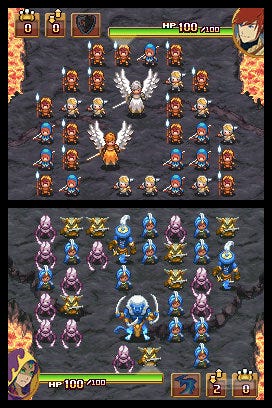
Battles take place on a grid, with the top screen occupied by enemy soldiers and the touch-screen by your own. There are three basic categories of troops: regular, elite and champion. Regular troops take up one square of the combat grid, whilst elites occupy two in a column and champions a square four. When each battle begins, troops are randomly dropped into the grid and a number of action points are allocated to each player. Units at the near end of a stack can be picked up and dropped into a new column, or specific units can be removed, letting those above them 'fall' towards the centre line, each action costing a point each.
1

See, not complex at all. Just imainge them as squares. Angry squares.

Stack three regulars in a column and they'll start a countdown timer for their attack. Elites need two regulars behind them, champions four - their attacks take much longer to count down, but are far more powerful as a result. Once the attack is completed - usually a projectile or a charge up the screen by the troops themselves - the attacker tends to disappear from the field, returning to a pool of reinforcements activated by a shoulder button, also costing an action point.

When units attack they will first attack any units directly above them, with any remaining attack power being channelled into the opposing general's 'zone', doing direct damage to their HP when they reach the top of the screen. Deplete your opponent's HP and it's time for the victory dance.

When troops are arranged in rows of three or more, as opposed to columns, they'll meld into a wall, shuffling up to the frontline screen divider. Each faction's wall has a different ability, with the Sylvan's hedges recuperating a hit-point each turn and others being tougher or a little bit shiny. These walls will absorb damage and protect your troops from attack, but take up a space in the grid where you could be stacking troops.

Activate two or more units of the same colour to attack in the same turn, so that their timers countdown together, and their attacks will be linked, improving their attack power. Units can also be "fused" by stacking active columns, coagulating them into one and further increasing their offensive value.

So, battles are largely puzzle-based, but troop and equipment choices are still an important part of a good strategy. Deer, for example, can leap over a single row of enemy walls, bypassing their protection, whilst dragons will leave a two-square swathe of acid in their attack's path, damaging any troops occupying those spaces for the next few turns. The various pieces of equipment which you'll accrue offer fairly typical bonuses, improving specific troop types or upping your survivability.

There are occasional variations on the straight battle theme, too. There are puzzle levels, where all enemies must be defeated from a set position in a single turn, not unlike the Puzzle Quest equivalent. Bosses crop up as well, moving around the grid and forcing you to strike them directly rather than go for a shot to the end zone.

2

The story is preictable enough, although the chracters are less annoying than they appear to be.

It sounds more complex and less intuitive than it actually is. In practice I found that the hardwired 'put things in lines' part of my gaming brain quickly engaged, giving the turn-based system a smooth ebb and flow - strategies can be planned with surprising depth and foresight, and enemy tactics must be countered before they are unleashed. In many ways it's actually more complex and satisfying than the traditional M&M model. A balance between attack and defence is key to victory, and protecting and using elite or champion units properly can turn a lost battle hugely in your favour.

Altogether it's quite the bold move for the series, even if a lot of the ideas have been quite heavily 'inspired', but looks like it'll translate the core values extremely well. At the end of my short campaign section I was definitely hungry for more - and there are another four factions, each with their own campaign, still to see. How much cross-pollination will occur from the main canon is uncertain, but there's really no wisdom in hating Clash of Heroes because it dares to ring the changes.

Might & Magic: Clash of Heroes is due out for DS in August.

Comments (13)

Comments for this article are now closed, but please feel free to continue chatting on the forum!

  • Loading...hold tight!