With its latest Medal of Honor game, EA wants to show you a different side of modern warfare, and that different side - whisper it - has goats in it. You can't turn them into vehicles, though, and you can't strap Semtex to them and coax them towards trundling into enemy boltholes before obligingly exploding. I doubt you can even use them as cover. They're just trotting around the game's Afghan landscape, chewing grass, staring into the distance with that strangely sage look that goats often have, and thinking their goaty thoughts.
There are goats in the game, in other words, because there are goats in the ravages of Afghanistan, and this project is all about accuracy. That's easy for me to type (although not as easy as it could be, because I cut my finger chopping an apple a few minutes ago), but as I've never been in the military, never been under heavy fire, and never been to Afghanistan, I'll have to take the developers' word for it.
They're taking someone else's word for it, as it happens - the game is the product of hours of discussions with shadowy figures in the real US army - and that brings us to today's buzz phrase: Tier One Operators.
Picture the American war machine as a pyramid. It's lucky they don't go into battles this way, because they'd never win anything. Anyway, there are two million men and women in the US military. Of those, 50,000 are spec ops. Of those, only 200 are Tier One. They're the elite of the elite, never used except in the deadliest, trickiest, absolutely most urgent of situations.
A brief trailer sets the tone with a downbeat voice-over - and a man tied to an office chair being kicked out of a window before exploding.
It's invitations-only, apparently, although I can't imagine it's an invitation that would particularly cheer most people. EA has been in very close consultation with a few of these mysterious characters, and their peculiar lives are the fascinating backbone of the Medal of Honor reboot - the first game, following in some rather large footsteps, to bring the franchise to the present day.
If you're imagining this elite squad of super-soldiers picking their way through the Ambassador's Reception in one of the great cities of Europe, ducking past trays of Ferrero Rocher as they move in on a sinister autocrat with an eye patch, you've got the wrong idea. The average Tier One - sorry, I forgot, none of them are average - is somewhere on the windswept crags of a lonely mountain range, probably disguised as a shepherd, and sporting an amazing beard.
Beards and goats: unlikely as it seems, that's what makes Medal of Honor seem pretty exciting. It doesn't appear to be a glitzy neo-con fantasy. It hasn't redrawn conflicts to make the enemies more old school and simplistic - "Phew, it's only the Russians again" - and it seems to want to deliver something other than vivid spectacle as it tells its story.
Modern Warfare, the property that, rightly, forever hangs in the air whenever Medal of Honor is mentioned, actually makes for quite an interesting comparison. Brilliant as it is, Activision's series is a fairly stellar example of the popcornification that occurs to any franchise over time. Skidoo chases and squaddies jumping over the flaming debris of a crashing helicopter are both undoubtedly cool things to take part in, but in its transition towards the scope and razzle-dazzle of Hollywood, Infinity Ward has given EA's team a neat little space to call its own.
It allows them to appear as the more authentic players - regardless of how incredibly stupid it is to believe that a videogame about war could ever be that authentic in the first place.
And the team's starting to put things together quite nicely, judging from the teeny-tiny slice of it EA is willing to reveal. Medal of Honor is set within the current conflict in Afghanistan, but focuses on a fictional story, based around a joint operation between a Ranger group, and two Tier One units. As you play, you'll flick back and forth between the two threads of the narrative, apparently; in doing so, you'll explore two different approaches to a troubled conflict.
The Rangers, like the rest of the military, are, in the words of senior creative director Richard Farrelly, "the sledgehammer". A blunt instrument. They blow stuff up, go in hard and fast, and leave a fair amount of charred rubble in their wake. The Tier Ones are "the scalpel". They're in behind the enemy lines, they speak the language, they have the beards. You know, just like scalpels.
DICE's multiplayer component will use the Frostbite engine, which can't be a bad thing.
The crucial thing to understand is that both elements work together over the course of any mission, and as Farrelly walks me through a demo, it's clear that even when you're playing the Tier One role, the rest of the military is always part of the picture.
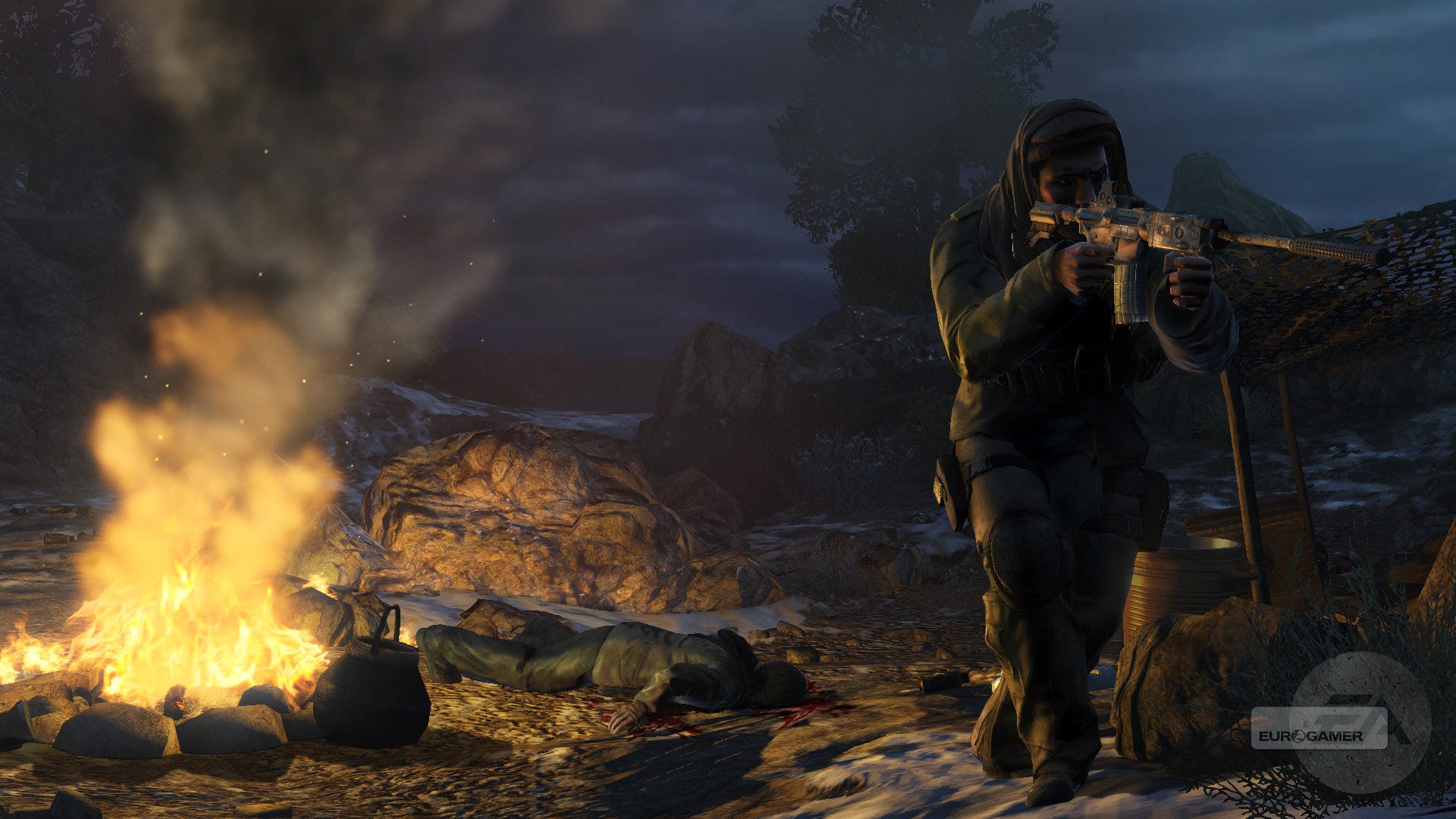
The level EA's currently unveiling is a night assault on an enemy-held mountain. The landscape is strewn with broken rocks and scrubby little patches of grass, the only light comes from distant campfires marking out enemy positions, and, playing as part of a squad, you're a Tier One advancing slowly into dangerous territory, with only the dark shapes of your nearby allies - and their precise, whispered commands in your earpiece - to keep you company.
The first encounter with the enemy is emblematic of the way you'll approach situations as an elite soldier. A gaggle of distant forms are gathered around a flickering campfire. Rather than wading straight in, your squad fans out around the edges of the area, each taking a target. It's a process that takes a surprisingly long time, given the zany pace of most action games, but it's all the more tense for it. Then, with just a few shots - resoundingly loud on the echoey hillside - everyone sat at the campsite is dead, and you're off again, moving further up the mountain.
The pacing is excellent throughout the 10-minute stretch of game on display - it should be, of course, given how little is being shown - and set-pieces are elegantly built from the sparsest of materials. An enemy patrol with a few flashlights is enough to create a moment or two of prickly tension, while rounding the crest of a hill and seeing a gunship blasting away in the distance only makes you feel like you're deeper under cover, in the middle of a complex and dynamic war, so hidden that your own allies might drop something nasty on you by mistake.
Blowing up an AA gun - the mini-objectives come thick and fast, and, no, some of them aren't particularly inspired - makes you realise how much a sound carries in this kind of environment, and later, when a proper firefight genuinely does kick off, as the scrubland and boulders give way to clusters of mud houses and narrow, overgrown alleyways, enemies are always closer than you expect, and the sound of gunfire really rattles in your ear after all that silence and heavy breathing.
Squad AI is hard to evaluate in such a heavily structured demo, but your colleagues certainly look the part at least, taking cover intelligently, wriggling forward over rocks, and providing helpful suppression fire if you're trying to flank.
And Medal of Honor looks the part too, blessed with a big-budget prettiness even in early pre-alpha code. The lighting is particularly good at capturing the glow of crackling flames, and the amount of detail available when you catch fleeting glimpses of an entire stretch of mountain riddled with tiny pockets of conflict is pretty astonishing, considering this is running on a (heavily adapted) version of the Unreal Engine 3, and that there's no visible pop-in to be seen.
If the developer plays its cards right, this can be a distinct alternative to Modern Warfare, rather than just a copycat.
It will be interesting to see how the game works when you're switching between roles in-between missions - how well the silent, pacey efficiency of the Tier One sections blends with something a lot more explosive - just as it will be interesting to see how the multiplayer, built by a separate team over at DICE, will fit into the overall package.
EA certainly doesn't seem to be worried about how difficult it will be to bring the whole thing together coherently. When I ask Farrelly what he thinks the Medal of Honor series means in a marketplace ruled by Infinity Ward, he has no trouble coming up with an answer. "It's still about the soldier's story, simply told. It's about understanding the world the soldier moves in, seeing the war up-close and at the sharp end."
It makes you hope, then, that Medal of Honor genuinely turns into the game that the developers are talking about: a punchy insight into a fascinating aspect of warfare where the drama is intimate and ragged, rather than bloated and unlikely. It would be a real shame for a game that starts like this - with that whispering trudge into enemy encampments - finishing off with Vladimir Putin driving a stunt car off the top of the Empire State Building. Thankfully, as the low-key presence of the odd goat is there to attest to, that isn't particularly likely to happen.
Medal of Honor is due out for PC, PS3 and Xbox 360 this autumn.
