Marvel Ultimate Alliance 2 Review

Civil bore.

Version tested: Xbox 360

Marvel Ultimate Alliance 2 isn't vastly different to the first Marvel Ultimate Alliance, which was pretty similar to X-Men Legends 2, which owed more than a little to X-Men Legends. Trouble is, X-Men Legends came out in 2004, so the fact that the series has only shown incremental signs of evolution is cause for concern.

As before, a buffet of superheroes is spread out before you, all ready to mash their way through level after level of Diablo-style action-RPG gameplay at your command. You choose a squad of four - swapping them out on the fly, should you wish - and access their superpowers through the face buttons modified by the right trigger. Experience is earned for every enemy dispatched, and each level-up grants you the opportunity to enhance one or more of your abilities.

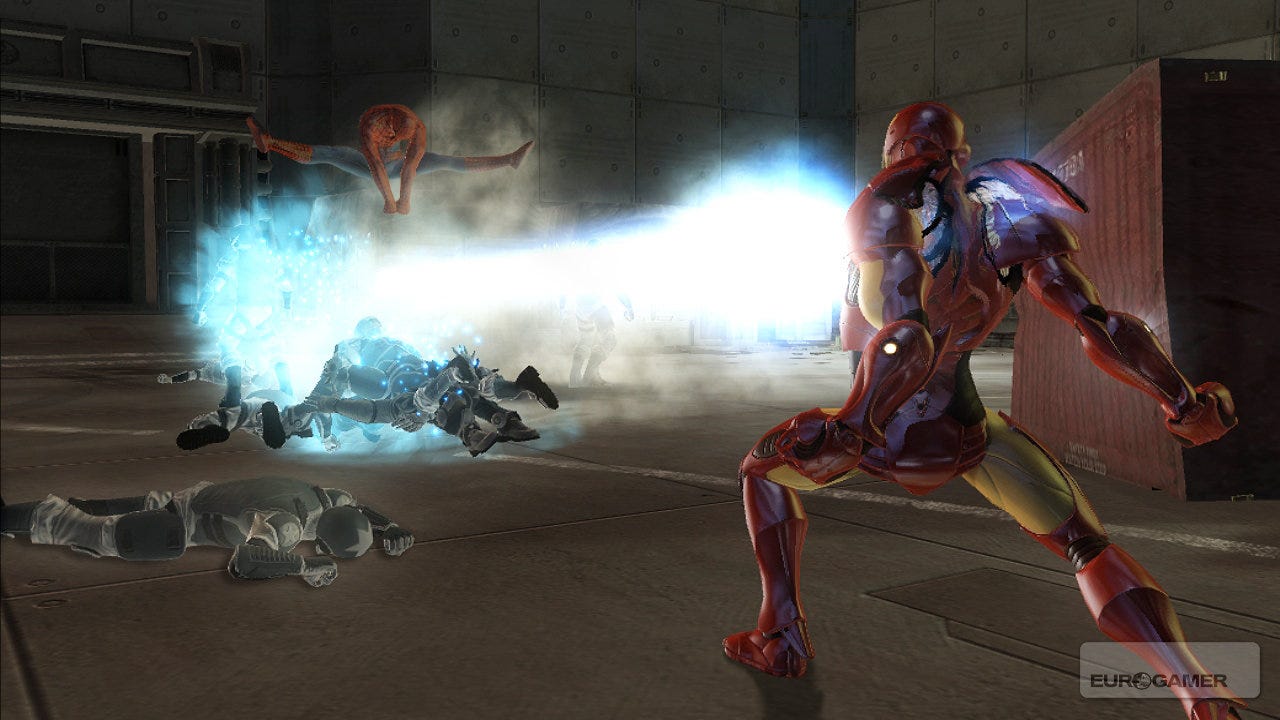
So far, so familiar, but this sequel does have a few new(ish) tricks up its sleeve. The biggest is the addition of Fusion attacks. These are earned by filling up a meter with normal melee and power attacks, and allow you to combine the talents of two of your heroes for one extra-powerful attack. There are three basic types, and which one you get depends on who you team up with. Targeted Fusions allow you to direct a strike at one specific enemy - ideal for bosses. Guided Fusions are ones you can steer around, great for mopping up scattered enemies. Clearing Fusions are wide-area attacks that come in handy should you get crowded. Each can be modified with a spot of button-bashing, to make them more effective.

It's a sound idea, if hardly original. The rather ropey game based on the last Fantastic Four movie did much the same thing, but at least here you've got 24 heroes to mix and match. Surely it must lead to a dazzling array of comic-book carnage, right? Well, sort of. It soon becomes clear that despite the large number of possible combinations, the Fusion attacks all fall into a handful of identical patterns. Once you've seen Hulk tear up a chunk of earth for Deadpool to pepper with bombs, before slamming it down on an enemy, there's limited enjoyment in seeing Thing and Human Torch do the exact same thing, only with fire. Or Luke Cage and Storm, with electricity. Or... well, suffice to say that the novelty soon wears off.
1

That's either a Fusion attack, or Spidey is going to perilous lengths to get a Brazilian.

The other deviation from the norm is the two-pronged storyline, but again this proves to be less than inspiring in reality. Drawing on the Civil War storyline which splattered across Marvel's comic books in 2006 and 2007, a retaliatory attack from Latveria and an explosive showdown between superpowered foes in small-town USA cause the President to sign the Superhero Registration Act, requiring all heroes to register their identities and become officially sanctioned - and accountable - agents of the government.

The superhero community is soon split down the middle, with Iron Man leading the pro-registration faction, hunting down the rebel heroes who have gone underground led by Captain America. At the end of Act I of the game you get to choose whose side you'll take, but the impact this choice has on the game is disappointingly minor.

You'll still play the same levels in Act II, regardless of what you decide, and they still play out in much the same way. You'll encounter different sub-bosses, and have slightly different objectives, but it's hardly the sort of deviation that makes it worth playing through twice. It's even more pointless given that the game pulls everyone back together by Act III, and continues to play out in the exact same way until the end.

Much like the muddled, sophomoric comic story it draws inspiration from, it's a waste of a potentially intriguing idea, content to pose vague questions of morality and free will before hurriedly reverting to generic expectations to avoid following through on any of the difficult answers. The choice of available heroes is carefully scripted, with new allies joining at the same point in both plot threads, so there's never any real decision involved. I had harboured foolish dreams that maybe we'd get something a bit more open-ended, where you could travel the Marvel Universe and recruit the heroes of your choice by using the right characters to talk them around, or performing side-quests.

The illusion of choice persists in the dialogue scenes, where you'll be given three options corresponding to aggressive, diplomatic or defensive responses. The script even changes to reflect existing relationships between characters, but when you play the same scene again, with different characters, you soon realise that the other character's responses are always the same and the only reason to opt for a different approach is to grind towards one of the bonuses awarded for making a certain number of attitude choices.

It is, at least, a passable dungeon-crawl even if the formula is showing its age. Developed by Vicarious Visions, which handled the PSP and Wii ports of the last game, there's certainly enjoyment to be had in the gleefully destructive environments and action-packed pacing. The camera is clumsy, collision detection is a little woolly, and it's too easy to lose track of where you are in the middle of a superhero scrum, but much like its beefier stars this is a game more interested in cathartic impact than detail and finesse. Hammer those buttons, send the bad guys flying, trash the scenery. Job done. And it works, up to a point. Anyone who has waited patiently since 2006 for another punch-drunk scramble through Marvel's roster will certainly be amused, or at least distracted, but there's an undercurrent of disappointment that is hard to ignore.

2

Press A, B, X to unleash Hulk's powerful Exploding Arse attack.

Although it has the same number of playable characters as the last game, it's a less than inspiring line-up this time and it feels smaller as a result. Obviously, there's a need to make space for the heavy hitters like Spidey, the Fantastic Four and various X-Men, but where the previous game filled in the blanks with esoteric choices like Doctor Strange, Moon Knight and Silver Surfer, this time we get rubbish new characters like Songbird and Speedball's terrible emo makeover, Penance. Your mileage may vary depending on how attached you are to the quirkier corners of comicdom, but for this old-school True Believer it was really only Green Goblin who seemed like a cool new playable addition to the series.

The same problem afflicts the levels. Last time we got a bona fide tour of the entire Marvel Universe, spinning a yarn that took our heroes from New York to Atlantis, from Mephisto's supernatural underworld to outer space locations like the Shi'ar Empire and the Skrull homeworld. Along the way there were battles with Fin Fang Foom and Galactus, even a trivia quiz against MODOK. It was an embarrassment of riches for Marvel fans, and this generosity helped to mask the sometimes clunky gameplay.

There's none of that for the second go around. The exotic varied locations are replaced by urban streets and samey metal corridors, with only a brief excursion to Black Panther's African kingdom of Wakanda to remind you that there's more to Marvel's world than grey concrete and brown metal. The boss encounters are all virtually identical in construction, many are repeated several times for no good reason and none of your foes are particularly memorable or carry much cult appeal, unless you've been praying for Grim Reaper or Diamondback to finally get their moment in the spotlight. As far as the source material is concerned, there's a persistent sense that the game is stuck making sandwiches with the leftovers from the previous game's banquet.

More worrying, this diminished scale has even slipped under the covers and gnawed away at the fundamentals. For example, you can no longer set the combat stance of your allies - they simply dash around hitting stuff at random. You even have less control over customising each hero's abilities. In the last game each character had several alternate costumes, each of which had its own trio of status effects that could be levelled up, offering another layer of depth to your squad choices. Now you get just one alternate costume, and it's purely cosmetic. The only modifiers you get are Boost medals, which are awarded for specific tasks or found in the levels, but you can only have three of these active at any time, and they apply to the whole team. You can't even choose which powers to assign to the face buttons.

For my second playthrough I eventually stopped paying attention to the RPG stuff and let the game auto-spend my XP, even though I'd obsessed over every point spent in the first Ultimate Alliance, and it never felt like I was missing out. For a series which always had a fairly strong RPG heritage, this is pathetically shallow and a major step backwards. It's also phenomenally easy. Several characters are wildly unbalanced in terms of their power - Thor especially - and once unlocked you can pretty much blitz the game with the same two attacks over and over. This is especially true of Legend mode, which unlocks when you complete the game. By that point your characters should be pretty much untouchable, so the toughest difficulty is, rather ludicrously, noticeably easier than playing on Normal.

3

Voguing - apparently still all the rage in the Marvel Universe.

Continuing the grumble parade, online co-op relies on an off-putting opaque system that segregates players based on their single-player save files, and penalises them with zero experience points if they join a game where their story progress doesn't match up. Lobby drop-outs are common, and that's if you're lucky enough to find a game that matches your requirements in the first place. The basic concept of the game makes it the perfect candidate for simple fuss-free drop-in multiplayer, but this mangled lobby and matchmaking system make Fable II's fumbling efforts look like the height of sophisticated network play.

The multiplayer hiccups are unfortunately indicative of the whole, since there are few areas where Ultimate Alliance 2 deserves honest praise without major caveats. The new elements fail to meet expectations, but the bash-and-grind basics haven't changed at all. With relatively few dungeon-crawl games available for consoles, that fact alone may make it more appealing to fans of the original but sadly the garbled story, half-baked gimmicks, creaky engine and rote gameplay all conspire to make it a satisfying experience only for those with extremely low expectations.

5 / 10

Read the Eurogamer.net scoring policy

Comments (79)

Comments for this article are now closed, but please feel free to continue chatting on the forum!

  • Loading...hold tight!