Space, it turns out, was not to be Mario's final frontier. Super Mario Galaxy 2 will no doubt offer players the chance to explore on uncharted planets, each with their own idiosyncratic colours and creatures and gravities. But it will be a case of extending our reach into the known universe rather than delving into a new dimension. By contrast, Mario and Luigi: Bowser's Inside Story breaks new territory, offering the chance to literally get under Mario's arch-enemy's skin and, for the first time, take to inner-space.
Here Bowser's veins and arteries are the winding roads along which the plumbers travel. His organs are the boss-fights, his stomach lining the backdrop. But contrary to what you might expect, this isn't a quest to take down Mario's spiked nemesis from within. Rather, you must help Bowser overcome challenges in the outer world by stimulating muscles and latent ability from within. Mario and Luigi act as inverse parasites whose influence on their host body is critical to his success.
But the pair's microscopic toil is hardly philanthropic. Mario and Luigi have been, rather obviously, ingested against their will and their overarching quest is to somehow make their way out of Bowser's body (we can count six possible exit points…). So rather than acting like the foreign bodies that they are, they work alongside Bowser on their quest, his continued well-being key to their survival, their usefulness also key to evading his cleansing antibodies.
So when Bowser's thrown a rope by a Frenchman stranded on an island and asked to haul the very ground back towards the mainland so he can get off, Mario and Luigi's job is, via a simple mini-game, to stimulate his arm muscles, powering up Bowser's strength to the task at hand as they work to pull their friend close while keeping their enemy closer.
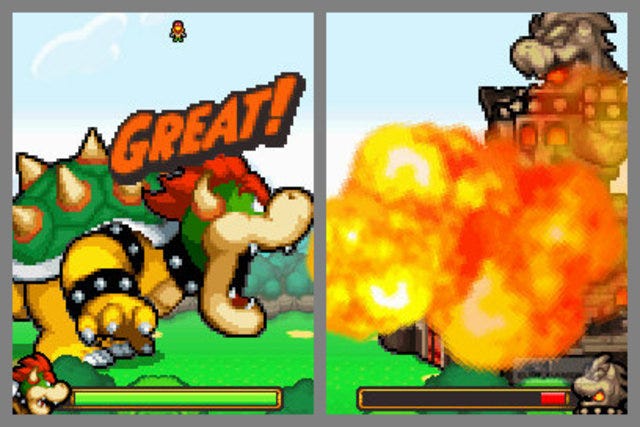
In time Bowser gains the ability to ingest enemies, allowing Mario and Luigi to pick up the fight inside his body.
The form and function of this, the third entry to the Mario and Luigi RPG series (as its known in Japan), will be familiar to players who enjoyed forebears Partners in Time and Superstar Saga. It would be churlish to describe the series as a Fisher Price RPG as its mechanics are surprisingly deep and its ambition different to the typical number-crunching grind of a traditional JRPG. Rather, you move through environments as in a side-scrolling platform game. Battles with enemies switch to a turn-based JRPG-style affair, albeit one that emphasizes timing and action over long-haul tactics and strategy.
Ever since SNES title Super Mario RPG (developed by the formative JRPG developer, Squaresoft) Mario's role-playing outings have sequentially devolved from the linear epic usually associated with the genre. Bowser's Inside Story is perhaps the most fragmented title in the niche yet, switching play between Mario, Luigi and Bowser himself (two distinct sections of the game that play quite differently). There are two suites of high-score challenge mini-games that isolate elements of the battle-system and test your proficiency at them.
Bowser's adventure is quite different in execution to Mario and Luigi's sections of the game, presenting a top-down, 16-bit Zelda-style view on the action that sees you smashing your way through rocks and uprooting trees as you move from place to place. Players who disliked switching between characters so regularly in Partners in Time will be pleased to hear that you control each character for a good 30 minutes before having to switch to the other squad.
As with the previous titles in the series the game bursts with bright Nintendo creativity, occasionally even offering you the chance to play from Giant Bowser's point of view - holding the DS sideways while using the stylus to punch and blow into the microphone to burn enemies with fire.
The mini-game suites included with the game encourage the perfection of in game-techniques for high scores. Here you'll be trying your hand at endurance challenges, seeing how long you can keep a special attack going by timing inputs or, alternatively, seeing how many metres you can bounce Mario along the road by positioning Luigi's head-mounted trampoline.
Similarly, Bowser's mini-games have you seeing how many times you can attack Broque Madame with your special attack, racing to touch the Goombas that appear on screen in time to set them on fire and send them scuttling off to explode in her backside. Another mini-game has you sliding Bowser up and down the screen like a misshapen Pong paddle in order to repel Koopa shells, while yet another has you lining up Bob-ombs with the stylus before they race off in a straight line to blow up their targets.
In contrast to Partners in Time, enemies have increased attack power rather than health points to lend the game challenge.
It's lighthearted and executed with exactly the sort of charm and humour you'd expect of the growing spin-off series. The English language sections of the game we had time with make clear that Nintendo's localisation department is, as ever, doing fine work ensuring both the character and comedy translates seamlessly from the original Japanese. Indeed, as with so much of their work, the text is so measured and its jokes so relevant that it's almost impossible to tell that the script wasn't originally written for an English-speaking Western audience.
Alongside the Paper Mario games, Mario and Luigi's handheld RPG outings are singular in their design and approach to one of Japan's eldest and least flexible genres. The core building blocks are similar: experience points, turn-based battles, character leveling and exploration all key elements.
But their application, presentation and context is like nothing else in the Japanese RPG oeuvre, both broadening and challenging its audience with its bold reworking of convention. In Bowser's Inside Story, Mario may have found his most unusual context yet, a singular premise that may prove the game's biggest opponent to success; as Bowser boldly demonstrates, so often our enemy lies within.
