Mafia II

Cosa nostalgia.

You can't get two more different approaches to open-world gaming than last week's Just Cause 2 and Mafia II. Both, it's true, descend in a straight line from the same revolutionary inspiration - Grand Theft Auto III - and in both, the world that's opened to you is the game's lead actor.

But where the tropical island of Panau is a playground for you to revel in and destroy, filled with sandcastles to kick over, the city of Empire Bay is a meticulously constructed movie set, an interactive museum of 1950s Americana that you would never want to wreck - it's far too beautiful. In Just Cause 2, you can spawn fighter jets; in Mafia II, there's a button that limits the speed of your car, so you can cruise without fear of arrest, and just drink it all in.

We've got an hour or so to drink in as much as we can, in the slightly seedy San Francisco event venue that 2K has chosen to show off Mafia II during GDC. Screens and Xbox 360s are arranged on plastic gingham tablecloths, behind wooden hoop chairs, between rows of pot plants and fake Grecian columns. The PRs have clearly caught the period-detail bug from developer 2K Czech, formerly Illusion Softworks, which released the first Mafia all the way back in 2002.

The setting's doubly appropriate since, as you can guess from Empire Bay's name, San Francisco is one half of the bloodline for this fantasy American everycity, the other being New York (although it has hints of a more blue-collar metropolis like Detroit about it, too). You'll visit Empire Bay in two seasons and eras; initially, in winter in the mid-forties, as protagonist Vito Scaletta returns home from World War II.
1

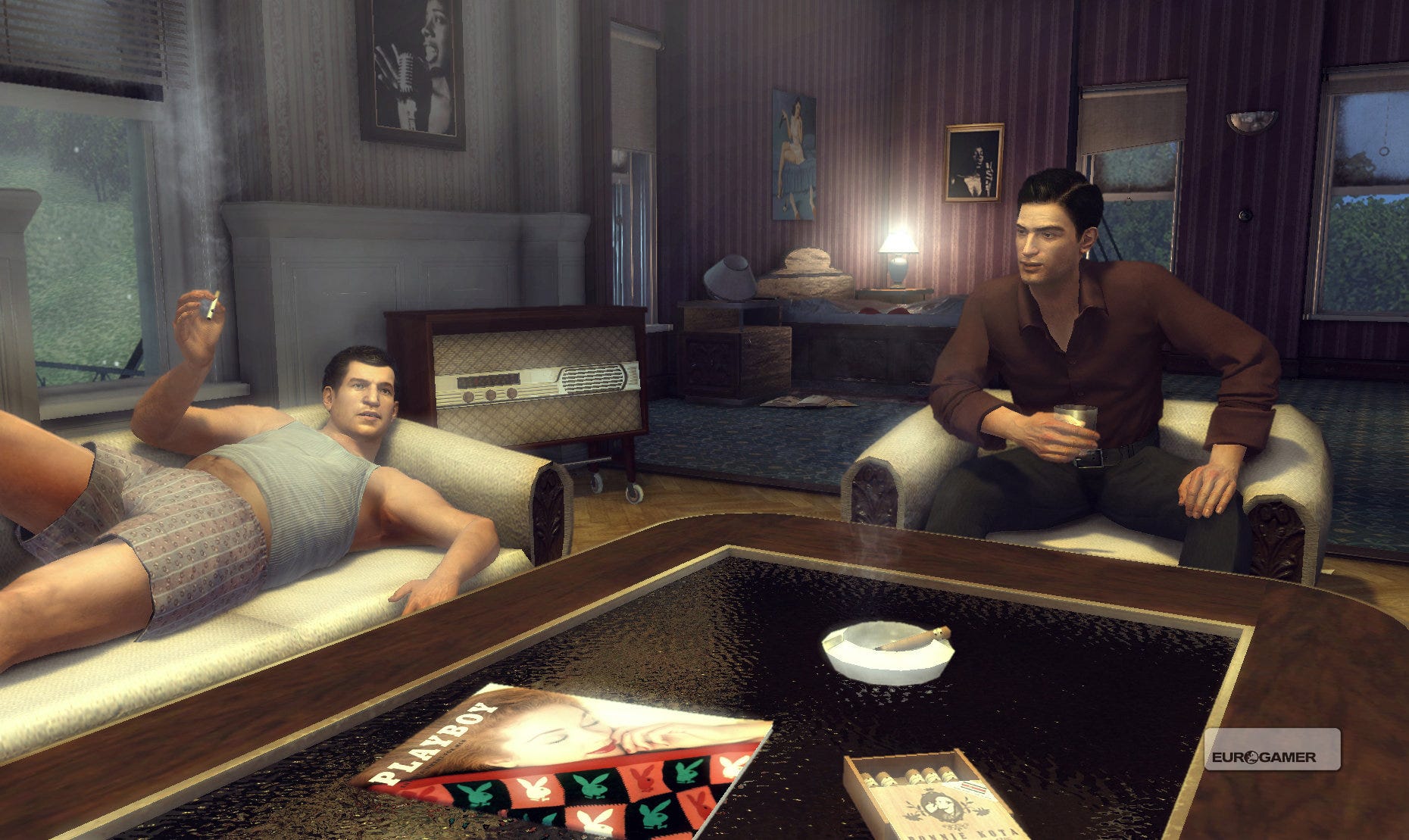
The deal to licence old Playboy issues strikes just the right balance between seediness and class.

The 2K rep shows us a reel of scene-setting cinematics and gameplay from this period, representing the first couple of hours of the game. Vito's greeted by his old friend Joe, who's making it in the mob and who uses his connections to arrange a permanent discharge from service for him.

Studied mood moments flit by: Vito eyeing up a smokin' dame in a bar to the brass stabs of Big Spender; walking home with suitcase and Army greatcoat through snow-dusted, lamp-lit streets; being served a hearty homecoming meal by his fussing Sicilian mother.

His Papa borrowed $2000 before passing away, his sister reveals, just so we know that there's some sort of moral compass pointing to the inevitable life of crime.

2

Tommy guns and pressed trousers: a timeless look.

Fast-forward to the fifties, a much sunnier Empire Bay in late summer, and a chance to take the game for a spin ourselves. We start the Wild Ones mission, which will pit Vito and the mafiosi against a gang of Brylcreemed, Brando-style greasers in leathers and hot rods.

First, though, we need to pick our own more tailored threads from the wardrobe in Vito's lavishly detailed apartment, all dark wood, pinstripe wallpaper, ruffled bedclothes and discarded breakfast things with period-appropriate branding.

If nothing else, 2K Czech's art team must be some of the most dedicated researchers in the business, and their hard work is handsomely represented by the game's solid, in-house engine. No opportunity to evoke the era is missed, down to the spinning acetate record that serves as a save icon.

Vito's voiceover reminds us to stop ogling and hit the streets, so it's down to the garage to select a ride. Although the cars aren't licensed, they're still absolutely recognisable as a Cadillac saloon, a Ford Thunderbird coupé and an Austin-Healey roadster. Each has detailed stats and a tuning level, indicating that your car collection can be modified over time.

On Empire Bay's relatively busy roads, the cars handle with satisfying heft and character, wallowing on soft suspension and gently sliding their tails out. Whether or not you use that speed limiter button will be a matter of personal taste, but it's quite likely you will, for a couple of reasons. First, there is plenty to sit back and enjoy in the game's sights and sounds, not least the excellent radio soundtrack of doo-wop and early R&B by the likes of Screamin' Jay Hawkins.

Second, the comic mayhem of open-world tradition simply isn't appropriate to the hard-won realism of Mafia II's world. There will definitely be times when you need to get somewhere in a hurry, but getting involved in wacky races on the way from A to B would break the illusion - and the cops are pretty punishing.

Even though they've been toned down for the purposes of this demo, I still end up having to bribe my way out of an arrest for speeding, and cars sustain quite a lot of damage in scrapes. They can be fully repaired at garages, or you can coax a conked-out motor back to life (just) by doing a little DIY roadside repair.

3

There isn't a part in this game that wasn't played by Marlon Brando at some point in his career (though Eddie, middle, is more of a Robert Duvall).

Vito hooks up with Joe to help him sell smokes from the back of a flat-bed truck, painstakingly picking the right brand for customers using Mafia II's rather finicky contextual button-prompts. They're rudely interrupted by the greasers, who shut down their cigarette scam by setting the truck on fire. (Mafia II's sparing use of swearing is notable: where most game scripts either avoid it it altogether or throw the f-word around liberally enough to make Quentin Tarantino blush, the single cuss I hear in an hour's play - a strong, Oedipal one - is almost shocking.)

Mafia II has its boots firmly on the ground, then, and that's even more apparent when we get to the real meat of the action at the end of the mission. Losing the greasers in a car chase, Vito calls local boss Eddie for backup from a phone booth, and they assemble a small squad of mafiosi to exact revenge. After shooting up the punks' favourite diner and torching it with Molotovs, the mobsters engage them in a taut, intense gun battle on a shabby industrial real estate.

4

Cars aren't reliable cover, since a shot to the petrol cap blows them up.

Unlike the exuberant action favoured by many open-world games, Mafia II offers demanding and deadly third-person shooting in which cautious advancement and constant use of cover are key. Even though Vito has lots of friendly AI assistance in this mission, just a few moments' exposure will easily finish him off. Aiming is rather deliberate but the feedback from the guns is good, the level layout and enemy attack patterns get more involved over the course of the battle, and there are some beautifully-animated vignettes and set-pieces to punctuate it. It's almost touching when one fleeing punk hesitates for a second over a fallen comrade.

2K Czech is just as serious about shooting as it is about licensing old issues of Playboy and researching fifties butter brands, it turns out. It's maybe a little too serious - the difficulty isn't unwelcome, but the yawning gaps between checkpoints can be pretty frustrating with action that's as methodical and linear as this.

I'm repeating one lengthy section for the fifth time when my play session ends, so those Wild Ones will have to go unpunished for now. But then if that's the price we have to pay for an open-world crime game as refreshingly grounded, grown-up and solidly rooted in a recognisable real world as this, then it could well be worth it.

Mafia II will be released for PC, PS3 and Xbox 360 on 27th August 2010.

Comments (44)

Comments for this article are now closed, but please feel free to continue chatting on the forum!

  • Loading...hold tight!