InstantAction's Louis Castle

Why Call of Duty will end up in your browser window.

Louis Castle's been around the block. The American videogame designer co-founded Westwood Studios, which, as all real-time strategy fans know, created the groundbreaking Command & Conquer series.

He stayed on when EA bought Westwood, eventually becoming a big cheese within the publishing behemoth when it closed the studio in 2003. Then, in 2009, Castle joined InstantAction as CEO, and set about changing the way we play games.

This morning Castle kicked off the Develop Conference in Brighton with a keynote entitled "Traditional Games Breaking into Social Networks: A View from the Frontline". Here, speaking to Eurogamer, Castle explains how he's going to rid gaming of piracy and why we'll all be playing the next Call of Duty game for free in a browser.

Eurogamer: Tell us about your keynote.

Louis Castle: My keynote is about traditional gaming. Any kind of game can be distributed through the web, if you're willing to approach it in a different way. Eventually the same kind of content we see in consoles and on PCs for dedicated download is going to be available through web browsers.

I know that's the case. I wouldn't even say it's probable. It's going to happen. I know it's going to happen because all the different companies are announcing initiatives, like Google with their native client stuff they want to do, and all these various companies all saying, 'Well we want to support 3D through the browser'. Even Flash is trying to get better 3D support through the browser.

The difference is all of those different initiatives are individual one-offs, and they're a very small fraction of an already fragmented and heavily pirated market. So it's very challenging to get any publisher that's spent $60-70 million building and marketing a game to want to put it into a place where it's basically going to get stolen and given away for free.

It's very analogous to the music industry. So my keynote, in one sentence, is talking about all the different barriers that exist for high-quality published games to make it into the web, both technical and market barriers, and what we are doing at InstantAction to try to bridge that gap.
1

Eurogamer: Do you believe that even high-budget console games with their impressive visuals will be playable in a browser?

Louis Castle: I think it'll happen, on PCs, Macs and consoles. It's going to happen across the board. At GDC we were showing demonstrations of InstantAction playing Assassin's Creed II. We've put Crysis on there, Call of Duty, all of these great games you would think, 'Oh my God, that's never going to work.' But we have them all working in a browser.

And we're talking to a lot of publishers out there. They're understandably concerned and nervous. They want to see the platform out there, well distributed, successful. We've got some announcements at PAX [Penny Arcade Expo] in September and hopefully some more following that over the fall.

Eurogamer: Obviously those high-budget games require a decent PC to run in a browser.

Louis Castle: Correct. To be clear, we partner with Gaikai for thin client. InstantAction as a platform offers thin-client play that masks a progressive download. The progressive download can happen in a very short period of time relative to the game size.

In the case of something like an Assassin's Creed or a Call of Duty, it might be a couple of hundred megabytes or more. It could take as many as 20 minutes, maybe 30. So during that time we serve a Gaikai feed that lets you play immediately. And while you're playing the Gaikai feed we're downloading the game in the background. As soon as the game is on your system and ready to run, we then switch you over to play on your system, with a free trial for some period of time that's up to the publisher.

After the free trial the publisher has lots of options on our platform on how they want to charge the customer. They can do a cliff purchase, which is what Secret of Monkey Island is doing right now. Or they could do rent-to-own, which we don't think works as well. So you're paying, say, $10-an-hour, and that $10 is coming off the purchase price. So if you've spent five hours for a $50 game, you've bought the game. You never have to pay after that.

They're playable through the browser, full screen, as well as a browser window. Games can actually talk to the browser and talk to things that are inside the browser, which is nice. Your friends list can be your Facebook list, which is a lot nicer when it comes to finding somebody you want to invite. You can create a Facebook group that is your Call of Duty friends, if you will. You then look to that group and invite people inside that group to play synchronously online. It does all the connections in place at 100 per cent of the game speed.

Eurogamer: The future you envisage, what does it mean for the console manufacturers?

Louis Castle: For the time being the ones we're doing are just for PC and Mac. But in time I believe the same thing will happen on a console, where you'll be on Xbox Live or PlayStation Network. You'll find a game through some sort of browser-like experience. It might be the PSN home screen or it might be through the Xbox Live menu system. When you find that game you'll be able to get an instantaneous play of a high-quality game that doesn't require a download. While you're doing that there will be some sort of download that's going to your hard-drive.

The system we've built is actually designed to work like a web server. It takes a space of memory on your computer and then uses that as a cache. It's not a traditional download. Games that might be 16 or 20 gigabytes, it might only manage five or six gigabytes on your hard-drive for that game. So you never really have the whole game on your system at once. But it doesn't matter because it uses your connection to keep the content in front of you, so you don't have to wait very long to get it.

The same kind of thing would apply very naturally to the consoles, the Xbox and the PlayStation. But as we're finding with the PC publishers, it's a very different business model. It's completely alien. And so it would take some time working with Microsoft and Sony to get to where we could deliver that. We're just not focused on it right now. But I believe it'll happen. If we don't do it, somebody will.

Eurogamer: What does it mean for those of us who go to a shop and buy a game on a disc?

Louis Castle: I'm infamous out there about bashing the bricks-and-mortar retailers. When they offer a service, which is the browsing the boxes and informing the customer, especially like a GameStop where you used to have people who knew what they were talking about, there's value there. It's like going to a record store. There aren't many of those around any more. The people who know about the products, that's a real value the retailers are providing.

2

Where I have an issue with the retailers is when they do the resale of a game because the law allows them to do it. By doing so they don't pay the publisher anything. They promote that as strongly, or even more strongly than the actual full sale game.

Essentially what they're doing is they're just quickening the death of the retail space for the publishers. The publishers have to spend more and more on games. They're not getting any cheaper to build. The big ones are getting a big audience, true enough. But the vast majority of games don't make money any more because your sales have been so badly chopped out by these retailers that are reselling.

So my answer to the question: what happens to the resellers? Well, as long as they add value I suppose they'll stick around. But if they cease to add value then they won't be around. They'll go back to selling it, in the case of Wal-Mart, everything under the sun. In the case of GameStop, I'm not really sure what.

I feel like they're the ones strangling the goose that's laying golden eggs, so I'm not particularly worried about their problems. I'm really more in for the consumers. Connecting the consumers directly to the people who create the content.

Eurogamer: Won't it be hard for gamers to wrap their heads around the future you predict?

Louis Castle: I don't think so at all. In fact my keynote, one of the things I pointedly show, is that we've been waiting since 1995, or maybe even sooner, to see the internet disrupt the game business. And it hasn't yet. There are a lot of reasons why it hasn't, but it hasn't. We did witness it, we just don't realise it yet.

It's like the dinosaur that's been stabbed in the tail - it hasn't got to the brain yet. The Facebook games, and Zynga, and Playdom and Playfish have shown us the future. I don't mean they've shown us the future in the way that many people do, which is all games are going to look like these games. What they have shown us is if you have an entertainment experience that's easy to get into, doesn't require any special requirements - hardware upgrades, anything like that, literally you just click and play - and it's tied to a place where people already are, where you're not trying to drive them to a place, it turns out millions of people will play poker. 20 million a month or something crazy like that. Or 16 million people playing the new FrontierVille in a couple of weeks.

Louis Castle: I would argue that Call of Duty: Modern Warfare, or Need for Speed: Shift, any of these games have such an immediate curve appeal to somebody. If you were able to actually easily access those games, with 500 million people on Facebook, you would have millions of people playing those games in a week, too. Easily.

It's just that you can't. It's just so challenging, it's so difficult to get to that content. You have to buy a box. You have to hook it up to your television. You have to use this funky controller. It's not where you are. You have to make a point to say, 'I'm going to go play a game instead of watch television.' All of those things are barriers to seeing this ubiquitous entertainment happen. Facebook, through their interface, allowed Zynga to show us exactly what games will be. That's the way games need to be distributed.

Eurogamer: You seem to be echoing what Bobby Kotick has said about wanting to put Call of Duty onto PCs and building an MMO-like subscription model around it.

Louis Castle: Yeah. The big publishers, having just come from one, look at the PC business and say, 'The only way this survives is if we can find something that makes piracy irrelevant.' The dumb ones are trying to stop piracy through protection and secrecy. You know what? Pirates are going to beat it. Build a better mousetrap, get smarter mice. They're going to crack it.

3

Our system is very difficult to crack, but I would never say it can't be cracked. Of course it can. But the reason it's difficult is different from the reason other people are. We're not out there trying to do a copy protection scheme, DRM. What we're really doing is we're offering a service which is hard-drive management, which never puts the entire game on the system. That just makes it very difficult to steal. You can do it, it's just harder. We encrypt every single packet with an individual for security to make sure that the right person is getting the packet. Then we tie it in to all the different networking features with your social network. So now that makes it even harder yet, because you'd have to rip all that out to get it to work.

What I always ask myself is, forget about the pirate for a second. People focus on the actual act of piracy and the pirate breaking the game. That's not the problem. If you think about it, those people are few and far between. There are maybe a few thousand in the entire world. Those guys don't hurt you. If all of those guys ended up stealing your game, and each of them bought a copy, frankly, to steal it, you actually sold a lot already, right? So they don't bother you. The problem is the consumer can find the pirated content easier and acquire it more easily and cheaper than they can acquire the official content, with all of the features intact. That's the problem.

What InstantAction does is it says, okay, let's attack it from the difficulty, first of all. Let's make it really hard. Well what's the consumer going to do? They could go to a pirate site, risk getting virused, download the game, which is going to take them on BitTorrent five or six hours on a cable modem. Or you can go play it on Facebook or InstantAction for free in 10 minutes. Instantaneously if you have a Gaikai feed.

Well I can tell you, from a consumer's point of view, I'm not going to the pirate site. I'm not going to wait hours to get something that may or may not be the real thing when I can go play the real thing for free right now. If I'm playing it for free for a while and I really like it, I'm not going to mind paying a buck or two for every so many minutes, or buying items, or paying subscription fees. Those fees are not the issue. Once the game is compelling the consumers will pay because they want the content. They've shown that time and time again.

Will they pay in small amounts? Yes, they'll pay small amounts over time. Will they pay 50 or 60 bucks? Probably not. But that's okay. You don't have to charge them that way. You should be able to charge them in incremental fees. Once you do that though, you've both eliminated the reason that the consumers go to pirate sites, and made it very challenging for those people who host those pirate sites to bother to crack your games. If you're doing it for a commerce reason, you'll never spend your time. If you're doing it for the challenge, okay, you'll crack it.

Eurogamer: Do you think you'll eliminate piracy, for all intent and purpose?

Louis Castle: I think we'll dramatically change the game. I don't think we will eliminate it, no more so than we would eliminate bricks and mortar. My approach is to avoid them, because they don't add value, they add friction between the consumer and the content that's been created. Just like piracy adds business friction between the content creators and the consumer, because they create a free marketplace that makes it very challenging to conduct business.

Those things are friction that I think we're going to help to eliminate. But we won't be the only thing. OnLive does a very good job of doing both as well, for example. They have their own issues, but our system is far from perfect. There's no perfect solution yet.

Eurogamer: You believe high-quality console games will be playable in browsers in the future. What kind of timeframe are we looking at? Five years? 10 years?

Louis Castle: I'm always the optimist. I always think it's going to happen sooner than I think. When I joined InstantAction a year ago, I was expecting major upheaval within that year, and it hasn't happened yet. But the signs of it happening are getting more and more frequent and closer and closer to the bone, as it were.

4

I don't even think it's five years out. I think it's just a few years out. In my worst-case scenario it would be five years. In my best-case scenario for the consumer, it's happening within a year, maybe two, where you'll see almost everybody would prefer to go play the game for free somewhere, download it incrementally and buy it in pieces or through some other microtransaction, than the few people that will actually go to the Best Buys, GameStops and Wal-Marts of the world.

I think those will still be sold. Just like, essentially you don't really buy World of Warcraft at a store. You buy the installation disc. The game is the game. You're paying for a subscription. I think that same model we'll find prevalent around the world on all games.

Eurogamer: So you reckon we'll have the option to play the latest Call of Duty through a browser in the next year or two?

Louis Castle: It could happen this fall if we can get the deal put together with Activision, quite frankly. Are you listening Bobby?

Eurogamer: This sounds like exactly the kind of thing he's looking at.

Louis Castle: They all want it. In fairness to the publishers, our system, we just launched it with Secret of Monkey Island. We changed everything about InstantAction. We built it upon the base we had before. I think those are some of the issues they're concerned about: can we go to scale? These are precious gems they have.

I understand why nobody wants to put their brand out there unless they're absolutely certain it's going to work and it's going to be a great consumer experience. It's thrust upon us. It's incumbent upon us to prove to them that it can work. I don't believe we're the only ones. In fact, I know we're not. There are lots of other companies out there. I mentioned them in my keynote, some of the other people that are out there and how they're approaching this problem.

It's really not a talk about InstantAction by the way. It's really a talk about the transition our industry is going to go through and the likely technologies that are going to get us there.

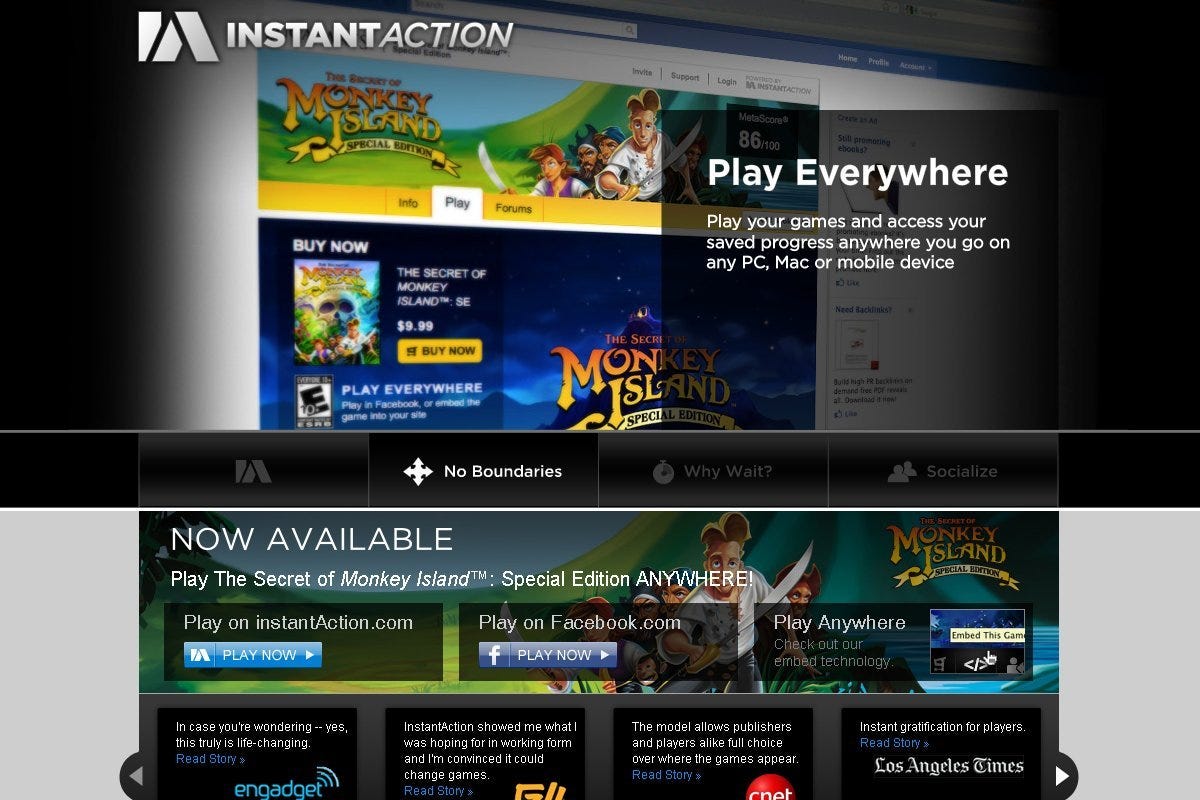
For more on InstantAction, which has just launched with The Secret of Monkey Island: Special Edition, head over to the official site.

Comments (32) Latest comment 2 years ago

Comments for this article are now closed, but please feel free to continue chatting on the forum!

  • StooMonster #1 2 years ago

    So, is it more like Citrix or Steam with caching (so you can start to play while rest is download) or something else?
  • Cosquae #2 2 years ago

    Sorry, but I don't see it making much of a dent in pc gaming.

    You still need a good pc to play high quality games (graphics wise). The prices of the games will be set by the publishers (aka ridiculous compared to amazon/play). You're basically only saving yourself a few hours over the normal steam download route or a day off the (much cheaper) online store route.

    Disagree with what he said about the internet not really affecting PC gaming too much so far (WoW anybody?) and that a thin client will play the game whilst it downloads 'a couple of hundred meg' game files. Most games these days are a couple of gigabytes. Interesting idea, but I can't see it being able to compete.
  • mingster #3 2 years ago

    I thought the game was called Louis Castle for a moment then like Mr Do's Castle.
  • Schiraman #4 2 years ago

    He might be right and he might not be - it's really hard to say. I doubt things will change as quickly as he suggests, but then again who would have predicted the rampant success of Steam when that first came out?
  • LazyDan #5 2 years ago

    I completely agree that the only reason piracy is an issue, is because it's easier for consumers to find a download than it is for them to go to a brick-and-mortar or online store. I like all his ideas actually, my only concerns are that firstly, playing via a browser is surely going to have a performance overhead, right?

    The other more immediate concern is value. With digital downloads, and especially these 'streaming' downloads, I feel like I'm throwing money in the air without the same guarantee that the game I've paid money for will be mine to enjoy foreverafter like I have with my boxed copies currently. I'd be alright with a constant 'rental' service (i.e pay £X for X days usage of a given game) only for so long - I like to own games and know that long after businesses have gone bankrupt and servers have been turned off that I still have the option to play the games I bought and loved once upon a time. If the NES were a streaming platform, I wouldn't be able to still play Kickle Cubicle. And that would be upsetting.
  • Rubarack #6 2 years ago

    So is he counting on BT making broadband cables out of hand-wavium? Gaikai on its own requires more bandwidth than 99.9% Internet users can handle and he wants to download a full game at the same time? Not to mention the "always on" Internet requirement is a real downer for users. He's overselling the advantage of his impossible system a fair bit there.
  • Drpwnage #7 2 years ago

    @Rubarack

    That was my immediate thought, having been struggling with my BT connection for a few days and my PS3 not logging in to PSN glad that I had a physical disc to play and a game that didn't require an always-on net connection.

    I also must say I was seriously challenged by buying a PS3 and plugging it into the TV. I still haven't got the hang of this funny plastic thing with buttons on. In fact I think it is far easier to plug my laptop in and use a MS operating system with a mouse and keyboard.....
  • LouCastle #8 2 years ago

    Just a few clarifications. ( Yes, this is the Louis Castle from the article.)
    InstantAction only runs a Gaikai feed if you have the bandwidth and ping time to offer a good experience while downloading. If your connection is not sufficient we run ads and cached videos like previews while we do the partial download.
    The reason Assassin's Creed or COD would "only" require a couple hundred megabytes is that we only download the portion of the game and assets needed to play the game. Then we launch the game and keep the content streaming in the background.
    The hand off from Gaikai to the game playing native is handled at our server level and all game saves are saved on our servers in the cloud.
    Things may take a while to change but I hope they change soon. I'm advocating free to sample premium games that are bought incrementally as you play. That's worth doing!
    We are working on a playable offline option for the reasons mentioned in other comments. It's nice to be able to decide to play offline if you want to. Airplanes, trips etc.
    Really love the comments, thanks for writing.
  • Koozer #9 2 years ago

    He better've named his son Frank.
  • chicknstu #10 2 years ago

    My experience on InstantAction...

    http://twitpic.com/24xcp3/full

    OK, I was kind of asking for that, what with being on a non-gaming platform, but isn't OnLive completely non platform dependent? How can InstantAction Compete?
    Edited by chicknstu at 13/07/10 @ 14:06
  • chibber23 #11 2 years ago

    Rubarack, calling the system "impossible" is a little naive, this is a system designed for the future of gaming and we will soon be in a position where all of us are connected to the internet all of the time, many of us on fiber optic lines.

    The PC is always ahead of the curve when it comes to implementing new technologies in the gaming space and this yet another example of the PC pushing the boundaries of entertainment delivery. I remember getting Steam in 2003 and pre- downloading Half Life 2 for just over a week just before it launched, at the time people were on the Steam forums claiming it would never catch on as it was so slow on their net connection, now I can download a game on Steam quicker than I could drive into town, buy the box and drive home.

    This kind of system will become the norm within a few years it just needs a big name publisher to come out and commit to download only on the PC an the rest will follow. It makes perfect sense for them to all do this for a number of reasons 1) They will get a higher percent of revenue as games will cost less to distribute. 2) They can stop people pirating their games on the PC. 3) Reselling wont sap away their profits. Throw in a few different download services and prices will also be driven down by competition.

    This kind of system becoming the norm is what all PC gamers should pray for, lets face it PC gaming is dying and mostly because if a game is released on the PC pirates get it up online before it's official release date. You can torrent any game you like, and though you may have to wait overnight to get it you get it for free. Always connected systems, with achievements and auto patching that check genuine copies of Games will give developers and publishers the confidence to start developing for the PC again and to start making real money on the platform - at the moment you can't an that's why the platform release list looks so bleak compared to 5 years ago.
    Edited by chibber23 at 13/07/10 @ 14:15
  • jtodroc #12 2 years ago

    I'm sure Louis has seen the article a few days ago that said "64% of gamers prefer discs over downloads".

    I'm actually one of those 64%. As much as I like downloading indie games on Xbox Live Arcade & PSN, I also like owning a physical disc that's going to be mine forever. I'm not looking forward to the future if games are only going to be available to download or through subscription based models.

    Piracy looks like its getting blamed for this "download only future" but in my opinion the reason is because of the greed of publishers like Activision. I don't know where Bobby Kotick heard that gamers are "crying out" for a subscription based Call of Duty because everyone I know is not going to pay £20 a month to play it. People will argue that if we buy the map packs for £10 we'll pay for a subscription, but there's a huge difference between paying £10 for a couple of map packs a few months after release than paying £20 a month just to play the game.

    I'd much rather pay £40 or £50 for a game that's mine forever, than pay £5 or £10 a week for a game that's never really going to be mine.
  • jtodroc #13 2 years ago

    Another thing, I don't see car manafacturers constantly whinging about second hand car sales impacting on their profits. Second hand sales & trading in of goods against happens in loads of other industries. The thing nobody mentions is that people trade in their old games so they can buy a new game. So if the second hand market was taken away, I'd imagine it would actually mean less new games were sold.
  • chibber23 #14 2 years ago

    jtodroc - I'm one of those 64% as well, but if I'm honest I simply can't see a future for it and the more I use Steam the more I realize that it's easier, when a sale is on, its cheaper and its usually quicker than getting a boxed copy. I still buy DVD's, games and Blu Rays as I do prefer to have the box, the box art and the instruction book but honestly I think were off down the same road the music industry is on.

    The fact is Piracy is a massive driving force behind this, Gamers are more tech savvy than music lovers and movie goers and as such are more likely to pirate stuff and know where to go to do it successfully. Piracy has almost destroyed the music industry and PC game development and both industry's needs to innovate to save themselves. For now game developers have gone over to consoles where Piracy is more difficult (but look at the PSP where pirates run riot - another dying system) but when console generations start to age developers have previously gone back to the PC to push their tech on, they arn't doing that this generation as there is no money in it - too many people steal the game.

    This is the kind of system that will be developed to stop the pirates and rightly so.

    Your point about second hand cars is also incorrect. When the government introduced the car scrappage scheme the Car industry was behind both its design and implementation. They lobbied for it and were active in campaigning for its introduction as the second hand market was hurting their ability to shift new cars.
    Edited by chibber23 at 13/07/10 @ 14:37
  • StooMonster #15 2 years ago

    chibber23 & jtodroc: for me it depends on the DRM.

    All my PC purchases are on Steam and have been for years, so no discs -- convenience and I can install on more than one PC, and now also on my Macs. =)

    All my console purchases, with the odd indie exception, are on disc -- e.g. I have more than one Xbox 360, if I purchased a download I can only use it on one of them.
  • jtodroc #16 2 years ago

    I agree Steam is great for PC gamers & in fairness the sales are usually great. My problem is that I'm mostly a console gamer, the sales on PSN are nowhere near as good as on Steam & the prices on PSN are usually higher than they are for the disc based equivalent.

    I know there aren't too many full-priced games on PSN but look at the PSPgo or Xbox originals on Live Arcade as an example. The prices for the downloadable PSP games are mostly higher & Microsoft are charging £20 for original Xbox games.

    As much as I love my boxed games, I'd have no problem downloading them instead if they worked out cheaper. Unfortunately, the way it looks at the moment, if the future is Microsoft & Sony bringing out download only consoles, then consumers will suffer. If Microsoft, Sony & the various publishers get to control pricing, then the lack of competition will hardly be good for consumers. You only have to look at the RRP for Modern Warfare 2 to see what the publishers would do if they thought they'd get away with it.

    I know the situation for PC gamers may be slightly different but that's just my view on how it looks like going for console gamers.
  • LouCastle #17 2 years ago

    More great comments and food for thought!
    To be clear, I have no issue with retailers buying back a game and then reselling it if they were to give the original creators some portion of those sales so that each "use" generated revenue for the game creators. This is not greed, it's simply a desire to have those who create intellectual property participate in it's legal and fair use.
    The laws do not require stores to pay on console titles but they do, in most cases, require payments on PC and Mac games. I know this makes no logical sense but it stems from the history of consoles as game cartridges.
    Our system is really just a way of downloading that offers quicker play, free trial and permanent ownership through entitlement. There are no limits to the number of installations and game play can be picked up where you left off on any system.
  • jtodroc #18 2 years ago

    I actually agree that retailers should give a portion of any resale back to the developers/publishers.
  • mingster #19 2 years ago

    Are you related to Roy Castle?
  • dbranchevans #20 2 years ago

    Fair play to Lou for commenting on this. Personally having become an advocate of Steam I really don't care any more about owning a physical disk, its fantastic to be able to not worry about losing/ scratching the damn thing.

    I like the idea of this, it makes more sense latency wise I suspect than some of the other offerings, however I still think a subscription based type model only really works for MMO's at present. Until the UK network improves I cannot see performance being up to someone owning the game and with the widespread variety of the quality of connections only those who are lucky enough to have steady, consistently fast connections will be interested.
  • trubadman #21 2 years ago

    For some reason, i'm against paying games in increments, maybe it's the fact that if I'm playing 10 games regularly, my icnremtns will add up to the price of a full game. I guess the only good thing is thta if you don't like a game, you only pay for how long you played.
  • Shakey_Jake33 #22 2 years ago

    Isn't this what QuakeLive does already? The main difference seems to be that InstantAction want to monetise it, which is fair enough in itself. However, I don't see too many advantages from a consumer angle other than being able to play the game near-instantly (and I don't think people really mind downloading a game through Steam - connection speeds are increasing in tandem with game sizes).

    The ability to 'trial' a full game for a short period (as opposed to a demo) is something I'd truely be interested in, and this approach is more appealing than OnLive. But when it comes to actually paying good money for a game, the advantages seem minimal right now. Being able to 'rent' a game for $10 (which then gets deducted from the final purchase price) sounds appealing on paper, but should you actually want to keep the game, you're still paying $50 for a game that runs through the browser. I'm trying not to be too cynical here, but I'm just not seeing an answer to the most important question - "Why?".
  • Rubarack #23 2 years ago

    "Impossible" may be a bit much, but there's a clear disconnect between what is claimed and what can be delivered this year. If someone who isn't a traditional gamer clicked on that Call of Duty link then rather than an instant play session it's going to be a good hour or two download of the core files, most likely followed up by an incredibly jerky play experience as their machine will skirt around minimum requirements at best.

    I'm also not sure how the idea of an offline mode can be married to the concept that "never puts the entire game on the system"

    Of the promise of Easy access, instant action, modern games, pirate proof, playable offline, this year it seems like about 2/3 of those can be met the others are mutually exclusive. That could still be a convincing proposition but it's hardly likely to set the world on fire. At the moment I'm struglling to see how a new CoD would get sales figures getting into triple digits.
  • Sunyavadin #24 2 years ago

    Now THIS is a more realistic development of this tech as a stop-gap until fibre optic broadband is the standard in all homes.

    Low quality cloud game feed, until you cache all the required game files, then local running.

    Also gets around the problem of net connection hiccups, as if your net goes down for a few minutes as often happens to many of my friends, particularly those on BT lines, when we're playing on XBox Live - it can continue running the game using the resources available locally up to the point where it needs to load anything new, at which point it can autosave if your connection has not restored yet.
  • Sunyavadin #25 2 years ago

    On the preowned games market argument here - addressing those suggesting the publisher deserves a cut:

    It's all or nothing. Something like this you cannot give special rights to one industry.
    Would people be comfortable with the manufacturer getting a share of the second hand car you buy?
    Or the property company getting a share when you buy a house?
    How about Samsung getting a percentage when you drop into cash converters to get a cheap TV?
    And how about if the British Heart Foundation were forced to pay a percentage on every clothes sale?
  • swills #26 2 years ago

    He is definitely right. Look at Tiger Woods online already. No big installation, no long wait, you just pay and play. You go to the website and after a 15-20 second download you're off and playing. It's perfectly adequate 3d in a full screen browser window. No reason at all why it couldn't be an optimised FPS instead of a golf game. Plus the play is all local unlike stuff like OnLive so no lag to worry about.

    I haven't seen Tiger Woods Online pirated anywhere and I doubt it is even possible. I have no idea how many people paid to play but I bet it is in the tens of thousands at least. No intermediary stores to pay a cut to either.

    This definitely seems like the best 'guess' at the future to me.
  • 3william56 #27 2 years ago

    Why are vid games publishers and music companies the only people who believe they have rights to be paid twice for the same bit of work? Jtodroc is dead right. I can sell a book second hand, and it's OK, or an Xbox, or iPod, or Ninty DS or clothes, all of which contain both a physical item and a load of IP but it's the IP that provides the bulk of the value.

    If an artist sells a painting, he charges the first buyer the price of a lifetime's enjoyment of that IP. If the first buyer either doesn't want that lifetime, or wants to spread the cost, he sells the remaining share of the experience to the next owner. And so on. The artist has been paid, so gets no more revenue. Any agent who facilitates the deal earns a cut for his effort.

    Duplicating (pirating) the painting is wrong because it allows 2 people to use the IP when the artist has only been paid for one. But passing along unwanted time with the IP is fine. Same as buying designer clothes - it's not the cottton that I paid for, it's the IP of the design, but Tommy Hillfiger doesn't expect a cut if I flog a pair of jeans that don't fit any more.

    In selling a game to the first buyer, you *have* been paid for your service and enjoyment of your IP for a lifetime when the first buyer paid you for the potential for owning and playing that game for life (and your pricing should reflect that). After that, the ownership of the game is *his* to do with as he pleases, and the more the industry fights this natural justice with EULAs and the like, the more they look like record company dinosaurs p*ssing into the wind.

    Prevent copying all you want, as *that* is where you lose rightful payment. Or rent time on your game, as that makes the relationship between cost and time of ownership clear. But please don't sell something for life, then assume you have a right to payment if that item is passed on. It is not, and will never be accepted by the general public.
  • Cronan #28 2 years ago

    Thanks for posting here Mr. Castle, refreshing to have an interviewee participate here.

    You mentioned in your comments that retailers should "give the original creators some portion" of the profits from the secondary market. Please give me examples of secondary markets where the creator gets a cut in perpetuity. Cars are a good example, one of the other commenters brought it up. The secondary market in cars obviously has a massive impact on car manufacturers. But they didn't try to address the problem by complaining about the secondary market, they became a part of it. All those "manufacturer approved" second-hand car schemes basically allow the vehicle manufacturer to insert themselves into the secondary market, effectively becoming a second-hand car dealer as well as a manufacturer.

    Here's your answer: if you want to have a cut of the secondary market, you need to make it smaller, or make yourself a part of it. You can make the secondary market smaller by producing games that people don't want to trade in, but this is hard, how many MW2s or Halo 3s are there going to be every year?

    The other step is then to become part of the market, provide gamers with an incentive to send their games back to you the publisher, not to sell them second-hand; give cash-back or credits, maybe Microsoft points for 360 games, maybe cash, maybe credit against another new game. You've got all the marketing wizards and finance guys, come up with some good ideas.

    Just don't expect to get a break that other industries do not have; the rights to get a cut of the secondary market without doing anything to deserve it.
  • Sunyavadin #29 2 years ago

    @3william56

    You hit the nail on the head.

    The price of something bought new is the price of A LIFETIME OF USING THAT ITEM.

    If you decide not to enjoy it for a lifetime - YOU, THE CUSTOMER deserve to be compensated for the time you ALREADY PAID FOR but will not be using.

    Whoever buys it off you (Friend, store, whatever) buys it at a price which is calculated as the worth of it over the foreseeable future. If they are a shop, they pay a little less so as to get a markup they can continue to operate as a business on.


    Here's the important thing - the value GOES DOWN EXPONENTIALLY OVER TIME. (This can change over a long enough time period as something becomes collectable, but we'll not go into that now)

    I can GUARANTEE a 100% way publishers could get that cut from the second hand market.
    1: Look at the average second hand price of a game every 2-3 months.
    2: Set that as the RRP, and as the price on download services
    3: PROFIT

    Newsflash: you do not determine the value of your product. The market does.
    Edited by Sunyavadin at 14/07/10 @ 13:14
  • dingo75 #30 2 years ago

    Both people that commented on the "right" to get a cut from 2nd hand sales are spot on.
    Please show us a valid argument why the game industry should get it besides every other industry simply living with it and as the example used cars shows adapted with their own offers.
    And while you are at it please show me a valid reason why I should only have purchased a "license" to play a game and NOT the actual game although it's feature complete in front of me in a box with a manual shrinkwrapped.
    You can try to call a horse a giraffe all day in the end it's a horse and will always be a horse.
  • vegard #31 2 years ago

    i'm a fairly old dude at this point, and i grew up bying the games i wanted. but i for one can't wait to get rid of all my dvds/bd discs, and have everything stored on a harddrive. it's what i do today with my music/movies, and i'd love for games to work the same way. no discswapping and so on. if it's a sollution like this or a downloadable service from MS (the current one needs work) is not a big deal for me.

    AND, i feel like i've gotten past the point where i need a huge library of stuff to impress friends. that's what i have my penis for.
  • craziii #32 2 years ago

    the moment this happens, I will be switching to a mac notebook :pPP bye bye ms!