Lost

Don't tell it what it can and can't do.

Lost, as you undoubtedly know if you've peered out from underneath that rock in the last couple of years, starts with a bloody big plane crash - and if we're being totally honest, it's probably fair to say that you're here in the hopes of rubbernecking at yet another hideous crash.

You're not reading a preview of the Lost videogame because you genuinely have your hopes up for the game, any more than you watch news reports about Britney Spears because you genuinely hope she's sorted her life out. You're here for the disaster. You're here hoping we'll come up with a handful of amusing, politically incorrect ways to describe this game as a pile of poo, which you can chuckle at and move on.

To you then, dear reader, heartfelt apologies, because today's regularly scheduled sarcasm and ranting has been cancelled. Don't blame us - blame Ubisoft, into whose hands fell the task of crafting a videogame from a TV franchise many people thought to have jumped the shark about a year ago. It should, by all the unspoken yet intractable laws which govern game development, be awful in every regard. It's not. From the dripping, grinning jaws of abject defeat, Ubisoft has snatched - well, if not victory, then at least respectability. Colour us as surprised as we are impressed.

Mislaid
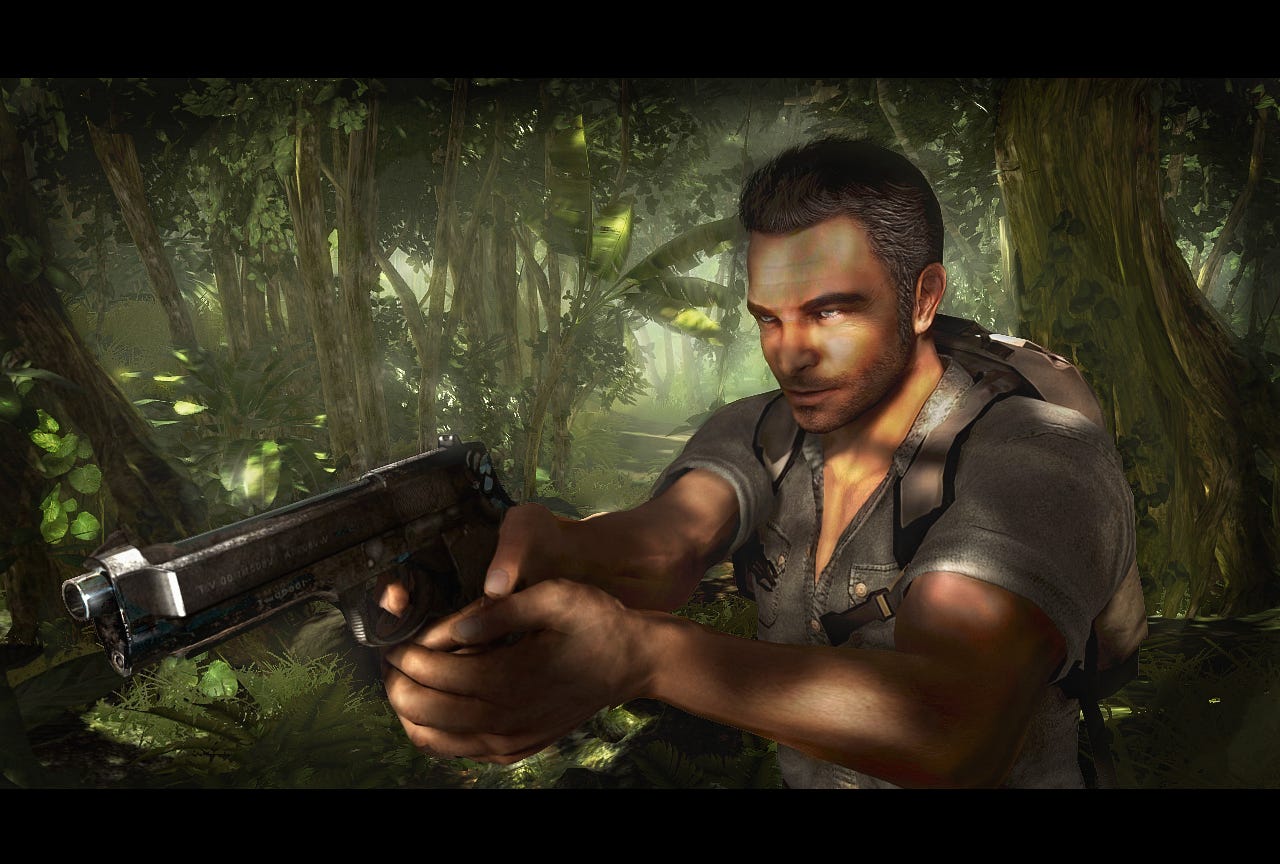
'Lost' Screenshot 1

His name's Elliott. We're not sure where he goes on Ellie's list yet.

Rather than simply retelling the events of the TV series, Lost opts to tell the story of an entirely new castaway - a passenger on the ill-fated flight who wakes up in the jungle along with everyone else, and has his own pathway through the story of the show. The story of the game covers the first two seasons of the series (with certain landmarks, such as the Flame Station, from Season 3 - "when we were making the game, they were just starting to film season three," explains the game's producer) but tells an entirely new story that only crosses over with the antics of the central characters at key points.

At first glance, it's tempting to dismiss the whole game as a collection of mini-games, albeit a collection of mini-games with astonishingly high production values. There are sections where you navigate through the jungle following markers, sections where you run along a forest path away from the Black Smoke, tapping jump and crouch buttons to avoid obstacles, sections where you navigate a dark cave by a pool of torchlight. Each of them is well-crafted and features lovely visuals, but each of them is, at heart, a mini-game.

In this instance, though, the whole appears to be rather more than the sum of its parts. Consider Lost as a more complete game, and a rather different genre emerges - the distinctly old-school adventure game, complete with inventory, puzzles and dialogue, but given a next-gen lick of paint, a huge TV franchise and occasional action sections. But didn't these die out years ago? Has Ubisoft really been compelled to make an authentic, high-budget adventure game with this franchise?
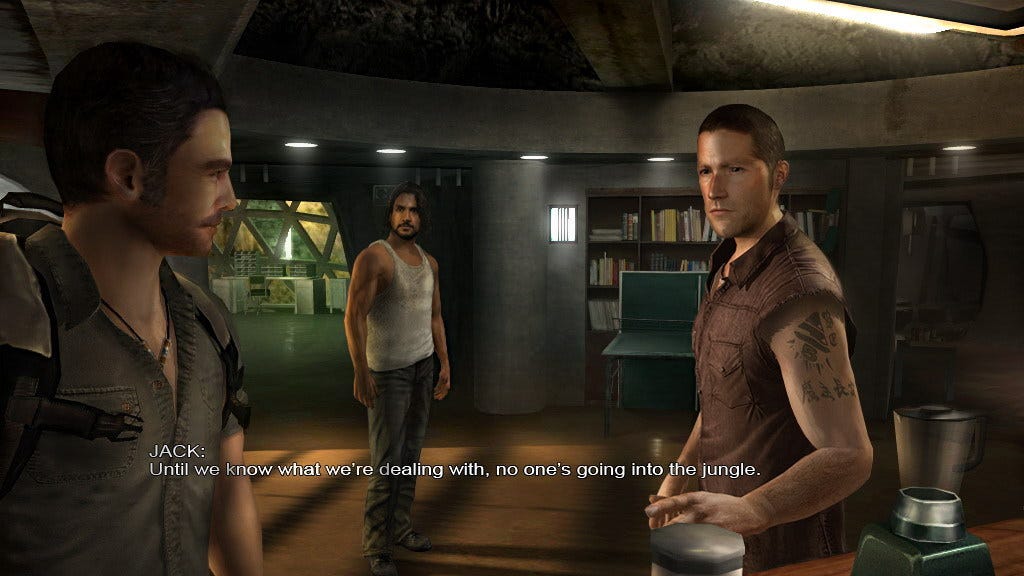
'Lost' Screenshot 2

Ordering everyone around already. Why don't you go and perform miraculous spinal surgery and then get married, eh?

"Absolutely," we're told with a grin, "because Lost is an adventure! It's about an adventure through yourself, about looking into yourself, and it's also about an adventure that you play on the island. At Ubisoft, we're well known for making shooter games, and we had the choice to do that - but if you take guns out of Lost, it's still Lost.

"If you think in terms of adventure, shooting and story, if you were to take out the shooting and leave the adventure and the story, you'd still have Lost. We really wanted to reflect that aspect, and we really wanted to cater to mass-market gamers - and we felt that first-person shooters wouldn't do that. Lost is a story-driven survival adventure game."

As such, the game's action sections largely play second fiddle to exploration, exposition, and puzzle solving - both on the island, and in your character's past. Lost's trademark flashback sequences are present and correct here, because your character is suffering from amnesia at the beginning, and must piece together his identity and his reason for being on the Oceanic flight through a number of dream-like flashback sequences.

These are key to moving the storyline forward, providing you with information from your past that's useful to your adventure on the island. Each one is triggered by an object or a few words of dialogue, and you're first shown a few scraps of a torn-up photograph before being dropped into a fuzzy, dimly recalled memory of an event. Identify the items from the photograph, and take that same photo in your memory, and you unlock the flashback - an interactive scene you can walk around in, talk to people, and even read notes or listen to recordings in.

Gone Astray

Other key aspects of the show, too, remain intact. All of the main characters are here, of course, and you can talk to them and interact with them as you move through the storyline. All of the key events, too, are present - although you won't actually see them all. After all, viewers of the TV show know full well that here was no mystery, unnamed man on the raft, or at the Black Rock, or at the Hatch when it was blown open - so while you see the impact of those events, and talk to the characters about them, your story brings you through a related but different set of events.

'Lost' Screenshot 3

John, John, made of magic!

Although ABC didn't have a "bible" for the series, it was still able to provide the Ubisoft team with extensive source material to make sure the game matches the show exactly. "We modelled every location that's in the series - in fact, we got blueprints from ABC," we're told. "We got blueprints for the Swan interior, for all the hatches, and even all the images. We even have a high-level map of the actual beach, and where each character has their tent - and it's identical to the map.

"We also took photos; our artistic director was in Hawaii and took photos of all the tents, so it's duplicated exactly. The only new locations we modelled were in the flashbacks, because those are new locations and new stories. Those were new locations. Even the jungle is as close as we could get for the series - for that, we took photo references of the locations they used in Hawaii. It's almost perfect."

The jungle, by the way, serves as a hub of sorts - you need to pass through it to move back and forth between the key storyline locations, and it's a mini-game in itself to navigate. The jungle is visually confusing, full of lush foliage and narrow pathways, and getting through is akin to solving a maze - you are given clear pointers, and it's important not to stray from the path they set you upon, or you'll never get back to it and will have to restart the maze.

'Lost' Screenshot 4

Where's Hurley? We demand Hurley!

"The main goal was to give the player the sensation of being lost - and the only way to do it was by making a jungle that was dense," the producer explains. "The jungles aren't big maps, because if we made them big we wouldn't be able to fit a lot of vegetation in there. So we made them smaller, but really dense."

On that note, it's worth noting that the game is powered by the GRAW 2 engine - which goes some way to explaining why it looks so incredibly good. Faces and facial animation are excellent, and the locations are modeled with great detail. However, anyone who has played GRAW 2 might pick up on one little point - as games go, it's not so hot on jungles.

"GRAW is pretty much the urban game, so we made a whole new vegetation system, a whole new rendering system for the vegetation," explains our helpful interviewee. "Our biggest challenge was making the game in an engine that's known for urban environments - so the vegetation editor, the vegetation tool, vegetation rendering, LODs for the vegetation and stuff like that, that was the key part."

Absent

Of course, assuming anyone who doesn't watch Lost has made it this far, you might be wondering if the game is purely for die-hard fans of the series - or if adventure game fans who don't watch Lost will find anything to enjoy here. The answer, frustratingly, isn't entirely clear. The sections we've played felt extremely disjointed, and would have seemed like very gappy narration were it not for the fact that we're familiar with the series. Whole sections of plot are explained away with a few words, and key characters appear and disappear with little exposition or explanation.

If you've watched the series, you'll understand. "Ahh, they're off to the Hatch; ahh, they're building the raft" - and so on. If you haven't seen the series, you'll probably be somewhat, well, lost. However, that's not to say that you wouldn't be able to play through, and even enjoy, the game as a whole.

'Lost' Screenshot 5

Perhaps the plane was just a bit old. Most of them are.

"We did want to give people who aren't fans the ability to play through the game," insists the producer. "The question is, do you think that if you're not a fan, and don't know anything about the series, could you finish this game? That's the goal. If people finish the game and it makes them want to watch the series, even better - but the goal was that both fans and non-fans should be able to finish the game, and I think that's what we've achieved."

Despite this, there's no doubt that Lost's real appeal will be to big fans of the series - and possibly to people who don't really play games that much. However, having played through a significant chunk of one of the episodes (the game is divided up into episodes, each bookended with a "Previously On Lost" section), we found ourselves rather compelled by the game. Some of the puzzles get quite challenging, and piecing together the story is a rather compulsive activity - even if a few of the mini-games are annoying, such as the cave-exploration game where walking into a dark patch informed us that we'd died by falling down a big hole and plopped us back at the entrance to the entire section.

"For me," says producer chap, "it's going to be the Lost fan who wants to have a story-driven, casual experience. We always say casual game, but it's a very hard market to pin down - you know, is it Brain Age or is it Wii Fit? We don't know. The reality for us is that the Lost fan is definitely our primary market."

'Lost' Screenshot 6

Tom and Kristan have both seen every episode of Lost. Another unexplained mystery, perhaps.

"We'd like to see hardcore fans play it, and I think this is a product they could play - because our feedback is that there really is no game like this around any more. I feel that a lot of hardcore gamers miss these types of games."

If our comments threads are anything to go by, he's not wrong. There's a definite nostalgia for adventure, we suggest. "Yeah, and we don't do them any more - and I don't know why! It was very difficult for me to convince the Ubisoft management that this was the way we should go - they said that adventure games don't sell on consoles. But we've never seen an adventure game on a console yet! Why not pick Lost to be an adventure game on a console - it'd be a great launch-pad!"

We have yet to be convinced that Lost is going to be the game to relaunch the adventure genre into a glittering new future - but we're certainly convinced that it isn't yet another bargain-bin TV tie-in. Sparkling production values and some genuinely thoughtful gameplay decisions, combined with very professional script-writing and a striking narrative, mean that this is shaping up to be a game that Lost fans will enjoy - and others may well find a soft spot for.

It's a rare TV tie-in that makes us actually want to play more - and while Lost may not be our choice if we had to pick one game to bring to a tropical island with us, it's looking like it might be a respectable addition to your game shelves.

Lost is due out on PC, PS3 and Xbox 360 in late February.

Comments (51) Latest comment 4 years ago

Comments threads automatically close after 30 days, but please feel free to continue chatting on the forum!