Lock's Quest
Key considerations.

Tower defence has had such a good run on the internet - and now on downloadable services - that it was only a matter of time before someone bound it to an isometric RPG and stuffed it full of spiky hair and hitpoints. With that matter of time now up, Lock's Quest throws us into the world of archineers - canny builders who erect massive fortifications in minutes and then run around shoring them up while Frankenstein's clockwork robots bash away from the outside.
It's more of a strategy ARPG than tower defence, but the inspiration is clear, and it has the same compelling quality. At the start of most missions you're given a couple of minutes to build walls and lay traps, and then you go into battle mode. Here you take control of the eponymous Lock, and send him running around repairing damage as the forces of the unashamedly evil Lord Agony lay siege. As enemy numbers grow and new units like archers, wizards and flyers present themselves, your build strategy evolves and you salvage materials to make new turrets and traps.
Controls for the build and battle phases differ, but both are well explained and intuitive to boot. Building involves selecting types of wall, turret and trap from a touch-screen selection menu and dragging and dropping them onto a grid that overlays the terrain. You can rotate them by tapping the left shoulder (or switch to the right shoulder if you're left-handed), and scroll the map with the d-pad (or face buttons). This allows you to pinpoint the dark ground that enemies emerge from so that you can adjust your defensive position to fit the scenario.
As you encounter more complex enemies, you get to play with new types of turret and trap. These are constructed out of the broken parts of the opposition, and in order to add them to your build menu you first have to piece them together in a simple stylus-driven mini-game, where you're shown what a turret or trap should look like and asked to piece it together from bits of scrap strewn around the touch-screen. It's very simple, but for developer 5th Cell it's the start of a theme where everything is a game or a simple puzzle in and of itself. Combat, when you do come toe to toe with enemies instead of standing behind a wall, involves tapping numbered icons or spinning a wheel, and as you run up and down the lines repairing defences you're asked to draw little semi-circles back and forward to operate a ratchet.
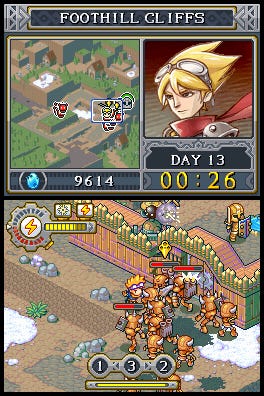
Another thing to consider is the amount of resource at your disposal. You collect this - the mystical "source" energy that is found in the wells you're protecting, and used by Lord Agony to power the evil clockwork army you fight - by harvesting the robotic souls of enemies your traps and turrets dispatch, and then spend it on construction and repairs. You can also build up an extra stock back at the capital city of Antonia by manning the siege tower - a separate, throwaway 2D mini-game where enemies advance and you have to measure cannonball trajectories to hit them. This isn't that great - and you'll groan when it's forced upon you from time to time - but it's passable.
While the game's real-time strategy bastardisation of tower defence is the focus, Lock's Quest also occasionally leans closer to its other, ARPG inspiration and dials up the story and combat. The former throws up a few surprises, but mostly it's standard fare - you save someone in peril, you go straight to the top of the class in a strange new world, everything is not as it seems, all the people you meet in villages have nothing interesting to say (and the cat says "Moo"), and there's a fair bit of angst. Applause for the animations, though, which make the most of limited screen-space with convincing limps and cuddly battles.