If music be the food of love, then karaoke is... What, exactly? A cheap, vaguely guilty but widely enjoyed pleasure - the kebab of romance? The battered sausage of passion?
We do mean "widely enjoyed", too. Karaoke has been rehabilitated. Once a word on a chalkboard outside your local which might as well have said "Go Away", karaoke is now a staple of parties, nights out and nights in alike. Very British inhibitions have given way to our inner songbirds, and we've suddenly decided that watching our pals murder the classics is actually great entertainment, rather than being embarrassment on a similar scale to walking in on your parents in flagrante delicto.
Two major things deserve credit for this renaissance in the warbling arts. Firstly, there's the sudden proliferation of Japanese-style karaoke booth establishments, where you book a private, waiter-served room with a handful of your friends - rather than stumbling drunkenly on-stage in front of a bar full of strangers to belt out Independent Woman three octaves too high for your voice. Secondly, and arguably more influentially, there's SingStar.
Whoops, there we go - three paragraphs into a preview of Microsoft's Xbox 360 karaoke title, and we've already mentioned the elephant on the table. SingStar is a big deal, though. It's sold millions of copies, and while the technology behind the game has evolved disappointingly slowly since its inception, there are tons of discs of songs available for the PS2 version - and hundreds of tracks online for the PS3 edition.
That's a big hurdle for Lips to jump over, because frankly - let's get this out of the way early on - any karaoke game lives or dies on the strength of its track listing and available content. You could build the most technologically impressive singing game ever, but 99 per cent of people's purchase decision would still be based on what they get to sing, at the end of the day.
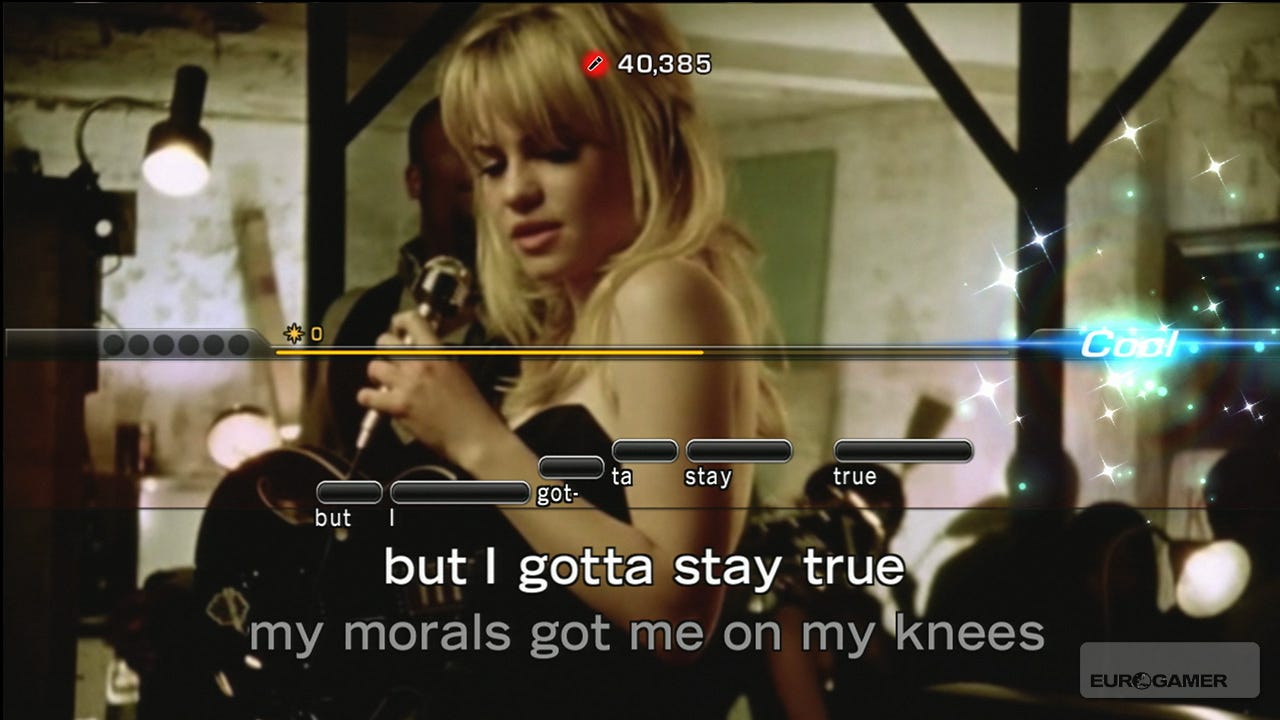
In general - especially with two players - the screen is much busier than this. When you do well, it's loaded with all sorts of explosions and nonsense.
To make matters worse, everyone's tastes are going to differ wildly on that front. There are people in this world who think it's acceptable to sing Celine Dion ballads in public, for god's sake - but if you want to make a karaoke game that'll be a success, you need to appeal to those deviants as well as those who just want to growl along to some throat-shredding rock classics.
Looking at Lips' original line-up of 40 tracks, there's a solid attempt at variety on display here. It's likely that almost everyone will find something they can sing. It's also likely that most people will only find two or three things they actually want to sing. The result is that Lips' success depends almost entirely on the quality and quantity of downloadable songs which appear after release. If they can get a couple of dozen songs out every Friday, with good variety and reasonable prices, and rapidly build up to (or surpass) SingStar's library, Lips will be a winning product. If not, they might as well not have bothered at all.
With that sobering note out of the way, though, there's actually a surprising amount to say about the other 1 per cent of Lips' potential success - the game itself, and the technology therein.
In case you're wondering, Morten from A-Ha managed to score 2.5 million points on Take On Me, which the game proclaimed to be Big Bang level. Take that, Duffy!
While it's easy to roll your eyes and accuse Lips of hopping on the bandwagon of SingStar's success - it's easy because it's entirely true, of course - Microsoft cannot be accused of creating a direct clone in this instance. In fact, after an evening with Lips at the publisher's rather oddly arranged "house party" (most of our house parties don't take place in grand ballrooms with waiters serving around trays of sushi, canapes and champagne while legendary pop stars sing their hits on stage - perhaps we're just doing it wrong), we came away pleasantly surprised at just how advanced the game is compared with Sony's karaoke queen.
Lips, in many ways, is the game we've wanted Sony to develop SingStar into. Going hands-on (er, lips-on?) revealed that almost everything on our SingStar Wishlist has been included in Lips - it's almost as if the developers had looked around the internet to see what SingStar players really, really wanted from the game, and built all of those features into their own version. In fact, that's probably exactly what happened.
Starting with the obvious - wireless microphones. We're sure we remember these being promised for SingStar PS3, way back when, but they've certainly never emerged. Lips' wireless mics feel fairly sturdy and, as you've probably seen, have a set of flashing, glowing LEDs in the bottom section of the microphone. Hurrah for LEDs.
The microphones also have another trick up their sleeve - they're motion-sensitive. Now, this isn't exactly a stealth Wiimote for the 360, but Lips does use the motion-sensing in a variety of ways - most notably, you can clap along with the percussion in some parts of the songs. Granted, Rock Band manages the same trick without a motion sensor in sight, but Lips' approach is a little more subtle - shaking the microphones makes them into tambourines, clapping them turns them into cymbals, and so on. At certain points the game will also reward you for posing in certain ways, or even twirling around.
We can see the latter aspect ending in disaster on many a drunken night, as bowls of Twiglets and bottles of cheap wine fly all over the place. In fact, this is one element of the game we sort of hope you can turn off - the posing aspects will be fun for some, but others just want to sing (or prefer their musical posing to be more impromptu, rather than this kind of regimented, score-deductible Fun).
Speaking of score, this is another area where Lips really has an edge over SingStar. Not to put too fine a point on it, Sony's game largely rewards you for being dull and boring. Genuinely good, entertaining singers do badly at SingStar (and Rock Band, for that matter) because the game rewards you for holding perfect notes, rather than actually singing.
It's too early to say just how much Lips improves on that - but it's hugely promising to note that on long notes, the game actually gives you a bonus for vibrato, rather than deducting points. It was revealing to watch A-Ha front-man Morten Harket singing Take On Me at Microsoft's event (it was also mind-boggling fantasy fulfilment for an unashamed child of the eighties), because as he sang, the game constantly popped up bonuses and rewards not only for singing notes accurately, but also for doing interesting things with them.
Oh good, I do like jam. The ability to play with real-time 3D backgrounds rather than videos is a bit of an odd one - we're not sure we see the point.
As a result, we're seriously looking forward to getting our hands on the game and inviting some properly-good singer pals around to see how they get on with it. Although the basic display - a track the notes follow, and the level your voice is at - looks hugely similar, the audio processing that Lips is doing is obviously much more complex than SingStar's efforts. Quite right too - it was a serious let-down when SingStar's PS3 edition turned out to be doing nothing more advanced in the scoring department than its PS3 ancestors.
Visually, Lips does look rather like SingStar, but it's significantly "busier" on-screen. Various special effects and gauges are littered over the play area which indicate when you're doing really well (or badly, presumably, but we wouldn't know about that...), and some may be a bit disappointed to note that the original music videos are quite obscured by all the scoring stuff. Curiously, there also seems to be an option to sing without the music videos - replacing them with 3D "visualiser" style effects instead. We're not sure what the point of this is (except perhaps to avoid having to look at Celine Dion's face?) - further investigation is required.
Er... Actually, we take it back. Replacing videos with real-time 3D is the best feature in a karaoke game ever.
The other key element of Lips - which is much-discussed - is the integration with your existing MP3 collection. Frankly, at this point in time, this sounds like a complete red herring to us. Microsoft has alluded to this feature repeatedly but has never properly explained how it'll work - and as far as we can gather at this point in time, it'll just play the music on your Xbox 360 with a visualisation in the background, and let you sing along through the microphones. It'll help to pad out the anorexic catalogue of music in the early weeks, but it's no substitute in the long-term.
And there, again, is the crux - all of this innovation is really only 1 per cent of the package. You'll base your investment on whether Lips is going to give up the goods in terms of DLC and music content, not features - but at the same time, in that crucial little 1 per cent, Lips has thrown a heavy gauntlet down right on SingStar's dainty little foot. Right now, it looks like Microsoft might legitimately have the best karaoke game in the world on their hands. As long as it also gets the best karaoke songs in the world ready for download (by which we mean every karaoke song it can get its grubby paws on), Sony's grip on our living room on Saturday nights could be about to slip.
Lips is due out exclusively for Xbox 360 on 21st November.
