I'd like to be able to tell you that I'm not that into Star Trek. Really, I'm not. Which makes it my eternal frustration that I appear to know frightening amounts about it. This is probably in no small part due to my having seen every episode of The Next Generation, primarily because it could be used to distract our A-level Chemistry teacher, Mr Williamson, coaxing him into discussing the events of the previous night's episode rather than banging on tediously about benzene rings and titration.
I failed my chemistry A-level. (Entirely my fault, not the lovely Mr Williamson's.) I am fairly sure I could still pass one based on Star Trek. I say all this to give the following some context: I had fond memories of Klingon Honor Guard.
So these memories didn't come from some crazed love for Star Trek of the mid-nineties, nor fanboyism. Going back to play it again, apparently these memories came from being a bit of an idiot. With two significant exceptions, as hard as I've tried to love it, it doesn't stand up. But those exceptions are very significant, and completely made revisiting the game once more worthwhile.
The first is grav boots.
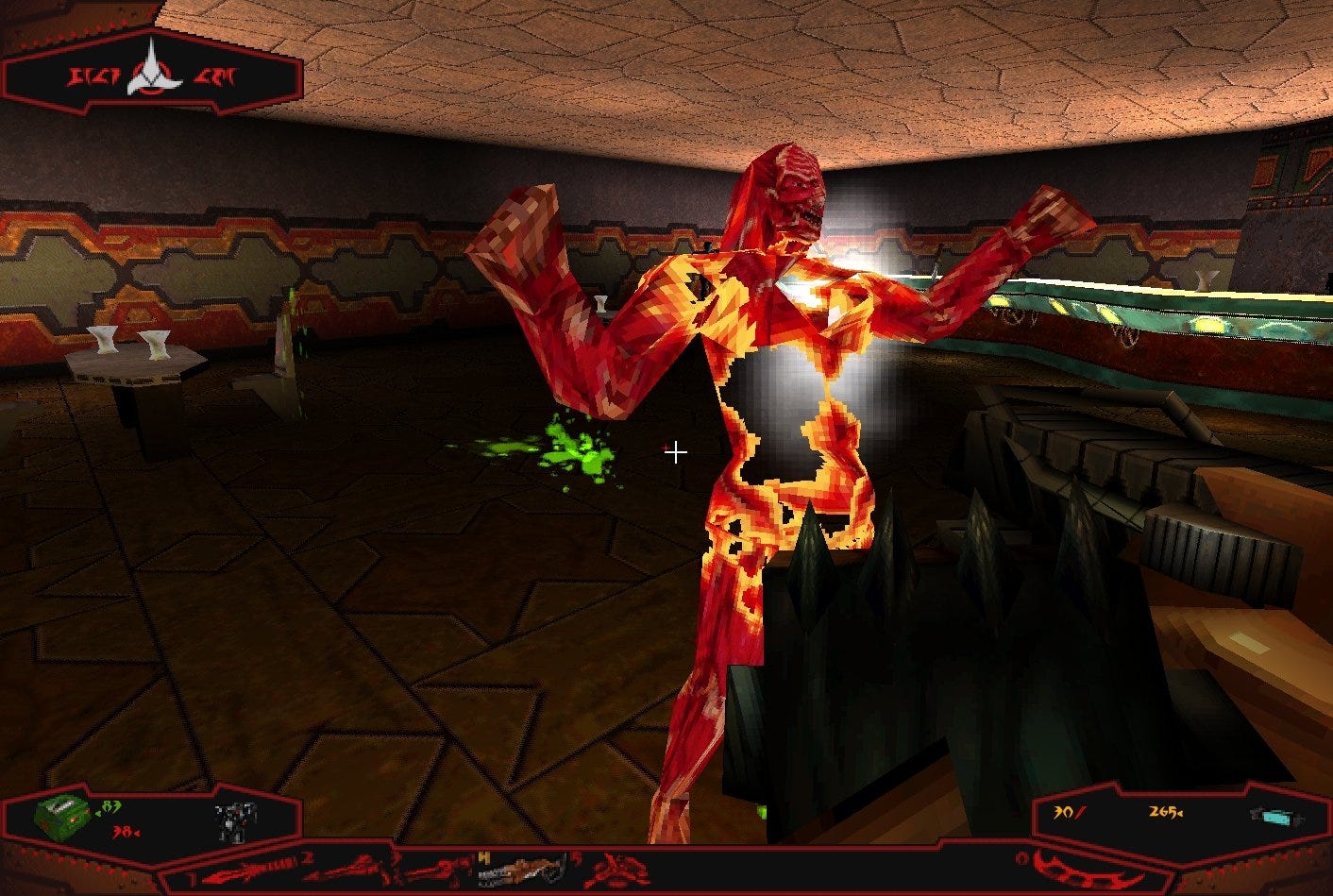
Well that's got to sting.
Like its full title, Star Trek: The Next Generation - Klingon Honor Guard is a very long game. Far too long. Longer than any first-person shooter should ever reasonably be. Worry not, I'm not some colossal idiot whose brain has been so addled by the brevity of modern shooters that anything lasting more than five hours leaves me scared and confused. Having gone back to see quite a few nineties shooters for these Retro Sunday articles, I've remembered with joy quite how huge the FPS used to be. Huge, and just packed with sublime ideas and fantastic level design, games like LucasArts' Jedi Knight knew what they were doing. MicroProse possibly did not with its Klingon-focused brown-o-fest.
Built using the Unreal engine, managing to make the majority of its first half as monotonously brown as Quake was quite a victory. But this colour choice matches so many of the other decisions made. For instance, you're playing as a Klingon - an awesome and auspicious start, putting you in the position of being a baddy in Roddenbury's shiny plastic world. The potential for mischief, for a game in which you get to shoot at silly Federation goodiebags, shouting Shakespeare and using the same Bird of Prey explosions in subsequent films (see, I know that. Why do I know that?) was all there. So they chose to make a game about shooting at other Klingons.
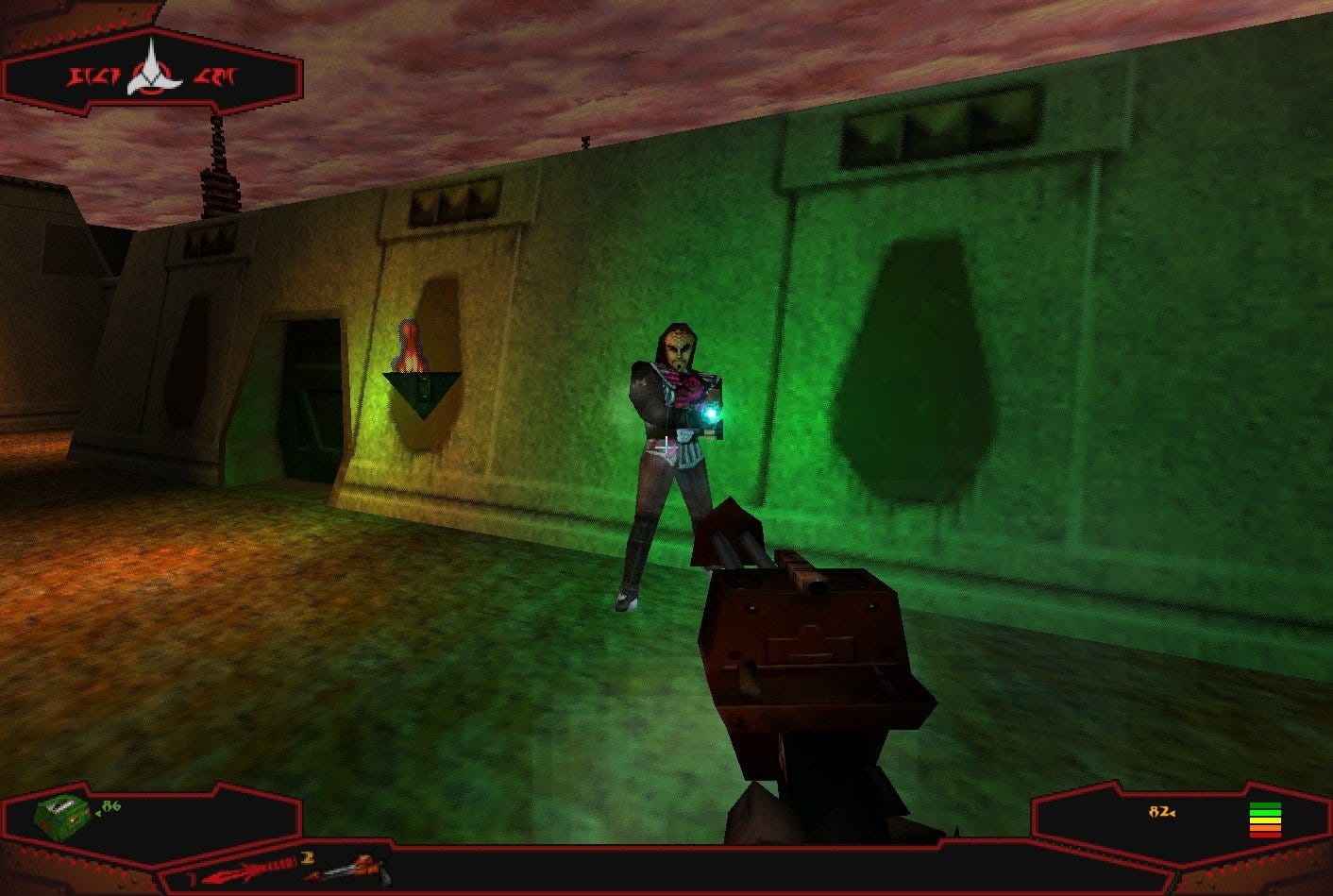
But we're both Klingons! We should be shooting the idiots in the jumpers.
More problematic for the first enormous stretch of the game is the locations. Rebel Klingon bases (the House of Duras, if you wondered), fighting a muddle of Klingons, Andorians (who for some reason my character keeps calling Ferengi), and Nausicaans (the ones who stabbed young Picard... OH WHY DO I KNOW THAT?), make for extremely repetitive locations. Long series of identical corridors, identikit tunnels, and large buildings lacking individual character, all make for a strangely confusing arena.
To KHG's credit, each level has a goal, but no clear path to reach it. This makes for some very liberating play, with multiple routes available, entire sections skippable, and a message at the end of each level informing you of how many secrets you missed, enemies you didn't kill, and items not discovered. However, this freedom is somewhat cheapened by the confusion of the levels looking so damned formulaic that half the time you've no idea whether you've been through an area previously.
But then come the mag boots. It was for these that I was playing the game. I remembered very clearly that there was a level on a spaceship in which you go outside, attached to the vessel by your magnetic shoes. I couldn't remember why it was such a fond memory, until the first time I accidentally switched the boots off and floated helplessly into space.
Being from 1998, Klingon Honor Guard can only go up to a resolution of 800x600. So it looks a mess. However, rather brilliantly its display options offer a windowed mode. And being Unreal, it's scalable, meaning you can then stretch that window to fit your screen, and the resolution scales up to match it. Suddenly it looks pretty decent. And nothing shows this off better than killing an enemy in zero-g on the outside of a spacecraft. Their circling corpse slowly drifts away, blobs of blood ejecting from their wounds in a floating spiral, against a backdrop of a vast planet. And sure, these are blotchy pixels, but your imagination stops noticing that after a moment.
I remembered why I so fondly recalled the mag boots. It's the drifting. Walk forward to gather some momentum, switch off the boots, and then float to the next arm of the vessel as a shortcut, the infinite reaches of space above, below and beside you should you misjudge this jump. Or indeed actually jump. Make it, reach a stable platform, and you reactivate the boots and safely land. It's sublime. That sense of absolute danger, converted to affixed security at the press of a button. I could happily play a game simply dedicated to this sensation.
This is probably the brightest room in the whole game.
Along the way the second memory - one so vague that it existed only in the form of: "play it again, John, because it's in there" - vividly returned. The Ding-Pach Spin Claw.
While many will clamour forward and proclaim Tron 2.0's disc as equivalent, I feel safe in saying the Spin Claw is my favourite weapon in any game ever. And I'd forgotten about it, beyond a will-o'-the-wisp of an inkling somewhere in the dusty caverns of my mind. It's a spinning circular blade, fired from a device held in your hand, that ricochets off all walls and surfaces until it can find you once more. But better, - ooh, even better! - you can click the left mouse a second time to call it back. It's completely wonderful, a monstrously powerful weapon, and one that lets you feel absolutely in control while still able to benefit from enormous good fortune.
The disadvantage of the weapon is that once fired, you cannot fire again until the blade returns. So if you miss your enemy, you need to run for safety, but still be somewhere the claw can find you again. But, time it well, and just maybe on its return flight it'll catch that enemy in the back, making you Earth's Greatest Fighter.
Silly purple-blooded dead man.
Even better, if there's a small room with a few enemies and maybe a couple of turrets, just open the door, fire the claw, then back away. The door shuts, you hear the sounds of death, and open the door again to see the utter brutality that's taken place, corpses scattered, the walls covered in brightly coloured alien bloods, and your claw blade returning to you like a sickening puppy.
So that was why I so fondly remembered Klingon Honor Guard. A game that is, unquestionably, fantastically overlong and dull. But a game that contains the thrill of space floating combined with the best FPS weapon ever made. And as it happens, those two are enough. I love this game!
