E3: James Cameron's Avatar: The Game
Is 3D the future?

Games companies are notoriously protective of their hottest properties, but film companies are even worse. Prior to the behind-closed-doors demo of Avatar we're told to hand in all electronic devices - mobiles, laptops, dictaphones, PSPs, Taser guns, the lot. It's a direct order from the movie people, according to the games people. Luckily, though, I'm still able to take notes, having dug around in the bottom of my handbag to find a pen and a piece of paper left over from 1998.
It all seems a bit excessive, especially since on entering the room we're each handed an electronic device. A pair of battery-powered glasses, to be specific. They're lightweight, comfortable to wear and could almost be mistaken for a regular pair of shades. Perhaps they are shades, there to protect our eyes from the blinding high-tech futureness of the 103-inch 3D television in the middle of the room. It's so big you could sleep on it, and it's so sexy I'd sleep with it.
But we're not here to see the telly; we're here for a first look at the Avatar videogame. The movie is being produced by Hollywood bigshot John Landau, who's even turned up to tell us all about it. (Later on I get to hold his Titanic Oscar, but that's another story.) Cameron came up with the concept for Avatar 14 years ago, but it's taken that long to develop technology good enough to bring his vision to life. Or so they say. Anyone would think it just took him that long to explain the plot.
In the interests of brevity, here are the storyline notes I scrawled on my piece of paper: "Man called Jake is paralysed from waist down while fighting a war without knowing why. Two blokes tell him estranged twin brother, who worked for mining corp on planet Pandora, is dead. Planet inhabited by 10-foot tall blue people called Navi. They can connect their ponytails into the backs of creatures and ride them (hairy USB cables?). Also there are Hybrids and Avatars, have human faces. Jake goes to planet, becomes Avatar. Finds out corporation is burning rainforest. Falls in love. Leads revolution. Etc."
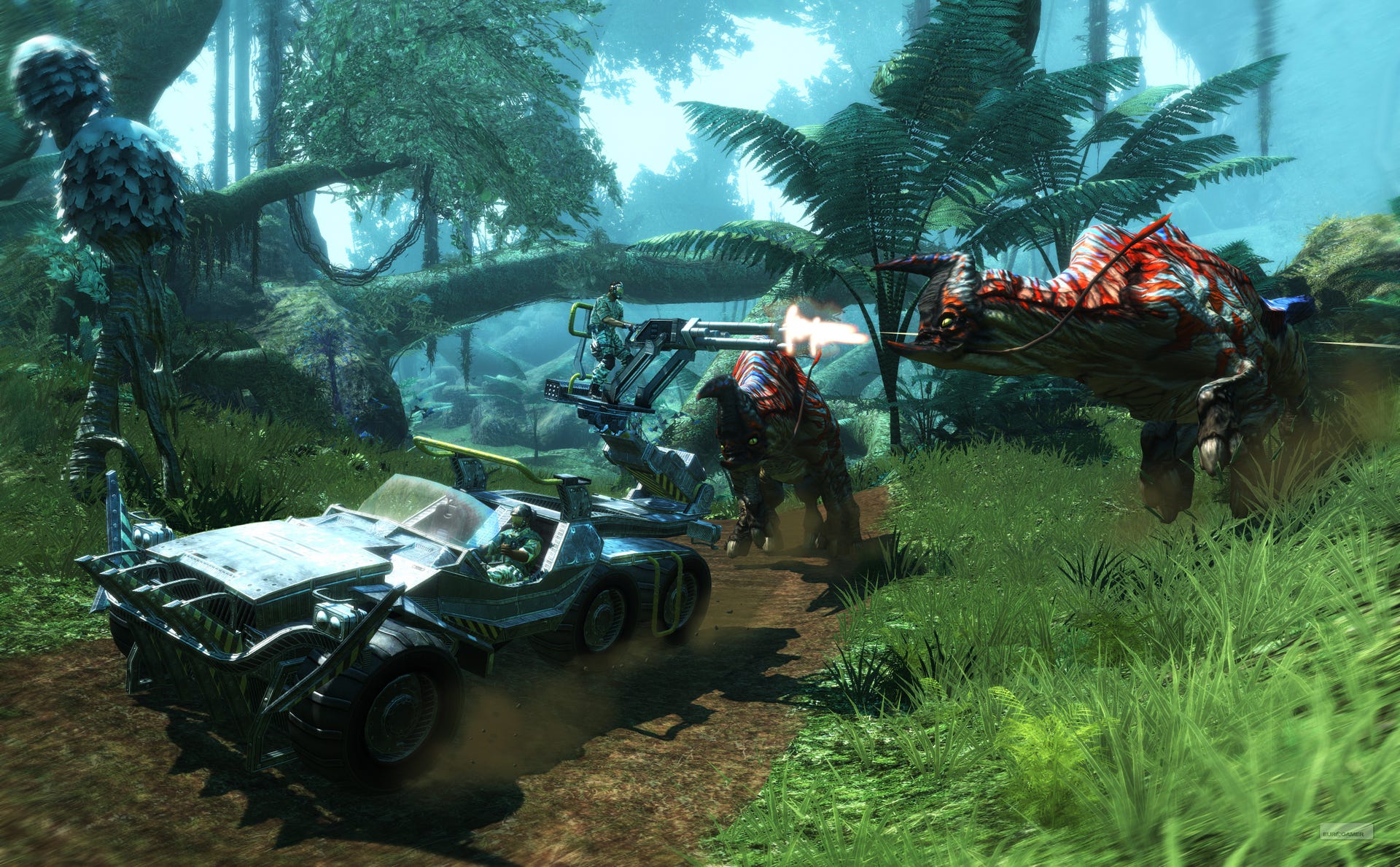
The Avatar game is set several years before all that happens, however. The mining corporation is just beginning its attempt to turn Pandora into a mining colony. You choose whether to align yourself with the big blue tree-huggers or the rainforest-burning capitalists. Take the latter option and you'll get superior weapons and equipment. The Navi have to make do with longbows, maces, axes and the like, but as they're familiar with the environment they can use it to their advantage. Either way you'll earn "Effort Points" for your actions as the game progresses, and these can be traded for new gear and skills.
For the purposes of this demo, the Ubisoft chap has chosen to play as one of the corporation's minions. The first thing we see is a burly man standing in a jungle sporting camo fatigues and holding a gun. A familiar sight if you've played more than two videogames, but pop those 3D glasses on and it's a different story. There's proper depth of field and a real sense of the distance between objects in the background and foreground. Everything from your character's helmet to individual leaves curves and pops out of the screen, and the unique perspective draws you in. It's not quite as if you're really there; this is a videogame, and it's still 2009, so the visuals aren't photo-real. They're on the way, though, and it's impossible not to flinch the first time an enemy lumbers across the screen.
Especially since said enemy is a giant roaring mutant who appears to be the offspring of a hungry velociraptor and an angry parrot. This is just one of the weird creatures you'll have to fight off in Avatar - others include viper wolves, who can move at astonishing speeds, and a stegosaurus who has a head like a hammerhead shark. The shark-dinosaur is extremely powerful and we're shown how it takes your character, four of his mates and a lot of grenades to bring his giant frame crashing to the ground.
It's all impressive stuff; the level of detail in the jungle environment and the creature animations are particularly notable for being of an extremely high standard. However, because this is a third-person game, there's still a sense you're observing rather than participating - watching the character on the screen running around the jungle, instead of running around it yourself. Why not opt for a first-person perspective and cut out the middle man?
"There are advantages you get in third-person you don't get in first," says animation director Brent George. "Third-person allows you to better see how your character's reacting to the environment. First-person doesn't give you visceral feedback about what the character's going through; you can't really see the bigger picture because you're looking through their eyes. There are just as many positives to third as there are to first."