Version tested: PlayStation 3
Dear Namco,
DIFFICULTY LEVELS, DORKFACE!
Signed, me.
Anyway. Probably the best way to start this review is to simulate the experience of playing Ridge Racer 7. Bear in mind that, for the next few paragraphs, you will be the subject of my whim. You are a rat in a cage of my design. HAHAHA. Continue.
Ridge Racer 7 is ostensibly Ridge Racer 6 with a few important changes. But for all its dalliances with nitrous, slipstreaming, customisation and 1080p, the reason we're all here is still the same: boosted starts, ludicrous tracks, and zooming around hairpins at 200mph, wiggling the stick efficiently as you do to preserve as much speed as possible.
Cornering has always been Ridge Racer's unique attribute. It turns the traditional set-up on its head in favour of "drifting". Instead of slowing to go into a corner, you want to be going as fast as possible. The challenge isn't finding the right line into one (although it helps); it's trying to avoid bashing anybody who's doing it at the same time as you, despite the fact that drifting has spun you both almost sideways, and then making sure that you don't overcompensate on the way out of the turn. If you do, you'll bang into the wall or another car and bounce off repeatedly - the manner of bouncing so completely stupid that you'll wonder if Namco's ever played any other racing games in its life.
If anything, this emphasis on spectacular cornering has only grown as the series has progressed. Namco has introduced more drift types - standard cars swerve around quite a lot, but usually only go into a drift if you make them, and click helpfully back to the racing line when you finish; mild cars swerve much less, and generally grip the road far more; while dynamic cars will go into a drift if the wind changes (or, more accurately, if you steer hard in one direction), and require a lot more talent to manoeuvre effectively.
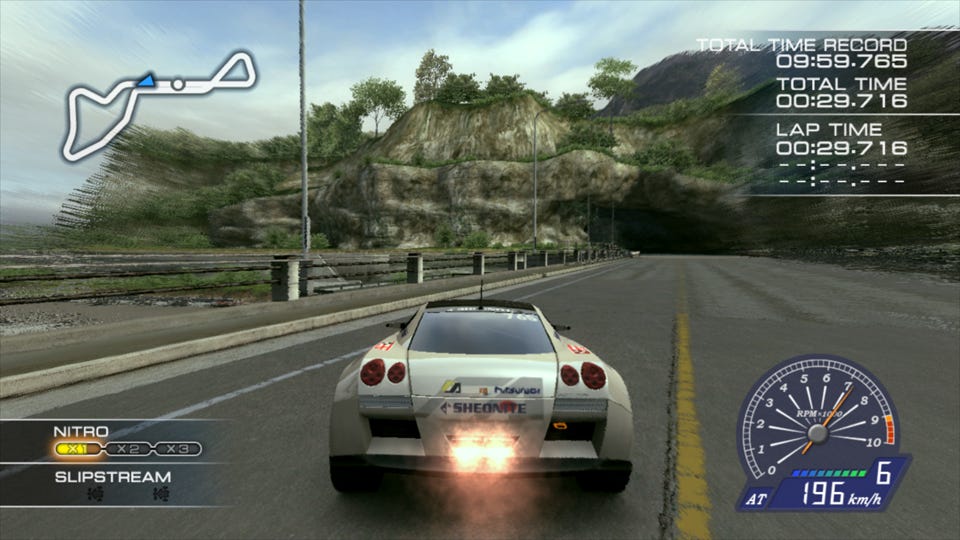
One of the new tracks. I like this one, but it's not very hard.
(You're still a rat, by the way. Keep going.)
Meanwhile the PSP version saw the introduction of nitrous, which is a means of boosting to increase top speed, with the nitrous "tanks" filled by drifting around corners as fast as possible. The clever bit was (and is) that you can't fill the tanks while nitrous is engaged, but, if a tank empties as you approach a corner and you immediately drift, some of the residual nitrous effect will see you cornering at greater than your usual top-speed and the empty tanks will refill more quickly as a result. The Xbox 360 Ridge Racer 6 refined this, allowing you to daisy-chain your three nitrous tanks into one long, even greater burst of speed, called "Ultimate Charge".
The other thing that the PSP versions and Ridge Racer 6 have in common is the enormous amount of races available to take part in.
And it's with the help of that sentence that you may now exit the cage (mind your tail) and join me back here in the heartland of the review, because the other thing about the PSP and 360 games' "enormous amount of races" is that, for anybody capable of pushing buttons without falling off the sofa and setting fire to their hair, the first few hours' worth were almost intolerably boring and trivial. They don't care if you already know the basics; you're going to have to sit through them again anyway, and before you know it you're bored out of your mind and just wish they'd get to the sodding point.
You can't use nitrous chains at all until you've bought them in the shop. Don't worry - it's not difficult to get there.
Which is roughly the effect I was going for. Of course you know what drifting is, and how nitrous works. Indeed, there's very little chance you haven't played Ridge Racer before (although if you haven't you should buy this, the 360 game or one of the PSP versions and come back when you hate Angelus), and if you have then you're bored of what I'm saying. And so you will be in the game for quite some time.
Well, that's not entirely fair. You will find novelty in a few of the early hours. For instance, you'll be playing the game in 1080p. Well, you might be. Either way, you'll be playing spot the difference, hoping to contribute to those exciting forum threads about whether the leaves are slightly browner than they were on Xbox 360 and whether this means the war is over. In truth, what you'll find is that RR6 looks smoother, and also seems to have a slightly richer colour-depth, but that RR7 also does some effects that RR6 hasn't (soft street-lamp reflections in wet surfaces, most noticeably), while looking slightly brighter on some tracks and, of course, filling your eyes with 2,073,600 pixels rather than 921,600. Most of the time though, it's hard to tell which is which at a glance - the only truly tell-tale bits being the rear-view mirror at the top of the PS3 screen, which is operating at a slightly lower detail level than the main game graphics (unlike RR6's), and, you know, the extra million-and-a-bit pixels, which are neither here nor there unless you're on a crusade, in which case fill your boots.
So there's that to occupy yourself with, but more interesting to Ridge devotees will be the differences in modes, the new tracks, and the roles of slipstreaming and customisation.
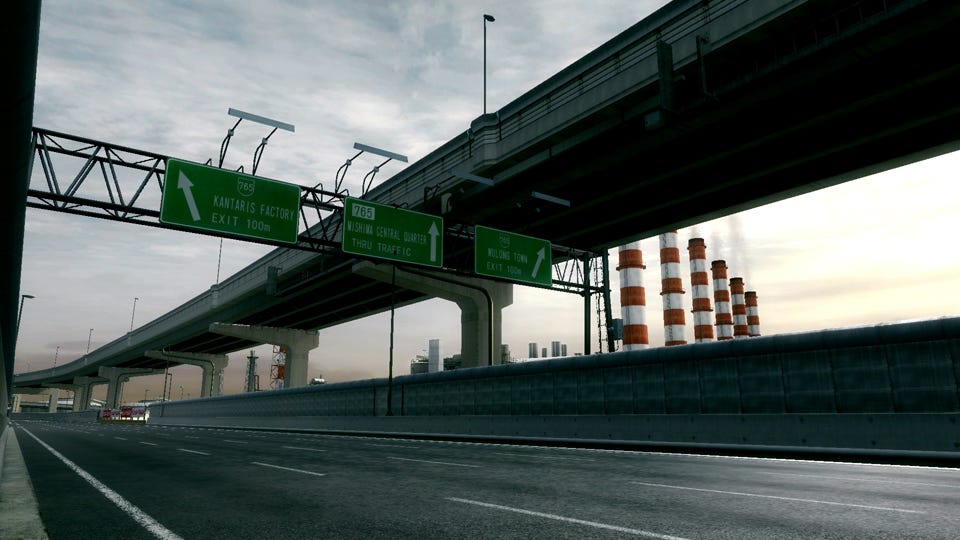
The future of bridges. Boring screenshot aside, it's worth noting that RR7 is very nippy, especially when you get up into category 2 cars and beyond.
Customisation is really the key improvement. As you complete races in single-player, you earn credits and the right to buy parts from certain manufacturers. These not only allow you to change the look of your car (take it or leave it) and increase its top-speed by upgrading the engine and so on, but more interestingly they also allow you to customise the drift and nitrous characteristics, and introduce "plug-in units". Some tyres will allow you to amplify the dynamic drift attribute, for example, while nitrous kits allow you to change how they charge. Reverse-nitrous only fills tanks while nitrous is being used (which, applied frivolously, means you can be left without the ability to accumulate nitrous at all); flex-nitrous is only active when you hold down the nitrous button, rather than emptying an entire tank every time you do; auto-charge fills your tanks up to a maximum of four (although you can only use three at once), automatically rather than when you're cornering, giving you a new source of boost every 12 seconds or so. There are also other variants that change the potency of single, double or triple nitrous charges - giving you a higher top-speed for Ultimate Charge, for example, but at the expense of strength in single and double charges.
In other words, there's a wealth of potential in customisation, and Ridge Racer fans who worked their way through the relatively rigid sixth instalment will be salivating at the prospect. Equally promising is that the "Ridge State Grand Prix" mode is far more varied than the equivalent campaign mode in RR6. Instead of lining up a procession of races each time, and eventually being allowed to do the same with special classes, duels, quad (four-car) battles and expert routes, here the player is given three basic avenues of exploration: grand prix, manufacturer trials and single events. GPs take you through a few tracks (the number varies) in eight-car grids, accumulating points for your position at the end of each race, as well as inheriting your finishing position for the next race's grid. Manufacturer trials and single events are one-offs - the former are straightforward races that then offer you access to a manufacturer's parts, while the latter are more varied, with everything from 14-car "overtake" races where you start at the back of the grid to time trials and no-nitrous races. Overall it's easy to grasp, and unlike RR6 it's usually possible to return to the map screen and do something different to the run of races you just completed.
On the track, things are slightly different to RR6, to the game's credit. The AI is more immediately challenging than it was, remaining in your rear-view for longer, and when it becomes challenging its elasticity ensures that even if you're making regular use of Ultimate Charge you can't afford to spend the whole of lap two banging your nose into the wall and smoking cigars. The introduction of slipstreaming also has an impact here - not only does it allow you to catch up with cars more easily if you're blocked off by giving you a slight speed boost as you ride along in someone's wake, but it means that simply using the rear-view to block off AI overtake attempts won't get rid of them, because they can do the same to you.
Obviously not my screen, but on the right side you can see a handy readout demonstrating the player stats screens.
RR7 also introduces a number of new tracks, although the majority will be familiar to fans of its predecessor, including the likes of Sunset Heights, Aviator Loop, Airport Lap, Rave City Riverfront and other regulars like Harborline 765 (as well as a welcome high-definition take on one you may recognise from another of the Ridge games). Newcomers include Mist Falls, which takes you behind a waterfall, demonstrating the engine's capacity for beautiful lighting contrast between the extreme brightness and glare of sun beaming through the water on one side, and the dark, moist, cavernous tunnel that dominates the rest of the screen. MF also mixes it up with houses on stilts and giant Buddha statues when you head out again into the sun, which is, er, nice. Other tracks see you racing through jungle and Aztec ruins, and speeding along highways that'll remind you of the Florida Keys. As you'd expect, they're all full of hairpins and huge jumps that help you marvel at the oily ocean, breathtaking vistas and loony helicopters that always pop up on lap three.
Taken online, the game offers Global Time Attack (download other players' ghost cars and race against them) as well as 14-player racers, and there are constant leaderboard updates after each race whether you're online or off. An addition here is that it's also possible to download new challenges posted to the PlayStation Store, suggesting that Namco aims to do more to support this PS3 instalment with downloadables than it did with RR6, which, at the time of writing, only offers background music and vehicle-unlock keys as downloadable extras. Another wacky internet thing that RR7 benefits from is a ticker along the bottom of the menu screens, which continually puts top lap-times and other information in front of you, including testimonials recorded by players who got to the end of the Grand Prix section. If you're looking for mine it says, "Ten hours of pretty yawn, that."
I forget what this one's called. Shadow Ruins or something. Or Pillar Dragstrip.
Which brings me back to the original point. I'm quite good at Ridge Racer, admittedly, but even the best player in the world shouldn't be able to play something for ten hours without finishing less than first, which is what I did. That's ludicrous. I was doing all sorts of races, but I wasn't being deliberately ponderous about my quest for glory. I certainly wanted that glory. Even so, it took ages before I unlocked the "extreme" races that start to pose a challenge with duels and quad battles, and even longer before I got my hands on a proper special-class car with which to amuse myself.
And really that just underscored the larger problem: RR7 is back to front. The Pronzione car is a sort of hovercraft. You have to beat it to win it. I did this on my first go, not because I was cunning and skilful, but because I was driving in a car with a higher-than-usual top-speed that I bought in the shop, and an auto-charge nitrous system that allowed me to do the bare minimum of drifting and gave me about six Ultimate Charges during the race. Here's an idea for next time: make the main game hard immediately, and offer these items as crutches that beginners can fall back on if they need to, earned through some sort of "starter GP". I don't know. I'm not a game designer. But it strikes me that the best and most rewarding experience you can have in Ridge Racer, or indeed any top racing game, is honing your skills and then unleashing them to beat off the challenge of a semi-cheating AI rival. Preferably one with a name you can swear at on the umpteen occasions you don't quite manage it.
And this looks like Mist Falls. One of the prettier ones (and the TGS demo level, fact fans).
Ridge Racer 7 certainly offers that in places, but it doesn't do it anywhere near enough. Its main problem is that it starts off easy, and as soon as it gets a bit difficult it rewards your patience with things that make it easier again. When I unlock the Pronzione, which has one of the most brutally efficient nitrous charge systems in the game (auto-charging and flex-nitrous, effectively), surely I should be called upon to justify my ownership of it, and not just suddenly able to obliterate the opposition more than I could previously? The same goes for plug-in units that automate the best-possible boosted start. Why do that just at the point that your game should be asking for peak skills? And so, yes, difficulty levels would be handy next time, Namco, my love. I want you to punish me. I've been a bad boy.
Overall though, Ridge Racer 7 still makes a good account of itself. It's better in some areas than 6, and is certainly brilliant played against real people, or just picked up and played properly with the nitrous turned off in arcade mode. But it's not really as challenging, I don't think, and hardcore fans will find more to sustain them lurking in the oceanic depths of its Xbox predecessor. On balance then, a slightly lower score. The fact that it's the best PS3 racing game in a field of one is probably poetic.
7 / 10
