The creator of Civilization, and granddaddy of prefixing game titles with the lead designer's name, then suffixing it with inexplicable exclamation marks, has won back a lost child. The Railroad Tycoon series departed from the station and ran off with another developer after his company, Firaxis, fathered the first one in 1990. Now though, it's come back to Papa, and is retitled as Sid Meier's Railroads! On the eve-ish of its release, Eurogamer chatted with one of videogaming's oldest and most respected luminaries about trains, hats and Stairway to Heaven.
Eurogamer: Whereabouts are you at with Railroads? Is it finished now?
Sid Meier: We have gone gold, it's in production and I think it's gonna be on sale 27th October.
Eurogamer: You must be glad to have it finished?
Sid Meier: It was a little bit of a relief to finish the game. We're working on a demo and some other things and then we're really done. It's a happy time to have a project completed.
Eurogamer: Do you have any traditions you do when you finish a game?
Sid Meier: We have what we call our Mastering Hats, which are funny hats we wear when we think the game's just about to be finished, cos we're always waiting for that last bug or we have to go through testing. So it's a good luck charm, we put on our mastering hats and wait to hear that everything's OK. Also, when we hear the game's in stores we have a little party and celebrate. People have put in lots of hours, lots of overtime, so we try and release the tension of all of it and have a bit of fun.
Eurogamer: So how do you refer to the game in the office? Do you call it 'Railroads' or the whole "Sid Meier's Railroads!", with the exclamation mark and everything?
Sid Meier: [Laughs]. Nah, we just call it Railroads. We drop the Sid Meier. Actually, we called it Railroad Tycoon for a long time because our original title was 'Railroad Tycoon Rerouted'. There was the Matrix Reloaded, so we thought it would be funny to call it Railroad Tycoon Rerouted, but it ended up being Railroads. A nice snappy name, rolls equally off the tongue.
Eurogamer: Did you have the option to call it Railroad Tycoon 4?
Sid Meier: I believe so. That name is owned by [Firaxis' parent company] Take 2, but it just didn't seem like the right thing to do.
Eurogamer: Do you see this as a sequel to the Railroad Tycoon series, or as a whole new game?
Sid Meier: It's more that Tycoon has gone off in a different direction [note - Railroad Tycoon II and III were developed by Popcap Games, rather than Firaxis]. There have been a zillion tycoon games, and not all of them are of the highest quality, so it was just a genre that we didn't really want to become part of.
Eurogamer: So if it's not tycoon game, what is it?
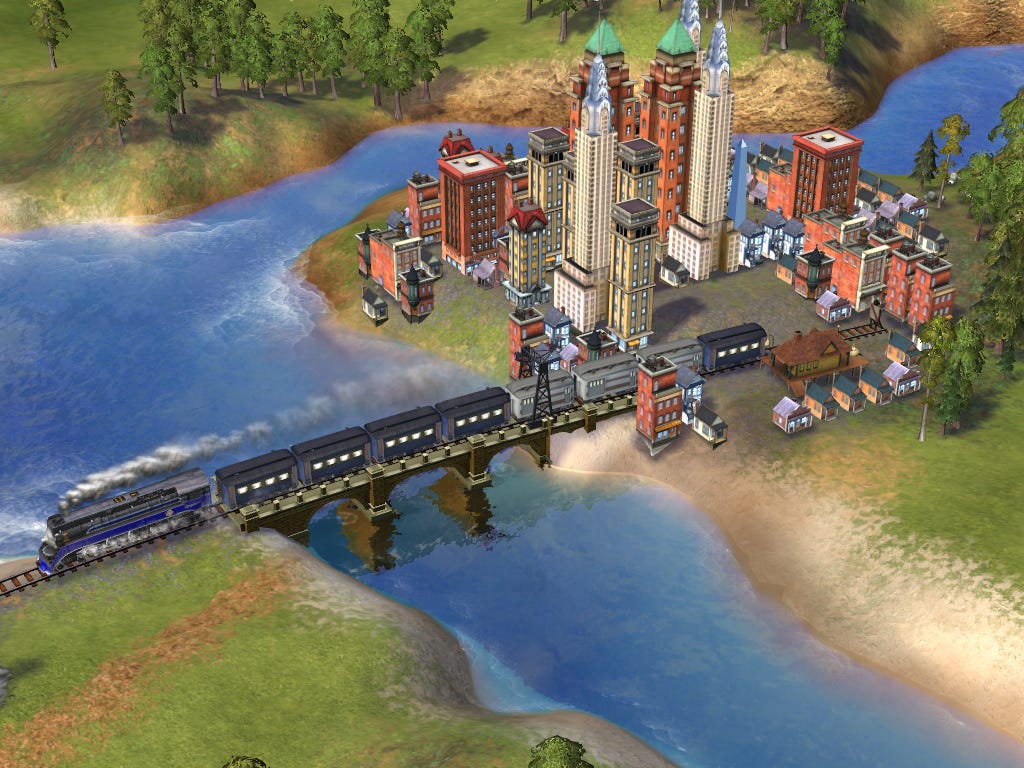
Sid Meier: Well, everything that you think is cool about railroads is in this game. Basically ,we tried to combine what's called a model railroad - the operating parts, the steam coming off the engines, the people getting on and off the trains, the loading and unloading of the cargo - with some of the strategy of actually operating a railroad, having to make money, choose routes and schedule your trains, take advantage of the newer technology, the different engines and things like that. So it's kind of all the fun stuff about railroads in one game.
Eurogamer: Does it still have much in common with 1829, the boardgame that inspired your original Railroad Tycoon PC game?
Sid Meier: In a few ways, yes. It kind of lets you enjoy the history of railroads, it takes you through a hundred or more years of railroad history in one game, so you get to start with the very primitive steam engines, then see the evolution of diesel and electric. With a computer game, we can just do so much more in terms of bringing the world to life, and bringing in the visuals and sounds and things like that. So it builds on the ideas of 1829, but really we've turned it into a full computer gaming experience.
Eurogamer: How much of a train nut are you yourself?
Sid Meier: I remember when I was a kid, having some model trains and working with my father to build track and things like that. It's a pleasant memory from my childhood. I'm not fanatic about it, but it's a lot of fun and we capture a lot of that fun in the game. You don't need to be a hardcore railroad nut to play the game, but if you think trains are fun and interesting, it's enjoyable to play.
Eurogamer: On that note, is there any concern that it is a very specialist subject matter and that may preclude it finding as wide an audience as, say, Civilization has?
Sid Meier: I think that's a question we try and convey with the advertising, with the demos, the website, that it's very accessible, easy to play, cool to look at and you don't have to be a fanatic about trains to play it. But, y'know, there may be some people that don't like trains and won't wanna play the game. We try and pick topics that have a lot of richness to them, a lot of possibilities, and this seemed like one. Going back to the original Railroad Tycoon, a lot of people have said to us "I really enjoyed that game, there was something about it." So there's quite a few people out there who do like railroads, and maybe a few that don't, but hopefully the few that like it will really enjoy this one.
Eurogamer: Are you expecting the people who do play it to spend most of their time building stuff in the sandbox mode, or playing it competitively, either against AI or online?
Sid Meier: I think there's something there for a lot of different styles of gamers. If you want to just build the railroad of your dreams, you can play in sandbox mode and have unlimited funds, or if you wanna play competitive you can play the computer, or if you want to play a social game you can play against other people. There's a lot of different types of game, depending on what you enjoy the most.
Eurogamer: But traditionally speaking, how do most people play your Railroad games?
Sid Meier: I think probably the single-player game, against the computer railroads. People like to try different strategies without other people watching. When they've gotten good at the game, maybe then they go out and start playing multiplayer.
Eurogamer: You were talking earlier about Railroads being more accessible than its precursors have been, and it's the same with Civilization IV. It's a lot easier for a more novice gamer to grasp, if not necessarily master. Is that a natural evolution of technology, allowing for more intuitive interfaces, or is this direction a deliberate choice you've had to make?
Sid Meier: Well, I think technology has allowed us to make better interfaces. We can graphically show icons with more detail, show many things at once, show a world that you recognise at the screen with things happening that you can relate to. With 3D graphics, we can show mountains that look like mountains, show trains that look like trains.... You kind of understand it, without our having to explain what things are, because they're already familiar to you. We've learned a lot though. One example is mousetips - if you let the mouse sit over an icon, it'll explain what that icon is for. We're able to do tutorials now and things like that. We've learned as the audience of computer gamers has expanded from the hardcore to a more general audience, we've learned some things about being friendly and accessible to that kind of an audience.
Eurogamer: Is this motif you've gone with of a model, rather than a real railway, part of that approach?
Sid Meier: Yes, I think part of the fun of railroads is how cool they look and how they operate, the sound and the visual aspect of them. Model railroads is one approach that really focuses on that, so we wanted to use a little bit of that model railroad idea, especially in the visuals.
Eurogamer: Which single element of the game are you most proud of?
Sid Meier: I think the look of the game is very appealing and accessible. I'd have to single out that aspect, it just looks cool, even as static shots it looks great, and then when you're playing it and everything's moving, it's a lot of fun just to watch what's going on.
Eurogamer: That look has a cartoonish element to it, which we've also seen in your other recent games such as Pirates! and Civ 4. What's the thinking behind this?
Sid Meier: We tend to be optimists. We tend to be positive. We think games are about having fun, so we try and create worlds that are fun to be in and places you enjoy spending time. Our games tend to appeal to a wider range of ages and people, so we're definitely trying to convey the idea of having fun. There's plenty of realistic things there, but overall, the tone is one of let's have some fun playing this game.
Eurogamer: So, a toughie. If you had to choose between making only Civilization games or only Railroad games for the rest of your life, which would it be?
Sid Meier: Wow, that's a mean question! Um.... Y'know, it's like choosing between your children. I couldn't do that, I'm sorry.
Eurogamer: Do you tend to think of yourself as being some kind of superstar, as you obviously are amongst developers, given the whole name-on-the-box thing?
Sid Meier: It is kind of a different person, the 'Sid Meier' who appears on the boxes. I enjoy designing and writing games. I realise that person allows me to do that, so I appreciate the freedom and the flexibility that I have given some of the games I've done in the past. But it's not that I'm especially interested in being a superstar.
Eurogamer: Is there a secret club of celebrity game developers you belong to?
Sid Meier: Actually, maybe 10 or 15 years ago, there was a lot more of a community of game design. The original GDC (Game Developers' Conference) started as 100 or 200 people. In those days we'd get together and talk about game design. But it's become such a large industry, and the fact that we're on the East coast away from some of the largest hubs of the game design. Game designers are individuals, they have their own style - it's not like we're all trying to write the same game and collaborate together. We do communicate together - I talk to Will Wright now and again - but we're kind of more focused on the game of the moment that we're working on, as opposed to some global philosophy of emergent gaming. We're friends and buddies, but there's not a lot of time that we spend together.
Eurogamer: You don't get any sense of there being guys like you, Will Wright as you say, or Warren Spector, of a certain age and considered so highly in the industry, who are versus the young punks? You're the Spielbergs and the Lucases to their Brett Ratners and Peter Jacksons?
Sid Meier: We appreciate the young punks! We like to play games ourselves, so when someone comes up with a new game idea that's fun to play, it just makes the industry stronger. There's not really a sense of a generation gap or an us versus them. I think we're hoping to maybe use some of our wisdom to teach lessons of things we've learned in the past. Younger designers have lots of energy and ideas and enthusiasm, and putting that all together leads to a better game.
Eurogamer: What would you say the most important of those lessons you've got to teach is?
Sid Meier: One of them is that game design is very important. I think the fact that a game like Civilization or Pirates! or Railroads!, which really were ideas that were created 10 or 15 years ago, they're powerful game design ideas that can transcend technology and can still be fun and exciting years later. So it's not about having to redesign everything all the time, it's more about building upon the great ideas of the past with some new ideas, so I think we can provide that kind of continuity in the industry that the new technology and graphics and things can be added on to.
Eurogamer: Who else's work do you most admire at the moment?
Sid Meier: The guys at Blizzard have continued to do great things, going back to Warcraft and Starcraft, Diablo and now with obviously World of Warcraft. Very high quality games. We're also big Guitar Hero fans, we had a great time playing that and are anxiously awaiting the new version. There's so much great stuff happening, that's part of the fun of being in the industry. It's international - games from Japan, America, Europe. It's just a great time to be a game player.
Eurogamer: So, talking of Guitar Hero, what would be your dream track to be included in it down the line?
Sid Meier: I saw, actually, online yesterday a list of tracks for Guitar Hero 2, and Freebird is on there, which is great. But I think Stairway to Heaven [someone in the background yells 'Yeah!'] is the one that we'd love to see that didn't get in there. Maybe in Guitar Hero 3...
Eurogamer: I was playing that in Frets on Fire the other day actually, the free PC Guitar Hero clone.
Sid Meier: I haven't heard of that. That'll tide us over until Guitar Hero 2 comes out...
Eurogamer: You also talked about World of Warcraft earlier. Given its huge success, do you feel that gaming has to inevitably move into that kind of online space? Is that a goal for you?
Sid Meier: Online has become a bigger part of overall gaming. Railroads! and Civilization both had strong online components, though Pirates! actually was single-player, so we haven't totally converted over to multiplayer. But certainly it's more important, and a lot of genres like real-time strategy are very dependent on multiplayer. Now with massively multiplayer, we're seeing a whole new style of gaming. Each evolution of technology adds a new layer, a new type of gaming, a new group of players to the universe of computer games. But I think there's still a space for all of them. Certainly with consoles, we've seen a lot of single-player gaming, multiplayer is only just emerging now.
Sid Meier's Railroads in released on PC on October 27th via 2K Games. Check back during the week of release for the full review.
