Jump to navigation
Sponsored by Alienware tracer
Advertisement

Darfur is Dying Interview

PC Interview by Simon Parkin

4 September, 2006

Endorphins for small victories: Is that all videogames are really about?

Tidy the blocks in Tetris to make them go away to make room to tidy the blocks in Tetris.

Is that it? Is making a great videogame just about finding a good cog and wheel and convincing a player to turn the handle for 30 hours? Is satisfying gameplay just a case of piling high little demands, each accomplishment whipping the player a bit higher into a chemical state of ecstasy until that post-coital flick of the power-off button? Is there really no point to videogames outside futile distraction?

Or could a videogame perhaps inspire an ideological shift in a player? Or some political change? Could games encourage charitable acts? Or perhaps put players in uncomfortable shoes and situations to promote some form of solidarity with the suffering and the oppressed?

Could videogames ever actually change the way people view and interact with their world like a Hotel Rwanda, a 1984, a Nevermind the Bollocks, a Supersize Me or a Mein Kampf?

Game producer Susana Ruiz was chewing all these questions when she visited the second annual 'Games for Change' conference in New York during October last year. There she met Stephen Friedman from mtvU. He was there to announce a substantial grant to be awarded for making an interactive game themed around the current crisis in Darfur. For Susana the idea was too important to pass up - and with MTV and Reebok sponsoring an entire development team to make the game, the financial and logistical support was already set in place.

Susana won the pitch and created what is perhaps the first true survival-horror game in which players experience life as a Sudanese living in Darfur in 2006, fighting to stay alive not from the threat of Space Invader aliens but from real world bullets and sun-cracked soil. Since its release this year (http://www.darfurisdying.com/) nearly a million people have played the game.

Eurogamer caught up with Susana to ask some tough questions of videogames.
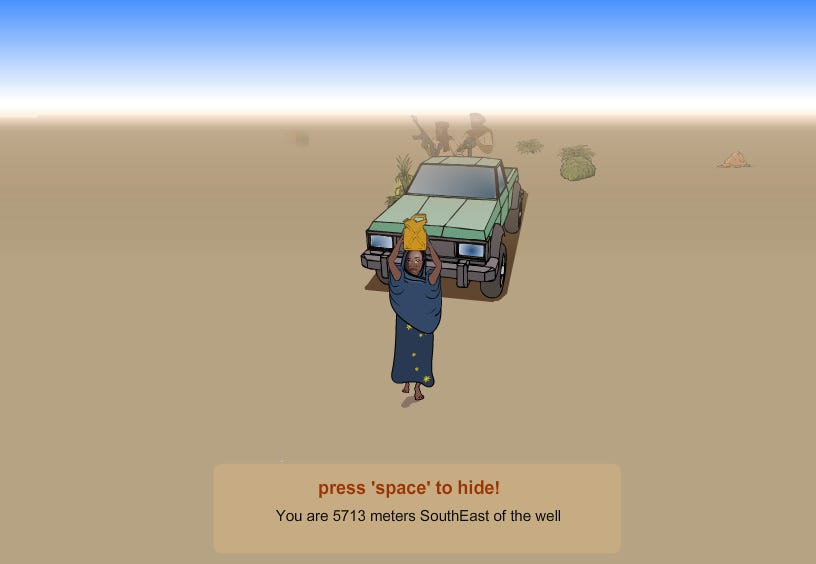
'Darfur is Dying' Screenshot water

Foraging for water means reaching the well before the milita reach you.

Eurogamer: What prompted you to make this game and what was the creative process?

Susana Ruiz: As part of my graduate studies at the Division of Interactive Media in the University of Southern California's School of Cinema-Television, I was already focused on the notion of bridging the form of digital gaming with content of sobriety, weight and urgency. I originally wanted to create a game based on the Gacaca post-genocide trials in Rwanda. But then I heard about the Darfur Digital Activist competition and it seemed an opportunity too good to pass up.

To produce a game concept (game design document) and a representative prototype, the student team took approximately two months. However, half that time was spent reaching out to experts for education and advisement as well as having many brainstorming meetings as a group. It was imperative that the group become as informed and sensitized as possible, even before producing anything, so that the ideas brought to the table would represent the reality accurately and hopefully be insightful.

Eurogamer: Has the game made any difference? If so what? How do you quantify that?

Susana Ruiz: The goal of the game is to raise awareness about the Darfur crisis and to motivate involvement on the issue by affording players basic and uncomplicated ways to become involved. It is indeed difficult to measure the success of a game whose goal is not to turn a profit but rather seeks to incite societal change. According to mtvU's traffic numbers, more than 800,000 people have played the game over 1.7 million times since its launch on April 30th. Of those, tens of thousands have participated in the activist tools woven into the gameplay - such as sending emails to friends in their social networks inviting them to play the game and become informed about Darfur, as well as writing letters to President Bush and petitioning their Representatives in Congress to support legislation that aids the people of Darfur.

Eurogamer: Videogames, of all the entertainment mediums, are perhaps the most preoccupied with 'fun'. Do you think there's room for videogames that are uncomfortable and not 'fun' to play - those titles that have the purpose of changing things/make a difference or to provide some social commentary?

Susana Ruiz: The notion of "fun" can be problematic in this context. Too often, I have witnessed the rhetoric of such an argument impede compatibility and progress. I think that media experiences can be engaging while not necessarily fun or even comfortable, as can be the case often with film documentaries, music, graphic novels, and so on.

It has previously been the case that, early on in the evolution of a new mass medium, entertainment was a leading motivator (i.e. cinema, television, etc.). As videogames evolve and mature (along with videogame-makers and players), I do think that there will be more meaningful social commentary inserted into the play - either at the forefront of the experience or in the background. The game industry (from the giant developers/publishers to the small independents) also has to explore funding and business models for such projects that do not necessarily seek high profits yet require substantial production budgets. In this last regard, the field shares similarities with film documentaries - many of which do not reap high economic profits, but do garner critical acclaim and have social import.
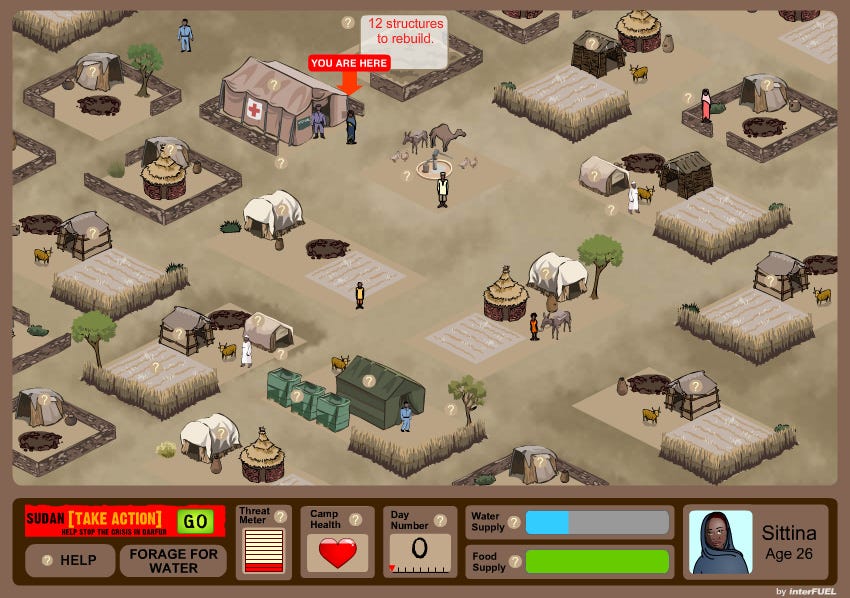
'Darfur is Dying' Screenshot camp

The main camp screen.

Eurogamer: Often uncomfortable films engage viewers but in a film you are simply a spectator - emotionally involved and interacting perhaps - but you don't become the protagonist. There's a distance between your experience and their experience that a videogame cannot provide. In a game you are the suffering party. Does the role-play element of videogames make it harder to engage players?

Susana Ruiz: The unique element of agency that games inherently provide is indeed why it is an incredible challenge to design experiences that deal with real-world injustices and tragedies. The designers must become highly educated, and diverse mindsets and domain expertises must be brought into the production. It seems to me that this is starting to happen within the academic sphere, but is yet seldom the case within the mainstream. This is a unique demand but an essential one if profound and appropriate game representations about important, sobering and uncomfortable issues are going to exist. Agency may present a new and risky challenge but I think that we cannot turn away from exploring whether it can also provide real impact.

Eurogamer: What do you think the videogame medium offers charities that more traditional canvassing and advertising can't? Why for example would 'Darfur is Dying' be a more effective tool in raising awareness than say having an episode of ER set there?

Susana Ruiz: I am not certain that a game would be "a more effective tool" than a TV episode. It is true, however, that each medium and genre appeal to different audiences. "Darfur is Dying" is meant to serve as an entryway into the crisis for an audience that would not necessarily find a New York Times or Washington Post newspaper article on the issue accessible. For this reason, one critical design point was that context should trickle in bit by bit and not overwhelm the player at the outset. Often, this high entry barrier presents a hindrance for videogames.

Furthermore, while it is a challenge to understand and measure the success of a game like "Darfur is Dying", it does contain - embedded in the gameplay itself - ways to take real-world action. This type of player activity can indeed be measured and can be thought to be a direct link between the audience and the cause/issue. I think that this type of interactivity is yet latent with potential to affect real-world awareness and action.

Eurogamer: Some critics of the game have said that it's wrong to make 'entertainment' out of another's suffering. How would you respond to that?

Susana Ruiz: We did not set out to entertain but rather to inform, engage and motivate. Early on in the process, we were inspired and driven by what Pulitzer Prize winner Nicholas Kristof wrote for his New York Times column in a piece detailing pro-Darfur activity in American campuses. He writes of the "way generations of Americans acquiesced in one genocide after another - only to apologize afterward and pledge 'Never Again'. So out of the miasma of horror that is Darfur, something uplifting is taking place. Ordinary Americans are finding creative ways to respond to the slaughter, so that they personally inject meaning into those traditionally hollow words: Never Again."

"Darfur is Dying" aims to offer a faint glimpse of what life is like for the millions of Darfurians that have been displaced by this genocide. Humanitarian aid workers who advised us on the development of the game have said it is hauntingly real, and we hope that feeling leads those who play it to become involved in helping to stop the crisis.

Furthermore, creating gameplay that is engaging, that informs, and that motivates real-world social change is a grand and elusive goal. As a result of creating "Darfur is Dying", we learned first-hand that the process of discerning appropriate representational aesthetics as well as appropriate interactive mechanics and play metaphors is a challenging and sobering endeavour. The student team thinks of "Darfur is Dying" as a work in progress and hopes to continue improving and advancing it.

This genocide can be stopped. Our world has the collective resources to end this suffering, but it takes personal and political will that is lacking. We hope "Darfur is Dying" will continue to motivate more individuals to take action to help end the killing and suffering in Sudan.
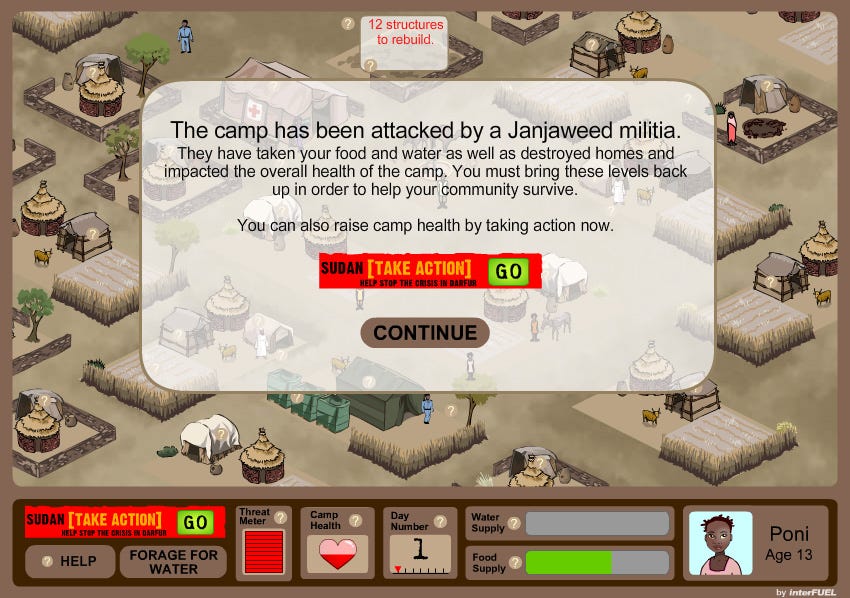
'Darfur is Dying' Screenshot attack

Let your threat level rise too high and the militia will attack.

Eurogamer: Do you think that the money used to make 'Darfur is Dying' was justified and why?

Susana Ruiz: This is a very interesting question. We don't know. It is true that aid organisations such as The International Crisis Group (which worked in partnership with mtvU and The Reebok Human Rights Foundation on this Darfur Digital Activist Contest) are always trying to strategically stretch their resources to achieve the most impact. And while we are certainly not experts on these methods, we do know this crisis has been occurring since 2003 and if music television companies or sports apparel companies want to put forth creative efforts to try to correct some of the injustices in the world, we would not have an ethical qualm. Furthermore, assuming the process is legitimate and genuine, this can actually present a viable funding model for social issue-driven game projects.

Eurogamer: Do you think any negative response to your game has more to do with the stigma of videogames themselves than with the content and ideology behind what you're doing? If so, can that be changed and how?

Susana Ruiz: During our production process, it was critical that we continuously sought out the opinions and advice of scholars and experts on genocide and Darfur - including those that have spent time on the ground in the region. Of course, the idea of a videogame tackling what they have devoted their lives to was initially confounding to some. However, the situation is so desperate that for many of these experts, the notion of trying something unorthodox was in the end, something they not only found intriguing, but something they actively supported.

I think that in time - with more experimentation resulting in more social issue-driven games out there - along with appropriate metrics to measure their effectiveness, it will be accepted as the norm.

Advertisement

Want to comment on this article? Log in, or register!

Comments: 1-22 of 22 in total

Poster
Comment Low-scoring comments hidden. Log in to see them!
bauhaus
04/09/06 @ 09:32
#1
0
You buried this comment
Comment below viewing threshold
Show
Good call
disc
04/09/06 @ 09:40
#2
0
You buried this comment
Comment below viewing threshold
Show
There's a lot of ideas you can hide in the story or even game mechanics of a game without standing there as Big Brother telling the children this is what's right and this is what's wrong in the world.

Every little bit helps.
skillian
04/09/06 @ 09:55
#3
0
You buried this comment
Comment below viewing threshold
Show
Really nice article.

As you mentioned, the most important barrier is the concept of "fun". Is it really possible to make a worthwhile game about weighty social issues fun? Or is it possible to make a game where fun is not the main goal?

To be honest, I'm not yet convinced either of those aims can be acheived at the moment, though as the medium changes I think the second concept may become possible. It's a tough issue really, but important if we want videgames to hold as much social worth as print or film.
disc
04/09/06 @ 10:03
#4
0
You buried this comment
Comment below viewing threshold
Show
Is a game such a Sim City or Sims fun?

The designers there force you do things like supply water and electricity and making sure to use environmentally safe electricity to get a city running.
newt
04/09/06 @ 10:07
#5
0
You buried this comment
Comment below viewing threshold
Show
Some movies are entertaining to watch yet raise serious questions about the world we're living in (Lord Of War, for example). I'm pretty positive games can achieve the same - they already did with Woodruff, I Have No Mouth And I Must Scream, Alpha Centauri, Deus Ex.. stuff like that.
space ace
04/09/06 @ 10:12
#6
0
You buried this comment
Comment below viewing threshold
Show
interesting, but why isn't this an adventure game? ecoquest with more edge!
pantherboy
04/09/06 @ 11:28
#7
0
You buried this comment
Comment below viewing threshold
Show
I've no idea if the game is any good or not, but just people attempting to make games like this may be a sign that the games industry is maturing.

Like the film industry before its not always just enough to be entertained by the marvel of pretty pixels, its time we had more of a mix of games, i've yet to play a game that has been moving or changed my perception on something in the way a good movie or documentry might - thing is I don't even know if its possible with games in the current econimic climate - no way will a publisher give greenlight to a project with such ambitions. and for quality you have to pay most of the time
Edited 1 times, most recently on 04/09/06 @ 12:31
GregorV
04/09/06 @ 12:10
#8
0
You buried this comment
Comment below viewing threshold
Show
ManicMinerUK,

that is precisely the point. It is pointed out in the article that "fun" is not the objective, whereas rewarding gameplay is what defines fun in games and has actually become the only expressive power associated with typical games. You can have gameplay that creates a different sort of an emotional response, which would be frustration and helplessness in this case, and if that can be acheived the project has reached its target. It is projects like this that can help make games evolve beyond their pure entertainment purpose and perhaps attain the more expressive (and artistic) attributes associated with most other media.
BurningR
04/09/06 @ 12:51
#9
0
You buried this comment
Comment below viewing threshold
Show
These sorts of articles, which has something profoundly interesting to say about the medium, is why I love EG
Edited 1 times, most recently on 04/09/06 @ 13:52
3william56
04/09/06 @ 13:56
#10
0
You buried this comment
Comment below viewing threshold
Show
It's good to see attempts like this, even though the success may be debatable. The issue of fun is a toughie, but are films like Hotel Rwanda, United 93, Schindler's List entertainment? Maybe (and they face the same issues as this). Fun? No. Uplifting and educational; certainly. And there's no reason "games" can't follow. It's an early attempt, but no less worthy for it. Certainly beats one more bl**dy WWII shooter.
04/09/06 @ 14:18
#11
0
You buried this comment
Comment below viewing threshold
Show
Nice idea.

…but…

I hope next time they have someone who understands the medium better.

And drop the Flash.
neuroniky
04/09/06 @ 15:24
#12
0
You buried this comment
Comment below viewing threshold
Show
I think newt has got the point here. The videogaming medium can provide very thoughtful experiences, but it has to provide them using its way of creating them. There are a lot of games that can provide a very clever experience that creates a lot of questions unanwered inside yourself (the cited Alpha Centauri and Deus Ex spring to mind, but also Metal Gear Solid 2 (on freedom of information and freedom in general), Silent Hill 2 (which has one of the most painful and deep reflection on euthanasia), System Shock, not to mention many older adventure and rpg games (Fallout anyone?)). But they do that within the context of playing a game, not instead of making you play a game. I don't think a game where you play as a Darfur inhabitant will make you more sensible on the matter, because in the end it's somethingyou would like to play only if you're already sensible towards it. But the aforementioned games... you would play them because they are good games, and intertwined with them you would find a lot of material for you to think about. That's making good use of the media.

edit: +1 ManicMinerUk
Edited 1 times, most recently on 04/09/06 @ 16:26
Martin
04/09/06 @ 15:48
#13
0
You buried this comment
Comment below viewing threshold
Show
I'm with GregorV on this one; this does not have to be fun to be worthwhile.

Remove the label "game" from the experience -- does it still have to be fun or is engaging and eye-opening enough for it to succeed?

To us the label "game" does imply a level of fun and enjoyment but that's just a matter of time until that can/will change -- just as it did with movies.

There are numerous documentaries that is neither fun nor uplifting that I still love just because they are engaging and educational.

And what if you can make small a difference, not only in the game (let's stick with that label for now), but perhaps in the real world, isn't that enough reason to play this?

Is there no curiousity to see what a darfurian goes through, to see life through their eyes? Even if it's uncomfortable?

I would say that it's that exact feeling of discomfort is what the designers are looking for in order to get you to act against the genocide.

It's up to you to decide if you're ready to accept that and go through this experience knowing that the ending is not one of happiness and sunshine but one of insight and knowledge.
Lacero
04/09/06 @ 19:34
#14
0
You buried this comment
Comment below viewing threshold
Show
I would've welcomed the chance to see life through a darfurian's eyes, what I got from this game was a simplistic run and hide mini game, with the twist of not being able to see where I was going on the way back, then I was thrown into something that looked like some kind of sim city.

Except after spending about 20 seconds reading some of the "?" stories I was told we were out of water and I had to play the water mini game again, and that people were coming to attack us and they'd destroy things unless I spammed my friends with a link to the game. As what I'd seen so far was tedious, not uncomfortable or provoking, tedious, I was in no mood to send my friends a link and I didn't see that I was going to learn anything by playing a silly water game non stop with a few seconds between to wander around a seemingly static picture of a camp.

Sorry but I love serious games, and I really wanted to like this, but it's just not that good at what it's trying to do. I certainly didn't learn anything.
I can put up with it not being fun if I'm at least seeing something new or learning something, while reading the "?" stories I felt like I was beginning to get something out of it, but then the water shortage popped up and the Janjaweed attacked and I quit.

If the hopelessness of getting anything from the game was it's way of reflecting the hopelessness of darfur I think it's underselling what serious games are capable of by a long way.
Edited 1 times, most recently on 04/09/06 @ 20:36
Bezzy
04/09/06 @ 21:55
#15
0
You buried this comment
Comment below viewing threshold
Show
I wonder... if the question was not "should all games be fun" but "should all games be engaging", would this thread turn out differently?

I can definately imagine that while it might not be "fun" in the lollercoaster sense of the word, this game could be engaging. Perhaps you try a tactic, and it doesn't work, and yeah, that's a pity. But it's not like lots of "fun" games don't have the same property of trying a tactic, then failing, then learning from your mistakes. And it's not like a game HAS to have a victory condition for it to be "fun", either - Tetris is mentioned in the first paragraph, and that could go on for ever and ever and still be enjoyable.

In the same way, this game with no victory, with guaranteed doom. is like any "survive as long as you can" games. It just happens to have a very serious theme. But it's still possible for the same possibility exploring joy to be present as any other game.

So. It's the same, then. The same as anything else.

It's just the "F" word that fucks everything up, and gets people defensive... like they're scared the academics are going to come in and steal their toys. Fuck that. They're just trying to make new forms of engagement. Fuck anyone who stands in their way.
Lowrin
04/09/06 @ 22:02
#16
0
You buried this comment
Comment below viewing threshold
Show
An interesting article. I don't wish to belittle what developers working in this vein are trying to accomplish (it's a noble effort), but it strikes me that creating 'ethical' games, or games that constitute some form of social commentary, appears to absolve you of having ratings or criticism levelled at your work... Where's the review rating? Or does creating games with a moral conscience automatically qualify you for a 10/10.

Brutal? Perhaps a little. But Hotel Rwanda was a masterfully directed movie and never mind the bollocks, while epitomising youth dissatisfaction in the UK at the time, was well produced...
Daikon
05/09/06 @ 03:56
#17
0
You buried this comment
Comment below viewing threshold
Show
Sportshoe activism, eh?
Just curious, any idea what the total production budget is?
ProtoformX
05/09/06 @ 08:33
#18
0
You buried this comment
Comment below viewing threshold
Show
This article is generated a completely different kind of posting as well. Here we have posts discussing the very nature of gaming and what should be considered a game. It makes refreshingly different reading to "ZOMG!!! TeH WiI iZ tEh PwNaGe!!!!1111" I will raise my hand and say that I like to endulge in a bit of that every now and then but this is different.
I think the reason Darfur iIs Dying has been called a game is there isn't really another term that discribes it that well. Like Pluto - it wasn't really big enough to be a planet when it was discovered but they had no other words available at the time so that's what it was called.
I can imagine some people actually finding this fun. The challenge of raising a camp of Sudanese and trying to give them a paceful existance, fetching water, etc and not being noticed by local militias would appeal to fans of the Sim City genre looking for a different take on the aspect. This will never be big. It seems to be big these days a game has to have fantastic graphics and a helluva load of fighting - almost the opposite of this game. But I'm sure this will find it's place somewhere.
kangarootoo
05/09/06 @ 11:38
#19
0
You buried this comment
Comment below viewing threshold
Show
It strikes me that discussing the value of "fun" shows how the definition of the word varies from person to person. I have commented in the past that for me "fun" is the number one aim of a game and everything else is there to serve that.

Now in my little world, my definition of fun is probably more akin to "engaging" or "entertaining" (as Bezzy suggests). But entertianing is also a word that can be interpreted in several ways.

I suppose what I am saying is that both "fun" and "entertainment" don't necessarily have to have a good feeling attached to them. I can watch a film, find it wholly miserable, but very moving and at the end I would say I had been entertained. I enjoyed watching the film, so I could suggest the experience was "fun", even if it might seem absurd to describe something like Hotel Rwanda (to carry opn the example) as fun.

It might even be said that "fun" is the absence of frustration. So if a control system is frustrating, its not fun. If a plot line is poorly written, its not fun. If the gameplay is confusing, its not fun. In that sense a game like this can be described as fun if it engages the player and doesn't frustrate their progress.

Ramble, ramble, etc.
kangarootoo
05/09/06 @ 11:40
#20
0
You buried this comment
Comment below viewing threshold
Show
As an addition,

http://dictionary.reference.com/search?q...

It seems that my more general definition of "fun" isn't really correct, as all the dictionary references relate to joviality, mirth, ridicule and so on (as in "funny").

Maybe I'll start using "enjoyable" as an alternative :)
newt
05/09/06 @ 14:09
#21
0
You buried this comment
Comment below viewing threshold
Show
I suppose what I am saying is that both "fun" and "entertainment" don't necessarily have to have a good feeling attached to them.

Exactly. I remember being genuinely scared in System Shock 2. Cornered by a cyborg assassin, whom I've seen for the first time, was it fun? Hell, no. Was it entertaining? Hell, yes!

Games need to be entertaining and rewarding, but simple "fun" isn't the only way to entertain and reward the player, no siree.
Martin
05/09/06 @ 16:10
#22
0
You buried this comment
Comment below viewing threshold
Show
I should point out that I'm talking from a purely hypothetical position as I haven't played Darfur is Dying. As a dabbling game designer (then again, who isn't?;) I find this discussion quite invigorating so I hope you don't mind me ventilating my thoughts.

Can you -- like Newt just did -- mention situations in a game where you enjoyed yourself without having fun?

Comments: 1-22 of 22 in total

Want to comment on this article? Log in, or register!

Metaboli

X View gallery