Hellgate: London • Page 3

Capital idea.

The once-thriving metropolis of London lies broken and devastated. Ash falls like grimy snow, drifting from the rolling smoke clouds that rise from fires that still smoulder around the city's great monuments. The terrified remnants of humanity huddle in the relative safety of the Underground, only venturing out to the streets in times of dire need, while above ground an ancient and terrible evil has taken grip of what was once the capital of an empire.

We know what you're thinking - and the answer is yes, this is a description of what's going to happen if the Tories get their clown-shoed demon in buffoon's clothing into City Hall in the next election. Mark our words. Conveniently, though, it's also the hugely atmospheric and evocative setting for Hellgate: London - a game whose value as a comedy allegory for London's mayoral election is only slightly diminished by the fact that we doubt its Californian developers could pick Boris Johnson out of a line-up of orang-utans. Never mind, eh?

There aren't very many games that we'd describe as arriving "laden with expectation", but Hellgate certainly fits the profile. Whereas many games are the overburdened of hype, a substance manufactured largely by the efforts of marketing and PR wizards, Hellgate comes with a helping of genuine expectation - a sentiment arising from the sense that the planets really ought to have aligned to make this game great.

It is, after all, the natural successor to Blizzard's Diablo series, arguably the most highly regarded action RPGs ever created. Separated from the Blizzard mothership and out on their own, the team behind Hellgate is promising a true update not only of the game, but of the genre as a whole.

1

So, London you say? Now you mention it, I think I can see my house from here.

What we're looking at, in theory, is a game which takes the Diablo formula and updates it with everything that's happened since Diablo - gorgeous graphics, superb online play, and countless minor advances in storytelling, user interface and the likes. Besides which, there's that premise. London burns in demonic flames, and only the combined technology and magic of the legendary Knights Templar can reclaim the city, striking from bases in Tube stations into the very depths of Hell itself. It's a geek-fantasy concept so cool that it can't walk down the street without being mistaken for Steve McQueen.

Always touch in

Unfortunately for the structure of this review, we've rather given the game away in the preceding paragraph. In theory, yes, this is a game which updates Diablo with modern sensibilities. We should now be listing all of Hellgate's failings in that regard, with a raised Roger Moore style eyebrow and a cheeky "ahh, but!" tone.

This presents a problem, because Hellgate really does what it sets out to do extremely well. The game picks up the action-RPG play of Diablo and its ilk and converts it superbly into a more modern experience - losing none of the charm or depth of the original titles along the way, and applying a modern coat of paint and some 3D polish with a deft hand.

The biggest change to the formula is that Hellgate is firmly a 3D game; in fact, the default view for characters is first-person perspective, which pulls out to a behind-the-head third-person view when you have a melee weapon equipped. Fight with a gun or other ranged weapon, and the viewpoint stays in first-person, looking for all the world like a genuine first-person shooter.

2

Ever wondered why they have to shut the Tube for five hours every night? Demons, that's why. Bloody demons.

It's not, though - nor is it an action game when in third-person mode. There is no requirement for the kind of quick reactions and targeting skills that action games expect from their players. In fact, despite the fact that it resembles an action game visually, Hellgate is very solidly within the RPG genre. It has simply replaced pointing and clicking in 2D with targeting and clicking in 3D; the way you see monsters has changed but the way you fight them, fundamentally, remains the same.

The move to 3D, in other words, has affected the game less than you'd expect - but that doesn't change the fact that it makes everything in Hellgate more immediate, more visceral and more exciting than the team's previous RPGs could manage. It's not an action game, but it feels like one when it really counts; your shots, slashes and spells may just be pretty animations over the top of standard RPG mathematics, but clever use of animation and physics means that you can still slice zombies in half, or send vile lizard-like hell creatures flying with a well-placed rocket.

Unusually for a modern game - but altogether normally for a successor to the ARPGs of the nineties - Hellgate uses randomly generated levels, which change every time you play. We weren't entirely sold on this feature at the outset, to be perfectly honest, and we remain somewhat agnostic. Sure, it means that every player has a different experience of the game - but doesn't half the fun of a game lie in shared experiences?

Perhaps more importantly, it breaks the whole "London" subtitle of the game to have well-known areas of the city which are randomly generated rather than being modelled on reality. In Hellgate's defence, key landmarks are properly modelled rather than being left to chance - although for some reason most of them seem to be vastly smaller than in real life. One of the first you'll encounter is the British Museum, whose in-game model could be tucked neatly into a quiet corner of the real museum's Great Court.

We can certainly understand the argument for randomly generated levels in some of the game's online modes, since they provide (in theory) a wider range of experiences for players. However, when playing through the standard game, either single-player or online with friends, the random generation adds nothing - and takes away much.

It's sometimes embarrassingly obvious that you're playing a level designed by a random algorithm, not a talented human designer. More than once we've played through levels hunting for a number of objectives, only to discover that the map generator has plonked one of them down in the middle of the map, and then bunched the remaining two or three together right next to one another at the end of the map.

Mind the gap

3

Enforcement of the smoking ban is serious business in 2038.

Besides the simple fact that no map generation program is ever going to be as good as a human designer, the random maps introduce some other problems too. Hellgate's map generator has come on a long way since old randomly generated maps, which were very blatantly made up of repeating tiles. For the first few hours, in fact, you might not even notice that environments are repeating themselves more than you might like - but by the time you've opened up a few tube station bases (which serve as hub levels for a handful of dungeons), it will start to grate a bit.

That same room layout, that same pair of tunnels, repeated over and over in slightly different configurations... We don't doubt that Underground tunnels really are quite monotonous, but there's no need to inflict that on us in a videogame. It's bad enough having to go through them in packed train carriages, frankly.

Hellgate's redeeming features do earn it a good measure of forgiveness for the disappointing random maps. The game's six classes offer a huge amount of variety, for a start, and there are some rather unique types in there - such as the Engineer, who crafts mechanical minions and wields guns. Even the more familiar classes have certain interesting twists on their play style. The Guardian seems like a fairly standard tank at the outset, but an interesting mechanism actually allows him to boost his powers when surrounded by foes, which changes the rules of engagement rather significantly.

4

We know this game was made by Americans because... Well, because we've met them, but also because they're under the impression that we have red phone boxes every four and a half feet in London.

Each of the six classes is genuinely fun to play, which is rare enough in RPGs. Most players will probably settle on their preferred archetype pretty quickly, of course, but it's definitely good to see a game where you can roll just about any class, and be fairly confident that you won't be coming back to restart in disgust a few hours later.

The game's handling of loot and equipment is something of a mixed set of blessings. We were rather taken with the ability to apply multiple bonuses to your gear by sticking things like batteries, ammo clips and fuel pods into the available sockets on weapons - a concept which was pioneered in Diablo, but which is taken to a new level by Hellgate. Helpfully, the game also allows you to tear bonuses off your weapons at special machines in large tube stations, so you don't find yourself stuck in the awkward situation of having permanently applied a fantastic bonus to your sword, only to find a better sword in the next room.

Sadly, Hellgate's recognition of issues like that which frustrate and annoy players is far from universal. The game's inventory is a completely frustrating, backwards affair, which has clearly been designed with an eye firmly on 1992 and a blind refusal to read anything that's been written on user interface design in the interim. Yes, boys and girls, it's the return of the ever-popular mini-game, "sort the inventory to make space for new items by shuffling old ones around".

You'll end up doing this at least once every ten minutes or so in Hellgate, and it's just as much fun as it has always been - in other words, about as much fun as poking yourself in the eye with a red chilli. In a game which makes much of having an option to colour-coordinate your armour, so it doesn't look like you mixed and matched it, the lack of an automatic function to sort out your damned inventory feels fundamentally ridiculous.

Love on the Northern Line

Throughout Hellgate's development, much has been made of the game's online functionality - to the extent that we have a sneaky suspicion that many people actually believe the game to be an MMORPG. This simply isn't true, we might add; first and foremost, in theory at least, it's a single-player action RPG.

However, it does certainly have a strong online component - and yes, there is an optional subscription fee which fully opens up the online experience. Even without paying any fees, though, you can still play online with other people. The fees unlock more MMORPG-style features such as the ability to participate in Guilds, and will be rewarded down the line with oodles of new content - or so the developers claim.
5

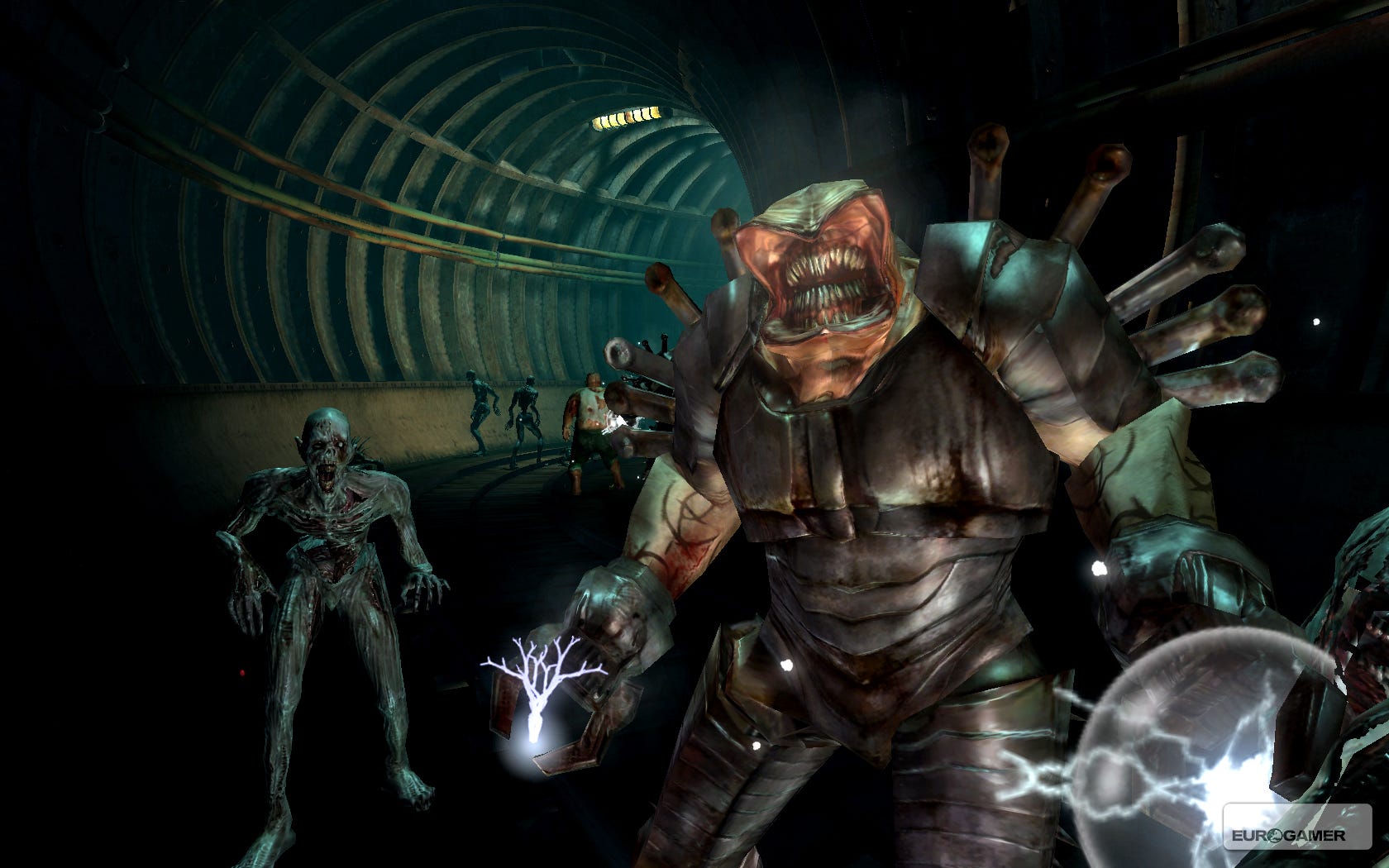
Enemy designs tend towards the 'lots of very big teeth' school of nightmares - or at least, they do once you get over the blatant Freudian symbolism.

To be perfectly honest, at this point in time we're completely unconvinced by the idea of paying money for a monthly subscription to Hellgate. The free online features will probably be more than enough for the vast majority of players, and while we'd love to see the paid service evolving into something more worthwhile, right now we're not really clear on the value being offered here.

In multiplayer, Hellgate is definitely a good experience, and there are hours of fun to be had here with like-minded types. The game's tendency to be a fairly intense button-basher does, however, mean that most multiplayer experiences will be more about the camaraderie and extra firepower than about any kind of tactics or strategy. Multiplayer works in a manner not dissimilar to Phantasy Star Online, with safe areas where players can meet up, before venturing into instanced dungeons to take on creatures and quests.

One major caveat, though, is that if you're going to play online, you need to do so from the outset. Hellgate doesn't allow you to bring your offline, single-player characters into the online environment - not even to play with your friends. We understand the security concerns, to some extent, but it's still likely to be a frustrating discovery for many players (it certainly was for us).

The other glaring problem revealed by the online modes - but present in single-player as well - is that Hellgate isn't the most stable piece of software in the world. Although we only saw a couple of actual crashes in our play sessions (at least one of which can probably be blamed on a suspect ATI driver), we did experience gigantic problems with slow-down, which got progressively worse as we played the game for longer before eventually necessitating a restart.
6

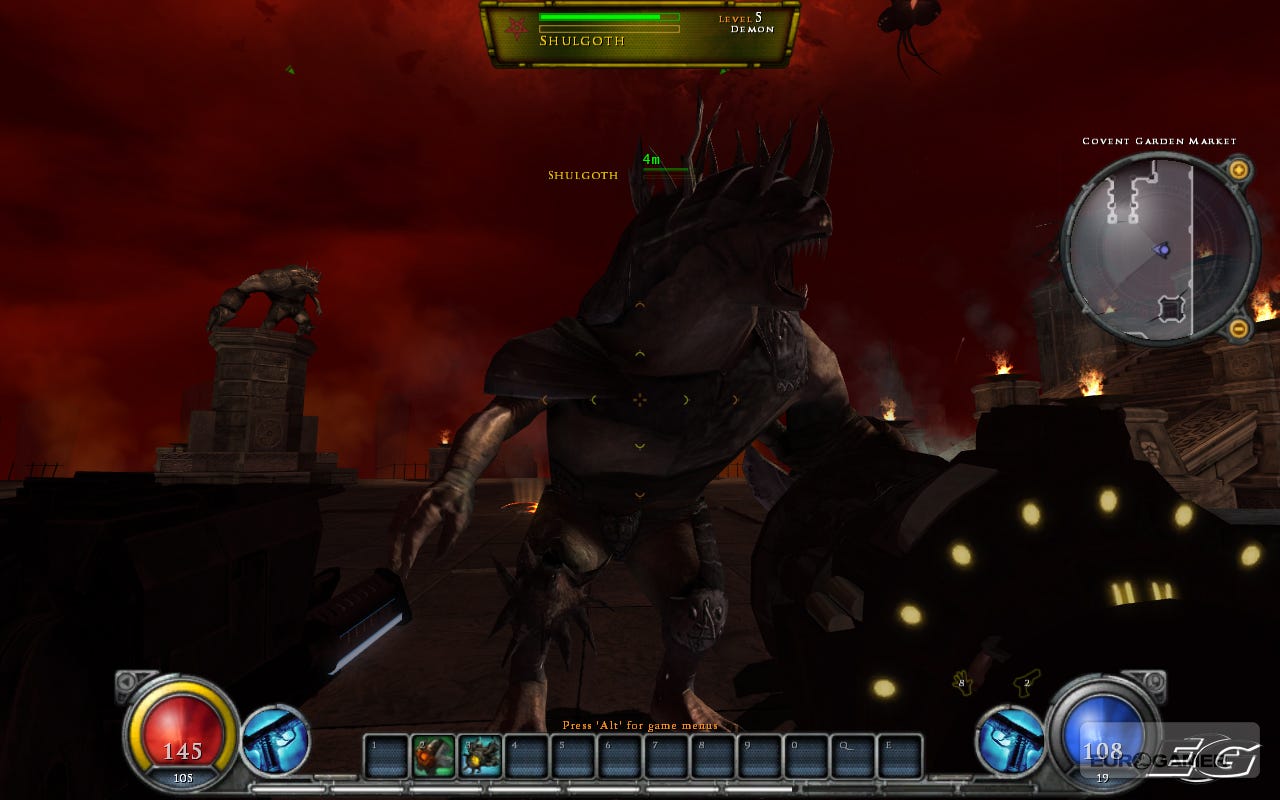
Every now and then, you'll actually have to go to hell for some plot reason. Disconcertingly, Hell is rather neat, tidy and pleasant compared to London. Northerners, you may make your obvious jokes now.

Pressing the attack button in a busy area could drop us down to getting one frame every couple of seconds for half a minute or more at times. We sincerely hope that this gets fixed with a patch, but it's tough to review a game on the basis of bugs that may or may not be fixed down the line - just as it's tough to assess a subscription online service that may or may not justify its existence down the line.

Hellgate: London is filled with gorgeous artwork and dripping with atmosphere; it's got a delicious sense of humour and finely tuned combat systems that will be keeping action RPG nuts happy for a long time. Despite this, we've got vast reservations about key aspects of the game; the randomly generated levels feel increasingly hollow, pointless and gimmicky as you progress, the user interface is clunky in some important areas, and there are clearly some hefty bugs here that need patching.

Our reservations are balanced out against the obvious talent and effort that has been ploughed into the game - and the simple fact that every time we put Hellgate down, either during its extended beta period or while reviewing it, we were itching to get back to it within hours. It's compulsive, it's good fun and it's certainly addictive; perhaps as the online service evolves, it'll even be worth coming back to for a further evaluation. For now, though, this is a game too deeply flawed to deserve the masterpiece status we'd all hoped for.

7 / 10

Read the Eurogamer.net scoring policy

Comments (57)

Comments for this article are now closed, but please feel free to continue chatting on the forum!

  • Loading...hold tight!