Half-Minute Hero Review

30 seconds of fame.

Version tested: PSP

Half-Minute Hero is a two-fingered salute to anyone who's ever complained that the Japanese RPG is too long and tedious to be worth the bother. From the moment your hero leaves his pastoral village to when he lands a death blow upon the world-threatening overlord, the game distills the traditional 60-hour play arc of Japan's interactive fantasy epic into 30-second speed-run concentrate.

It may be a single-note joke - building a frantic dash against the clock in the gaming genre least suited to the task - but it's an excellent joke nonetheless. Moreover, in its self-assured execution and endlessly inventive subversion of cliché, Half-Minute Hero succeeds in becoming a masterful reinvention of that which it parodies, simultaneously celebrating the form while overhauling the function of one of gaming's oldest templates to create something fresh and imaginative.

Like the Reduced Shakespeare Company, Half-Minute Hero appropriates the language and aesthetic of its influence (in this case, the 8-bit JRPG) but trims away the bulk. The result is a conveyor belt of ADHD-friendly bites of play. Entire plotlines are snipped through like shorthand synopses; random battles explode and vanish like double-time fireworks while your character levels up in the blink of a transition screen.

The need for all this hurry is pressing: in 30 seconds' time an evil overlord is set to whisper a spell to end the world. The aim (at least within the core game mode) remains resolute throughout: race from your home village to the overlord's castle and defeat him within this improbable time limit in order to save the world.

While traditional random battles interrupt your progression on the world map, you have no direct control over combat. Instead, your character careers across the battle screen from left to right, bumping heads with enemies until one or the other's health is depleted. Post-battle there's no results screen. Any experience points gained are added to a hidden total and, if you earned enough, level your character up, ensuring the next battle is faster won.
1

Every conversation can be raced through with a touch of the start button, a welcome shortcut for those whose eyes glaze over at protracted cut-scenes.

An unflinching digital countdown timer is constantly stamped on the screen, revealing how many milliseconds are left till global annihilation, adding a near relentless pressure to proceedings. Time pauses only when you enter village safe havens, where you can replenish health, purchase better armour and weaponry or gather clues for how to reach the overlord's castle. Step outside again, and the mere suggestion of sloth is enough to invoke the apocalypse.

To begin with, tactics primarily revolve around balancing levelling on the world map with leaving enough time to get to the castle and defeat the overlord. Misjudge your timings and you either won't be strong enough to defeat the overlord, or you'll run out of time before you can reach him. The game's broken into missions, each one presented as if it's a complete JRPG title. As a result, once you've defeated one overlord, the game's end credits roll (45 seconds after you first booted the game up) and you move on to the next mission, billed as a numbered sequel in the Final Fantasy/Dragon Quest tradition.

As the game progresses, the barriers that stand in your way between village and overlord become more numerous and convoluted. For example, you might need to take a detour into a sacred cave in order to retrieve a Ring of Valour in order to prove your worth to the dwarfish people who, once onside, will grant passage to the castle. As a result, the focus soon tightens upon time management, as you race from clock-stopping village to village, gathering clues and directions before executing your hastily prepared plans within the limit.

Of course, as stages begin to gain complexity, so the 30-second time limit becomes unworkable. Here the game introduces the Time Goddess, a benign deity who is happy to turn back the clock for you for a fee. At most villages in a mission you can pay the Goddess to reset the clock, although the cost of doing so next time dramatically increases on every occasion you do. As your money doesn't carry over from mission to mission, you must manage resources plundered from battling monsters between upgrading equipment and buying back valuable seconds, and striking the perfect balance is the key to high scores.

While the number of game variables is relatively small, the fact they are condensed into such short missions means there's a lean sort of elegance to each, one emphasised by the scoring system that awards ranks for completing missions quickly and efficiently. A numerical code can be entered into the game's website to record you performance on a per mission basis, and thus the unlikely transformation of the JRPG into an arcade-style score attack exercise is complete. There are even meta-challenges to encourage revisiting missions: titles earned, for example, by not using any health items before the final showdown, which encourage you to replay the game using artificial, approach-altering restraints.

The tight, engaging core systems are helped along by a knowing, funny script that balances poking fun at genre staples with more general, universal humour. Each mission's overlord is a parody of a genre staple, given voice and character by a scriptwriter obviously relishing his task ("If the world can't understand snakes then...IT DOESN'T DESERVE TO EXIST," exclaims one slithery overlord, stating his motivation for world destruction).

Tactful, effective use of All Caps emphasis combines with sharp sarcasm to give the writing a snarky, internet-culture savvy tone, which, in the context of its dusty old narrative framework, works extremely well. Likewise, the in-vogue, blown-up 8-bit pixel art is entirely suitable and despite its rudimentary presentation manages to make the game appear both attractive and archaic.

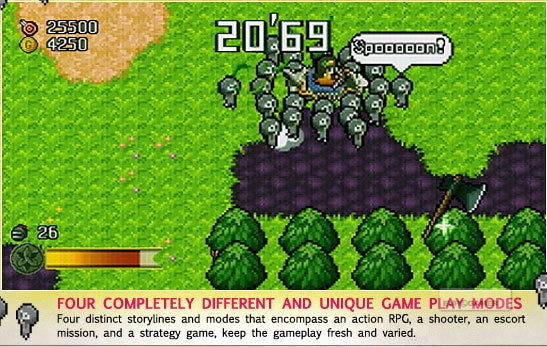
The core JRPG 'Hero 30' mode is bolstered by another three, all of which take a similar time-management approach, but to different genre styles. Princess 30 is a delicious if simple shooter in which your feisty female character is hoisted onto the shoulders of a battalion of soldiers and must use her crossbow to take out enemies as they race her from pillar to post.

There's also Evil Lord 30, which is a basic real-time strategy game, with a slew of rock-paper-scissors-style units that must be deployed to defend an overlord's castle. Finally, Knight 30 is an action mini-game in which you must escort a character through a series of mazes. In each case, the extra modes are simpler than the main attraction, but nevertheless each packs a slew of missions and just as much heart and character into its approach.

2

A sprint button allows you to traverse the World Map at double speed, saving valuable seconds, but at the cost of halving your hit points...

While the initial sense of delight at the amount of content on offer and its immediate freshness and pace will take some time to subside, each mode does grow repetitive as it draws on. The brilliance of the designers' ideas laid down in the groundwork of each mode doesn't quite sustain over the long haul, even if the stories do a good job of drawing you towards completion.

But outside of each mode's core progression, the ideas and variety maintain across the package. Hero 300, a variant which unlocks later in the game, gives you more seconds to play with but removes the rewind feature, and strips you of all armour and money at the start of each mission, forcing yet more thoughtful use of strategy and approach. Finally, the ultimate challenge comes in Hero 3, which gives you just three seconds to save the world, in what must surely be gaming's ultimate speed-run.

It would be wrong to say Half-Minute Hero merely exploits nostalgia. Rather, developer Opus manages to unstop new springs of creativity from the over-farmed 8-bit landscape: clichés are turned into opportunities, and tropes are mined for humour and workable, hybrid systems.

The approach certainly doesn't render its inspiration redundant because, in reality, Half-Minute Hero is essentially an innovative arcade game dressed as a JRPG. Indeed, the similarities between the two are limited to aesthetic, tone and theme: underneath the parody, entirely different systems hum. For that reason, while Half-Minute Hero will be best appreciated by gamers familiar with its surface inspirations, it can nevertheless be savoured by anyone.

8 / 10

Half-Minute Hero is due out for PSP in Europe this February courtesy of Rising Star Games.

Read the Eurogamer.net scoring policy

Comments (78)

Comments for this article are now closed, but please feel free to continue chatting on the forum!

  • Loading...hold tight!