Gravity Crash Review

You get its thrust.

Version tested: PlayStation 3

You wait 23 years for a rehash of the BBC Micro classic Thrust, and two come along at once - both exclusive to PS3 on the PlayStation Network. PixelJunk Shooter, not yet released but the recipient of an 8/10 review last week, is the very model of a modern old-fashioned videogame, splicing the retro concept - pilot tiny spaceship through caves, pick up stranded men - with Metroid-style exploration and puzzling, cutting-edge fluid dynamics, a brace of fresh ideas, a more forgiving structure and a stylised cartoon look.

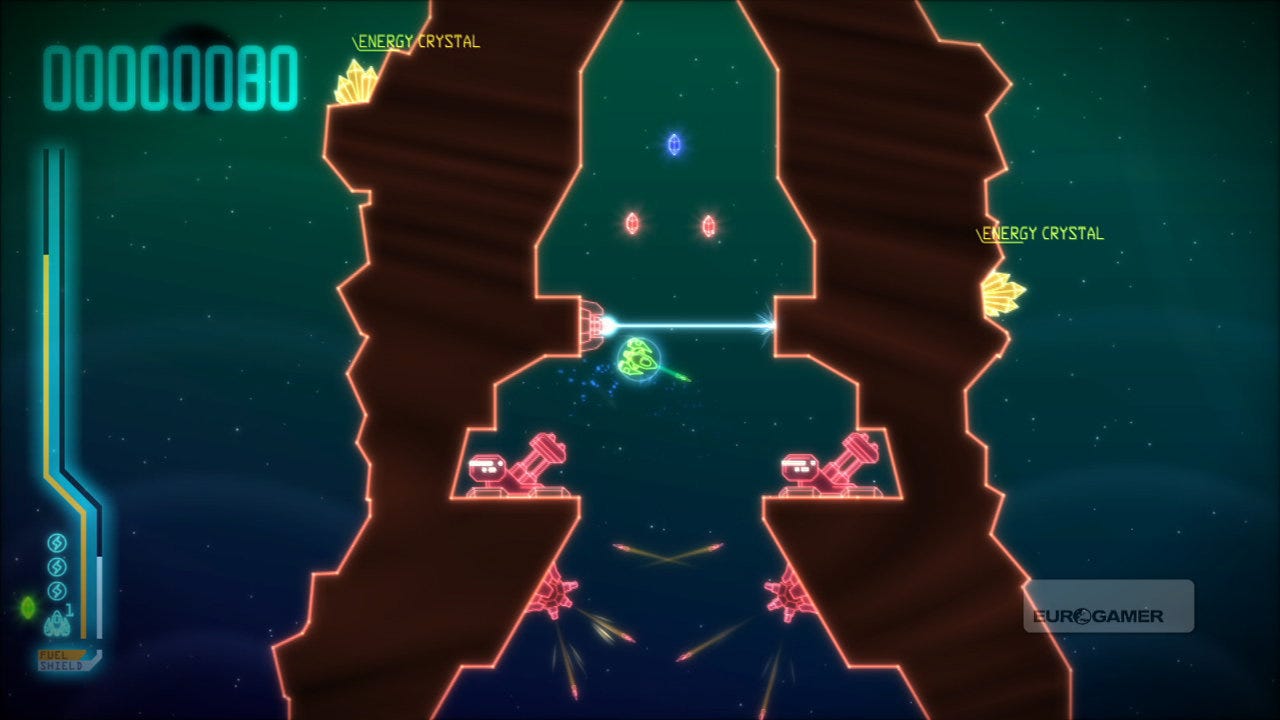
Gravity Crash, available now for £6.29, has a lot more in common with the original Thrust. It has gravity, for one thing, a constant downward tug on your craft that you'll need to combat with thrusters, minding out for your heavy inertia and the walls, which may not destroy you outright but will damage you. It's a test of perseverance and skill rather than ingenuity. Its phosphor-etched vector graphics are less noughties album art, more eighties arcade cab. If Shooter is a hipster with a sense of history, then Gravity Crash is just a bloody-minded throwback.

Gravity Crash makes a strong appeal to nostalgia, then, but in the end that's just about all it has going for it. Developer Just Add Water leans heavily on its by-the-numbers retro style and appropriately stiff difficulty, but fails to invest the game with enough imagination, variation, attention to detail or reward to make it work in a modern context. There isn't even anything as exciting or game-changing as the original Thrust's pendulous pod that you had to drag out of each level on the end of a tractor beam.
1

Whether you'll enjoy the Cold Storage (WipEout) soundtrack depends how much of a nineties rave casualty you are. Sophisticated it isn't.

Instead you're given a shopping list of enemy units - usually ground structures - to destroy and/or coloured gems to collect from each level, and a simple blast and scavenger-hunt ensues. Some levels are linear, but most require you to wander around hunting your targets or performing circuitous unlocks, to take down a shield or open a door, before you can get to them. Most caves are flooded with water at the bottom - in which your ship floats, but your already rather lethargic bullets are slowed to a short-range crawl - and the more interesting level designs feature changing water levels, although the triggers for these seem rather arbitrary.

There's a radar map - small enough not to be much use, large enough to obscure an irritating portion of the screen - but your initial run through a level will involve a lot of toing and froing around the maze seeking out the randomly-scattered objectives. In stark contrast to Shooter's spectacular and stimulating navigation, this is usually a befuddling chore, the maps being sorely lacking in distinguishing features or structured design. They all look the same, too, so it will probably take a few runs before you've memorised a level well enough to bring it in under the "recommended" time and set a decent score.

They're scattered with secondary objectives - crystals, crewmen to pick up by tenderly landing your ship next to them, "nodes" to "activate" - but these lack much in the way of incentive to hunt them out beyond a certain dogged completism. In general, Gravity Crash is a game that's more comfortable with the stick than with the carrot. It's certainly not unfairly punishing, but it's hardly ever gratifying. The shooting is insipid, slow and lacking in impact, a situation not helped by the weak power-ups; you can either earn a short time shooting in multiple directions or an extremely rare and limited use of a "special weapon" (selected from a range of four at the start of the game, and neither effective nor exciting).

Thrust-style games are all about pure ship control, however, and here Gravity Crash doesn't disappoint, offering two vastly different but pretty rewarding set-ups. A twin-stick scheme in the modern idiom - move with the left, shoot in any direction with the right - is highly playable but still provides plenty of challenge when fighting gravity in tight sections. The classic controls - rotate left and right, thrust, and shoot the way your ship is facing - are a stern test, but not an unfair one, although you suspect that some levels' enemy placement wasn't designed with this in mind, so hard can it be to keep your enemies in the firing line and your ship off the rocks at the same time. The two control schemes effectively make for two difficulty levels, almost two different games.

You can also opt for manual or automatic shields, the former having the advantage of recharging over time, but needing quick reactions to avoid constant death. The latter need to be recharged by shooting large crystals and collecting the shards left behind, which also refill the fuel gauge. Balancing exploration against straying too far from where you know crystals, or developing a fuel-efficient flying style, are the sort of old-school mechanics, rarely seen these days, which it's fun to reminded of.

2

One of the few unexpected and interesting touches is underwater currents, effectively a change in the direction of gravity.

That's not so true of the campaign mode's structure, which is soft enough to grant infinite continues with the only penalty being to reset your score to zero, but harsh enough to offer no halfway house - opt out of a continue, and all your progress is wiped clean. The difference between rejecting a continue (back to square one) and simply quitting the game (current progress is saved) isn't intuitive or explained anywhere, leading to inevitable tears before bedtime. Worse, the game's risk-reward balance is thrown out of whack, as there's no real incentive to put in a good performance on your first run - the score will inevitably be wiped clean - whereas trying to run the entire thing in a handful of lives is an extreme endurance test. Better to retreat into Planet mode, where each level unlocked in Campaign can be played and perfected independently.

Gravity Crash is fleshed out with a level editor, which is simple enough to use, and we wouldn't be surprised if the community managed to come up with some more imaginative uses of its limited rules and bits of furniture than Just Add Water has. There are also three awful split-screen multiplayer modes, deathmatch, race and scavenge - all of them hampered by the tight display size, clumsy interactions and afterthought map design.

Although they're more different games that at first appears, Gravity Crash suffers terribly from the comparison with the slick PixelJunk Shooter. They may be trying to do different things, but the charm, ambition, imagination and fine execution of Q-Games' effort - or of something like Geometry Wars - shows how to make retro gaming relevant in a way Gravity Crash can't muster. It's just about worthwhile as a chance to test yourself against some long-forgotten mechanics, but you can't shake the feeling that Just Add Water is just joining the dots.

5 / 10

Read the Eurogamer.net scoring policy

Comments (95)

Comments for this article are now closed, but please feel free to continue chatting on the forum!

  • Loading...hold tight!