Ever since Peter Moore's bicep set the clock running on 10th May 2006, the world has been watching and waiting, and Rockstar has probably been sleeping rather badly - albeit on rather more comfortable sheets than the ones it was soiling in October 2001 when Grand Theft Auto III first went on sale.
Back then, GTA was a good PC game, but 3D updates of 2D games were struggling to get the best out of their source material, so while interest was high, no one anticipated the impact GTA III would have. You could steal cars, do jobs for mob bosses and spend your money on hookers. You could stand on top of a car park and bait the police with a sniper rifle. At a time when everything else was a cartoon or a Capcom fighter, it turned out that this was what everyone wanted: a grown-up, mainstream videogame that made fun of politics, religion, the media and pop culture.
Rockstar knew it had a good game on its hands, but it had what is commonly known as "the fear". With a few carefully managed exceptions, it kept the game away from journalists until the last possible minute. In the end it needn't have worried, although that hasn't stopped it doing the same thing ever since, not least on Grand Theft Auto IV. As well it might, since this is the biggest game in the company's history. The fear is back. In light of the game's much publicised delay, we sat down to consider what we know.
Tequila Slammer
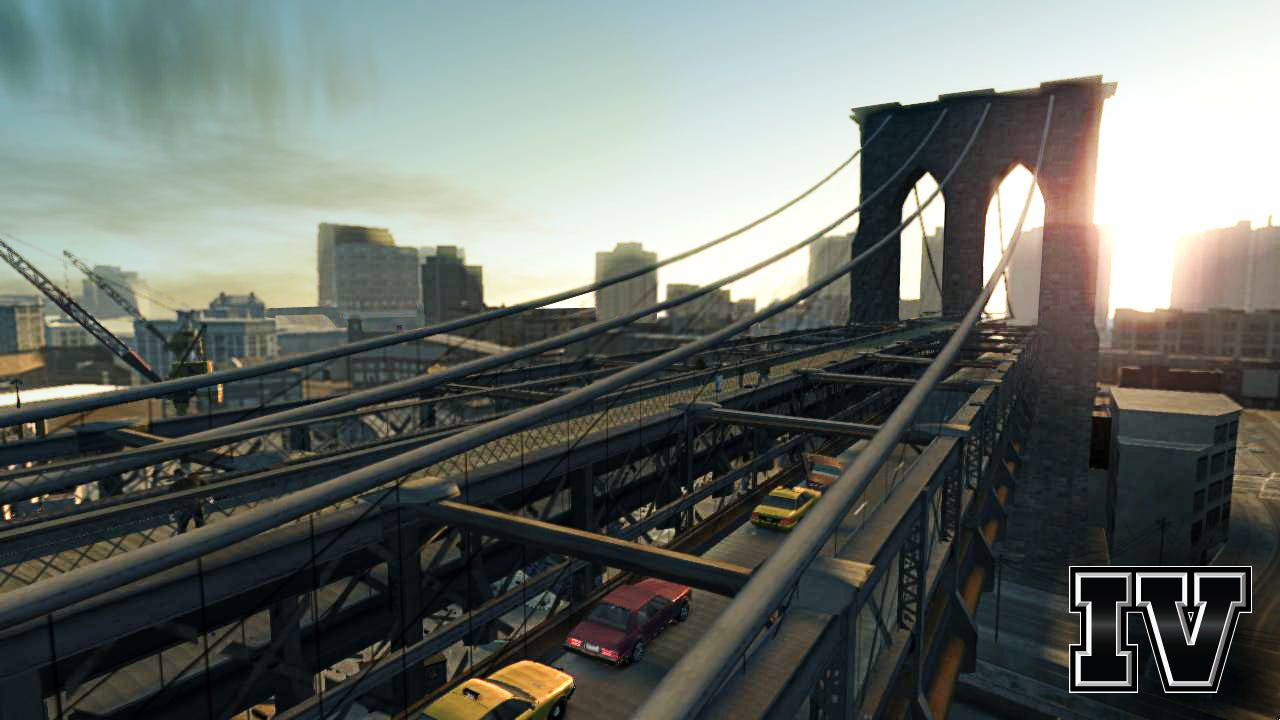
Rockstar says it would be absurd to completely accurately model New York, but it's paying attention to landmarks.
Whereas GTA III, Vice City and San Andreas were rags to riches tales, GTA IV takes a less optimistic view. Player character Niko Bellic is an immigrant enticed to Liberty City by his desperate cousin, Roman, only to discover that the life of money and models in Jacuzzis is further away than ever. Starting out at a desk in a taxi depot, he's tarnished not only by his status but also by association with his cousin, for whom he's forced to work in order to make ends meet. GTA games traditionally begin in squalor, but the road to glory is a relatively comfortable one. Theft and murder are virtually incidental, because nobody remembers, providing your car's changed colour. In GTA IV, Rockstar isn't changing the rules completely, but it's making things more difficult, and describes the endgame not as "riches", but as "slightly better rags".
You can't just press a button to steal a car. The world doesn't allow it. You have to elbow the glass, break in and hot-wire it, all without being spotted. The cops notice; people report what you're doing, and if you're in a cop's line of sight then you're in a cop's line of fire, and he's not leaving his gun in its holster. When you're under police scrutiny, the crime scene forms the centre of a circle of investigation, which grows much wider depending on the nature of the crime. Revisit that area at your peril, because they are looking for you. Pay And Spray is no panacea, either. If you can steal away to a secluded spot, switch cars and play it cool, you might be all right, but that isn't something you're going to be able to do if you've kicked up a huge fuss getting there. This isn't the sort of game where you can stand on top of a car park and expect the cops to loiter on the ground wondering what to do.
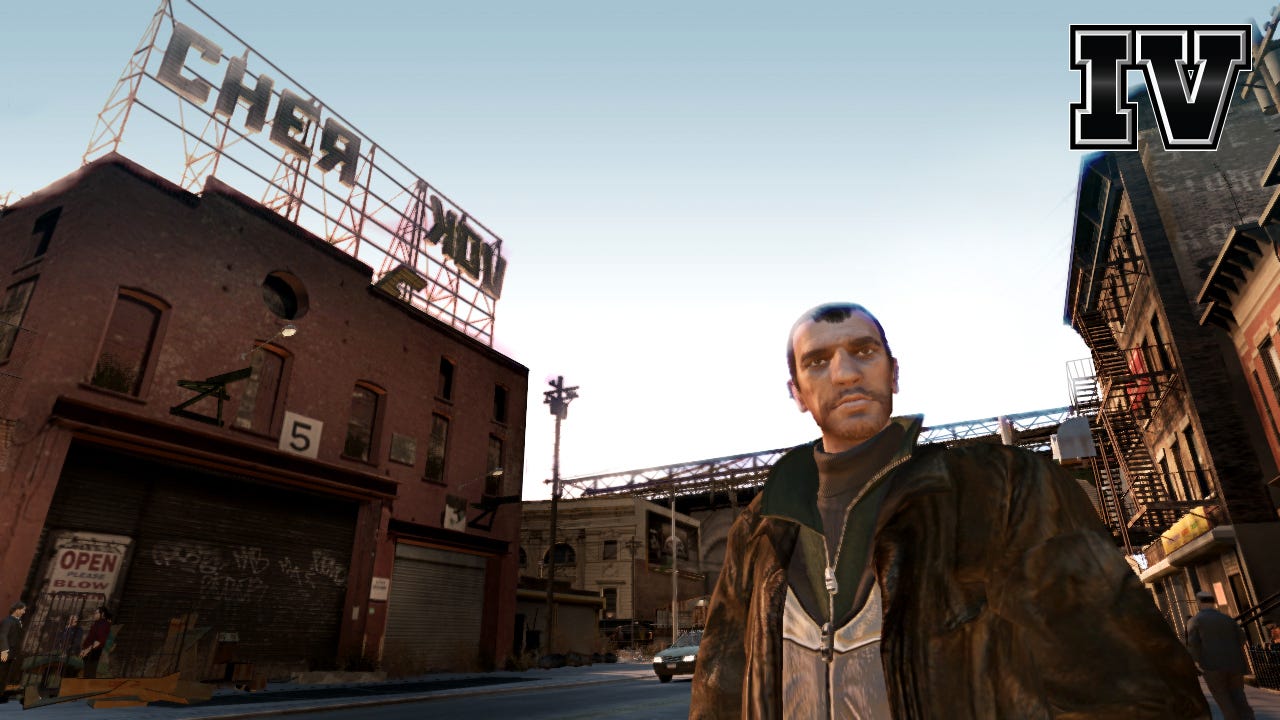
Niko, seen here, isn't in for the same kind of world-dominance afforded to Tommy Vercetti and Carl Johnson.
"Verticality" is a word that pops up in Rockstar's press briefings, but their point is that the world will have greater depth. One example of this is your mobile phone. Previous GTA games involved taking calls and acting on them, but seldom making them (in GTA III, you couldn't even talk). But here your phone isn't just a way of receiving instructions; it's a way of getting into the world, and getting what you want from it. One of your first missions involves seeking out a man in a park. You have his phone number, so in order to find him you stand on top of a hill, dial the number and watch to see who picks up. With the game set in 2007, Niko uses his phone to keep track of contacts, organise meetings and keep track of his life - a neat way of hiding the interface, but also a way of saying that GTA is ready for the new world after years of living in a dream.
The Internet's here too. Rockstar has done mock websites in the past, but this time there are Internet cafés (called "TW@", obviously). The role the virtual world will play isn't clear, but Niko's likely to do more than throw a crim's name into Google now and then.
Bent Cop Blues
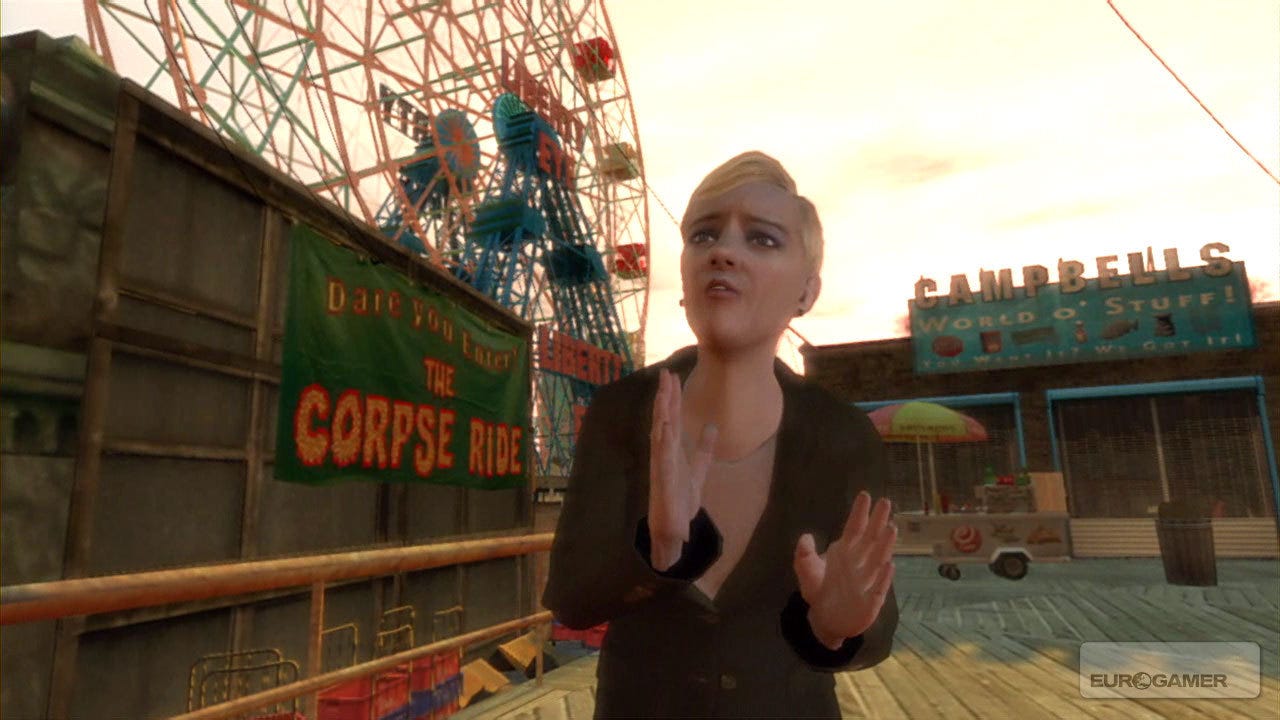
This woman, glimpsed in the second trailer, isn't keen on killing. Wimp.
Liberty City, home to GTA III, has been redesigned under a heavier influence from its original source material, New York. There are five distinct boroughs - Broker (Brooklyn), Algonquin (Manhattan), Dukes (Queens), Brohan (the Bronx) and Alderney (New Jersey, or at least some of it). Staten Island is missing because, the developer says, it doesn't really add anything (apart perhaps from a ferry). The choice of a single city rather than a sprawling state like San Andreas catches the eye, but in a sense it was inevitable: in order to achieve the level of graphical and interactive detail that Rockstar needed to bridge the gap to expectation, the rules had to change.
To get closer to the world, Rockstar is keen to make more of your relationship with it on a small scale, and reduce the clear lines of artifice. Individual streets have more personality - their own names, and landmarks - and the people of Liberty City behave less autonomously, chattering on their phones and reacting to things besides you. You can buy hot dogs and watch them smoke. You can blow up their petrol stations and businesses, even when it has nothing to do with a mission. You can sign yourself up to more than one mission at once, and complete them in stages. NaturalMotion's Euphoria system has been employed, controlling Niko's movement through physics rather than simple rehearsed animations. When he runs, he leans into it as you would in real life; when he barges through a crowd, he has to fight against their weight as you do in Assassin's Creed. There's less absurdity; less going to the gym and wearing a silly mask, and more dressing the part, like donning a suit to convince someone you're there for a job interview, rather than murder.
Niko begins the game working at the behest of a bent cop called McReary, who seems to have information that would cause Niko some bother. Dressing up to fool the people at Goldberg, Ligner & Shyster, a law firm, was McReary's idea, and killing one of their top lawyers was his instruction. Arriving in the lawyer's office, Niko stalks his unsuspecting prey as he's given a sermon, allowed to move freely while he's addressed, before pulling a gun. What follows is the sequence that caused Take-Two's nemesis Jack Thompson such consternation: a line about admiring the principle, and how "guns don't kill people, videogames do", culminating in a bullet that sends the Not-Thompson stumbling backwards, tumbling through a glass window and plummeting to the street below. If you like the sound of that, that word verticality springs up again - you'll be able to throw people off the buildings you scale, before descending the fire escape to beat a path away through the back alleys.
Mandarin Mayhem
When you get caught in a firefight, the rules are different too. Although hand-to-hand combat is still under wraps, ranged weapons are given greater conviction by a cover system similar to Gears of War or Uncharted: Drake's Fortune. Automatic and manual aiming are available, with gunplay handled over-the-shoulder rather than from directly behind, and if your enemies get close you can blind-fire from safety. How you get those guns is also different. Similar to car-jacking, you're no longer given the luxury of sauntering into an Ammunation and waltzing off with a carbine. Now you make a call, and Little Jacob turns up with a boot full of weapons. Presumably the arsenal develops over the course of the game, but in early instances you can pick from a 9mm, a sub-machine gun and a micro sub-machine gun.
On the surface of it, it's change for a greater sense of realism's sake. With travel tougher, you'll also find yourself hailing cabs, wherein you can relax and watch the city crawl past the windows, skip the journey to your destination, or double the fare to go twice as fast. Jacking cars is still possible, but under the scrutiny of mobile-phone-equipped bystanders with fingers itchy for 911, and police who investigate what you do rather than waiting to catch sight of you, or coming in waves, the difficulty of remaining at large - and realising the American dream Roman outlined for you - ought not to be understated. When you do get behind the wheel, as is your wont, the most noticeable difference will be the viewpoint - offset slightly to the left to give things a driver-side bias - while a new "vehicle physics package", in Rockstar's term, will add depth to a driving experience that is likely to borrow from more recent Hollywood riffs than Bullitt.
As seen in trailer number two, windscreens are quickly pocked with bullet holes.
And this, for now is what Rockstar is telling us. The absence most keenly felt in the above is the previous games' sense of humour. Those satirical elements are certainly not absent, Rockstar says, but will have to find a new context. TW@ probably isn't the end of it. Nose around the real net and you'll also find your way to WKTT Talk Radio, where you're invited to call a real US phone number and rant about your health, the world, America and anything else that catches your attention. Rockstar saves these recordings and may use them in the game. With Lazlow Jones (favourite host of the original in-game talk radio) inevitably connected with the project, as reported by IMDB, and the same IMDB cast-list listing Joan Baker as a "Vice City TV Reporter", it seems the game's relationship with the media and the media's relationship with the public will once again come under the scrutiny of a writing team headed by Rockstar co-founder Dan Houser.
Heist Almighty
Hanging onto choppers is possible, as well as the backs of lorries.
Beyond that, much is still hearsay. Journalists who have seen the game in action have been quizzed by fan-sites, revealing all sorts of tangential ancillary information: you can go on dates; you can fly helicopters, and possibly in other ways, but there are no planes; you can't build up a property empire the way you could in Vice City and San Andreas; it takes about an hour to cross the city; Hollywood talent is likely to be ignored in favour of less established talent; the soundtrack will reach beyond 2007 for its influence, and beyond the back catalogues of the MP3-hating RIAA for musical content; some characters will return, but others won't ("virtually none", in the words of Dan Houser, "as a lot of them are dead anyway"); multiplayer will be included, possibly for up to 16 players, but not persistently, and away from the single-player. Rockstar echoed some of this, and hasn't denied any of it, but has called some of it "rumour and speculation".
Speculation has been fuelled too by the two trailers Rockstar has officially released. The second plants the idea that Niko isn't just in America for the sake of a better life, but that he's looking for someone, and has been for some time. The first trailer - shot in a style that many observers have likened to 1982 documentary Koyaanisqatsi, not least because it shares the Philip Glass music that backed it - talked about Niko's past. Or rather he did. "I killed people, smuggled people, sold people. Perhaps here, things will be different."
Hand to hand combat details are still to be announced, but Niko's clearly up for it.
They already are in some senses. GTA III stands next to films like The Matrix in having captured the spirit of its time so completely and significantly, and has been copied relentlessly ever since. Developers like Volition, responsible for Xbox 360's Saint's Row, justified their reproductions by identifying Rockstar's work as a genre unto itself. But this time, Rockstar can't create a genre; it can only reinvent it. To do so, on the evidence so far, it intends to explore and re-consider the underlying conditions upon which its success was built. And so, to some extent, is has come full circle: up against an audience that watches its progress with interest, but with scepticism borne of familiarity and preconception. To overcome that, it will have to do what GTA III did all over again. Little wonder, then, that it's handling the publicity drive with such delicacy and paranoia.
Grand Theft Auto IV is currently set for release between February and the end of April. For more, check out the first and second trailers on Eurogamer TV. A third is expected pre-release. Post-release, Rockstar has pledged to release two downloadable sequences for the Xbox 360 version, reportedly worth USD 50 million to Microsoft, adding "hours" of gameplay.
