Grand Theft Auto: Chinatown Wars
Scores on the wars.


If you thought Grand Theft Auto on the DS was unlikely, how about GTA on the DS ported to PSP? Already home to two of its own GTA games, which are also the two most popular games on the system, Sony's handheld could be forgiven for thinking it was above these top-down action-adventures, especially imports from the land of Nintendogs. Where are the fancy 3D graphics? Surely the PSP deserves better?
Well, first thing - no, judging by Sony's current hardware strategy, the PSP does not deserve better. But look on the bright side - the original Grand Theft Auto: Chinatown Wars was much better than anyone expected. "GTA as it first was, with the inherited wisdom of GTA as it's been since, finished off with all sorts of things that would happily belong in a GTA of the future," according to whichever idiot reviewed the DS version.
Chinatown Wars was - and remains for PSP - a more frivolous take on the Liberty City laid out in Grand Theft Auto IV. Protagonist Huang Lee, son of a murdered playboy, returns to the States to deliver an ancient sword to his uncle, but the sword is stolen, so Lee ends up doing missions for various wannabe Triad bosses. Forget the grim and grimy soliloquising of Niko Bellic, everyone here needs their heads examined, from the psychopathic Zhou Ming, who cuts out hearts and then boasts about the size of his manhood, to transsexual prostitute-loving Chan Jaoming, son of the current boss. It's very crass but keeps you smirking.
It's also an approach that better fits the mostly top-down gameplay, which sees tiny pixel-men running around firing weapons and racing Micro Machines, and makes more sense in the context of the game's tempting array of missions and distractions, which include arcade-style high-score shoot-'em-up rampages, lining up perfect jumps from ramp to billboard, and a cockeyed take on the world of drug-dealing that's all about wacky one-liners, back-alleys and car chases and not so much with the people lying in gutters with needles hanging out of their veins.
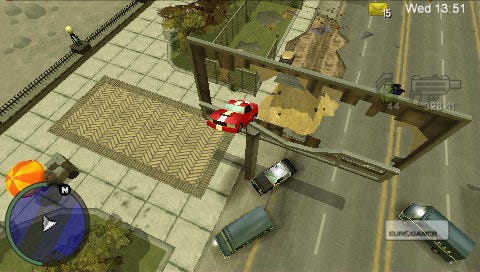
The drug-dealing is a fundamental change to the GTA economy, but fits in well. The idea is to buy low and sell high in various districts throughout Liberty City's two main islands, based on tip-offs received via emails to your PDAs. It's possible to build up a huge stock of funds buying cheap drugs and then sitting on them until the right tip-off arrives, and in some respects the dealing can be a little game-breaking, but it's always satisfying, interferes with the general mission flow in a compelling way, and can be hair-raising when you're trying to fend off the police after you've just spent thousands on the goods in your backseat, which are confiscated should you get busted.
The main missions themselves are generally good, too, and even people who have played every GTA since the first top-down PC game will be surprised the direction some of them take. For the PSP version, Rockstar Leeds has introduced a few more, some of which focus on gung-ho journalist Melanie (a sardonic, blonde narcissist - the journalist trademark), who's trying to film a documentary about the drug trade with a series-typical lack of sense. The missions fit in without feeling obtrusive, make good use of a crane at one point, and even take you indoors, which works well enough despite a few camera issues.