Global Agenda

The MMO that isn't.

You can't launch a rocket in a first-person shooter these days without clipping an MMO influence - whether it's Call of Duty 4's world-conquering perks and persistent stats, the elaborate intra-team relationships within Team Fortress 2, or Battlefield Heroes' reliance on microtransactions - but developers heading in the other direction are fewer and further between.

Hi-Rez Studios, with its mixed background in shooters, strategy games and MMOs, is an exception. In fact, on the surface of it Global Agenda resembles an MMO with its feet merely dangling in an action pond. You level up your character by grinding player-versus-environment missions for resources that can be crafted into stat-boosting implants, and combat delivers experience points that go toward improved skills, all of which benefits your Agency (guild) in a hex-based metagame that sees you fighting for territory in "seasons" of gameplay that last just over a month. It floats along on Unreal Engine 3, leaving Tribes-shaped ripples in its wake, but it's treading water on the shoulders of goblins and will charge a monthly subscription.

Except a brief hands-on at Penny Arcade Expo last month suggests it's a lot closer to games like Team Fortress 2 when it comes to player-versus-player combat. Thrown into a "ticket game", where two teams of eight compete for ownership of three control points, it's very much a team-based shooter, albeit a third-person one rather than first.

I get to play as an Assault class, equipped with a rocket launcher, a shotgun and an axe. Controls are FPS staples, apart from a few number-key stabs to employ rechargeables - an EMP grenade and a pair of shields for blocking area-of-effect and other attacks for a few seconds each. Every class has a wicked jetpack, too, easily controlled with a jump and a bit of mouse-button mashing, which allows players to take advantage of the maps' impressive verticality.
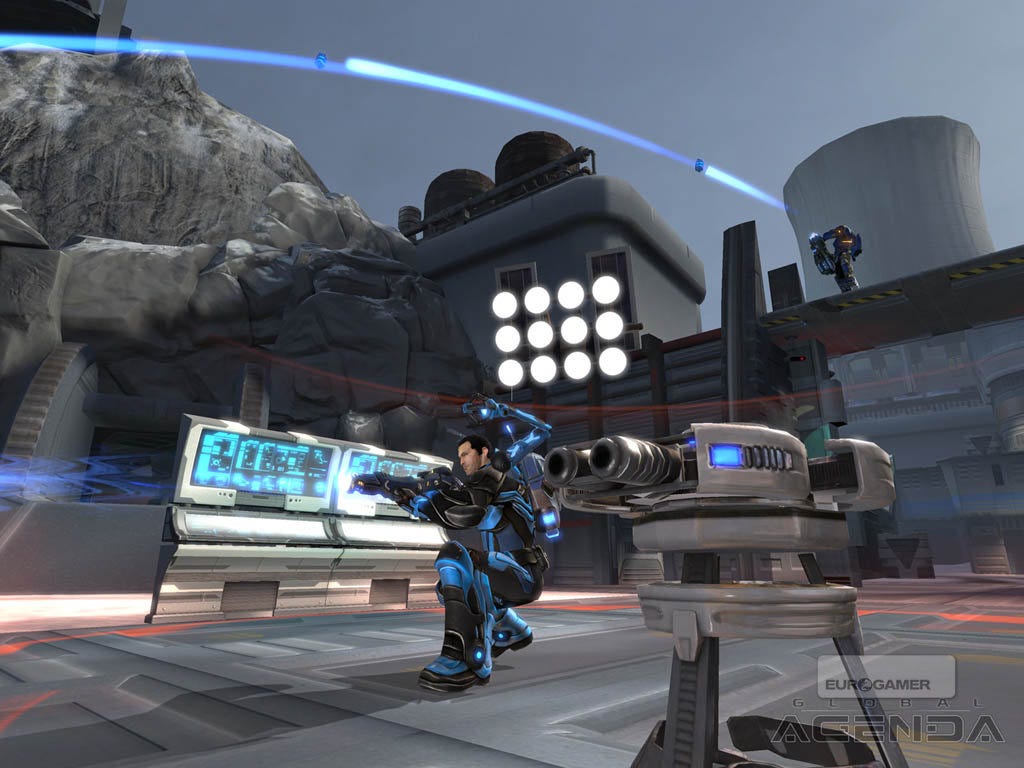
'Global Agenda' Screenshot 1

The Robotics class can lay down turrets and other obstacles.

There are four classes in all - the others are Recon (stealth), Medic (healing, wouldn't you know) and Robotics (engineer) - and the nature of the interplay is comparable to TF2. The Assault class works well either as a Tank or a Destroyer, stomping around doing lots of area-of-effect damage to people defending control points, and had I not been thrown in at the deep end while simultaneously trying to interview game designer Andy Harmon, I'm told I would have been striking up good relationships with a nearby Medic, whose speciality is a healing gun, or perhaps Recon players, whose stealth speciality allows them to infiltrate objectives while my bruising Assault character draws the enemy's attention.

"There's an interplay of rock-paper-scissors to it," says Harmon, sporting an impressive moustache, "but it's not class-based, because sometimes we've done some so that just as often as there's a counter to another class, there's a counter within your class - so a Robotics can be one of the most effective Robotics-killers, and Assault Tank and Assault Destroyer face off against each other very well."

The Assault class' speciality today is a rocket launcher, but there will be other weapon options, and you can reconsider your loadout in respawn areas. Frankly, I wish I'd chosen a different class, but it's a bit late now. I'm interested in the Robotics' setting up spawn points for their team inside control areas, or up on balconies where they can attack from above, drawing jetpacking defenders away to deal with the problem. As it is, I do reasonably well once I start reaching for shields while under attack and get a grip on the melee system, which allows you to attack with one mouse button and block with the other - absorbing a small amount of damage but also deflecting some of it back if you can time it well enough.

Besides the ticket maps there are also maps where one side attacks objectives and the other defends. Some ask you simply to overrun a particular position and then move onto the next, while others involve playing escort. There's also a Capture the Robot mode where each team tries to transport a mech to safety to score.

The hex-based metagame sees your Agency competing for territory by going into battles in these modes, attempting to win and then defend any grabbed land in combat. Harmon points out that it can be dangerous to spread your teams too thin because competing Agencies may be more sensible about consolidating territory rather than constantly striking out for the next futuristic beachhead.

The PvE element will be ongoing, too, allowing you to raid NPC faction The Commonwealth for further resources that goes towards crafting weaponry and so forth, and there's talk of 60-person raids later on. Although I don't get to sample the PvE scenarios at PAX, reports from the closed beta suggest that they're more than simply PvP designs with bots - the enemy can also deploy even more specialised opposition and single-purpose cannon fodder designed to disrupt your attacks. All in all, it sounds a bit more elaborate than collecting five wolf pelts or mashing up Bambi in the woods to pay for a potion and a new pointy hat.

In other words, it's an MMO-shaped game but it's up to its neck in shooters, and to that end Harmon tells me you're not bound to play with your Agency alone. If you fancy playing with friends in another Agency, you can always team up and play matches for experience and credits. Although I don't get to see any of it, Harmon also speaks of a big old friends list and built-in voice communications for hooking up.

'Global Agenda' Screenshot 2

This is my rifle. There are many like it, but I'm shooting you in the face with this one.

Level design looks very different to your Halos and Calls of Duty, clearly influenced by the jetpack's presence. Harmon says the team sought to "emphasise mobility and the Z-axis fighting, but we didn't want it to get too crazy". The map I play seems to take place on a base elevated into the clouds with huge drop-offs to worry about in its well-routed outdoor locations, and warrens of passageways around each objective, allowing less robust classes to do their work protecting and infiltrating through tighter confines.

Visually there's a lot of clean lines carved through gunmetal bases and harsh mountainous terrain, but the characters are the draw: bright and colourful, swathed in swanky exoskeletons that wear green piping like ribs with dashes of insect about their armour and extrusions, depending on the class anyway and, presumably, the players' flamboyance.

Global Agenda is currently in closed beta, with a couple of thousand people feeding war and bug stories back to the developer, but an open beta isn't far away according to Harmon. Anyone heading to the Eurogamer Expo in late October can play it there too. My advice would be to do so; not unlike APB, it's a game that sounds like an MMO but stretches the definition considerably, and in considered fashion.

Global Agenda is currently in closed beta. You can sign up for access to future betas on the game's website.

Comments (5) Latest comment 2 years ago

Comments threads automatically close after 30 days, but please feel free to continue chatting on the forum!

  • telboy007 #1 2 years ago

    Looks a bit section 8-ey!
  • Eraysor #2 2 years ago

    Looks like Section 8 with MMO bits tacked on and without the awesome burn-in mechanic.
  • Grom #3 2 years ago

    Or like Section 8 it looks like Tribes?

    I miss you, Tribes.
  • Kentlad #4 2 years ago

    All the videos I have seen just say Unreal tournament to me.

    Throw in a bit of persistent stats and you have a MMO, not sure how this game will justify a monthly fee.

    Very little info coming out regarding PVE other than they look like PVP instances with bots. Will give this a whirl at the expo to find out more though.

  • Lachsgeruch #5 2 years ago

    I don't get, why none of these developers took the Planetside-approach. That's the first - and only - thing which comes to my mind, when I read "fps-mmo"... Everything else is just CS/UT/whatevershooter + a tidbit of statistics no-one really cares about.