"I believe that it is alright to create a stupid and irresponsible game, I really do."
That's my favourite quote of 2009. It comes from the second interview I did with Keita Takahashi, the endearingly loopy creator of Katamari Damacy, about his odd little PS3 download game, Noby Noby Boy. In fact, Takahashi uttered all my favourite quotes of 2009 (some more of those later), and Noby Noby Boy furnished my single favourite gaming experience of the year too, despite barely being a game at all.
But those aren't the reasons this morsel of dadaist interactive anarchy is my favourite game of the year. Above all, I love Noby Noby Boy for what it stands for. I love it for standing for anything at all. This stupid and irresponsible game, and the wilfully stupid and irresponsible man behind it, secretly had a deadly serious point to make about what videogames are and where they are going - and the contrast with what the rest of the industry got up to in 2009 could not have been sharper.
Back in February, I sat in a cavernous, empty conference room on a business park somewhere on the outskirts of Paris, and played Noby Noby Boy for several hours for our review. I was completely entranced.
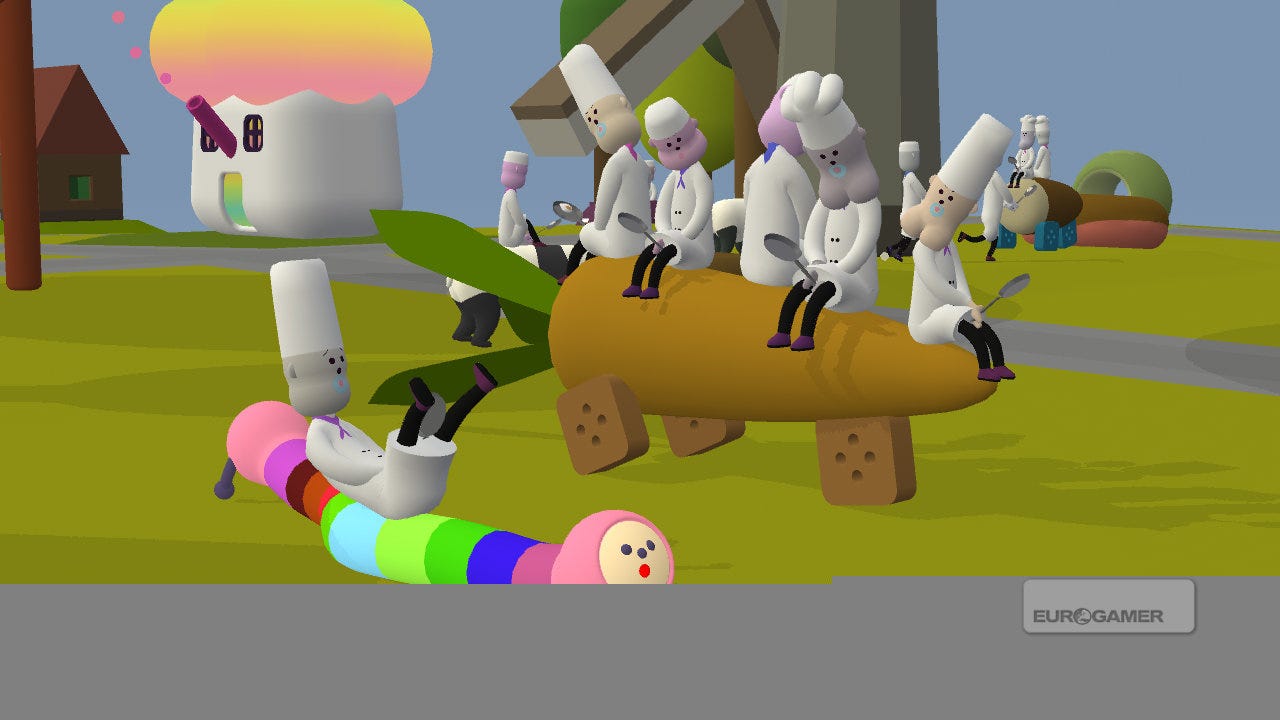
I often wonder whether my relationship with Noby Noby Boy would have been different if I hadn't been reviewing it, or even if I'd been reviewing it at home, in less abstracted surroundings, with more distractions around me. I know a lot of people who downloaded it, played it for five minutes and then gave up, failing to see the point. I don't blame them - because Noby Noby Boy has no point.
Or rather, it has no goal. It sets you no challenges, at least not directly, and offers no obstacles for you to overcome. It just gives you a plaything - BOY, a silly little quadruped with two independently mobile ends and a floppy snake of a body that can stretch to infinite length - and a playground, in the form of randomly-generated plots of land dotted with strange animals, people, machines and structures. That's it. As far as having fun is concerned, you're on your own.
It's disconcerting. As grown-up gamers, we're very used to throwing the term "sandbox" around, but we're not used to being confronted with one. We need targets. We need challenges. We need a job to do. We've forgotten what it's like to sit down with a toy and make up our own games and our own stories, even though it's something we all did as children and a vital part of what makes us human. We're so bound up in playing games that we've forgotten how to just play.
Keita Takahashi wanted to remind us. He'd been depressed by the formulaic objectives in the otherwise free-spirited Katamari, he told the audience in his memorable Game Developers Conference session in March. "Of course there are games that absorb these things and result in something wonderful," he said. "But I wanted to throw these off and start from scratch with what games should be." There are many who would debate that this is what games should be, or at least the definition of the word game as he uses it, and they'd have a point - but if nothing else, his willingness to fly in the face of all received wisdom about game design was thrilling.
And, on me at least, it worked. On that day in February, with nothing to do for hours but fool around with Takahashi's ridiculous digital noodle, I remembered - slowly, but with a deepening joy - how to play. I explored the possibilities of the deceptively deep range of interactions, of the wild, skittering inertia of the controls.
I set my own goals: lasso a cloud down to earth, drape BOY between skyscrapers like a washing line. And the game rewarded me, with trophies, surprises, random happenings, hilarious slapstick and an endless supply of new maps littered with new toys. By the end of the day I was in a completely different frame of mind, and had rediscovered a simple, inquisitive pleasure in interaction that, as a gamer - especially one who does it for a living - it's all too easy to forget in the race to the next achievement.
Noby Noby Boy was the only game I played in 2009 that changed the way I thought.
Naturally, it flopped. No-one got it. A few more people might have got it if the camera hadn't been a hideous exercise in finger-twisting motion-control masochism, but not many. It was too strange, too formless, too childlike. Takahashi's bosses at Namco Bandai complained about the design and asked him to give the player goals or it wouldn't sell, and they were right. "I was told something like 'make it look more like a game', 'make it easier to understand', 'make it more accessible' I think," Takahashi said in our first interview. "I just tried not to care about what I was being told. To be honest, I don't really remember."
Does that make him a hero, or just stupid and irresponsible? Well, probably both, but it makes him a hero to me, and not just because his absurd game gave me an epiphany in a conference room on the outskirts of Paris. Noby Noby Boy rejects all expectations, norms and commercial reason. It doesn't care about what will sell or about patting its players on the head. The only things Takahashi cared about were making the game he wanted himself, and challenging our assumptions about what games are and what they can do. Nobody else could tell him what his game was supposed to be.
Videogaming is a young medium, but it's getting old before its years. In 2009, it's been deeply conservative. There were many excellent releases, but how many of them surprised us, or changed how we felt about games? Where was the Ico, the Deus Ex, the Super Mario 64? With New Super Mario Bros. Wii and Zelda: Spirit Tracks, Nintendo had to turn the clock back a quarter of a century to regain its creative health. Uncharted 2 and Batman: Arkham Asylum are perfect paragons of structure and presentation, of streamlined gratification, of reducing the number of button-presses between us and what we expect. I loved playing these games, of course I did; they gave me a job to do and made me feel good doing it. They were supremely easy to consume.
But you can't consume Noby Noby Boy. You can't complete it. It offers you no validation or sense of accomplishment. This was the game that dared to wonder why I wanted to be told what to do in order to have fun; the game that dared to ask me what I felt like doing myself; the game that dared to ask me what I thought a game was, rather than telling me what it thought I wanted to hear.
You don't have to like Noby Noby Boy. You don't have to understand it. You're allowed to think it's stupid and broken because, well, it kind of is. But you do have to listen to what Keita Takahashi is saying with it, a message he very eloquently delivered to his fellow game creators at GDC.
"If we love videogames, we have to feel more, and observe more, and enjoy more while we create games. There is no completion in games, they are always developing, but despite that we say that there is a certain way that games have to be.
"Perhaps we are hiding behind these rules, and relying on past experiences. Perhaps we have to ignore the players and our companies. Maybe we should just try creating a game that we like."
Check out the Editor's blog to find out more about our Games of 2009.
