Version tested: PSP
Disenfranchised: no word better describes Final Fantasy VII's once-upon-a-time lovers. Where fans of the seminal RPG would once announce their devotion to the game with boldness, nowadays - outside of the dew-eyed cosplayers and fanfic writers - few would be so ready to admit this is a world and clutch of characters they once adored.
The reasons for this are myriad and complex but almost all relate to the fact that people and culture move on. Where once players were bowled over by Final Fantasy VII's record-breaking stats (3.28 million sales in Japan, 2.92m in North America and 1.77mi in Europe; two years' development time, 100+ team members; three PlayStation discs stuffed with 330 CG maps and 40 minutes of full-motion video to create the largest JRPG ever conceived) today these headlines are neither unique nor necessarily positive.
Where once the game's anime sensibilities seemed exotic and wonderful, in a post-Matrix world where black trench-coats, big swords and vacant-eyed sci-fi philosophy are utterly mainstream, now they seem over-familiar and unexciting. Cloud's solid poise and outlandish getup is no longer the cutting-edge of Japanese cool. The iconic CG still of antagonist Sephiroth striding off into the flames might have once made our hearts flutter, but now it only makes us blush a bit that we were so enamored by such obvious clich.
But more than all of that, 9 million of us were fourteen, sixteen, eighteen-years-old when Final Fantasy VII exploded the sci-fi RPG into 3D Technicolor: everything was new and unbelievable, everything was changing and this game was the gateway to that future. And deeper than the showy aesthetics, these characters put pixels to the themes of identity and purpose many of us were struggling with at the time, while the fan culture provided a much-needed place to belong.
Now we're nearing our thirties and while these memories are dear, they also seem a little childish. This feeling has only been exacerbated by Square Enix's recent forays back onto Final Fantasy VII's hallowed ground via straight-to-UMD CGI movie Advent Children and the ill-advised J-FPS, Dirge of Cerberus. The shallow nature of these products served as a stark reminder that while we had grown up with this universe, this universe hadn't grown up with us. So Final Fantasy VII holds a place in our hearts as something we did when we were younger, something magical and transformative and important but something to be remembered and not interminably revisited. We are Final Fantasy VII fans: disenfranchised are we.
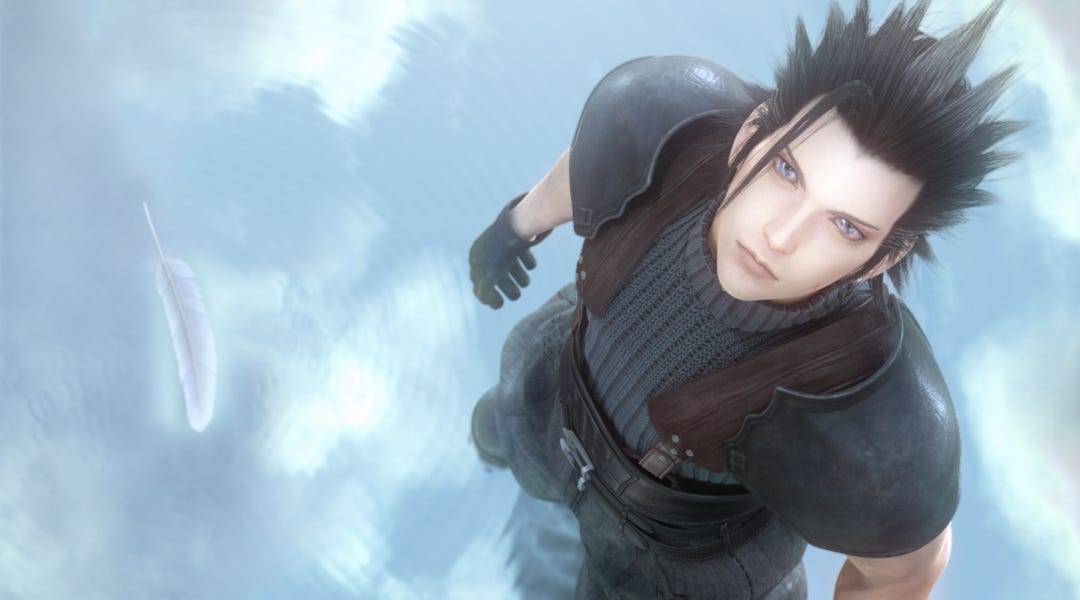
Knitwear and pauldrons - tricky combination to pull off.
Crisis Core then, the final product in the 'Compilation of Final Fantasy VII' arrives on PSP with a strange kind of expectation upon its shoulders. For publisher Square Enix its job is to re-awaken disillusioned fans to this world, to exploit nostalgia, to fill out the back-story to the original game, attract newcomers and gloss over the mediocrity of its most recent follow-ups. For the fans who still play videogames and who still care enough to follow these things, it's probably the company's last chance to prove there's still value in elaborating the story and developing the mechanics.
It's clear right from the start-up sequence that with Crisis Core, Square Enix has made nostalgia top priority. Menu sound effects are copied and pasted from the PlayStation original, snatches of old melodies tug the ear before fluttering off into new places. The rich and recognisable iconography calls forth deep memories providing the overt fan satisfaction that's been mostly missing from the other spin-offs. As with the original, the game opens aboard a train that's racing towards the heart of the steam-punk city Midgar. It draws up to the station and lead protagonist Zack bounds onto the platform, step for step like Cloud. This fan service doesn't put a foot wrong until he reaches into his pocket, pulls out a mobile phone and speaks.
It's easy to forget but Cloud was an unvoiced protagonist. Throughout Final Fantasy VII his reactions and attitudes were conveyed by way of simple gestures and the reactions of others. This choice, as with Chrono Trigger, allowed players to cast themselves in the lead role, the game's protagonist a blank canvas onto which all players from all nations with all accents could superimpose them. Crisis Core, by contrast, is voiced by a boisterous, over-enthusiastic American boy and kapow there snaps the suspension of disbelief, dropping with it a hundred thousand players who don't look or sound alike. In time, the chirpy American drawl ceases to irritate and Zack's voice actor does a good job of showing his character's maturing and developing over the 15-hour storyline, but it's still an initial shock.
The game acts as a prequel to the events of the original, leading up to the fateful events at Nibelheim (which were shown by way of flashbacks in the original game). This allows Crisis Core to revel in back-story. You'll hear how Sephiroth first fell out with Genesis and how Aerith was called to sell flowers in Midgar; you'll witness the time that Zack bought the pink ribbon that would never leave her hair and, of course, see the final (excellent) scenes of this sub-drama from a new and enlightening perspective. This fan service is in no way subtle or elegant but it does enrich the game significantly to the mythology's true believers.
As a result this is not a game for newcomers - at least, not for newcomers who want to get to grips with the story. 'Soldier', 'Avalanche', 'Seed', 'Jenova', 'Mako', 'Turks': the list of ill-explained terminology isn't so much off-putting as impenetrable to the uninitiated and the iconography that the game so successfully trades in will be meaningless to beginners.
Zack is a dark-haired version of Cloud (literally: Cloud adopts his persona later on), an elite Soldier working for the energy-sapping multinational company Shinra. Throughout the game he works alone so there is none of the team management seen in most RPGs. Indeed, while Crisis Core is built upon the RPG basics of exploring areas, hunting for treasure chests, fighting randomly attacking monsters, managing inventory and leveling up, the actual execution of these mechanics is fresh and interesting, pulling the game into new territory outside the genre's confine.
Unequivocal proof of the eyelash-length to evilness ratio.
Principle amongst its innovations is the battle system which acts as a kind of RPG system sped up. During fights you have free movement control of Zack and you can block and dodge with the face buttons as in an action game. Conversely, attacks and magic must be executed up from a horizontal menu at the bottom of the screen. As such you'll find yourself running around the battle screen, feverishly inputting attacks via the overlaid menu while trying to weave past enemy attacks. Certainly on the default difficulty it's possible to simply button-mash through battles, lining up various attacks with deft but unthinking use of the buttons. After the first play through and at higher difficulty, though, the game grows far more tactical and you'll need to make use of the 'defend' and 'roll' manoeuvres if you're to be successful - although few will pursue the game this far in.
The moves at your disposal are directly tied to the 'materia' you own, crystals that must be equipped if you're to take advantage of their power. Materia can be combined to create different types and you can equip and increasing number of them as your rank within the Shinra organisation increases. The vast array of different materias on offer allows you to customise Zack in almost any direction you choose and, as he can equip so many different moves, you feel more individually powerful and flexible than any single RPG protagonist before.
Overlaid on the core battle system is the Digital Mind Wave (DMW) system, a kind of fruit-machine ticker that constantly reels in the top left of the screen. You have no control over the DMW. When three faces match on the reels (a bit like matching three cherries on a fruit machine) a short cut-scenes triggers and Zack will execute a more powerful special move or summon based on which character portraits matched. These (skippable) mini-cut-scenes are very impressive, echoing the exuberance of the original's summon and limit break animations.
As well as character portraits, each reel also displays a number. Match two numbers and you'll level up one of your equipped materia. Match three numbers and you'll level up Zack - the only way to increase his core stats. It's a brave move that, initially at least, is quite off-putting. While the chances of matching three numbers and leveling up Zack increase as you play via a hidden exp system, even the illusion of random game design is a misstep leading players to believe their progress is in the hands of fate rather than their own.
That said, after a few hours you settle into a traditional play arc, Zack levelling and augmenting his abilities with pleasing regularity. The missions you carry out as you drive the story along are short and sweet and, while the lack of a map system irks, environments are so small, bland and funnelled that it doesn't take long to find your destination or target through chance.
To bolster the game's breadth, at any save point you can take on additional freelance missions. These bite-sized assignments usually task you with defeating a powerful boss or finding a particular piece of treasure. There are scores of them, each one taking from two to ten minutes to complete - perfect for mobile play. While the main game is short, if you choose to tackle this extra curricular content the game's depths offer much ground to mine and discover.
Smooch.
It's a game that's left us torn. On the one hand, the youngster in us finds his heart warm when the familiar music starts up, when running errands in the Midgar slums with Aerith in tow or while watching Genesis, Angeal and Sephiroth engage in a filmic fight atop one of the huge gun emplacements. Indeed the game is at its absolute best when it's performing raw fan service. But, peel back the Final Fantasy VII clothing and what lies beneath is, after prolonged scrutiny and, despite the meticulous presentation, tiresome.
While there are successes in the battle system, were this a game with any other branding it would be soon forgotten. The impenetrable story makes it a no-go for younger gamers who might be more willing to forgive its adolescent excesses. But for the twenty-six, twenty-eight, thirty-year-olds who it's aimed at, the game has little to offer beyond polished sentimentality. In six months' time Crisis Core will be remembered not for being a classic that changed the landscape, demographic and influences of videogames the world over like its forebear once did. Rather, it will be remembered for being a well-produced PSP curio, the best Final Fantasy VII spin-off for certain, but the best of a rotten bunch. Anyone who tells you otherwise is fooling themselves. And while there are those who want to be fooled - who need to be fooled to keep the dream alive - the rest of us would be better off burying these heroes if we're to treasure them.
7 / 10
