Final Fantasy Fables: Chocobo's Dungeon Review

Chick-like.

Version tested: Wii

Roguelikes are not games for children. The randomly-generated dungeon-crawler, first conceived when videogames were written in DOS, displayed in ASCII and measured in bytes, is one of gaming's most cranky and unforgiving propositions. Chances are you'll start off all bright-eyed and confident, sword in hand and satchel stuffed with potions and hope. But fifty floors later, when you've exhausted all of your supplies to make it to the final boss, only to be punched in the neck by a fat goblin and unceremoniously kicked back to town, losing all of your items and money en route, you're going to need some epic swears that are beyond the range of those of school age.

Roguelikes are not games for children. So dressing one up in bright, primary colours and making the protagonist a doe-eyed, kweh-ing custard-yellow chicken is a bit like asking Stephen Hawking to lecture a children's party on theoretical physics while dressed as Bugs Bunny: one way or another, kids are going to end up in tears.

It's not the first time Square-Enix has sent their cutesy mascot into a Dante-esque hellhole. This is, in fact, the third Roguelike Chocobo has starred in, the first two games released for the first PlayStation (only one of which made it to America and none of which came to Europe). This title follows the template and tone of the previous games, an unexpected resurrection for Square-Enix that, despite its mismatching of childish presentation with sadistic mechanics, provides a solid and engaging experience.
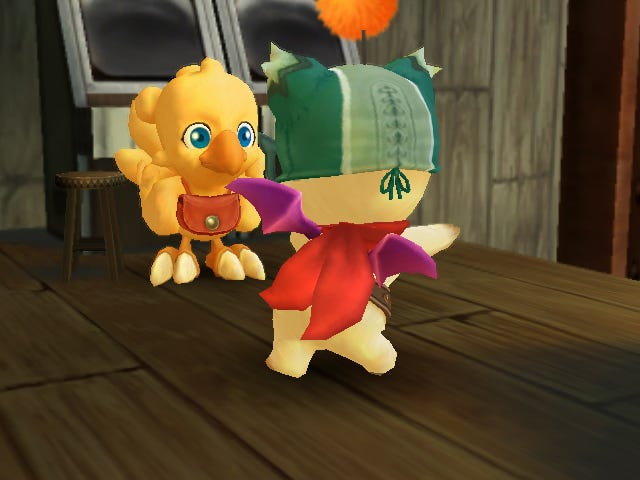
'Final Fantasy Fables: Chocobo's Dungeon' Screenshot 1

The voice acting throughout the game is excruciating, swinging from the wildly overdramatic to implausibly saccharine.

The story is told in full, florid Final Fantasy vernacular. You play as Chocobo, sidekick to the explorer Cid, and through the adventure you'll meet white mages, moogles, Ifrit and Leviathan all the while Uemtasu's arpeggio melodies play out on delicate music boxes. In contrast to the main series most of Chocobo's Dungeon takes place in one central location, the town of Lostime. Its inhabitants are losing their memories, more slipping away each day with the toll of the town's bell. Far from being concerned about the creeping amnesia, the townspeople embrace it, believing that their quality of life increases in step with their forgetfulness.

Your mission is to prove them wrong by literally entering the dungeons of their minds, travelling to the deepest floor and recovering their un-treasured memories. In mechanical terms this translates to a series of increasingly difficult, randomly generated dungeons (one per town's citizen plus a host of optional extras). Complete a dungeon and you recover a memory; collect all of the memories and the town's individual and collective identity will be restored. It's a strong conceit and one that proves more compelling than the usual quest to save the world. The tight geography might reduce the breadth of the game, but it helps to focus the player's mind on its depth. And Roguelikes are all about the depth.

While Chocobo's free to explore the town as in a standard RPG, almost all of the game's true content is focused in the esoteric underground chambers of its inhabitant's minds. Each floor of these dungeons is constructed by the game on-the-fly. The aim is to find the staircase to the next level as quickly as possible, avoiding traps, picking up items and defeating any enemies that stand in your way.

The game takes few liberties with the genre. Though you might not realise it at first, play is turn-based in that enemies only act when you do, be it by moving around the environment or issuing a spell or attack. Stand still and everything else on the dungeon floor will stay put, reanimating the moment you do something. As such, movement requires some tactical consideration, encouraging the player to find the most effective routes, luring enemies into tight corridors where they can be attacked one by one rather than en masse. The strategy isn't deep but it is interesting and, as all of the game's calculations and turns take place in an instant, the game hides its antiquated rule set well.

Chocobo's heath must be carefully managed using potions found on the dungeon floor. Further low-level pressure is exerted by his hunger gauge, which must be continually kept topped up with gyshall greens. If this empties then Chocobo begins to starve, draining his health with each pang of hunger. Lose all of your health points and you'll be kicked back to town, losing any unequipped items and money you'd accrued during the excursion.

Luck plays a key role in the game, a design decision that will likely put off methodical western players. Not only is the placement of potions and food randomly decided but also the locations of hidden traps that litter the dungeon's corridors and chambers. These can be foiled by swiping at adjacent spaces but no player will have the time or patience to do this before taking every single step. Traps, particularly later in the game, can be deadly, pummelling Chocobo with rocks, fire and even summon-monsters who can wipe an hour's progress in an instant. The random game design means that sometimes it appears far too easy (like when you reach a new floor only to find the next set of stairs are right next to you) but sometimes far too punishing. As such it's best approached with an understanding that sometimes the odds will work your way and sometimes they most definitely won't.

'Final Fantasy Fables: Chocobo's Dungeon' Screenshot 2

The grueling dungeon-crawling is tempered by leisurely in-town pursuits. These include flower planting, card playing and fishing as well as a raft of mini-games at the local arcade.

Food and potions aren't only items that litter these floors. In addition you'll be able to pick up new armour and weapons, which can be upgraded at the blacksmith's in town to increase your attack and defense power. The designers' generous decision to let you hang on to equipped items when you die is a welcome one and as such weapons and armour are to be treasured as the game's most valuable commodity. Final Fantasy's well-established job system also features, imported to make the game further stand out. The opportunity to cast your Chocobo as a White Mage, Dark Knight, Scholar or Dancer makes him a super-versatile entity and setting the class to match the dungeon's theme becomes second nature.

Many Roguelikes made today are created on a shoestring budget by niche Japanese developers with few resources. By contrast Chocobo's Dungeon has the full weight and financial support of one of Japan's largest publishers and the quality of the execution this affords is obvious. Chocobo's animation is exemplary, his control responsive and satisfying. Graphically the game doesn't push the Wii, but the visuals are competent and don't overreach themselves.

Roguelikes are something of an anachronism in these times of forgiving, everyone-must-succeed game design. But the relative success of handheld titles such as Shiren the Wanderer and Izuna: the Unemployed Ninja demonstrates that, when handled well, this crotchety genre can still attract a dedicated following. Chocobo's Dungeon succeeds where the recent Pokémon Mystery Dungeon fails, by delivering a licensed dungeon crawler that is a credit to its franchise as well as its tradition.

8 / 10

Read the Eurogamer.net scoring policy

Comments (20) Latest comment 3 years ago

Comments threads automatically close after 30 days, but please feel free to continue chatting on the forum!