Version tested: Wii
What's the difference between a toy and a game, if there is one? Plot? Progression? Structure?
Buggered if I know. Nonetheless I'm going to declare that, for me anyway, this latest FF spin-off falls firmly into the column of toy.
Firstly it's something you play with rather than just play. Despite a well-crafted, palatable storyline and characters (excluding perhaps the awkwardly arch pomp of player character Layle), people who pick up Crystal Bearers and follow the story arc from A to B will be missing the point somewhat.
Layle is the titular Crystal Bearer, a young man imbued with a special power who blah blah blah... He's telekinetic, basically, picking up all and sundry with his mind like David Copperfield turned rogue shoplifter. Zap an object or enemy with a point of the Wii remote and a squeeze of the trigger and Layle encloses his target in a ball of glowing blue mind-juice, ready to be manipulated. Slap the motion controller left or right to throw the target in that direction, downward to slam it against the ground or up to pull it into a hover above your head, ready to be launched.
It's a simple mechanic, but remarkably flexible - in fact it's pretty much the only interaction you'll have with anything in the game world at all. Slap down or spin enemies to knock them over and lift them to throw again and deal more damage. Pick stuff up. Throw it. Repeat.
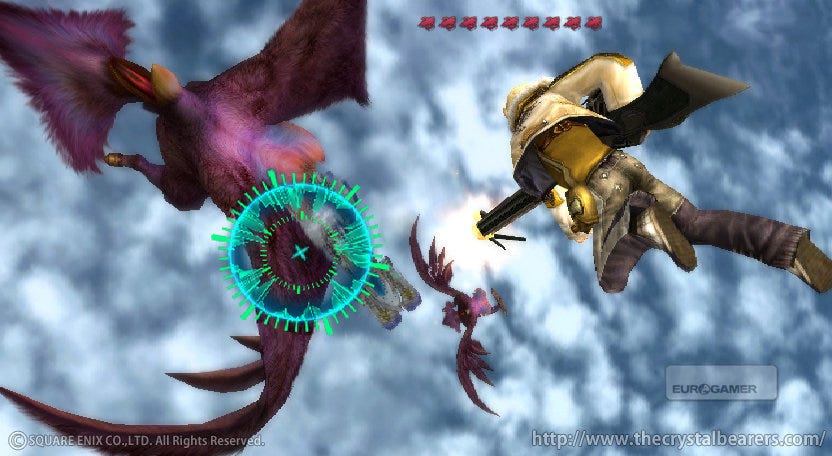
Simple really - a lightweight action RPG with the traditionally nuanced FF combat replaced by a single mechanic. Kids' game, waggle, haircuts et cetera.
But there's a mischievous subtlety to Crystal Bearers, a sense of exploration and interaction which belies its simplistic exterior and makes it much more interesting. It's all in the interactions, really, the way which objects affect each other and the enemies around them, the totally unsignposted nature of so many of these hidden gems, the fact that you'll receive no tangible rewards for most of them at all - because it's really just for kicks.
Well, that's not quite true. Most of the tricks you pull off will unlock a 'discovery', one of hundreds of medals on a grid in the game's menu. When you get one, those around it on the grid are partially highlighted and a tip on how to achieve them is revealed - usually subtle enough to keep you guessing. Achieve the correct action, combination or set of circumstances and the medal will be awarded.
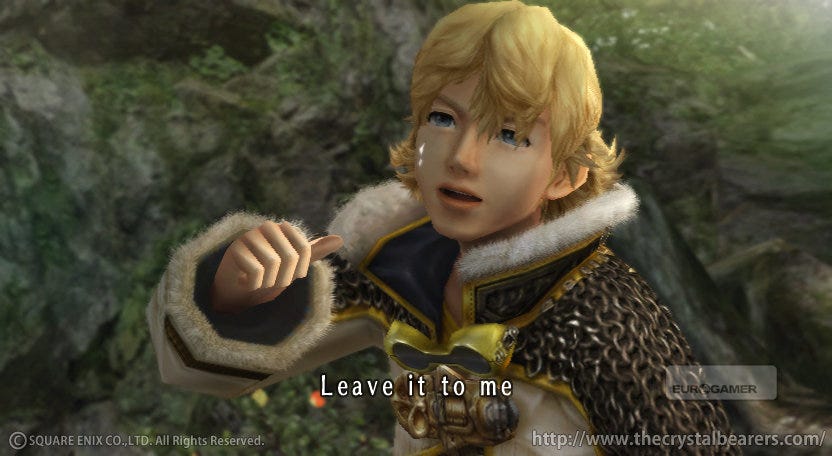
It's apparently impossible to get every medal first time, and several of the opportunities are once in a playthrough affairs, some being distinctly of the blink-and-you'll-miss-it variety. Unusually, considering Square's penchant for reward-based achievements, these medals aren't accompanied by new items, upgrades or powers - just a little warm feeling and the tinkle of a tiny bell, like you're kicking a morris dancer.
It works though. Somehow it's compelling rather than inane, prompting ludicrous experimentation which always follows the meanest level of logic. I found myself spending a good ten minutes playing with dogs and skeletons, stealing the undead skulls and playing fetch. Mistiming one throw meant the skeleton meted out a little bit of retributive justice, knocking me down. Silver lining: I got another medal when one of the dogs followed up by urinating heavily on my prostrate form.
There are hundreds of these little touches, from simple single actions to more complex procedures. You can throw the switch on one of the hub city's shuttle trains for example, changing destination or putting it into 'express' mode and flooring all of the passengers. Watering Cactaurs makes them grow, throwing balloons or balls to children sends them crazy with adoration - tiny hearts popping above their heads as the game's Sim-like emotion indication system shows you just how happy you've made them.
But I'm spoiling it. The fun is finding these things, ambling around and manipulating each and every object and hot-spot you find. There's no point, really, apart from the completism of getting every medal, but it's fun finding them - a lesson which so many lazy 360 achievements could learn a great deal from.
It's not all pick up and play, though. Interspersed with the sandbox roaming and experimentation are borderline minigames, short pieces of storytelling portrayed through one-off events. The first you'll encounter is actually the very beginning of the game, throwing Layle straight into a light-gun shooting gallery game as he fends off a number of wheeling aerial monsters from that most Square-ish of transports - the airship.
There are chases too, and fishing and grape-picking and train-fare evading. There's also a slightly uncomfortable arse-wrestling scene between two bikini clad adolescents which swerves incongruously into semi-DOA territory. These games are simple but solid, although replay on demand would have been nice for all of them rather than the current few.
The one concession to Final Fantasy's RPG roots in all of this action adventure shenanigans is the material collection and item creation system. Initially it's a predictable case of monsters dropping things which can then be made into accessories, but a bit of extra depth is added once you realise that the order in which objects are mixed affects the outcome - sometimes producing an especially stat-beneficial piece rather than what was advertised.
The game is easy enough that these stats are largely ignorable if you're just here for the core story progression, but they're really there to make the day-to-day tasks and exploration easier and quicker. All shops are run by Moogles, who also deliver the post, and are therefore justified completely before they've even served a purpose.
Technical deficiencies let the side down a bit, with the camera problems inherent to so many 3D sandbox worlds rearing (and looming, and spinning) their ugly heads reasonably often. There's a fair bit of slowdown too, often at curiously calm moments, where Layle will suddenly adopt a treacle-paced walk. Areas are generally large and well connected though, so this is likely a backround loading symptom which is preferable to more level segmentation.
The map is the real chore, being a largely undetailed affair of the most rudimentary value, especially when there's so much running back and forth to be done. You'll become more familiar with areas and their connections as play progresses and areas open up or are revisited, but it's certainly confusing enough to warrant an objective pointer or compass. Oddly, given the prettiness of the environments and cutscenes, Layle is a jagged little man, his patchy animation sundered further by his blocky frame. Having him centre stage the whole time is a bit of a visual blemish.
I have to admit I didn't 'get' Crystal Chronicles at first. I dismissed it as simplistic and unchallenging, a hollow game of point and click. It needs to be played with to get the most from it - doing otherwise is like buying an awesome LEGO castle, assembling it once and then gluing it together to sit on your shelf forever - something only the most imagination-poor children would ever consider.
Don't buy this expecting an epic RPG, and consider keeping someone under the age of 12 at hand to help you justify the twee nature of the game as a whole. But there's something here which is notably absent in any number of lushly produced and scintillatingly scripted games: a real sense of fun and discovery.
7 / 10
