F.E.A.R Multiplayer
We go hands-on with the multiplayer aspect of Monolith's action-horror FPS. Sorry: Wooooooy geeeooooooh hhhhuuuunddsss-oorrrrrnnnn wiiii-- you get the idea.

Shop for games now with Simply Games.
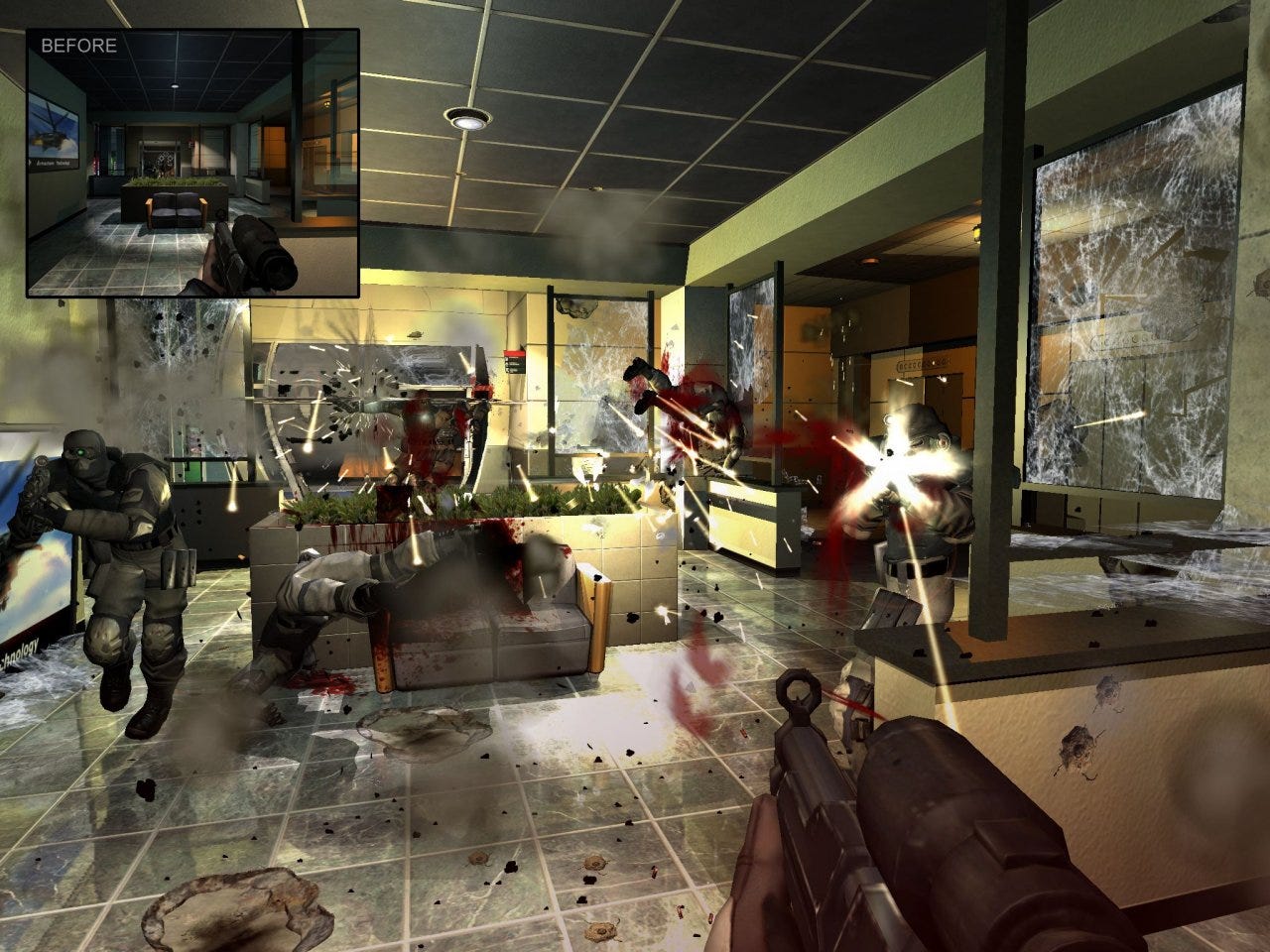
Do not play F.E.A.R if you have no head.
Action movies are often described as "mindless entertainment". F.E.A.R wants to be an action movie, and gets it more or less right in a lot of ways (apart from the way it's actually an action-horror movie, but you can't really complain about getting two for the price of one), but running into a room and outdoing the Matrix lobby scene for sheer carnage is far from mindless. You couldn't do it without a head. What Max Payne, which had similar aspirations, arguably got wrong and what F.E.A.R gets right - whether accidentally or deliberately - is cutting down the number of blanks you have to fill in with your imagination but generally focusing them on your own actions rather than those of your enemies.
That probably didn't make much sense served like that. Let's ground it in something familiar. In Max Payne you jump in slow-mo and Max's coat flares behind him, his body arches and his arms crane round to gun in whichever direction you're pointing the aiming reticule with your mouse, and bullets arc through the air puncturing henchmen and knocking over the odd tinned asparagus. But however many folds and creases you corkscrew into Max's outfit; however much light bounces off it; however realistically his shoulders and neck twist and pulse to turn and meet the danger, ultimately you're still seeing something that falls short of the blockbusting action sequence that you wanted to play out in your head.
The difference with F.E.A.R isn't just the unprecedented level of incidental detail, which turns the average firefight into a maelstrom of smoke, splinters, shards and what-have-you, but also the first-person view. Every time we talk about FPS games we discuss the Gordon Freeman factor - allowing the player to carve a consciousness of his or her own by never risking the sense of immersion with dialogue or reflections of a face or anything like that - but that's not the key either, although it's certainly another element of F.E.A.R. The difference with F.E.A.R - and the reason you need a head - is that when you swan dive-off a balcony and hurtle forwards in slow motion, catching another leaping enemy in mid-air with your nailgun-fire and literally nailing him to the wall so that he hangs there limply as you forward-roll on landing to stroll away purposefully, ejecting brass as you go and reloading to open fire on anything else in the vicinity... When you do that, Monolith isn't completely in charge of the spectacle as you interpret it. You did not, for example, dive headfirst. Nor did you tumble on landing. These are invented details.
By putting you behind the eyes of your action-avatar, though, and making sure that everything within your field of vision is the best and most dynamic and destructible it possibly can be, Monolith leaves only the smaller point of how good you look open to debate, and, well, we don't know about you, but our imagination always tries to make a powerful case for our grace and skill in situations of imagined ultraviolence.
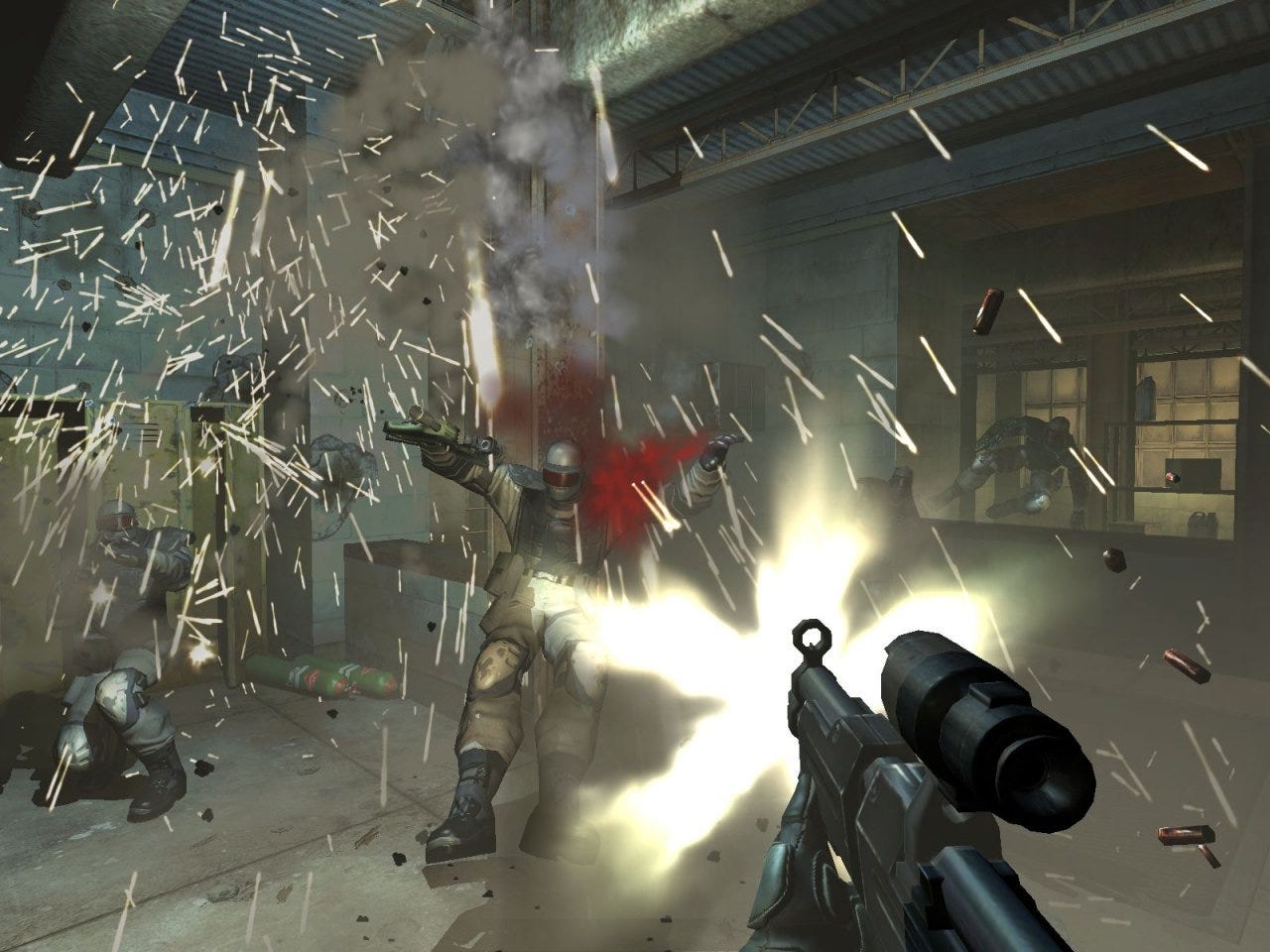
Multiplayer F.E.A.R [ah, there it is -Ed] benefits from this "look after yourself and we'll handle the rest" approach to design just as much as the single-player action sequences. But the question was always going to be how well it managed things like weapon balance, level design, graphical detail and, of course, the slow motion - if indeed it could manage to implement the latter.
On the evidence of our recent playtest, the answer seems to be that it manages them all well enough to make deathmatch and team deathmatch fun again. Remember deathmatch? We used to play it. We used to play it a lot. Now that was something that you could play without a head. But sooner or later we lost interest, and it took clever ideas like Half-Life 2's gravity gun to lure us back thereafter.
F.E.A.R doesn't have a gravity gun - though amongst its wonderful technical achievements there is the realistic physics factor (Havok 2.4, apparently, to recount the one technical detail we did jot down) - but it does have slow motion to layer on top of its gorgeous aesthetic, and therein lies the key. And it only took only a few minutes to banish our own fear that a concept like that just couldn't work relying on multiple PCs. Surely if you slow down and the other person doesn't, we reasoned, you're going to actually have to overcome relativity for it to be advantageous for the side with the slow-mo...
Unless of course you slow down both sides, but one more than the other, and give the slightly faster chaps an increased rate of fire too. Yep, that'd do it.
So the way the slow motion stuff works is thus: When someone picks up the power-up, apart from being illuminated by a kind of Quad Damage-like flare effect, he or she also has to stave off damage while a little charge-bar in the bottom left of the screen fills up. When it does, the player can unleash slow motion by pressing Ctrl. Doing this slows down everybody in the game world immediately. Sounds become muffled, everything seems to bleed and ghost into everything else as you turn, and bullets leave smoky trails of disturbance behind them. But while both sides slow down to a plodding speed, the side with the power-up is actually moving about twice as fast, and firing a lot quicker too. It makes it all the more satisfying when you manage to kill from the defending side, and it means that you can control the slow motion power-up and still play out those fabulous Bullet Time gunfights with other people.
And the gunfights are fabulous for lots of reasons outlined in yesterday's single-player impressions. To elaborate a little further - the weapons are deliciously meaty and often accompanied by gloriously intense explosions and shattering effects; particularly the suck-in-blow-out effect of the grenade, and the little clouds of blood-mist that spring from wounds in slow motion. Some of our early favourites include the shotgun, which packs a major wallop and looks the business too; the rocket launcher, which is probably no better or worse than any other but Is In Slow Motion; the nailgun for the simple fact you can pin people to stuff; and the plasma gun.
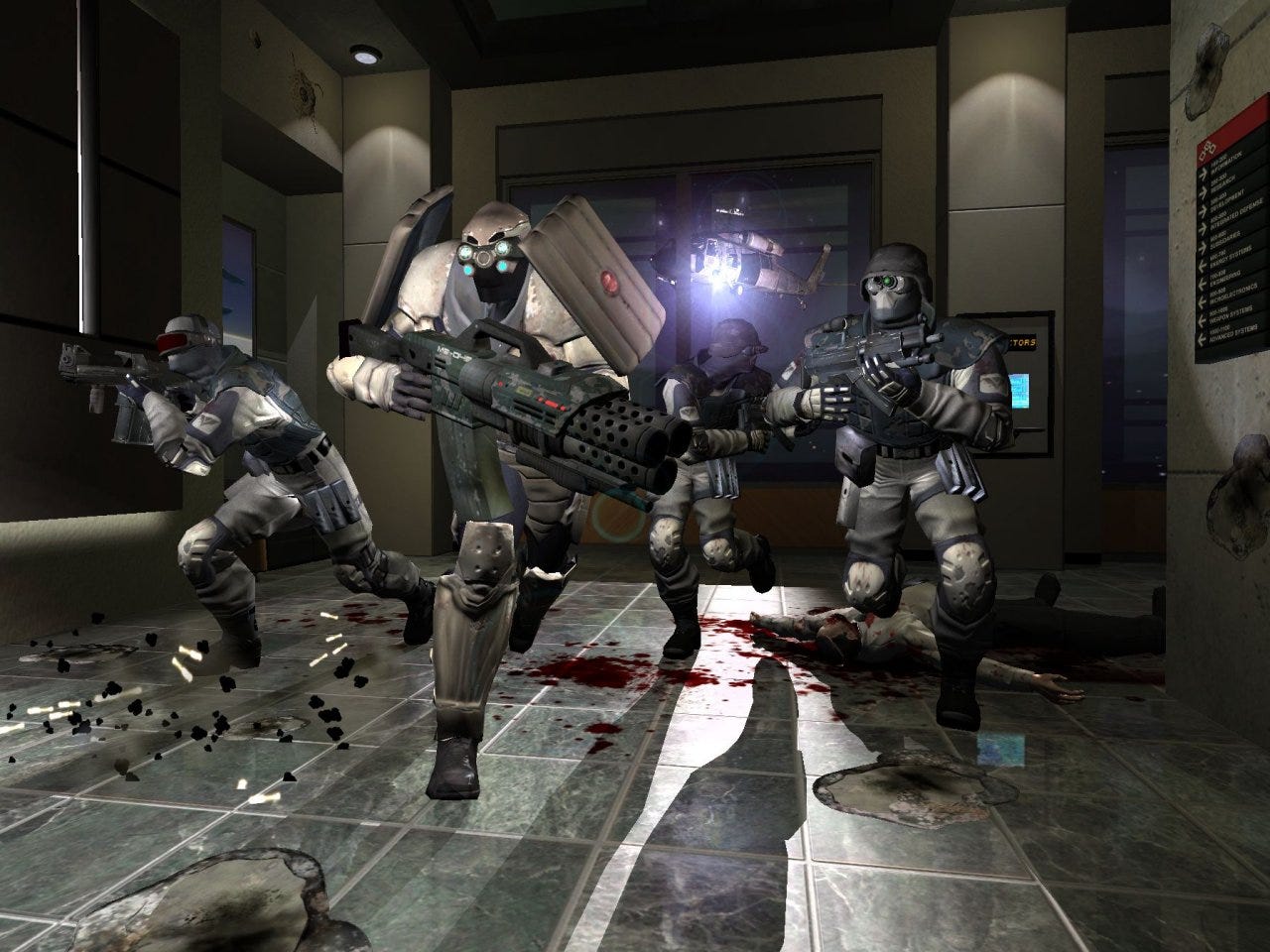
We're also rather fond of the melee attacks. Clicking the right mouse button whilst standing normally will pistol-whip or roundhouse, holding crouch at the same time will perform a running sweep move, and jumping at the same time has you leap through the air kicking constantly as though you're cycling on some invisible bike - for all the world like Neo in the dojo with Morpheus, to bring it all back to the Wachowskis.
Questions of balance and level design have still to be answered, really; we simply weren't given long enough with the individual maps to give you a particularly informed verdict. But the evidence so far is that controlling the slow motion power-up is difficult thanks to the relatively high death-rate, despite the fact it's a highly advantageous piece of kit to keep control of. And if we had to rate the levels we played, we'd say that the shadier ones brought out more of the game's graphical prowess, the open areas are nicely designed with courtyards and enclosed factory-workfloor style areas that are just big enough to demand thoughtful manoeuvring with balconies running around the wall halfway up and stacks of crates and other expendables.
Oh, and going back to the need for a head - need it you may, but you'll probably want to keep it out of sight when you realise that your shadow can actually give you away when it peeps round a corner ahead of you. Pretty lighting finally pays off.
As you can see, we've largely ignored the basic deathmatch and elimination modes and their team variants. Probably because we're simply not that interested. In slow-mo deathmatch Monolith has created something that gives us that same sense of shifted goalposts that Half-Life 2 DM managed. It's new. It's clever. And it makes every firefight look and feel really cool. The only thing that could make it any better would be more to blend more of the supernatural side of the single-player game into the multiplayer broth, but we can't really see how you'd do that at this point.
Whether or not it will stand up to prolonged exposure is a question we've also levelled at the single-player. F.E.A.R's success is by no means a foregone conclusion. But what is clear, having played the bits of the single and multiplayer games that Monolith is prepared to show off, is that it's worth eulogising. And if you tell us it's not we'll completely lose our heads.
Shop for games now with Simply Games.