Fatale: Exploring Salome Review

Hide the Salome.

Version tested: PC

So you're John the Baptist - sell me that one, GameStation - and you're knocking around in a dripping cistern, waiting to be killed. The walls loom closely out of the grey mist, water ripples gently beneath your feet, and a single artful blast of light beams down from above. You're wedged tightly into an awkward variation on the first-person perspective, the viewpoint beloved by disciples of shooting, neck-breaking, and wonky hand-to-hand combat everywhere, but none of that appears to be on the cards today.

The controls are familiar enough, but they're quirky and sluggish. There are crates lying around, but they're only there to mock you for your traditional dependence on crates and the ridiculously handy things you tend to find within them. There's even a jump button: useless, given the circumstances, but still present, like a knotty lump of vestigial tail. Not to worry, all of this stuff is just theatre, really, just false hopes built to reinforce - deep in this dark, wet, underground cell, where your ever-approaching death is already a matter of record in, oh dear, the Bible - just how very screwed you are.

But that's only the half of it, because you're also the player, stuck behind your PC or Mac, wondering what it all means, wondering where it's going, and wondering, possibly, if lurking around the corner there's an on-rails shooting section where you get to take out a Judas Iscariot while clad in a giant amphibious Mech outfit (the answer's no, sadly, but there's always DLC).

Fatale: Exploring Salome's opening third - the John-the-Baptist-waiting-to-die bit - can be a disorientating experience, and one that takes a long time to play out, as you bump around in the dark, kicking at crates, and perhaps stabbing at the keyboard to see if the prophet who foresaw Christ, the patron saint of French Canada and Newfoundland, has picked up any modish parkour skills in his latest incarnation. He hasn't, of course, and the blocks of luminous text sporadically appearing in the air as you wander aimlessly aren't tutorials teaching you how to punch, zip-line, swap weapons, or crouch. They're brief, fairly shrill quotes from Oscar Wilde's interpretation of the story.
'Fatale: Exploring Salome' Screenshot 1

Tale of Tales' latest is another GameFAQs disaster, in other words: what do I do? Where do I go? Why won't the door open? How do I get my seven quid back? If Fatale had a hints hotline - and I really wish it did - I'm pretty certain players' calls would be patched directly to Mark Lawson and Umberto Eco, dressed as mimes, answering all queries in Aramaic.

If you're in the wrong mood, it would be possible to take Fatale rather badly: to feel that you're being made fun of, or patronised, and that your decades of accrued traditions - the crates with handy stuff in them, the jumping, the not-getting-killed-in-the-first-scene - are being poked and prodded by people who think that you and your games are stupid and juvenile. But then the door to John the Baptist's cistern opens, and you realise no-one's trying to make fun of anyone, really. The team of art junkies at Tale of Tales possibly love games just as much as a Gearbox or a WayForward, but they're trying to take the form in different directions: to bend it, stretch it, tease it into new shapes. They want to see what it can do.

And it's possible they aren't entirely successful on this outing - certainly not as successful as they were with The Path, mid-March's gothic frolic through the grim fringes of Little Red Riding Hood. Fatale lacks the folk-tale immediacy of The Path, but it lacks the strange coherency of its mysteries, too - it lacks the feeling that behind the horror and the developers' troubling smirks, there was something easily accessible to at least focus your interpretations around.

This time, Tale of Tales leaves the world of grannies and wolves behind, and centres its gaze on the slight, rather gory tale of Salome. Salome is biblical morality at its crazy best: it's all about understated sex, overstated violence and the corrupting influence of women. Throw in a mention of how haggard Fergie is looking these days and something about how you can't trust minorities, and the whole thing could have been plucked from the pages of the Daily Mail.

The story is simple: young Salome dances before King Herod, her stepfather, and wins the right to make a request. Possibly as a favour to her mother, or, in Wilde's version, on which Fatale is loosely based, because her advances have been spurned, she asks for the head of John the Baptist to be brought to her on a plate. Even though he was expecting something more along the lines of a pony, Herod reluctantly grants her wish - probably because step-parents will do anything to gain a little favour with their new families.

Tale of Tales' approach to the subject breaks the story down into three sections. In the first, you're poor old John, down in the cistern, jumping around on crates while you contemplate how difficult life can be sometimes. Your instructions here are simply to wait, and, in case you've missed the point because all that playing games with enemies and target reticules and rechargeable shields has made you thick and impatient, there's even a YouTube-style timer running along the bottom of the screen to tell you just how long you have left.

'Fatale: Exploring Salome' Screenshot 2

After that, you waft upwards to the terrace above the cistern. Night has fallen, perhaps morning is on the way, and a handful of figures, frozen in various artful poses (character design is by Takayoshi Sato, of Silent Hill fame), are positioned about the place while you float around, drifting in and out of the scene, tasked with extinguishing any nearby light sources by moving in close, and then blocking them out with a strange, shifting black cloud.

The world is beautifully lit and filled with flickering nocturnal colour, but there's a definite impression - inevitably, given the imagery of your mission - that you're engaged in something rather dubious here, not to mention a creepier sensation, as fresh candles pop up behind you in the small, yet fiddly, space, that you aren't alone, and that an opposing force moves around nearby, slipping past just out of view, and re-arranging things when you aren't looking.

The peculiar blend of stillness and unease is only heightened by the soundtrack, in which a persistent chattering whisper fades in and out, reciting yet more lines from Wilde's play, and it all works to ensure that the heart of the game - the most gamelike part, in fact - is comfortably distant from anything I felt I'd ever played before.

'Fatale: Exploring Salome' Screenshot 4

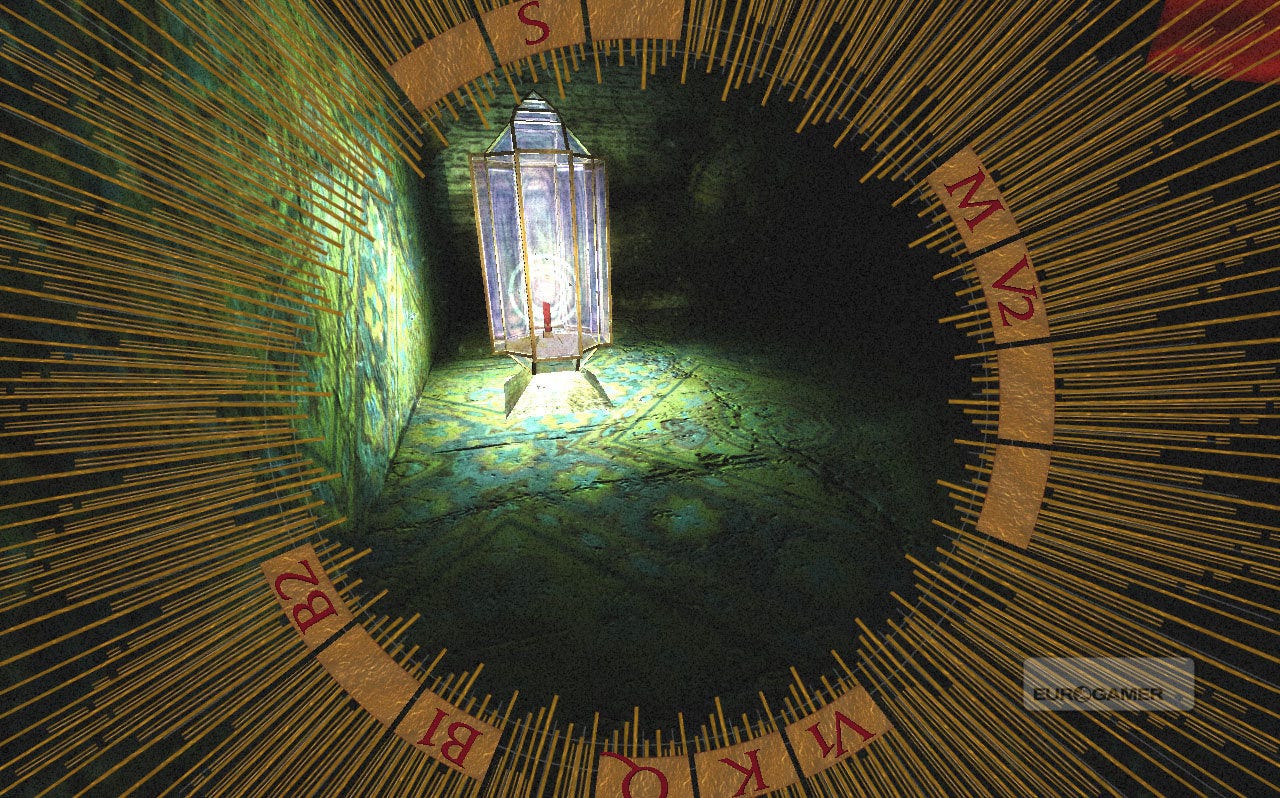
Finally, with all the flames extinguished and - this is bizarre - once you've restarted Fatale, you'll find yourself in the epilogue, back in the courtyard under the full glare of daylight. You're now stuck, I'm guessing, in the role of Herod, while Salome performs her dance, and all you can do is zoom in and out of the action rather creepily, your inability to move about or do anything King-like suggesting that step-dad's just as much a victim of fate as John the Baptist himself.

Taken as a whole, Fatale may fill you with the sense that you're purposefully missing out on a lot of fairly important things: dialogue is reduced to distant echoes or slabs of dead text, the actual people you encounter are either silent or frozen, and the game's single moment of action is over blindingly fast. For the rest of the experience, you're left with a calculated feeling of disconnection, arriving after everything's happened, or long before the good stuff will kick off.

The timeline's been trendily dislocated, too: we start with the fruits of Salome's violent bidding, and then retreat to the placid night above, a chance to muse on her motivations, perhaps, or just wonder why there's an amp and acoustic guitar laid against the wall of Herod's palace, before zipping back to her fateful dance that will set the whole thing in motion.

It's possible that the game's brilliantly infuriating air of lingering vagueness is crucial to the point Tale of Tales is trying to make, and what the developer's getting at, with all the shifting perspectives and fluctuating mechanics, is just how open to interpretation the story of Salome is, from its muddled origins in the pages of the bible through Titian's serene - possibly calculating - minx, to Wilde's curdled temptress. In the face of such a range of different agendas, why not offer a dreamy, ambiguous Salome for an era in which neat explanations are always suspect, and narrative has given way to a dismantled muddle of events that make you question whether history is a product of accident or design?

That's possible, certainly, just as it's possible that I may have had way too much Night Nurse before writing any of this. What seems a little clearer, however, is the sense that, after the sprightly horrors of The Path, Tale of Tales has struggled slightly with this one, perhaps weighed down with a reverence for the source material.

Wilde seems a constant intrusion, popping up in the glowing chunks of script and whispered dialogue that appear whenever Fatale could be establishing its own mood. Wayward and distinctive as the final product is, the developer doesn't seem as able to screw around so deviously with the subject matter this time: the darkly playful tone it brought to the creaking details of Little Red Riding Hood is replaced with something more sober, and more distant.

'Fatale: Exploring Salome' Screenshot 3

Tom Wolfe once argued that a grotesque transformation is taking part in the world of art, in that critical theories are becoming more important to a specialised audience than the work itself. He joked that, in the future, galleries will be filled with the rambling, self-indulgent spewing of academia covering the walls, with the painting and sculptures turning up only in the form of little photographs to illustrate the text.

Was he right? In terms of Fatale, it's certainly true that thinking over what you made of the whole experience is often as entertaining and dynamic as the tentative half hour it takes to poke your way through it. Writing about The Path, Kieron pointed out that it clearly wasn't much of a game, and the same is true here, with a slightly shapeless - or at least unwieldy - structure, spread over three wonky acts, topped with awkward controls and an air of cerebral self-involvement that many will find infuriating.

And yet despite all that, you may find that you can't quite forget Fatale, that you come back to its problems, its frustrations, and its ambiguities even when the memories of more fully-realised games have faded. Trapped somewhere between survival horrors and full-blown gallery installations, Tale of Tales remains a fascinating studio. Intimidating and ponderous, its games often feel stunted and incomplete, certainly, but they still manage to trail long shadows behind them.

7 / 10

Read the Eurogamer.net scoring policy

Comments (30) Latest comment 2 years ago

Comments threads automatically close after 30 days, but please feel free to continue chatting on the forum!

  • Nephirion #1 2 years ago

  • Br0ken_Engli5h #2 2 years ago

    Congratu-fucking-lations!
  • Matthew_Hornet #3 2 years ago

    I am happy that this game exists, that Eurogamer has reviewed it, and that it was reviewed in this manner. Makes a person feel like new things are happening.

    Still, though the style of the review was well judged I think it went on a bit too long. Two pages might have been better, specifically leaving out such a detailed blow-by-blow description of the game. Being so short, the game suffers if the player is too familiar with it in advance.
  • Malek86 #4 2 years ago

    I want to get this. By the way, isn't it coming out on Steam?
  • loopholezero #5 2 years ago

    the scene description is perhaps a bit too detailed, but that was probably unavoidable, considering how short fatale is.

    anyway, it was a great read and it's good to see more obscure stuff being reviewed here besides the usual console/mainstream games :)
  • lmephisto #6 2 years ago

    i cant find it on steam so maybe no
  • thedaveeyres #7 2 years ago

    Perhaps the greatest EG tagline ever. :D
  • Wendelius #8 2 years ago

    I agree that the description is too detailed. Thank you for experiencing it for us. But did you have to tell us all (most?) of what it has in store?
  • Boomerang #9 2 years ago

    Jesus. This sounds more depressing than watching Antiques Roadshow while someone saws my cat in half.
  • DrR0b3rts #10 2 years ago

    That sounds quite exciting to me, Boomerang.
  • pervertron #11 2 years ago


    Yes, yes, that's exactly what they do. I think they also type "blah blah blah" for the whole review unless they see something different.
  • Skurmedel #12 2 years ago

    Milky: I could accurately predict you whining in the comments as soon as I saw that seven.
  • MENTAL1ST Verified Senior Software Engineer, Picsel UK Ltd. #13 2 years ago

    Throw in a mention of how haggard Fergie is looking these days

    York, Man U or Black Eyes Peas?
  • b00n #14 2 years ago

    7 pounds for half an hour sounds a bit much, or did I miss something?
  • SuperBas #15 2 years ago

    Too long, didn't read (attention span destroyed by playing games for 20 years now). Is it pretentious bullshit like The Path, or is it playable?
  • Alterego-X #16 2 years ago

    The Path was the best thing to be created since The Lion King.

    This one was not that great, but still a fascinating piece.
  • kwarive #17 2 years ago

    This sounds interesting. Might need a big smoke before I play it though. I'm a big wilde fan but I don't know his work on this so discovering it through a game? installation piece? like this might be just the ticket. After said big smoke.
  • loopholezero #18 2 years ago

    @doveroxford: you don't make any choices, as far as i've seen. and calling it a game isn't very fitting, i think the tale of tales guys describe it as an interactive vignette.

    @kwarive: yeah, a smoke is prolly good advice, it was enjoyable for me after one :)
    Edited by 1 at 22/10/09 @ 18:02
  • YourMessageHere #19 2 years ago

    Given that I'm not familiar with Wilde's Salome in the first place, and care nothing for the Christian mythos, I suspect this will be somewhat wasted on me. I applaud its developers in principle though - it sounds like the sort of thing that should exist, but I question their choice of such a (relatively) obscure text. It also seems a subject that's curiously irrelevant to, well, pretty much everything, to make games about; biblical morality belongs in the bible, not in the world.

    Tom Wolfe once argued that a grotesque transformation is taking part in the world of art, in that critical theories are becoming more important to a specialised audience than the work itself. He joked that, in the future, galleries will be filled with the rambling, self-indulgent spewing of academia covering the walls, with the painting and sculptures turning up only in the form of little photographs to illustrate the text.

    Already happened, and not just in art - anything that has critical theories seems to be overtaken by them, so that the actual thing is of miniscule importance compared to what people say about it. Which is presumably why I'm commenting on this, not playing it.

    EDIT: I laughed for a straight minute at "Hide the Salome." by the way. Buy the writer of this a cookie, please.
    Edited by 1 at 22/10/09 @ 19:19
  • Chufty #20 2 years ago

    "FFS, not another 3-page review," I thought, until I saw it was by Christian.

    I'm always partial 3 pages of Christian, but please don't extend this new 3-page-review fad to Ellie and the like.

    I think I'll give this "game" a miss though.
  • OrgasmicMutton #21 2 years ago

    While I was willing to throw the Path some money and give it a shot I have to say I wasn't particularly impressed by the experience (though the art and music was very good).

    Don't think I'm ever going to be a Tale of Tales fan so I'll give it a miss. Fair play to them for trying something different though.
  • SheffieldSteel #22 2 years ago

    Worth 3 points more than Risen? Hmmm.

    Challenging postmodern artistic reinterpretation of a classic biblical tale? Hmmm.

    Hmmm.

    At the risk of seeming like one, I think I'll stick with the Philistines, the fanboys and the idiots, and not bother.
    Edited by 2 at 22/10/09 @ 21:07
  • john_silence #23 2 years ago

    If only Tale of Tales didn't come off so pretentious...

    YourMessageHere, while I absolutely disagree with the view that Wilde's play is too minor a text to support such an endeavour, I do think it's a problem here in that it's too precise a starting point, and that indeed can smother the creative impulse; I'm not sure I trust Tale of Tales to manage a really meaningful reinterpretation of such a text. I'll have to buy this to find out.

    Red Riding Hood was a better starting point I'm sure, because there's a folklore that creates a great, vast background to any new creative interpretation.
  • darc #24 2 years ago

    Have read two reviews of this now and one thing is still unclear: is an understanding of the tale of Salome etc. prerequisite to interpreting this "game", or does the story present itself sufficiently in the course of playing it?

    No idea what "Night Nurse" is (a British product, presumably) and no way I'm Googling that at the office. :)
  • darc #25 2 years ago

    "I agree that the description is too detailed. Thank you for experiencing it for us. But did you have to tell us all (most?) of what it has in store?"

    I feel this is true of most game reviews lately. Especially where RPGs are concerned. 50% review and 50% spoilers, and at the end of 3 pages you still have questions, somehow.
    Edited by 2 at 23/10/09 @ 17:33
  • frenchlies #26 2 years ago

    That was a fantastic read. I'm happy that there's a company out there making these games and that there are reviewers eloquent and well-read enough out there to give them a proper analysis.
  • morbidflyer #27 2 years ago

    Christian, when you beat this game, was it a rapturous experience?
  • YourMessageHere #28 2 years ago

    John_silence, having not read or seen it, I can't really argue; I didn't mean to say it was a minor work or of little importance, simply that it's unknown to far more people than it is known to. Going by the impression the review gives, it sounds really obscure and really something that isn't going to interest anyone who's not heavily into bible stories. Of course, I could be totally wrong.
  • Gunzberg #29 2 years ago

    Did not enjoy this review, it doesn't flow well. Also who would actually pay £7 for this when you can get AAA 2nd hand or on ebay for that price...
  • Sagan #30 2 years ago

    I think I read this review when it was first posted, and at that time it didn't really tell me whether I would want to play this game or not.

    Now having played the game, I re-read the review, and this time it proved really valuable to me. The experience feels more complete to me now, after first having played the game and then reading an analysis about it.
    I also understand now why you didn't write a more classical review. It just wouldn't have made sense for Fatale. It would have been a very short review where you could just say "if you are like most people, you probably don't want to play this." Your review, Christian, is the much better choice.