Fallout: New Vegas
Obsidian falls in.

Sometimes, in order to step up, you need to take a step back. Over the last couple of weeks, Bethesda Softworks has shown the world's gaming media what it thinks is the strongest line-up in its history, a line-up which announces its arrival as a publishing force to be reckoned with: Rage, the comeback game from new stable-mates id Software; a very different vision of the future of the FPS, Splash Damage's Brink; modern-day dungeon-crawling in inXile's Hunted; and of course, Fallout: New Vegas, the follow-up to 2008's smash hit Fallout 3.
But Bethesda, the developer, is absent from its own star parade. Helming New Vegas in its place is Obsidian Entertainment, a seasoned RPG understudy that's done stand-in duties for BioWare in the past (on Knights of the Old Republic II and Neverwinter Nights 2). There's a world of difference between BioWare's style and Bethesda's, and another leap again back to Obsidian's Black Isle roots. But if you were looking for a radically different take on Fallout from New Vegas, you'll be disappointed. Chances are, though, that you weren't, and you won't be.
Obsidian has slipped into Fallout 3's clothes as comfortably as it once assumed KOTOR's mantle. New Vegas is technically and mechanically almost identical to the older game. As he walks us through a demo, creative director Chris Avellone reveals a number of tweaks and additions to Fallout 3's character development, conversational storytelling and the crunchy, stop-start hyper-violence of its VATS-powered combat. But the engine is plainly unchanged and to all intents and purposes, the game looks just the same.
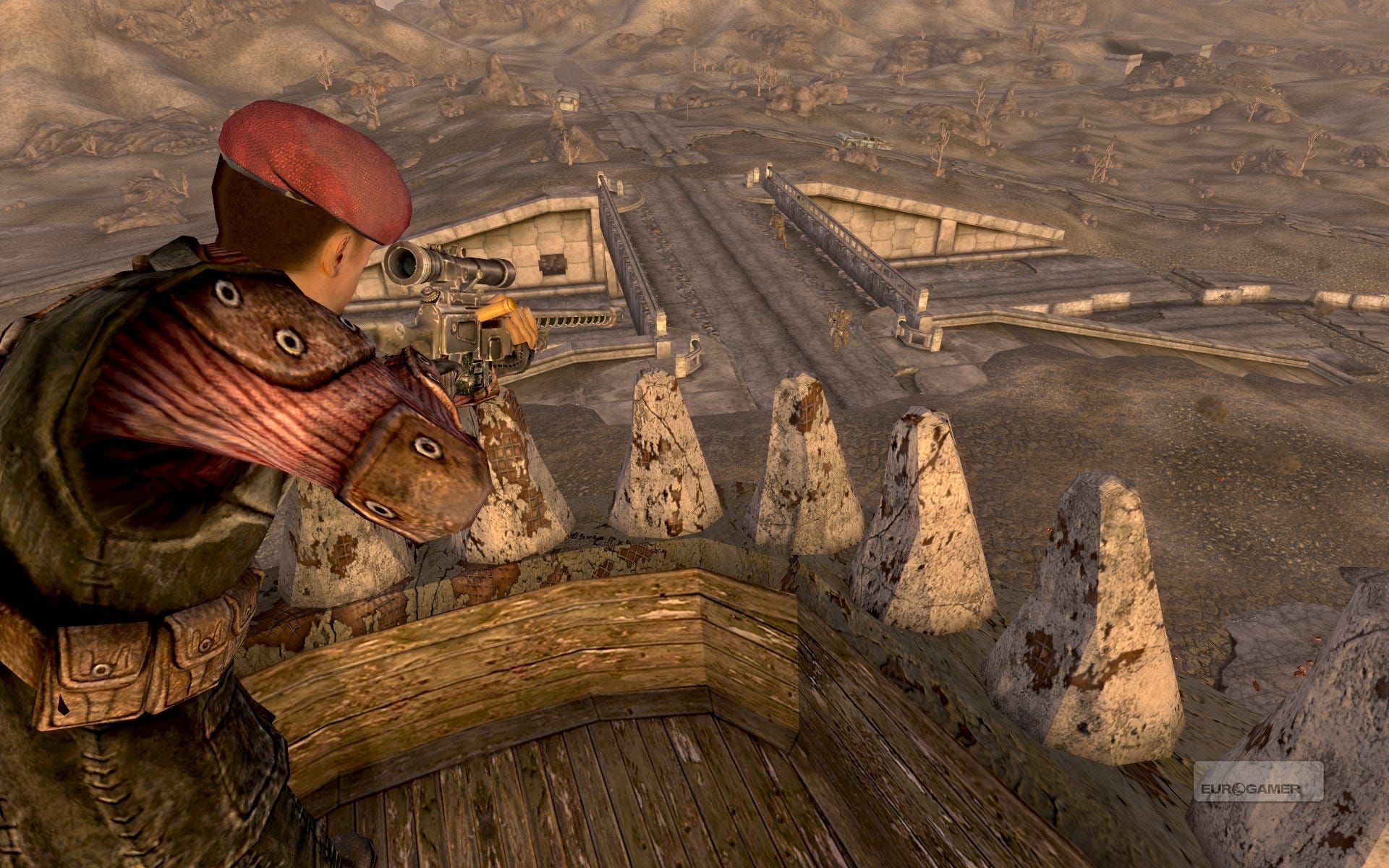
It doesn't feel quite the same, however. It's three years later. The Mojave desert, though still identifiably post-holocaust, is nowhere near as ruined or bleak as the Capital Wasteland. Buildings stand whole, there's a pale wash of blue in the sky, scrubby vegetation clings to the landscape and some warmth and colour have seeped back into the scene. Although he doesn't take us there, Avellone teases us with glimpses of the still-standing Las Vegas Strip dominated by the huge Stratosphere tower, McCarran airport in the foreground.
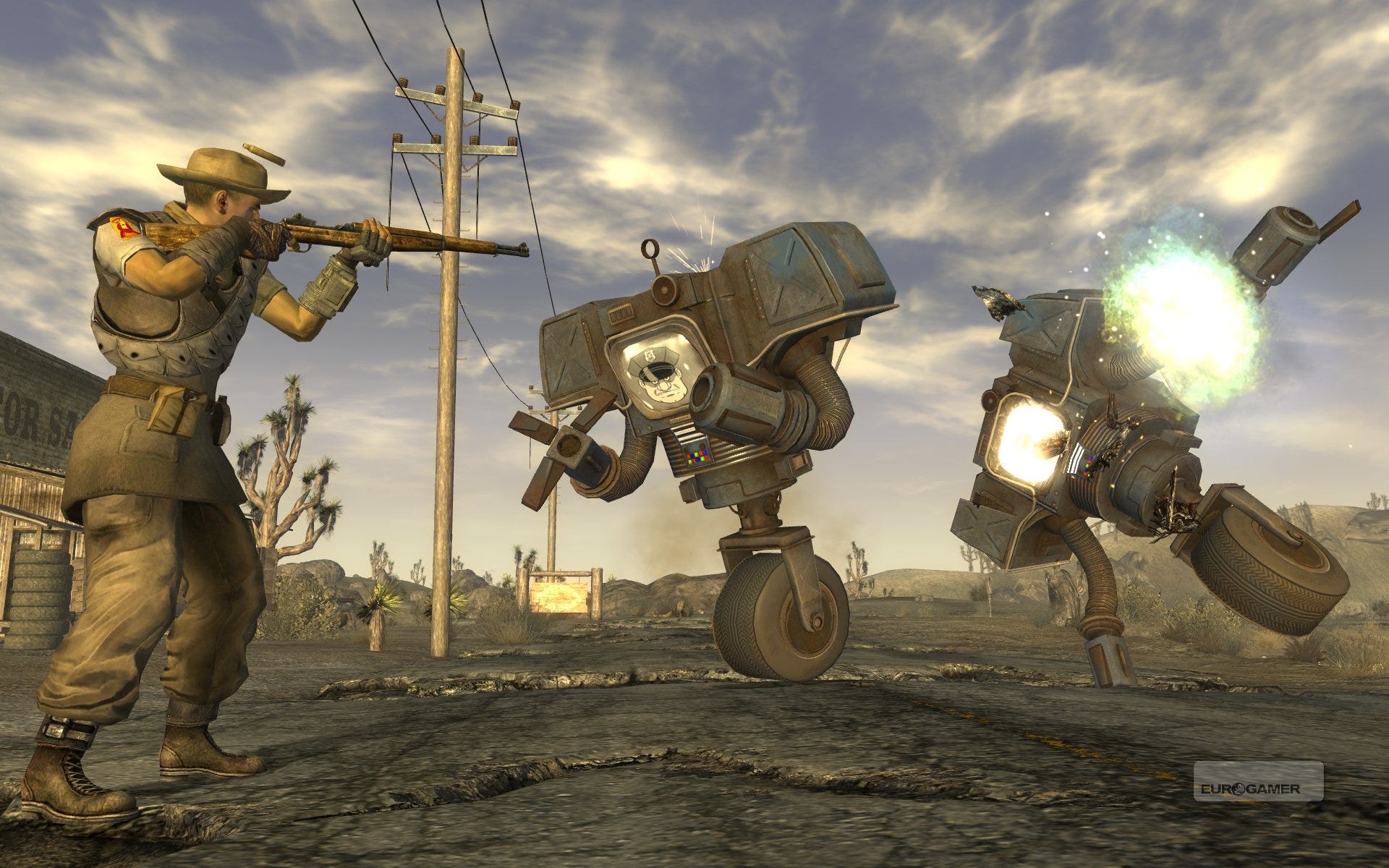
Where Fallout 3 had you emerging from the buried Vault into a hostile world like a visitor from another planet, New Vegas casts you as a surface survivor, a functioning member of some sort of society, and starts by surrounding you with a few friendly faces. You're a courier who's been left for dead by bandits, but a mysterious robot named Vic - displaying Vegas Vic, the city's cartoon cowboy mascot, on his chest - recovers your body and takes you to Doc Mitchell to bring you back to the land of the living.
A rapid character-creation process allows you a few more options - creating an older character, for example - and suggests the skills you might take according to your answers to the doctor's personality questionnaire and Rorschach test (you don't have to follow these suggestions, naturally). The skills, like the stats, are all familiar and include combat skills like explosives as well as social skills like bartering. A scavenged Vault jumpsuit and Pip-Boy personal interface ensure that you'll feel at home, and you're dispatched to the saloon of the village of Good Springs (like many of New Vegas' locations, a real place) to meet a female hunter called Sunny Smiles who'll walk you through the tutorial quests.
It's at this point that you're offered a chance to play in New Vegas' new Hardcore mode for "veteran players". In Hardcore, healing from stim-packs only happens over time and cannot mend broken limbs, ammo has weight, and you'll need to drink regularly to stave off dehydration as you wander the wastes of the Mojave. If Hardcore proves too much for you you can revert to Normal at any time, but once you do that, you can't go back, and you won't get the special achievement for completing the game on Hardcore.
Appropriate to its location, New Vegas has a Wild West, frontiersman feel. Dust devils cross your path, an old prospector called Easy Pete rocks his chair on a porch, and Trudy, the down-home saloon-owner, wants help against the bounty hunter Joe Cobb and his gang who are holding the town to ransom. This is all after you go hunting for Geckos (one of many references to Fallout 2 Obsidian is folding into the game) to learn, or re-learn, your way around the real-time, first-person combat with optional tactical pauses via VATS.