Tameem Antoniades, Ninja Theory's chief creative ninja - that's according to the business card - looks like he's been yanked back in time from some promising point in the dim future where videogame designers exist in the same social troposphere as Hollywood actors and hip-hop personalities. His face has something of a young Bill Murray's charming cragginess to it, which blends well with the fact that he appears to have borrowed Johnny Cash's hair for the day.
Sat wearing a double-breasted pin-stripe jacket, Lady Gaga sunglasses and huge leather boots (their sartorial brilliance lies either with the fact that they were once very, very expensive or luminously cheap) you could be forgiven for thinking that he's hanging out in the bar of an upmarket London hotel on an afternoon in March to discuss what it's like to work with Bowie, or explain why he took time off from the difficult second album to launch his own line of luxury four-slice toasters.
Instead, he's here to talk about rust. Here's what he has to say on the subject: "You think about rust and you assume it's all the same: dull brown, a bit ordinary. But that's not the case. When you really get into it, you can get all kinds of rust: green rust, bright blue rust, yellows and silvers. Rust is amazing."
Antoniades is talking about rust because he's eager to explain that not everybody's take on what happens after an apocalyptic disaster has to look the same. His certainly doesn't. Most games suggest the aftermath of civilisation's collapse will be "dull brown" and "a bit ordinary". Ninja Theory launches things in another direction.
These are the stats: 150 years after the world ends in a muddle of nuclear whimpers and drone warfare, the population of the US stands at around 50,000. The landscape is sparsely populated, but it's still perilous, riddled with aging military robots too stupid to stop fighting.
A tiny countdown clock tells you when an enemy is trying to broadcast for backup.
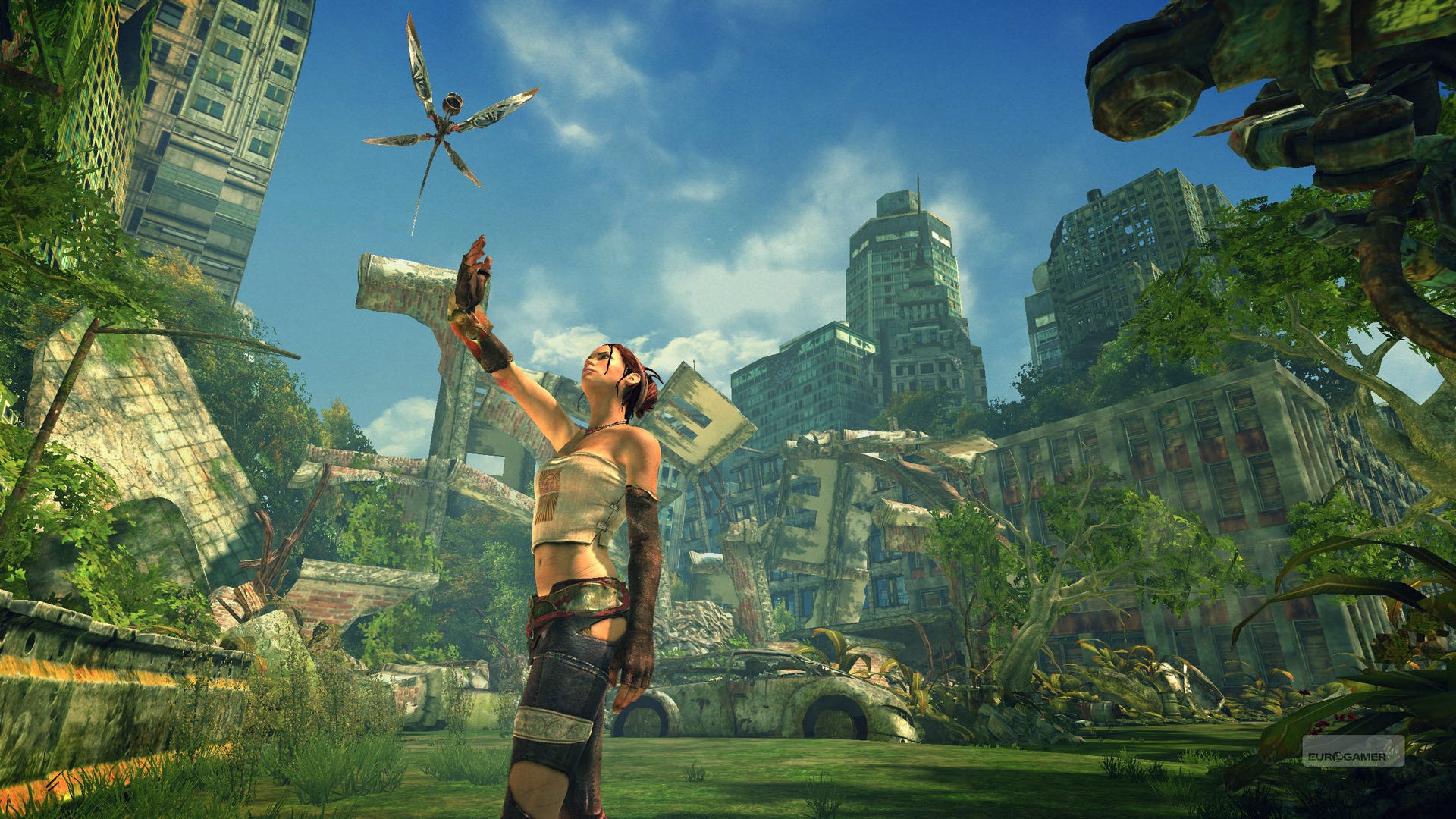
But here are the snapshots: with Fox News and all those pesky Chinese sock factories out of the way, nature has clawed its way back into prominence, sending creepers and vines spilling over the decaying bones of cars and lorries, towns and cities. Urban skyscraper canyons burn red with swaying fields of poppies, mechanical graveyards look more like grottoes than scrap piles as they ripple with clear pools of shimmering water, and New York City is a vast, echoing nature reserve, bisected by a huge, and fairly pretty tectonic rift.
This is the world of Enslaved: Odyssey to the West. Ninja Theory's latest is inspired by the Eastern classic, Monkey: Journey to the West, and is a game that Antoniades hopes will confound your expectations at every turn. "There's always a twist to what we're doing, hopefully," he says. "It's the end of the world, but everything's so pretty. And the landscapes are beautiful, but they're also deadly."
Speaking of confounding expectations, Enslaved is another acrobatic action game, but if you're hoping for a spiritual successor to Heavenly Sword - all carefully separated combat arenas and intricate fighting stances - you'll be disappointed. "We spent months on Heavenly Sword giving the combat depth," says Antoniades, briefly looking like he might want to snap his sunglasses in half. "It was all about these huge combo strings to pull off special moves. I don't know how many people really put the effort in for all that in the end. Enslaved takes it in the other direction: tactical depth rather than mechanical depth."
Quite. So it's the future rather than the mythic past, and it's New York City and the Eastern Seaboard rather than a fantastical Asia of rope bridges and unlikely rock formations. Enslaved casts you as Monkey, a wild man survivalist and loner, who's unfortunate enough to find himself captured by one of the slave ships that scours the wastelands of this future earth, plucking up stragglers for nefarious - yet largely unknown - purposes.
Even more unfortunately for him, he makes a frantic escape with a fellow prisoner named Trip. Trip is, frankly, a bit Goat's Cheese, a flower child from a nearby eco community and a lady who's philosophically keenly opposed to Monkey's go-it-alone approach. She believes in collectivism, in rebuilding the world one society at a time, and she probably believes in Dreamcatchers and mood rings, too.
She also wants to get home pretty sharpish, however, and, crash-landing deep in New York, with the world still riddled with those ancient hunter-killer robots, she knows she won't be able to do that alone. Instead, she fits Monkey with a headband that, rather charmingly, will explode if he doesn't do her bidding, and forces him to take her back to her people.
It's not, as you might have gathered, the friendliest of alliances. Antoniades, with a gift for understatement, describes the relationship as "quite tense", and while the emphatically single-player campaign might call to mind the likes of ICO as Monkey helps Trip across tumbledown ledges and around precarious finials and rooftops, if you look at the details you can see a very different story being told.
The robots look like the world's most expensive Bionicles.
Monkey's in-game animations betray real hostility. When he throws Trip across a gap between fire escapes, there's very little love in the gesture, and when he carries her on his back whenever they need to move at speed, he makes sure she jounces uncomfortably against him.
It suggests a very promising mechanic, as the game is a three-way split between acrobatic traversal, combat and good old spatial reasoning. Thrown into a section fairly early in proceedings - in amidst the toppled brownstones and creaking water towers of New York - it's immediately clear that, as with Splinter Cell: Conviction, if you squint a bit this is essentially an elaborate puzzle title disguised as action.
While the game flows between set-pieces much more organically than Heavenly Sword ever did, planning ahead is an essential part of the Enslaved's rhythm. One of Trip's gadgets is a Dragonfly - a kind of hovering CCTV camera that she's reprogrammed to allow the duo to scout out the next few city blocks - and your best course of action when moving to a new area is almost always to send it out, and get a sense of the landscape.
The Dragonfly highlights your eventual objective, tagging the doorway or alcove that will take you onto the next section, and alerts you to any drone enemies that lie in your path. Crucially, it fills you in on each robot's activation zone, pointing out the spots on the map that you really shouldn't step into if you want to escape alive.
While it's rare that you'll ever be able to actually avoid combat, the real task of the game is to approach it from the best position. Monkey's strong, but he'll rarely be able to take on more than two Scouts at any one time, and he's absolutely useless against anything with a cannon attached.
Instead, you have to use cover to get as close to your targets as possible, ending fights almost before they've begun, reaching turrets before they've sprung to life, and ripping off their gun arms to use against more powerful foes, clearing any grunts out of the way before something truly mammoth comes at you.
The 'something truly mammoth' might look like a Berserker: an oddly lovable giant with a squat body and wrecking balls for arms and legs. Monkey's main method of attack - a staff that brings to mind all the right memories of Beyond Good & Evil - can be used to stun the Berserker if you're quick enough, allowing you the opportunity to crawl up on his back and pull off one of the game's truly lovely Takedowns - a finisher which, in this case, sees you literally pulling the robot to pieces, yanking off plate metal and whirring gears before short-circuiting his spine.
Finishers like that are just one element to take into account in combat scenarios, but there are plenty of others: cover is useful but entirely destructible by the looks of it, and some enemies will broadcast for reinforcements if left unmolested long enough, turning each battle into a stacked series of little timing challenges.
Trip, while never able to actually enter the fray - she's probably too busy dreaming about socialised healthcare and reciting Gerard Manley Hopkins poetry - can still be issued simple orders asking her to fire EMPs or cause distractions, and even in the middle of a brawl, there's always your traversal options to take into account, as each area is generally built with a couple of usable paths in mind.
From the half-hour Antoniades is currently able to reveal, it looks like a pretty smart take on action-adventure games, and it's worth noting that it's extremely pretty, too. Characters are large and detailed, with the robots filled out by gears, pistons and tiny little lights, while Monkey is every bit the grizzled loner, even if he appears to be wearing a pair of Iggy Pop's trousers.
Tactical depth replaces long lists of moves, but Monkey still has stun attacks, room-clearers and a few handy combos to enjoy.
Trip looks like she hasn't just been surviving the end of the world, but has been able to track down branches of LA Fitness and Jimmy Chop Chop. The landscape is beautiful, too, as New York slips into the embrace of a fairytale woodland with huge, twisted oaks rising out of brownstone courtyards and Technicolor sunsets shooting staves of light through the emaciated skeletons of old skyscrapers.
It's a world that's been pieced together by a fair amount of star power. Besides the staff at Ninja Theory's Cambridge offices, novelist and film producer Alex Garland has been brought in to serve as writer - a job he apparently ran with, having weekly daylong meetings with the design team, by the sounds of it.
Nitin Sawhney handles the music, and Andy Serkis returns from his stint on Heavenly Sword to co-direct the performance-captured cut-scenes, as well as play the role of Monkey, slotting in alongside Lindsey Shaw, from the TV show "10 Things I Hate About You" - number nine being: "You stuck me in this bomb-riddled headband and now it's going to kill me," - as Trip.
While it's easy to be blinded by famous names, the most interesting element of the whole project remains Ninja Theory itself, a team which, up until now, has made striking, stylish, fascinating games, but has yet to create one that seems to be entirely complete.
Although it's still got a long way to go before release, the team's latest is starting to look like it could change all that: in its blend of action and adventuring it seems far more rounded that either Heavenly Sword or Kung Fu Chaos, while its love-hate story and handsomely derelict world combine to create something that's slightly pricklier and more interesting than most studios tend to offer up.
Enslaved has robots, thudding combat, intrigue, and flexible set-pieces, all of which sound pretty good to me - and even if any of those aspects fails to convince, it's still got multicolour rust, too.
Enslaved: Odyssey to the West is due out for PS3 and Xbox 360 later this year.
