Eidos Montreal's Jean-François Dugas
Revolutionary guard.
It may not be out until early 2011, but Deus Ex: Human Revolution already has a fight on its hands in convincing fans of the series that it's worthy of the name. Developed by a different team - a new studio, in fact, at Eidos Montreal - it's still intimately associated with the story behind the original Deus Ex, and takes place 25 years beforehand.
After getting enormously excited about the game in our preview, we sat down with lead designer Jean-François Dugas - who spoke to us recently about the amazing E3 trailer - to probe those associations and discover how much choice the player is really given.
Eurogamer: If you don't mind me being blunt, there's a lot riding on this. There are a lot of hardcore fans praying that you don't **** it up.
Jean-François Dugas: [Uproarious laughter then silence] I know.
Eurogamer: Scary eh?
Jean-François Dugas: We say we have this pressure from the outside world and everything, but even within us - internally - there's a commitment to making a great game. We really are very harsh with ourselves: 'That doesn't work.' 'That's not enough.' 'Let's push it further…' That sort of thing. So there's the pressure from the outside, but also a pressure that we're putting on our own shoulders.
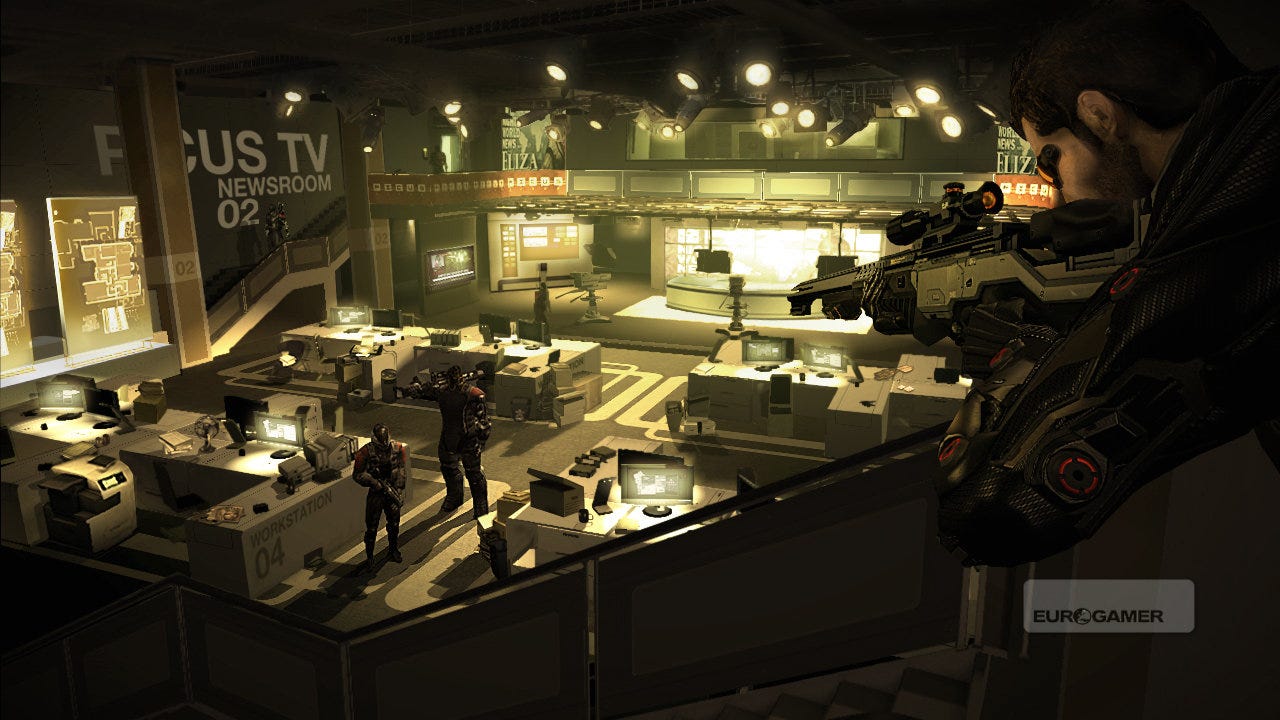
Looks like you might be able to meet the pretty lady who reads out your various misdeeds on the nightly news...
Eurogamer: In terms of how it all works, such an important part of Deus Ex is the experimental nature of the gameplay. How open will the action be?
Jean-François Dugas: All missions have multi-path solutions. It's not once in a while - it's all of them. We also have a lot of areas that are more open, like Detroit or Heng Sha streets - in the demo your saw today we went round two corners. It's much, much bigger than that.
Eurogamer: How much bigger? Give me numbers and statistics.
Jean-François Dugas: Big enough to lose yourself. It's not Fallout big, don't get me wrong, but there are a lot of streets, back alleys, rooftops, building interiors, sewers, conduits... There's a lot to explore.
In terms of how the game is open, and the experience of playing the game, one example I can give is in Detroit. It's early on in the game and as ever you have objectives: when you've done A you can move on to B and C.
The thing is while you're doing A you can come across something, and can hack it and shut it down. If you do that then right away one of your colleagues will call you and ask, "Jensen, what did you just do?" You say: "I don't know. There was this switch and I shut it off."
But as you progress and do the other objectives it becomes clear that what you've already switched off is actually the final objective for the map - only you did it at the start. So basically we support players that maybe go left when they're meant to go right, when it makes sense, as much as we can.
Eurogamer: And how about open gameplay within individual missions?

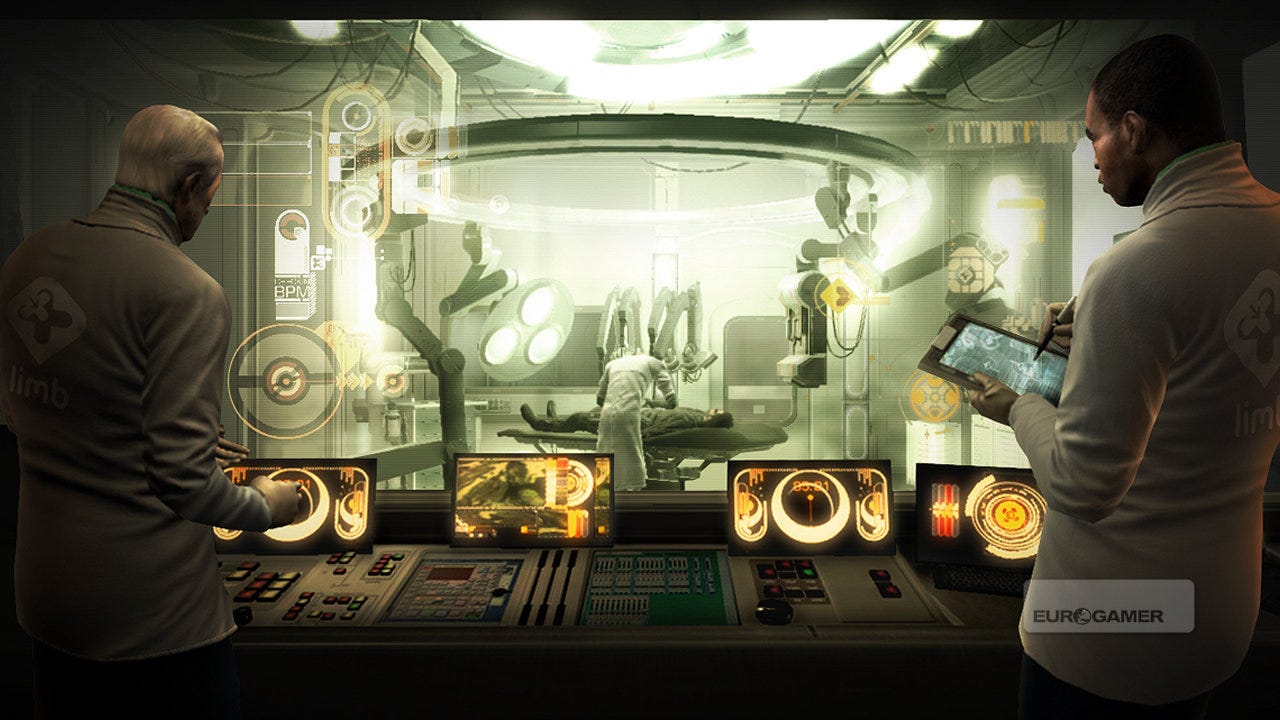
Jensen appears to be so cool that he even wears his shades when going under the knife.
Jean-François Dugas: In terms of that we have one mission in Detroit when you're meant to go into a morgue in a police station. It's been locked down, but you've got to retrieve some data. You can decide to go through the main door and through the police offices, but one officer will ask you to stop and not go beyond the lobby.
You can decide to go further, but you'll go into combat. Also though, there's a desk sergeant in the lobby that you can talk to - and if you do then you'll discover that Adam Jensen knows him.
They have a past together so you try to convince him to let you into the morgue; all the time though he has a grudge against you from something that's in the background story.
There are different ways to convince him - through full dialogue, or maybe with an augmentation that allows you to convince him... more heartily. If you do that then he's going to get really mad, and threaten just what will happen the next time he sees you.
So, much later on in the game, you might bump into him again - and he will have lost his job and he won't be very happy. Alternatively, you could have just found access to the morgue through the sewers.
Eurogamer: I did love the way that in Deus Ex the game would react to your actions hours on, or even on a small-scale level like when Manderley tells you off for going into the women's toilet. Is that something you're looking to replicate?
Jean-François Dugas: Exactly, that was an awesome moment. And definitely. In some places it doesn't make sense - there are places where we don't do it because of the story and the context, when technically nobody knows that you're there.
But when it's events that have been publicised within the game world you'll have things like characters say, "Erm gosh... were you forced to kill everyone in that building?" We want to keep that spirit in the new game.
Eurogamer: So are the hubs in Human Revolution directly comparable to the hubs in the original, say Hell's Kitchen and Hong Kong?
Jean-François Dugas: Absolutely. You can go left or right, there are streets and buildings to explore. There are people to meet who have side-quests. You can find weapon dealers that are hidden here and there. You can expand your experience outside of the critical path of mission objectives. I actually think the maps that we have are a little bit bigger than the one's we're talking about in Deus Ex 1.
Eurogamer: One of the biggest changes is the flip to the third-person, and the takedowns such as when Jensen leaps on two people unawares and stabs them. It's actually a little Assassin's Creed-y. Why have you gone down that route, how does it fit in with Deus Ex?
Jean-François Dugas: When we started to brainstorm about this guy being augmented, we wanted him to have some sort of weapon concealed in the arms. At the time Assassin's Creed II didn't exist, and they only had a small blade in the first one. It was somewhat remotely related, but not really. But we thought it was cool with our character, and moved forward.
Then Assassin's Creed II appeared with the two blades, and now you can see a correlation with ours more strongly, but that's what we were doing and we continued to do it.
With the takedowns you can either kill people or knock them unconscious, so the blades are a visual cue that you're killing them. And we wanted to go for the cool aspect as well.

You can go in stealthy, or you can make your presence known from the off.
Eurogamer: It does seem a bit more brutal than the earlier Deus Ex games.
Jean-François Dugas: We did that somewhat on purpose, we don't want killing in the game to be [giddy, excited voice] "Hey I just killed a bunch of people!" We want players to play Adam Jensen in the way they want to see him.
By making those takedowns violent it's not something you do lightly - some players will do it, others will think that they're not that kind of guy. We didn't want to portray violence in a glorified way.
For instance when you go up to a passer-by, point your gun at him and he cowers. For us it's more like, "You have a gun. You carry a responsibility. You can fire it, but there are consequences."
You're not just going in with a rocket launcher and having people not notice. People will say things like, "You have a gun! Remove it from my face!"
Eurogamer: Deus Ex is a very old game (and I realise that we're somewhat skipping over Invisible War here) but is there anything from the original that you thought doesn't really work in modern gaming, and that you're scrapping?
Jean-François Dugas: We didn't go into it thinking, 'That doesn't work anymore, cut it out!' It was more like identifying what we thought was really strong, and identifying what we thought was less strong. Then making sure we were taking the strong stuff and condensing it, while working out what we'd do differently with the content that wasn't so great.
At the beginning, when we were first developing Human Revolution, we had the augmentations and skills separate - like in the first game. Later on we realised that we wanted the augmentations to be centre stage of the experience and that the skills were starting to conflict with that. So we decided that they should be put back into the augmentations; so they don't exist anymore, they exist in augmentations.
Deus Ex: Invisible War actually already did the same thing, so basically we had to go full circle to understand that and do it ourselves.
Eurogamer: What different directions can you pull your character in if you were to max it out in different ways?

She's a pretty lady called Farida Malik. She flies a jet-copter for Sarif Industries. She has an iPhone stitched onto her knee.
Jean-François Dugas: You'll have enough money to buy all the basic augmentations if you want, but when it comes to the XP points that you use to unlock the abilities within a given augmentation - you won't have enough to max them all out.
Plus if you choose to spend money on cool weapons that you won't find lying around in the world, then that's less money to spend on augmentation.
Eurogamer: The manager of the bar is called Tong, and that clearly gets everyone's Deus Ex antennae waving around a bit. How important are nods and winks like that?
Jean-François Dugas: I don't want to spoil anything, what did you make of this 'Tong' guy?
Eurogamer: Well, I was trying to work out whether he was Tracer Tong's brother. Perhaps, seeing as he's augmented that might set up the Tong we know's opinions on nano-augments and technology by the time we get to the beginning of Deus Ex. I guess it's designed to get your mind racing.
Jean-François Dugas: Yes, if you're new to the Deus Ex world it's entirely standalone. But here and there there are flavours of the old game. Even in this E3 demo there are three or four Easter eggs. Tong, the references to the Triads, a familiar string of music with a bad guy and the mention of Versalife.
Eurogamer: Was there also an advert for the lemon-lime soft drink that Gunther Hermann prefers to the orange?
Jean-François Dugas: [Baffled silence] Erm. Okay?
Eurogamer: Well, maybe not.
You may also like...
-
Why Devs Owe You Nothing
-
Digital Foundry: PS3 Skyrim Lag Fixed?
-
Face-Off: The Darkness 2
-
EA evaluating FIFA Street features for FIFA 13
-
Who Killed Rare?
-
Gotham City Impostors Review
-
Sony admits "dropping the ball" with Demon's Souls
-
Kingdoms of Amalur: Reckoning Review
-
The Darkness 2 Review
-
CD Projekt: Witcher 2 intro cinematic "the most expensive asset we ever created"
-
Grand Slam Tennis 2 Review
-
Skyrim patch 1.4 now live for Xbox 360
-
Skyrim patch 1.4 performance tip: make a new manual save
-
Metal Gear Solid: The "Lost" HD Remasters
-
Epic's Sweeney on graphics tech: "the limit really is in sight"
-
King Arthur 2 Review
-
Mass Effect 3 FemShep trailer debuts
-
Next Xbox has tablet-like touch-screen controller - rumour
-
Double Fine Adventure passes Day of the Tentacle budget
-
Valve admits hackers accessed Steam transaction log
-
Blizzard legally opposes Valve's Dota trademark application
-
Skyrim gets high-res PC texture pack
-
Sony: The Last Guardian is making "slow progress"
-
Amnesia: The Dark Descent follow-up teased
-
Catherine Review


Comments (11) Latest comment 4 months ago
Comments threads automatically close after 30 days, but please feel free to continue chatting on the forum!
Comment below viewing threshold Show
Deus Ex: Invisible War actually already did the same thing, so basically we had to go full circle to understand that and do it ourselves."
Well they're already off to a bad start.
They talk like they have all this respect for the first game, and then go and do something stupid like this. Augmentations weren't "center stage" in Deus Ex, so why do that for this game? Just fucking leave it the way it was! That's what people want. IDIOTS.
Comment below viewing threshold Show
But they are in Human Revolution, as he clearly states. Some things will change, it's not a remake after all.
And I would like to see augmentations as central part. But I'm not "people" I guess.
Comment below viewing threshold Show
There are many reasons Deus Ex is a classic and Invisible War is completely forgettable; emulating one of Invisible War's worst changes isn't starting off on the right foot.
Having a normal skill system in addition to augmentations was half the RPG-like development of your character. They've taken that whole aspect away, just like Invisible War did.
Comment below viewing threshold Show
I don't see why it makes a difference if the augmentations *function* as skills, with multiple levels of ability, accessed by investing XP points.
Comment below viewing threshold Show
I can see why in IW they implemented the focus on augs. After all some of the moaning about the first game was down to comments like "why can my super brilliant agent not aim a pistol" and so on. it's not hard to see why choosing a focus on augs was seen as a way to avoid this. Unfortunately it just didn't feel like they'd quite nailed it, but in the grand scheme of things which made IW a much more forgetable experience than Deus Ex the lack of skills was probably quite far down the list.
It seems to me from reading the interview that they haven't gone quite as far as IW in removing skills. There's still experience points available (so you get that reward from exploration that was in Deus Ex but absent in IW) but they go towards improving your augs, which will allow a diversity of play styles without punishing players who don't like waggly crosshairs. I may still well prefer the original game's way of doing things but from what has been said here it doesn't seem like they've gone quite as far as Invisible War and still have an element of skills based progress.
Edit: Subtlesnake just said the same thing far more succinctly!
Comment below viewing threshold Show
You can't hide the fact that you are French.
How I know that!
Comment below viewing threshold Show
Ah, then I'm still people I guess. And I haven't even played IW. But as people I also see that it's not enough to just copy & paste the old game. And to be honest: the skills in Deus Ex weren't "the thing", not even one of the things that made the game a classic for me. It was the fact that the game world felt 'alive' compared to pretty much all other games. It was the freedom in how to approach a mission.
Comment below viewing threshold Show
I feel exactly the same way. Those were the core reasons I loved Deus Ex. The freedom it gave you in completing missions your own way and the dynamic, living feel of the world it created.
I actually quite enjoyed Invisible War as well. Not to the same degree as the first, but not too far behind either.
Based on everything I have read, Human Revolution seems like it is going to live up to the Deus Ex name. It is by far my most anticipated game.
Comment below viewing threshold Show
Exactly the same, I loved Deux Ex, by far best game ever!
Elissa Laser Eye Doctor Louisville