NEVES
Every now and then, you play a mini-game - either in a collection of such games, or as a distraction in a larger game - and think to yourself, "hey, this would work as a full-size game!"
This isn't a thought that crossed our mind when we first encountered a NEVES-style puzzle. Simplistic in the extreme, the game's core idea will inevitably be familiar to most people - given a collection of geometric shapes, you need to slot them into position to make up a single shape. It's a classic puzzle game, but not, perhaps, the kind that makes for a full-scale game experience that you'd pay actual money to play.
After going through a worrying phase of NEVES addiction, however, we're not quite so sure. Conflicted, if anything. It's not that NEVES turns out to be any more complex than we'd expected - there aren't any hidden depths to discover here, unless you count a fairly straightforward two-player single-card mode. Instead, it simply transpires that the basic idea itself has significantly more legs than we'd expected.
The game offers up 500 puzzles to be solved, which should occupy a pretty substantial chunk of your time, and pitches the controls very nicely for the DS' stylus. It can take a little while to get used to spinning the pieces with the stylus, but once you pick up on it, the actual act of assembling pieces will be second nature - leaving you with a very pure puzzle-solving experience, whose interface never steps in the way.
You do have the option of turning on a count-down timer if the whole thing is altogether too sedate for you - and you can even enable a mode that gives you no room for experimentation, demanding that each piece is put into its correct position first time. However, there's a certain brain-teasing, Sudoku-like charm to simply solving the puzzles in your own time, spotting patterns in the pieces and learning to build up more complex shapes as you progress.
NEVES isn't going to win any awards for originality, or even for presentation - great controls aside, it's all incredibly minimalistic. But despite coming to the game with a deep well of cynicism in our souls, we've found ourselves rather taken with it. Perhaps not a full-price purchase, all the same - but it's a charming, relaxing little game, and further proof that the DS richly rewards those willing to take a simple idea and do it well.
7/10
Teenage Zombies: Invasion of the Alien Brain Thingys
About half an hour into Teenage Zombies, I realised that I was missing something vital. The game's disjointed nature (and its low production values), I realised, must be down to it being a tie-in with a cartoon series. It would all make so much more sense if the central characters were much-loved laugh-along pals for the 8-12 year old post-school TV brigade. So off I went to check my facts like a good little journalist, and along the way I discovered two pertinent things.
Firstly, there was indeed a movie called Teenage Zombies. It was made in 1959, is considered to be one of the top 50 worst films of all time, and has nothing to do with Teenage Zombies on the DS. It does, however, have a much better tagline; we'll take "Young Pawns Thrust into Pulsating Cages of Horror in a Sadistic Experiment!" over "Invasion of the Alien Brain Thingys" any day.
Second, there is no cartoon, movie, book or artificial colouring-heavy snack for Teenage Zombies to tie in with. This is bad all on its own - a game that looks and feels like a cheap, rushed and exploitative TV tie-in without actually being one.
The basic idea is that Earth is being invaded in comedy fashion by floating alien brains in glass jars - so you play the planet's rescuing heroes, a troupe of zombies who rise from their graves at the prospect of so many tasty brains to munch. That's quite clever, in a way. Unfortunately, within seconds it's degenerated to the level of a really, really dull platform game, and it proceeds to wallow at that level the whole way through.
At the core of the game are your three protagonists, each of whom has different powers that you need in order to move through the levels. Lefty is tall, and can extend her arms to reach ledges the others can't. Half-Pipe has no legs and trundles around on a skateboard, so he can dive through low gaps and fling himself down inclines. Finally, Fins has odd tentacles on his back that allow him to scale vertical walls, and has the best combat abilities of the trio.
All the action happens on the top screen, with the zombies' coffins displayed on the lower screen. At any moment you can tap a coffin to swap to that zombie, so the whole game is essentially an exercise in identifying which ability you need, swapping to that zombie, and proceeding. There's remarkably little puzzle-solving, and on the occasions when you do need to find a power-up to get through an area, you'll generally find it right next to it. The plodding pace of the game also makes combat incredibly dull, as you might expect.
On the plus side, Teenage Zombies' presentation really isn't that bad. The whole thing is styled like a retro comic book, and there are some nice little flourishes like the appearance of tutorial text boxes that you can actually clamber over and interact with as though they were part of the environment. The cartoon artwork also includes enough squishy zombie gross-out moments to entertain younger players - but not for long, since even pre-teens are likely to have finished the game within a few short hours.
4/10
Brain Assist
You know what the Nintendo DS really needs? It really needs more brain training games. Lesser mortals like you and I may have thought that Brain Training, More Brain Training, Big Brain Academy and their ilk pretty much filled this market, but SEGA knows better. SEGA knows that these games merely created a gaping chasm of longing in the souls of every DS owner, begging to be filled with cheaply turned out knock-offs.
Moreover, the DS doesn't just need any old brain training games. Oh no. What the DS really wants - and if you own a DS, then in some twisted little corner of your soul you obviously want this too - is a brain training game which dispenses with the pleasant, muted graphic design of Nintendo's high-budget titles. Instead, the visual experience should be as if a dying tramp has consumed the contents of Jackson Pollock's paint cupboard and is vomiting it furiously into your face.
Presumably satisfied that they'd got the colour scheme right (the "lurid and nauseating" section of the palette, with as many colours as possible on each screen - if that means a different shade of neon puke for each letter of a word, so be it), the developers turned their eye to the all-important content.
We can only assume, however, that there wasn't much time left in the schedule after they'd finished picking horrible colours and drawing really appalling graphics, so content had to get the boot. There are ten mini-games in here, ranging from the speechlessly insulting ("are these two pictures different?" questions which might as well be showing you side by side images of the Empire State Building and a dog's arse) to the downright ludicrous, such as a game in which numbers fly past so quickly you can't consciously register them, and then you have to try to remember them. Surprisingly, you often do, which suggests that the human brain is a wonderful thing, but then you recall that the people who made this game presumably used human brains to do so, and start to have second thoughts.
Essentially, you can probably see every scrap of content this game has to offer within two or three hours - but we don't recommend doing so, since your eyes will be hanging out over your cheekbones and steaming like a pair of overdone boiled eggs by that stage. There's simply no reason at all to touch this game. It's one of the most horrible-looking things we've ever seen, the mini-games are uniformly awful, and the whole thing comes off feeling like an obnoxious ten-year-old child was asked to design a Brain Age clone in half an hour.
On the plus side, there is single-card download play for wireless "fun" with up to four players. On the down side, if we really want to tell up to four friends that we despise them and never wish to suffer their company ever again, we can think of more direct ways to do so.
1/10
Ninja Reflex
Ellie's review of the Wii version of Ninja Reflex revealed that it is, well, pretty much exactly the kind of game we've come to expect Ellie to review - so it's fair to say that expectations were not running terribly high for the DS version when it popped through the letterbox.
The concept, unsurprisingly, remains the same. The path to becoming a cold-blooded and fearsome stealth assassin, it seems, is paved with mini-games - ranging from shuriken-tossing and katana-swinging through to that old ninja reliable, catching flies with chopsticks. The line-up of games closely mirrors those available on the Wii, but the controls have been pretty well converted to the DS. They're simplified in some instances, but they generally work nicely, and the whole thing is very slick and responsive - as you'd rather hope from a game that tests your reflexes, really.
Actually, "slick" is a reasonable description for the whole package. The presentation is great, and is arguably the most polished aspect of the whole thing - it's got nice visual design, and really clear, crisp graphics in the games themselves make it very clear what you're meant to be doing. Even the sound is pretty good, in a plinky-plonk traditional Japanese instrumental style.
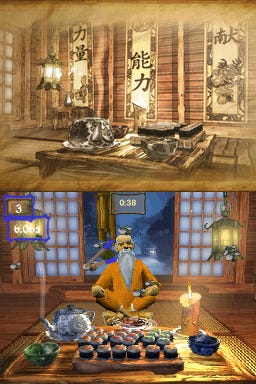
What isn't very good, though, is the fact that the game only boasts six mini-games. Yes, six. Now, the developers would probably argue that the addition of multiple modes in each mini-game means that there's far more to the whole thing - but honestly, we're not sure we care whether we're catching a Super Fly who buzzes around like a six-year-old who's just been fed Skittles for half an hour, or just twenty normal, less buzzy flies. We're still catching bloody flies by tapping on them.
The basic lack of content is a crippling problem. The game has a range of belt rankings to move through which increase the difficulty level as you progress, and it's all quite nicely thought out - aside from the baffling omission of any actual new games to play. Once you realise that you're stuck with those six, and that's your lot, all the great progression systems in the world aren't worth a rusty shuriken.
It's a genuine shame. The game is well-presented and polished, the control system works nicely, and the progression lays the groundwork for a really enjoyable experience - but the team decided to come over all Zen minimalism when it came to the games themselves. It's by no means bad, but there isn't enough of it to justify picking it up from anything other than the bargain bin.
5/10
Crayola Treasure Adventures
Reviewing games that are clearly designed for children is a fraught activity - and it's worth saying from the very outset that if you're even within spitting distance of puberty, let alone actually through the whole traumatic thing, then you shouldn't touch Crayola Treasure Adventures with a bargepole, let alone a stylus.
It's about travelling around, talking with a suspicious red crayon and colouring things in, and not in an arty, "child-like-wonder" Okami sort of way; this is the kind of game where the red crayon regularly expresses how happy he is to have a friend like you. In the hands of an aging cynic, it feels like it's designed for juvenile loners who'll end up buying those pillows in the shape of women's bosoms to sleep on later in life.
Looking beyond my oh-so-clever adult cynicism for a minute, though - because I can only do the "look at me, I'm poking fun at a game designed for toddlers! Guffaw!" act for so long before I feel like feeding my own face into a blender - Crayola Treasure Adventures is actually quite a confusing piece of software. I understand that it's not aimed at me, but I'm struggling to work out who it is aimed at.
The thing is, it's incredibly simple. There are a mere handful of puzzles - some jigsaws, all of them very easy indeed, some join-the-dots puzzles (which all boil down to drawing a circle, in essence) and some colouring-in puzzles, which just ask you to scrub bits of the screen. In terms of actual game, that's it - and I can't escape the feeling that any child who can read (required to follow the dialogue and instructions) and count (required for joining the dots) is probably going to feel quite insulted by the whole thing.
Rather better is the colouring book section, which gives your nipper a huge selection of Crayola colours to choose from, and lets them go wild on the DS screen, colouring in a library of images. Cunningly, the DS is actually better than a normal colouring book, in a sense - it detects which area you started colouring in, and doesn't let you go over the borders of that area until you lift the stylus. On the downside, of course, there's no way to print out or share your images, which makes us suspect that most proud parents would be better off investing in some real crayons for their budding Picassos.
Perhaps there's a market here for parents of very small children, who want to play the game with them - treating it, in essence, as an interactive storybook and colouring book. If so, then it probably hits that mark quite nicely - but the absolutely tiny amount of adventure content, and the fact that the puzzles simply won't be any challenge to a child of reading age, makes it impossible to give this game a particularly good score. We doubt it was on many wish-lists anyway - but for parents in the audience, honestly, we'd suggest easily washable walls and a nice pack of real Crayolas any day.
5/10
