Version tested: DS
In a JRPG landscape filled with identikit teenage protagonists, indistinguishable blacker than black antagonists and drab, clinical futuristic cityscapes, Dragon Quest IV is a deep breath of fresh air. This is, after all, a game in which you begin by assuming the role of a blue-mustachioed soldier in his fifties, a man who speaks in a thick, near-indecipherable Scottish brogue.
Ragnar McRyan is in no way a character designed off the back of some intense Japanese schoolgirl demographic focus testing. He is not aspirational. He does not wear a fussy, frilly shirt, unbuttoned halfway to reveal an over-designed amulet nestled betwixt stony pecs. He will never be a poster boy for a Dragon Quest Mountain Dew ad campaign in downtown Shibuya. He has a blue moustache.
A man approaching retirement, Ragnar is all tufty grey hair and regional accent, on a mission to catch a peeping tom and track down some missing children. And my goodness, for a game that was first released 18 years ago onto the NES it's a piece of anti-hero casting that feels braver and more interesting than pretty much any that's happened in the genre since. Doesn't that speak depressing volumes?
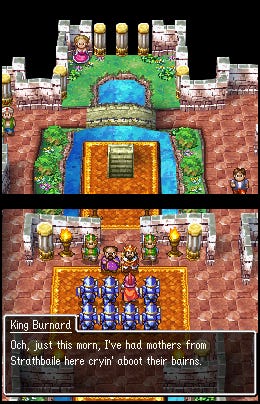
DQIV is bright and engaging, with 2D character sprites on 3D environments (using the PlayStation's Dragon Quest VII engine).
Better still, Ragnar is but one face in an ensemble cast that continues to buck expectation. The titular chapters exist beyond mere metaphor. This is a game literally divided into segments, each one focusing on a different character: the Russian tomboy and Tsarevna, Alena, the overweight trader Torneko, a man who decides late in life it's time to make his fortune as the greatest merchant in all the world and the twin sisters Maya and Meena, out to avenge their father's assassination.
Then, in the fifth and (almost) final chapter, each of these narrative threads string together as the chosen unite as a team behind you, the hero character. It's an excellent conceit, one that no doubt contributed to the diversity of the protagonists. After all, if you have the luxury of telling five different tales in your game, you can afford for one of them to be about Ragnar McRyan and his blue moustache.
At an hour or three apiece, the first four chapters are relatively brief, but this again contributes to rich and interesting feel: nothing is protracted so far as to become tiresome. The story is smoothed over by another solid translation from Square-Enix, whose recent localisation work on the Dragon Quest series has been exemplary. The diversity in accents (there are 13 dialects represented) lends the game world a real sense of geography, something that many JRPGs fail to do with their all-American voiceover casts.
Mechanically the game is straightforward but robust, albeit with an execution that will seem a little unusual to players unused to Dragon Quest's idiosyncrasies. For instance, during battles your characters appear as portraits on the top screen, enemies lined up in front of you on the bottom, with only a menu system to link actions between the two. Saving, and resurrecting fallen characters all takes place in churches, meaning you'll need to trek to the nearest town if you want to record progress, a design choice that initially seems to labour a metaphor rather than provide slick functionality, but which in time becomes second nature.
Happily, if your team is wiped out in battle you'll be returned to the nearest church without losing any of your accrued experience, money or items, meaning that you'll never need to reload a save irritated at having lost half an hour's leveling.
Of course, this fawning praise doesn't come without reservations. The plot is clichd, even if the narrative isn't; the option to quick-save only when on the world map is irritating and, while the environments spread across both screens, many of the most basic DS functions, such as touch-screen input, are ignored. By chapter 5 you'll have full manual control over all of your characters, but in the earlier parts of the game where the AI is backing you up in battles you'll curse its frequent idiotic decisions. Nevertheless, in terms of menu arrangement, and the nuts and bolts of interface design, this is better executed than last week's release of Final Fantasy IV.
This is a world of cutesy blue blob monsters and, as always, pea-green hills with nary a leather trenchcoat, sweeping fringe or steampunk motorbike in sight.
While the Dragon Quest series continues to struggle to find a western audience (despite continuing to be the most popular videogame series in Japan) its creator, Yuuji Horii, is to the JRPG what Miyamoto is to the platform genre. His games are bright and engaging, accessible but never dumb, funny without being sarcastic, joyful but never simplistic, sweet but never saccharine. Horii knows how to make you feel good about playing his game and, for those with the type of brains predisposed toward the JRPG form and function, his game design is irresistible.
At one point, when you complete your first mission as McRyan, the king you serve offers you a parting gift: thousands of free experience points. It's a cute idea lent more impact by virtue of the fact you then get to sit watching as your character methodically increases level per level for free. As an in-game reward it is wholly meaningful, directly affecting the strength and efficiency of your character. As a result the simple sonic fanfare at every level up fills your mind with stupid endorphins as game design and story work together in rare harmony. Sure, it might just be the sight of numbers increasing in an almost arbitrary manner - something surely we should have grown tired of by now - but it works.
This is, of course, an old game, built for one of the earliest Japanese consoles, now dressed up and made modern for a new generation of players unborn the first time around. But despite its age, Dragon Quest IV is a heavyweight update of a marvellous game. Indeed, it emerges as the strongest RPG for the system, an extraordinary feat considering its long journey to get here. Blue moustache and all.
8 / 10
