Doctor Who: The Adventure Games - City of the Daleks
"Geronimo!"

The hope is that as of 5th June this year, living rooms up and down the great British nation will face a sudden and irrevocable redesign. The first of four interactive Doctor Who episodes will materialise online, each a separate story yet built to be considered as an authentic part of the current Doctor Who series.
The living room sofa then, its castors squeaking and tangled in carpet fuzz, will suddenly be placed in front of the family PC (or Mac, if said family are posh London types) to act as a guard against a new entry point for the Doctor Who menagerie.
The dream is for those who are historically non-gamers to join us in our accustomed interactive bubble: mother and father up front on said sofa, earnestly discussing the doctor's next move, and 2.4 children hiding behind it, rolling their eyes when they come out to help with the difficult bits. Or indeed, vice versa.
Inclusion is everything: Doctor Who loves everyone equally. It's presumably because the Doctor considers the entire human race to be so very special.
However, the Venn Diagram that shows the bridge between hardcore UK gamers and Doctor Who fans has an extremely crowded centre - and although the conversation is great in there, people's ponytails keep on getting tangled. Vast numbers of fans are already comfortable with gaming, and they too demand high levels of entertainment.
Can City of the Daleks please everyone? Can the children of earth and their progenitors be amused to the same degree as my own, personal, tribe of increasingly middle-aged gamers who've been dreaming of blowing holes in eye-stalks and plungers ever since the introduction of the Special Weapons Dalek in 1988?
Probably not. Having played the most part of City of the Daleks, it's clear there are more than enough gameplay niggles to cause it problems. But the churlishness of this reaction is fairly extreme: these four downloads are free, earnest, authentic and part of a forward-thinking and exciting interactive strategy from Auntie Beeb. As a signpost for the direction we're going in, they're pretty mind-blowing.
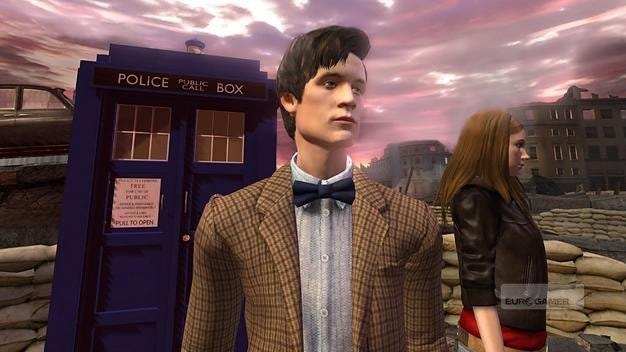
The game begins in 1963, as the Doctor and lovely lovely Amy Pond amiably chitchat about the Beatles in the Tardis - showing off both the excellent voice acting of the new leads and dialogue that (while not instantly hilarious) is happily on a par with that of the series.
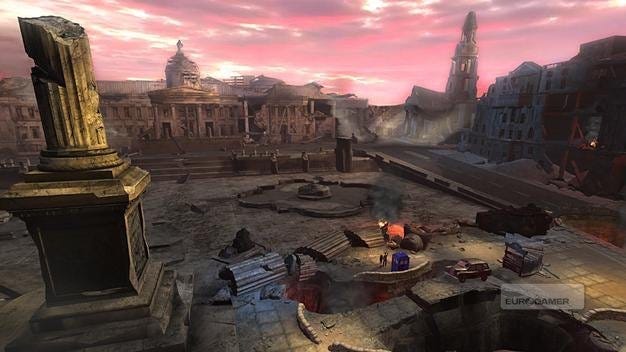
The Tardis then opens up on a scene, however, that anyone who's ever caught a Night Bus in central London will recognise. Trafalgar Square is a scene of chaos and destruction, full of undesirable characters wandering around in circles and talking to themselves.
The Daleks are patrolling the area around a decapitated Nelson's Column - and a cut-scene shows them taking 'Exterminate!' potshots at the last Earth survivor, a nice black lady with a taste for explosives and purple hipster clothing. Your first task, then, is to track her down in the Underground, and the way you're going to do that is through the medium of an old and much-missed friend: instadeath stealth.
First things first though. Unless you've got a thing for cursor keys, Matt Smith is controlled entirely through the mouse. Right-click has him manfully stride forwards in a Tony Adams-style upright jog (comparison stolen from an upcoming episode of Doctor Who: Confidential), left-click has him interact with objects and obstacles (climb/jump/talk/initiate mini-game) and the middle mouse button brings up a small-scale inventory screen should the Sonic Screwdriver need an airing.
Lovely lovely Karen Gillan, meanwhile, traipses along behind in case you need a brief chat about what you should be doing next, or if you just want to platonically gaze at her lovely face. In the presence of enemies, however, gazing at said lovely face is less of an option: both Doctor and Amy will automatically hunch their backs and enter stealth mode. Avoiding death is a serious business.