Version tested: Xbox 360
The turnaround has been astonishing. Guitar Hero launched in 2005, its first set-list composed extensively of cover versions, with the music industry's nostrils too busy sweeping lustily over cisterns to pay it much heed. Developer Harmonix was virtually required to shuffle up to record label doors, cap in hand, begging for whatever scraps of licensed music were lying around.
$2 billion and 25 million sales later, someone else is now wearing the trousers in this increasingly noisy relationship, and so DJ Hero arrives this week with an emperor's fanfare and a marketing budget beyond the wildest fantasies of the original Guitar Hero team. Indeed, as I type this, fizzing flutes are clinking at the DJ Hero London launch bash where, the game's official Twitter feed hics, "DJ Shadow two hour set rocked the house!" Not this one, buddy.
But the point is that DJ Shadow features heavily in the game, both as content and semi-shrouded avatar. And he's hardly alone. Jay-Z, Eminem, Daft Punk, Grandmaster Flash, Scratch Perverts, Z-Trip and DJ Yoda are just some of the Who's Who of stars actively involved in the project, from inception through to release.
Somewhere beneath this megabucks power-mongering is FreeStyleGames, and a tale of two studios: one in glamorous Leamington Spa, handling the game development; the other in trendier east London, devoted exclusively to mix-creation. It's this that starts to mark DJ Hero out as something different from other music games.
The 93 mixes on the game disc, blended from a pool of some 100 tracks, have been created exclusively and specifically for the title. At best, a Guitar Hero or Rock Band product is a game and a greatest hits compilation. DJ Hero's vital, varied, surprising and vast musical content is as fresh to a music gamer's ears as the gameplay is to their fingers.
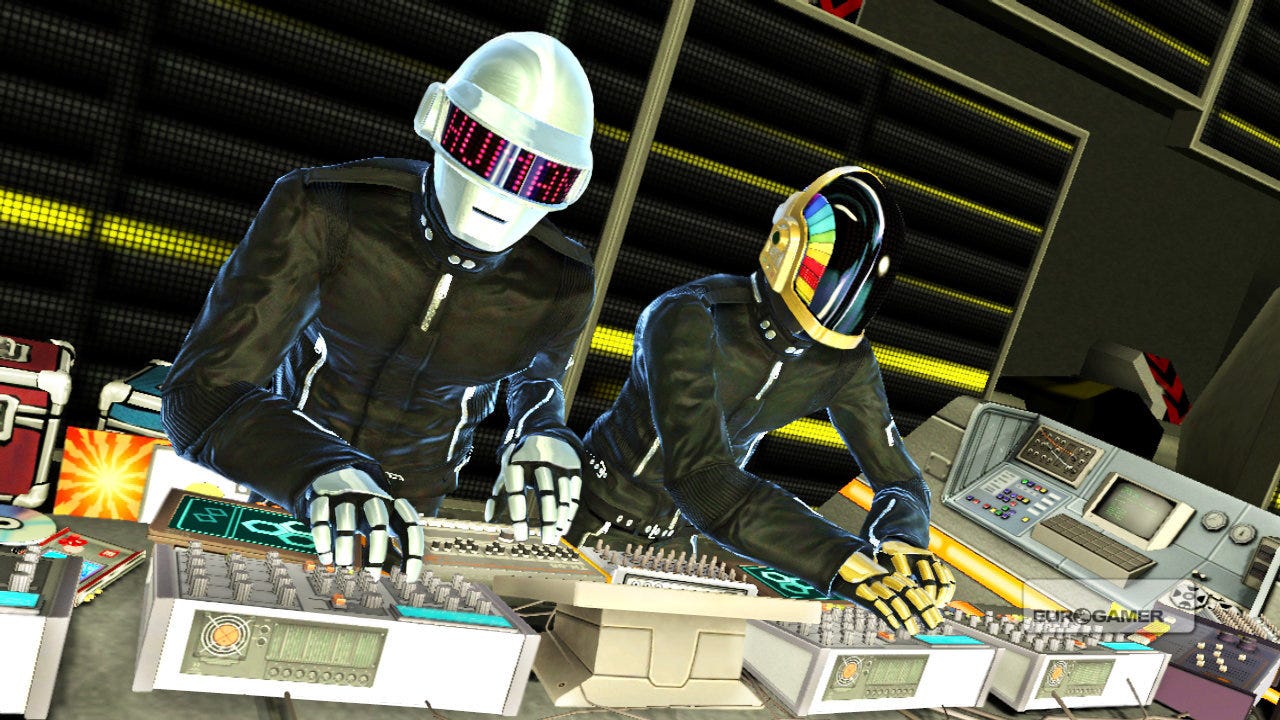
As a first-timer, DJ Hero boasts a phenomenal cast of superstar DJ talent, like sci-fi weirdos Daft Punk.
It's brilliant. Different strokes for different folks and all that, but it's hard to imagine any interested gamer not finding something to inspire them here, whether it's the cocksure Euro-sleaze of Queen crowned by Daft Punk, the prankish eargasm of Vanilla Ice melted into MC Hammer, or the synapse-frying relentlessness of Scratch Perverts' Noisia.
The music is divided into 24 distinct sets, some artist-specific - "Jay-Z Mixtape", "DJ Shadow presents", and so on - others compiled thematically by FreeStyle. This provides a compelling structure that accentuates the game's unexpected diversity, with some sets leaning heavily on frenzied scratching, while others fly more familiar button combos down the vinyl track at the player.
Let's talk turntable. While DJ Hero's peripheral carries the unmistakable, Fisher Price 'my first instrument' look pioneered by Guitar Hero, it feels pleasingly sturdy and, in the main, performs its tasks admirably - with one notable exception, which I'll come to.
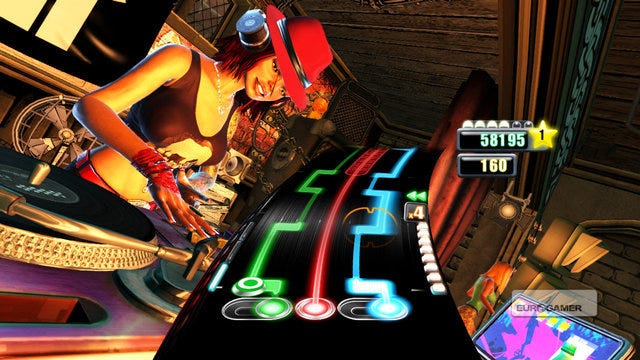
It can be frustratingly hard to cross-fade precisely in the heat of the action.
First, to recap how it all works: to simulate real-world dual turntables without requiring the player always to look down at the controller, blue and green buttons on the single platter represent left and right. The platter rotates freely in both directions through 360 degrees, though the only time you're required to give it a full spin is when activating 'Rewind' - a skill reward allowing you partially to roll back and replay to boost your score. Otherwise, short, sharp scratching is in order to match the on-screen patterns.
Mixes are performed by button-matching and scratching in time, switching left and right with the crossfader, then layering samples - either scripted, via the platter's central red button, or freeform via the 'euphoria' button at relevant points - and bending audio in real-time by twiddling an effects knob.
I've no doubt there will be many self-regarding 'real' DJs queuing up to call out Hero's inaccuracies and inconsistencies as a DJ experience. I can't comment directly since I don't DJ; what I can say, as a Guitar Hero-worshipping guitar player, is that I see such opinions as I do those of the binary-minded bores who scorn Guitar Hero because you can't suddenly break out into a minor mixolydian flourish mid-song. To do so is to miss the point spectacularly; the failure is one of imagination. What should be focused on ought to be obvious: how engaging it is as a game, and whether the simulated experience is actually fun.
A neatly-constructed training mode guides you through the various gameplay features step by step. This will be necessary for most, since there's a lot to digest, much of it of the rubbing-head-while-patting-tummy variety.
As with Guitar Hero, difficulty is graded Easy, Medium, Hard and Expert. On the easiest setting, the commands move towards the player the slowest, with strictly limited inputs required. Medium ups the ante with more adventurous crossfading and combinations. Hard raises the stakes considerably, adding specific directional scratching, and complex multi-tasking routines to master. Finally, Expert, in a similar fashion to Guitar Hero, tasks the player with performing every relevant detail: every note in Guitar Hero translates to every scratch in the mix - as implemented by FreeStyleGames' resident scratch man, DJ Blakey.
The experience is infinitely less fulfilling and engaging on the lowest setting. But whereas the palpable thrill of clutching a guitar compensates for the funereal Easy note tracks in GH and Rock Band, occasionally jabbing at the odd button or dial on a table or laptop tray is relatively dreary and charmless.
Crank it up a few notches, however, and it soon becomes clear that FreeStyle has created a thrilling, involving, refreshing, frequently sublime music game which, at its best, is effortlessly as good as any other rhythm action game I've played.
The learning curve is steep, and will prove a little dizzying to some at first. Practice, patience and persistence are essential if you aspire to conquer the game's most terrifying mixing peaks. But DJ Hero has been structured fabulously to nudge you gradually closer to the summit, with each progressive setlist ratcheting up the challenge, regardless of difficulty level.
If SEGA had made this, it would've been DJ Shadow the Hedgehog.
I pick up rhythm-action games quicker than most, and found I could negotiate the earliest tracks on Expert in no time at all. A week and a half after getting the game, playing it several hours a day, I'm still a million miles away from handling Scratch Perverts' Noisia - DJ Hero's equivalent of Through The Fire And Flames in Guitar Hero. If you're looking for challenge, DJ Hero smashes you in the face with it while tasering your balls.
What also delights is how 'videogamey' the music can be. Noisia essentially plays out like a multi-wave boss battle, with speech samples you launch taunting your abilities as the range and complexity of sequences is cranked up brutally. It displays an acute understanding of great rhythm-action gaming, as well as a refreshing self-awareness and sense of playfulness.
Happily, the turntable controller is as easy to use lying on the sofa as it is sat at a table or with it resting on the lap. But if, like me, your music game experience remains incomplete without a dignity-crushing performance element, nothing beats playing the game standing up with the turntable on a flat surface. On my own in my flat, I routinely find myself jigging in my imaginary booth, punching the air to rally my fantasy crowd as the beat goes on. Embarrassing and pathetic in equal measure, but loads of fun.
One very clever thing DJ Hero does is to create the illusion that you are actually making music. When an orange arc appears above a track, the effects dial can warp the music in real-time; outside of this the knob switches between a pre-selected list of cheesy samples that can be engaged during certain sections of the centre track by pressing the 'euphoria' button (euphoria is the equivalent of star power). And while cross-fading is entirely scripted, the combination of these elements - particularly on higher difficulty - offers an illusion of creative freedom not found in Guitar Hero.
Which is why it's disappointing that there are so few sample lists to choose from, ensuring that what is a novel if silly delight at first quickly loses its appeal through over-use. FreeStyle would do well to add a bunch more for free via DLC sooner rather than later.
Less compelling is the support included for guitar peripherals. It's not hard to guess why the developer has added this feature, and on the music side at least, thought has been put into creating rockier mixes with the likes of The Killers, Weezer, Motorhead and Foo Fighters making an appearance. But while the small number of guitar tracks play exactly as they would in Guitar Hero, playing through riff loops isn't the most fun in the world.
I also wonder, for all the talking-up of the game's universal appeal and accessibility, whether it's really that great for a casual user. You can't fail any songs, which is a pretty big and largely sensible gesture to this audience. And, since 93 exclusive mixes is in itself a pretty big draw, the drop-in-drop-out Party Play mode is an obvious but nevertheless welcome addition. Yet this is undermined, inexplicably, by most of the music remaining locked off at the start, requiring a large investment of time to make available.
Multiplayer, whether on or offline, isn't the engaging experience it could be.
This structure engages experienced gamers extremely well. But I'm still amazed that in 2009 - when even Guitar Hero and Rock Band have wised up - a supposed party game shuts most of its entertainment away needlessly. Does The Beatles: Rock Band's career mode suffer because you can play any song at any time? Of course not.
DJ Hero's party credentials take a further knock with the rather mundane multiplayer, which seems to have been added in with little thought on how to make it exciting. There's no engagement between players, and the score-chasing actually makes for a more tedious experience than single-player as both sides tweak frantically at the effects knob to eke out extra points, where you should be encouraged to apply it more artfully. It's there, and it works smoothly, but it's underwhelming and an area one would expect will receive greater attention in the inevitable sequel.
But perhaps the biggest issue of all is with the crossfader bar on the controller. Switching all the way between left and right works fine as there are definite endpoints. The problem comes when you're required to move rapidly to the centre and out again. There is resistance there allowing you to feel when you're centrally positioned, but it isn't quite enough and so initially results in lots of frustration as you go too far one way or the other and screw up a passage. The good news is, after a week and half's play, it's become largely instinctive (though not flawlessly so), but that's in spite of, not because of the controller.
The turntable controller: place on high stand or table for maximum shame posturing.
It's a relatively minor quibble in a game I remain blissfully hooked on. In many ways DJ Hero is a triumph, offering one of the most refreshing gaming experiences of the year and one of the best soundtracks of any music game. If you're a genre fan wearying of endless guitar-based updates, this is a thrilling shot in the arm; and if you're the type of rhythm-action gamer who relishes a ferocious challenge, you can probably add another mark onto the score.
Weak multiplayer and control issues prevent it from being the instant classic Guitar Hero was four year ago, but FreeStyleGames has nevertheless created a slick and enormously enjoyable music game that deserves to succeed and evolve.
8 / 10
