God of War AA coming to PC/360?

Can new MLAA match Sony's quality?

Custom anti-aliasing techniques are becoming increasingly popular among leading games developers. Last week LucasArts talked to Digital Foundry about the new AA techniques used in the forthcoming Star Wars: The Force Unleashed II. But the yardstick remains the quality level set by Sony's morphological anti-aliasing (MLAA) tech as seen in the phenomenal God of War III. Last week, AMD has released its own GPU-based MLAA implementation for PC and other developers are working on GPU solutions for Xbox 360. MLAA is going cross-platform.

Available now for the new Radeon HD 68x0 series of graphics cards (though available to 58x0 owners too via an unofficial hack), AMD's tech has received plenty of plaudits from the PC tech blogs, garnering particular praise for its excellent edge-smoothing capabilities along with the relatively unnoticeable impact on frame-rates. In good conditions MLAA can match the quality of 8x multi-sampling anti-aliasing (MSAA) but requires far less in the way of system resources. On the PS3, Sony's MLAA is parallelised over five SPUs and takes around 4ms of processing time - freeing up precious RSX resources.

AMD's solution has much in common with Sony's, but is fundamentally different in many ways. The fact that the God of War III MLAA operates on SPU has some very specific advantages - the Cell's satellite processors are far more flexible in terms of how they can be programmed, leading some to believe that GPU implementations will struggle to match the quality level.

More obvious to the end user, AMD's approach is a post-process filter that works through the entire completed frame, including the HUD and any on-screen text. This results in exactly the same kind of artifacting on text as seen with The Saboteur on PS3. As the MLAA algorithm works on the whole screen, it simply doesn't know the difference between a genuine edge and text, resulting in a noticeable impact to quality, along with occasional dot-crawl on HUD elements.
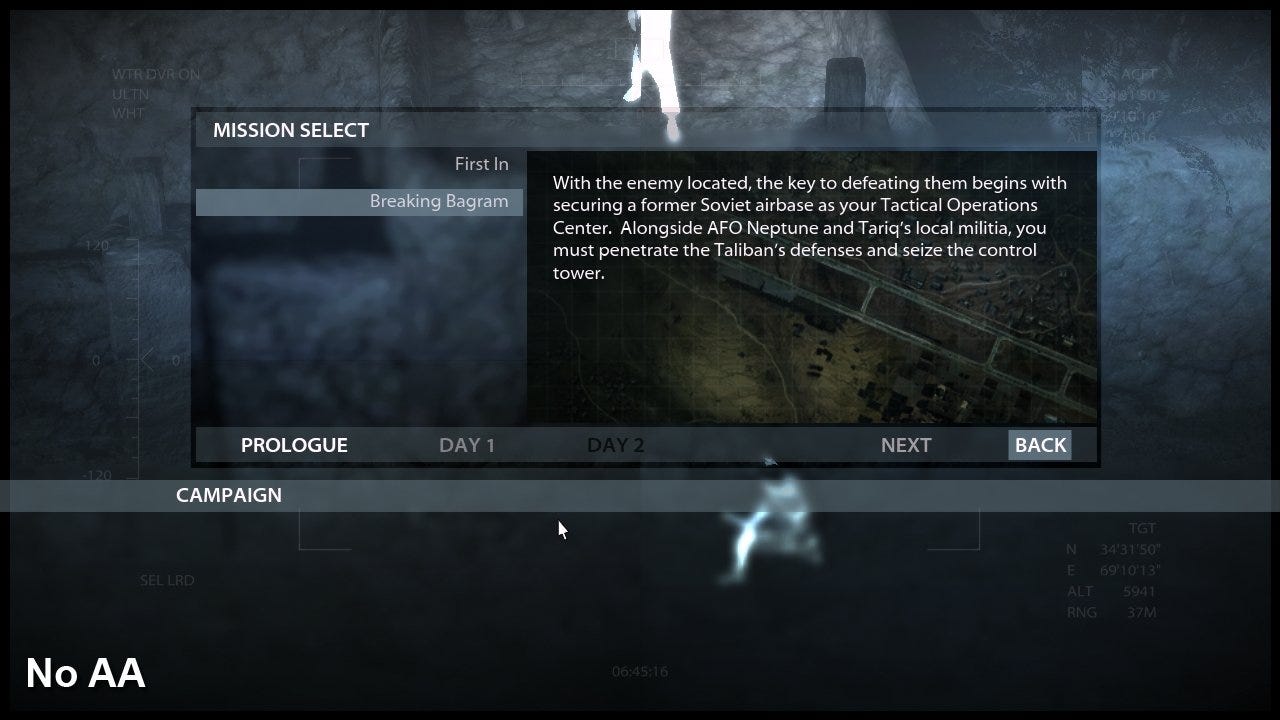
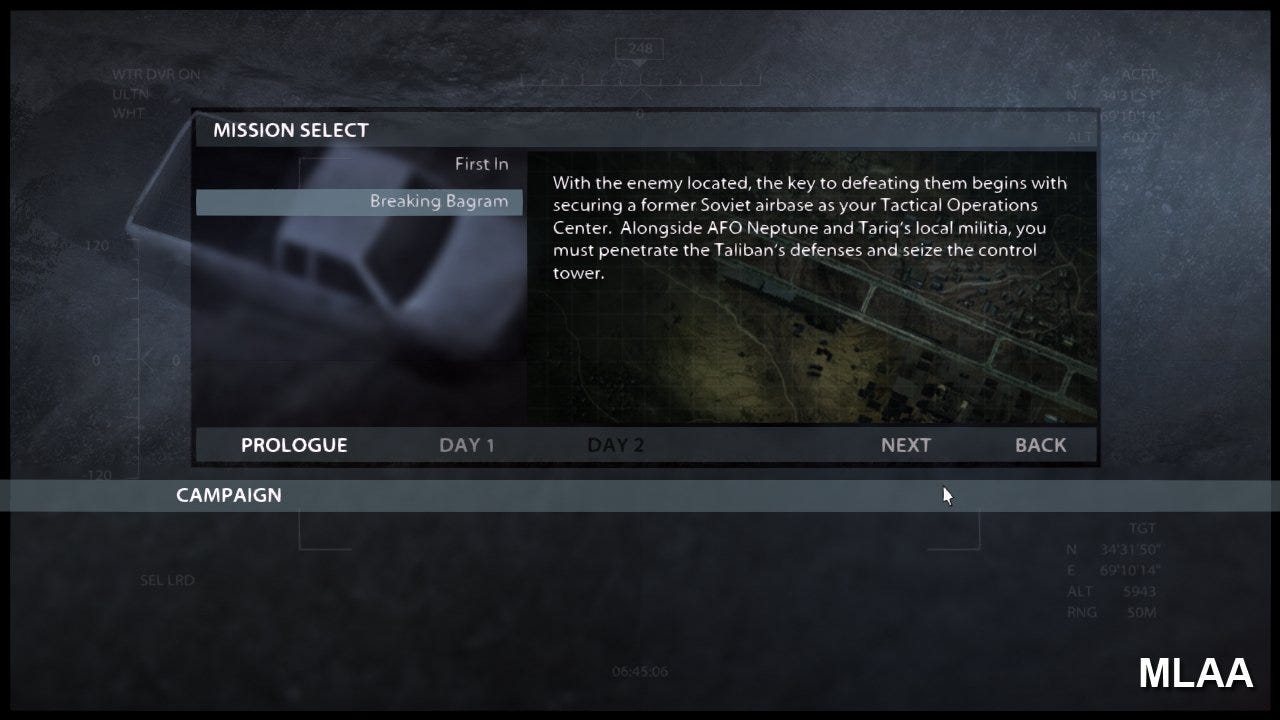
Artifacts can be minimised by running at higher resolutions, and the cards that the MLAA mode runs on should be able to cope with most - if not all - games at 1080p and higher anyway. However, the effects can never be eliminated with the current implementation. Sony's MLAA tech, in contrast, works on the frame before the HUD and text are added, producing a noticeably cleaner result.

So just how good is the image quality from AMD's version? Images like this don't exactly inspire confidence, but screenshots dotted around the internet show plenty of promise. Here are a couple of comparison shots. Apparently, AMD's MLAA can't be picked up by the usual range of PC grabbing tools, but it's no problem for us since we take our data losslessly direct from the DVI port of the GPU via our TrueHD capture card. What your monitor displays, our capture tech records.
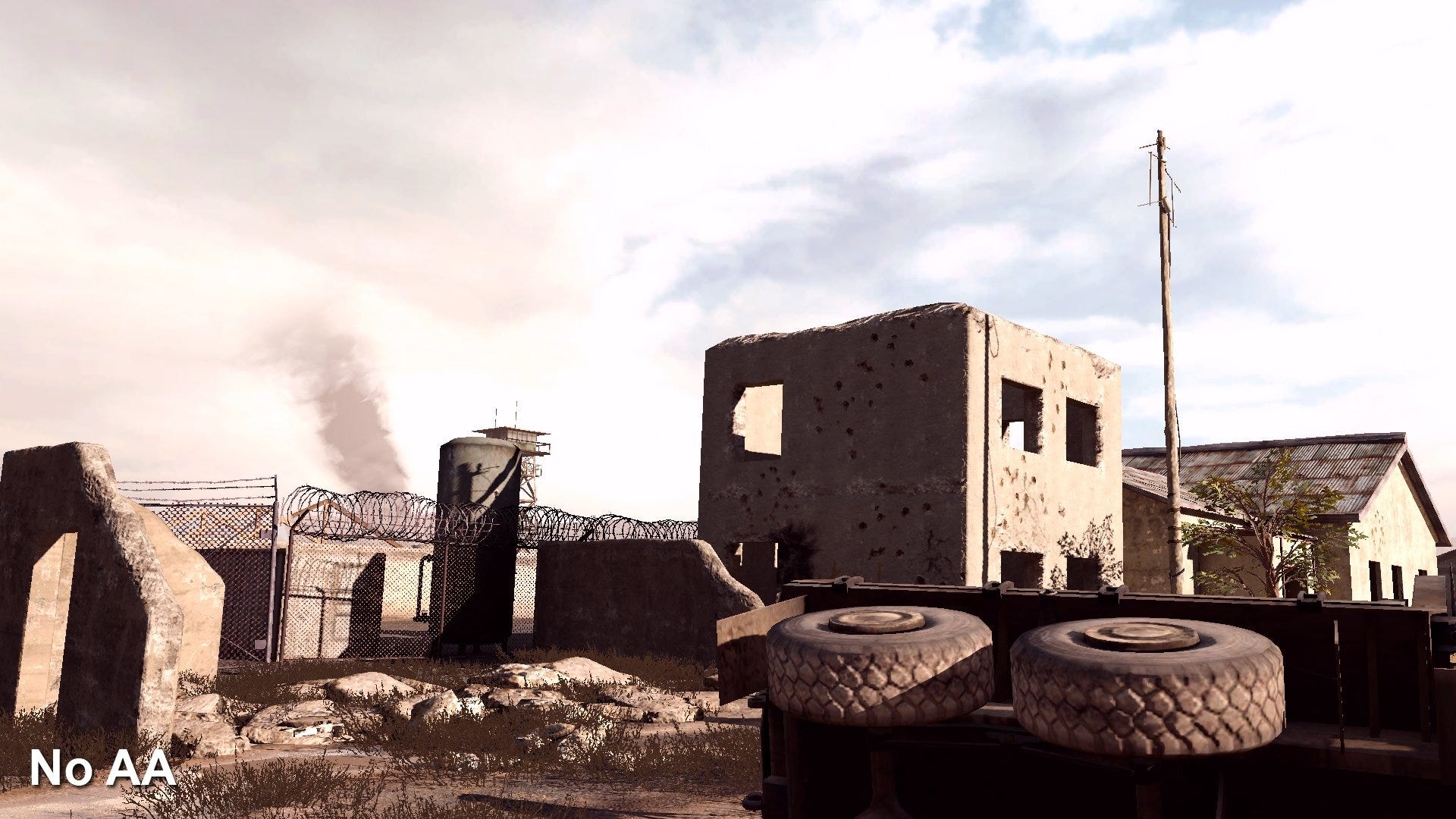
Based on the quality of the shots, MLAA in this guise comes across phenomenally well, but having witnessed it in motion, there's a definite sense that the implementation is closer to the original Intel proof of concept as opposed to Sony's refined version. We know a lot about this, having worked with a compiled version of the sample code and processed a number of different games with it.

At the time we were hugely impressed with the quality of the still shots, the quality of the games in motion was far less impressive, and DICE's rendering architect, Johan Andersson, shared his thoughts on the drawbacks of MLAA.

"On still pictures it looks amazing but on moving pictures it is more difficult as it is still just a post-process. So you get things like pixel popping when an anti-aliased line moves one pixel to the side instead of smoothly moving on a sub-pixel basis," he said.

"Another artifact, which was one of the most annoying is that aliasing on small-scale objects like alpha-tested fences can't (of course) be solved by this algorithm and quite often turns out to look worse as instead of getting small pixel-sized aliasing you get the same, but blurry and larger, aliasing which is often even more visible."

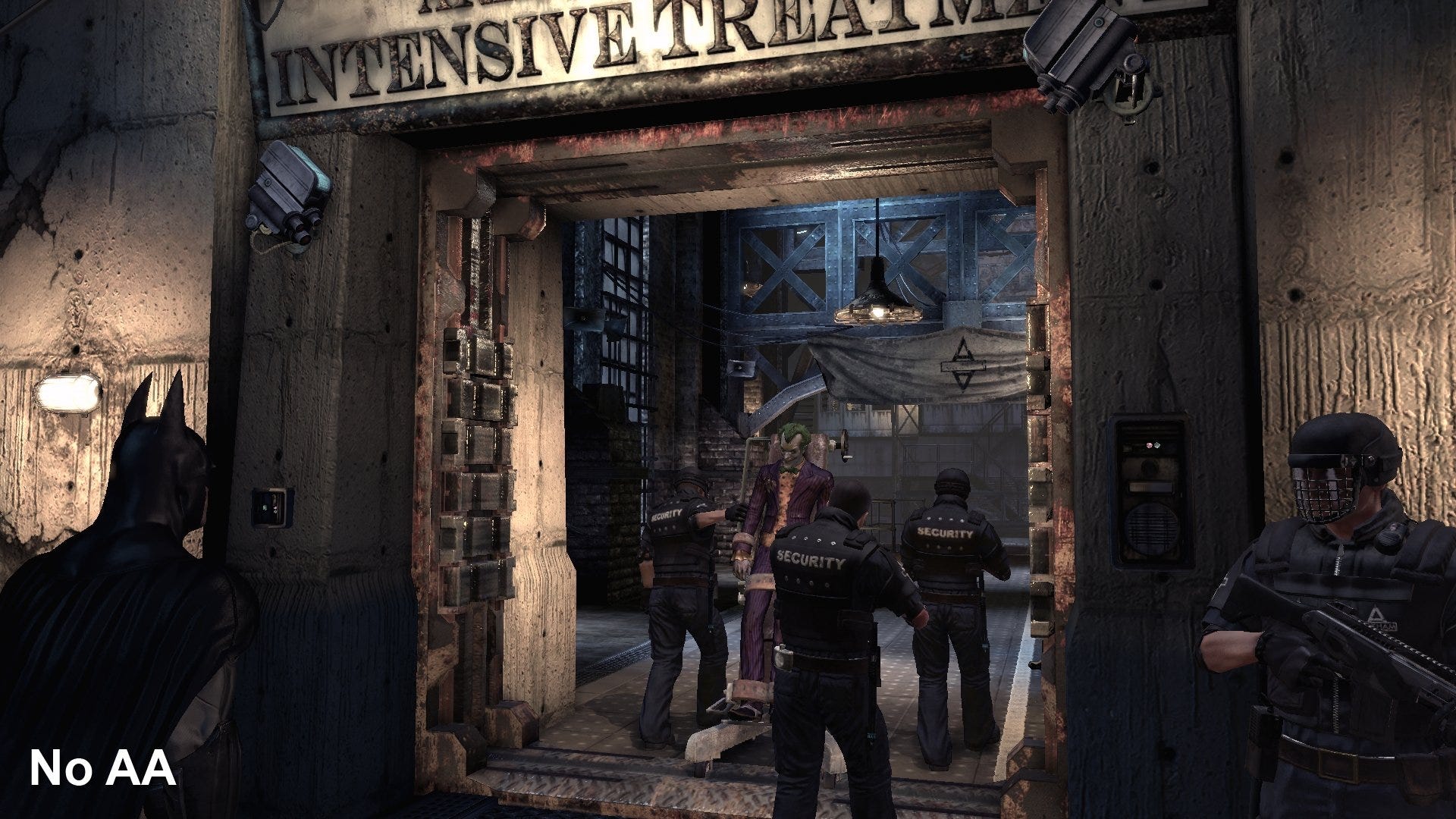
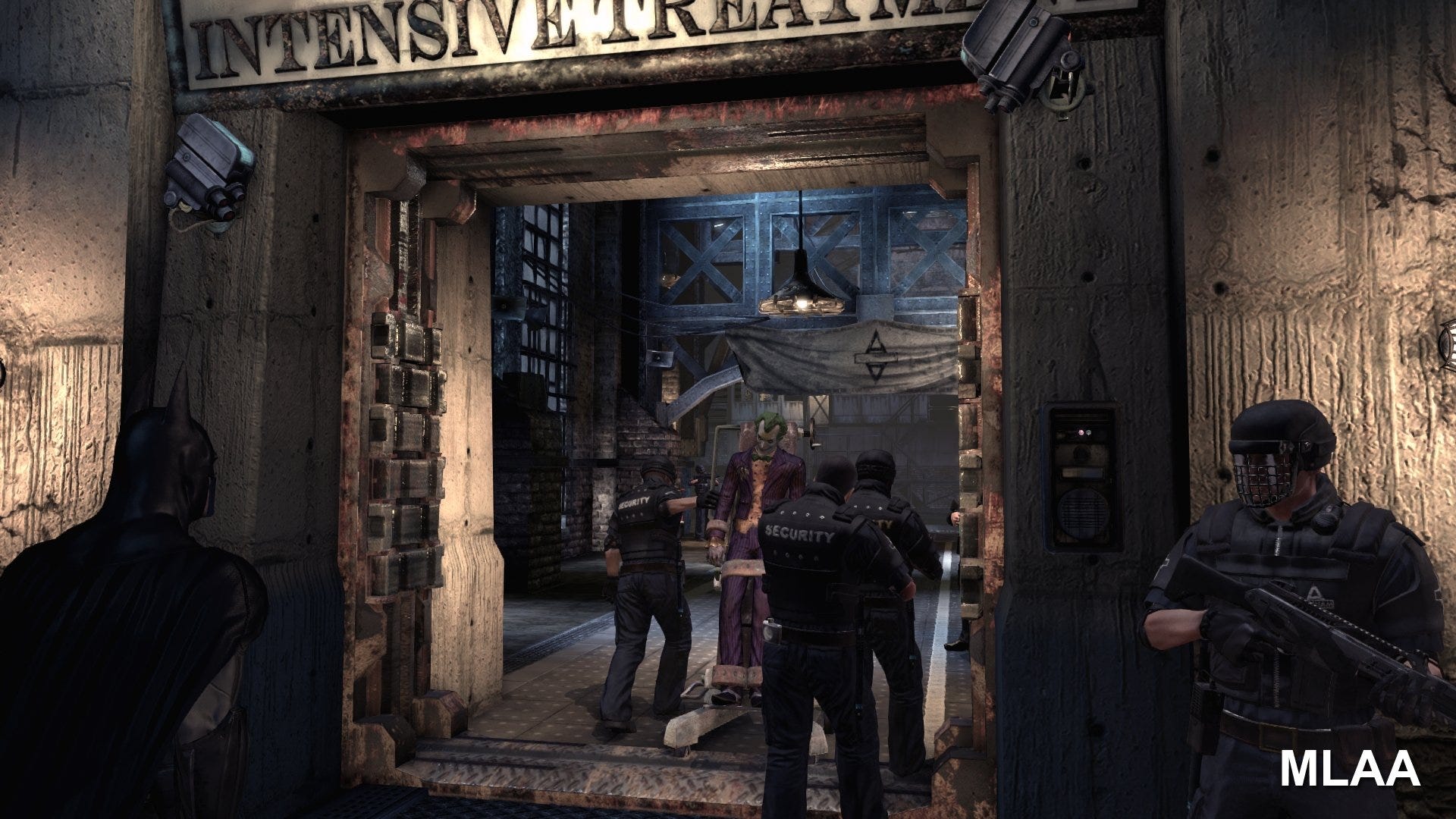
Andersson's comments, based on his own experiments with MLAA, appear to mirror closely the issues we see in AMD's tech. To illustrate, here's a 720p comparison of the PC versions of Danger Close's Medal of Honor (somewhat notorious for its "jaggies" and the inadequacies of its built-in AA option) and Rocksteady's Batman: Arkham Asylum.

No anti-aliasing up against the AMD MLAA implementation. Use the full-screen button for HD resolution or click on the EGTV link for a larger window.

In the Batman scene we can see both the good and bad of MLAA. Prominent foreground edges are effectively smoothed off, but far off geometry exhibits exactly the kind of pixel-popping that Andersson warned against. The blur effect is constant regardless of depth, making sub-pixel edges actually much more prominent than they are when there is no anti-aliasing in effect.

With the Medal of Honor clips, we see another perfect example of what Andersson describes - alpha-tested fences do indeed suffer because of the filtering, plus we see the effects of HUD artifacting and more pixel-popping.

Comments (40) Latest comment 2 years ago

Comments for this article are now closed, but please feel free to continue chatting on the forum!

  • matrim83 #1 2 years ago

    Good thing if you are one of those people who find jaggies a game breaking flaw. Going by the forums there are a quite a few of those.

    Personally it doesnt really bother me at all. Even in SD games played on an HD tv. Guess I am one of the lucky ones. So I will use it if the option is there and it doesnt impact performance but I am fine without it as well.
    Edited by matrim83 at 26/10/10 @ 14:06
  • lordofthedunce #2 2 years ago

    SEO friendly headline there ;p
  • Big-Swiss #3 2 years ago

    I didn't understand a goddam thing...........
  • Widge #4 2 years ago

    This is why you don’t spam out consoles every 3 years like some idiots demand, developers out there can actually do rather cracking things with existing hardware.
  • Widge #5 2 years ago

    Ok I read that as a good solution for PC cards doing 1080p+ resolutions with some devs looking into a multiplatform implementation that apes the PS3 specific one. Which is pretty much good for multiplatform parity I’d say?
  • sink257 #6 2 years ago

    Some great work by the red team there, I'm itching to grab a 69xx series card anyday now. My 8800GT has lasted me long enough.
  • Zappa #7 2 years ago

    cant beat the SPEs!
  • coolbritannia #8 2 years ago

    Misleading title is misleading.
  • NewbieZilla #9 2 years ago

    But... But... The powah of the cell!
  • Retroid #10 2 years ago

    For god's sake will someone change that headline to "God of War's AA technique coming to PC/360?" please?

    /Fears for sanity
  • Sharzam #11 2 years ago

    I find the idea of a console technique making it way to PC a fascinating one when you consider the raw horsepower available to a gaming PC. As a lot of PC developers have sat on just pushing up the hardware requirements rather than using refinement.

    MSAA has been a big resource hog for years, yes PCs have had it before consoles could even dream of using it in any form but in alot of cases you simply cant make full use of it (also why the hell do Nividea cards support X16).

    I personally try to use X4 in all games as i find it the best balance between image quality and frame rate however there are plenty of games when i dare not go above X2. So this new solution might be a good way forward and evolution.
  • BOBBYLUPO #12 2 years ago

    I find these articles fascinating but, to my eyes, it's like the world's hardest game of spot the difference.

    Though in example 2, the MLAA seems to have added some men with beards and guns.
  • lcmnick #13 2 years ago

    Post deleted at 12:48:44 14-04-2012
  • richarddavies #14 2 years ago

    @Bobbylupo Glad im not theonly one.

    I keep looking at these pics and I don't even know what im supposed to be looking at half the time. It wouldn't bother me if they were comparing stuff that impacted gameplay or your enjoyment in a game but the crap they compare on this, it's just like does it matter really?
  • Darren #15 2 years ago

    I have ATI RADEON HD 5870 graphics cards and with the 10.10a Hotfix drivers and a simple INF hack I was able to enable MLAA in the Catalyst Control Center (CCC). Currently it is only supported officially by ATI for the new HD 6850/6870 cards but I can confirm it *DOES* work with the HD 5800 cards but results are mixed.

    It only seems to work with DirectX 9 titles at the moment; any DirectX 10/11 games won't work (so that unfortunately includes BioShock and BioShock 2 under DX10). You just enable the Morphological AA option in the CCC and pretty much any DX9 game will use it even Mafia 2, Arcania: Gothic 4 and GTA IV. It works well enough but text and HUD elements are distorted slightly.

    As an option though for games that don't support traditional AA this is a great extra especially for console-to-PC ports which usually lack AA support.
  • FogHeart #16 2 years ago

    Well! Ask and thou shalt receive it would appear! (see last paragraph)

    [link url=http://www.eurogamer.net/articles/digitalfoundry-lucasarts-on-tfu2-tech-blog-entry/comments#comment1950675
    ]http://www.eurogamer.net/articles/digita...[/link]

    Well, it may be early days, but it looks like we're all going to settle on an AA scheme applied universally that produces good results. Hurrah! So we just have to concentrate on everything else....

    Good job to AMD, as 'ATI', they've historically been ninja with their fast AA algorithms. On my PC with their cards I could often crank up the AA with little drop in framerate.
  • JoeGBallad #17 2 years ago

    The day I get excited about anti-aliasing is the day I fellate a gun barrel, Old-Snake style.
    Edited by JoeGBallad at 26/10/10 @ 16:18
  • arcam #18 2 years ago

    ^ This is why we have developers and technical specialists work on image quality.

    Gaming would be in pretty bad shape if it weren't for the people who make small and large technological breakthroughs every year. It's not exciting (for you) but it is important.
  • Zeburdee #19 2 years ago

    Beyond the consoles, would be great to see this implemented into drivers on PC for mid-range gaming laptops for the same reason...

    My trusty old(ish) nvidia 9600m based lappy plays a lot of games great at 720p, but smoothing things out like a baby's 8x anti-aliased arse would be super nice.

    Also, looking forward to God of War finally coming to PC and 360. ;)
    [SEO results... New visitors: 28,493 Immediate bounces: 28,493]
  • Bonders99 #20 2 years ago

    Rather a disingenuous headline. Either for controversy or hits. The latter I would think. Come on Eurogamer surely you are far better than the red top tabloids ?
  • lagoonalight #21 2 years ago

    Bullshite the SPU's are NOT available when running MLAA. This donkey is a douche. That must be why we see better physics and intelligence in games like Infamous 2 and GOW3 and then for sure KZ3. I am sure it doesn't help but it is all up to the programming. This guy is a tool.
    Edited by lagoonalight at 26/10/10 @ 17:53
  • drumbaby #22 2 years ago

    PS3 has already got Halo Reach's Dolby implementation? Say what??!!
  • layleeloo #23 2 years ago

    haha thats it - bring it out on PS3 just when its said to be a dying game on PS3. Why even bother? The series should shop now when its on top, and not go down hill like many IP's do. Unless they something astonishing wit it - nothing they can do will make it feel fresh again as there is so much similar around like Heavenly Sword, Castlevania etc. A bit boring now..
  • BuckEntropy #24 2 years ago

    Cool read, but now I have all these new questions!

    As with the TFUII article, I was already wondering if, even theoretically, the DLAA (and now MLAA) process could be facilitated by the smart-RAM on 360. I do wonder if MS is restrictive about that though, reprogramming the eDRAM is clearly something outside of DirextX protocols. But if not it would irk me to think of all those logic circuits sitting around doing nothing at all...

    It also seems like the 2x MSAA to MLAA could work great on 360, for games that really want the IQ. But I believe the MSAA resolve will normally output directly to main RAM, which would mean the frame has to be copied back into eDRAM again for the new process. Which may not be that big an issue, and then the HUD elements could be applied after that step as well.

    It'll be interesting to see the results, too bad it'll probably be a while yet, if ever.

    EDIT: @lagoonalight - *smacks head* GoW3 is the only game there that's already used MLAA, and it's physics and "intelligence" are superior to... WHAT? Are you truly incapable of understanding the idea that if a processor is fully engaged on one task, it can't magically be doing another at the exact same time?
    Edited by BuckEntropy at 26/10/10 @ 20:25
  • Lord_Gremlin #25 2 years ago

    Well, I saw that technology in Saboteur and God of War 3 on PS3, and it's really good in a way that it removes any jaggies completely.

    Some people don't care though.
  • Grayfox32 #26 2 years ago

    im assuming PS4 will utilize some type of POWER CORE IBM architecture with some spus on the side to give perfect image quality at 1080p
  • Moarachanox #27 2 years ago

    @Grayfox32

    First Sony finish the PS3, not a psp story please, or i get a wii
  • RKOwned #28 2 years ago

    If this can be applied to Multiplatform games, this could maybe fix the Multiplatform AA differences we see with some games.
  • edhe #29 2 years ago

    Yeah nice to see better techniques being used instead of just ramping up the power of the silicon. In the long run that means better overall image quality across the board, with less performance hits.

    Should be interesting to see how things change over more time with this gen.
  • bloodflowers #30 2 years ago

    I wish games let us turn AA off, to be honest looking at the comparison screenshots above, in both cases the no AA shot is far easier on the eyes, all the detail is much easier to pick out. Hard detail is also displayed much better on modern TVs with all their picture processing.

    At high resolutions you just don't need it, give us the option at least.
  • davidov92 #31 2 years ago

    I'd much rather have no AA at all than this console B.S. This is just random, complete blurring of each frame, not real AA.
  • womble #32 2 years ago

    It's not "random blurring" at all.

    It's the opposite. The technique specifically looks for aliasing patterns, and attends ONLY to those patterns.
  • RKOwned #33 2 years ago

    AA is only a issue when it blurs the image enough to lose detail in the image quality, like QAA does.
  • vizzini #34 2 years ago

    Clearly, screen space anti-aliasing techniques are still an important tool to remove aliasing artefacts, but I think when many people say they can't see the benefits, I feel like developers are ploughing a lot of effort and system resources into solutions that suffers from diminishing returns.

    Greater geometry sub-division (ie more front facing polygons of smaller size) and better scenery/character modelling at the development level will provide higher fidelity imaging with smaller aliasing than this will.

    Look at the inadequate polygon count on the round(ish?) table in the Fable 3 video(1st 15mins)@ 10mins 38 secs in, ask yourself what you notice more, big polygon faceted hexagonal edges like those? or small aliasing artefacts?

    [link url=http://www.eurogamer.net/videos/fable-iii-15-minutes-of-gameplay
    ]http://www.eurogamer.net/videos/fable-ii...[/link]

    In games with vast amounts of fragment shader lit geometry (of higher order sub-division), you can get away with less aggressive AA at the model space or screen space level when the camera is static, and you need almost no AA when the scene is in motion, provided the sub-division/tesselation produces triangles with small enough aliasing artefacts that they are anti-aliased by the camera motion itself.
  • womble #35 2 years ago

    @vizzini: the basic problem with that approach is that increasing geometry count is very expensive in terms of GPU load, file load, artist load and dollars.

    Whereas screen-space anti-aliasing is extremely cheap dollar-wise, is free artist-wise, and reasonably cheap CPU/GPU wise (relative to other AA methods.)

    The trick is to be able to do the AA at some point in the pipeline prior to the rendering of interface elements.

    Increasing scene complexity is not only extremely expensive, but it doesn't actually fix the problem.
  • BuckEntropy #36 2 years ago

    Plus, you know, sometimes objects just have straight edges?
  • duffster #37 2 years ago

    PC-wise, the only practical use I can see for this, is for games that don't include AA options (looking at you Gothic 4). I have the nvidia equivalent of a 68x0 card, and I run everything at least 8 x AA anyway if the options allow it, doesn't affect performance noticeably.
    Edited by duffster at 28/10/10 @ 10:12
  • vizzini #38 2 years ago

    edit1: Womble: @vizzini
    read above

    I know where you are coming from, but I don't necessarily agree that the GPU workload is comparatively more expensive for vertex unit processing, than fragment unit AA processing; especially if the CPU based PVS/Frustum culling/back face culling algorithms have been done well to start with. Screen space AA techniques typically require extra video ram and texture fetches and writes, so it is probably quite even.

    For the PS3 with each SPU being a vector-stream processor, it is probably a touch more efficient to give SPUs vertex unit work that the GPU normally does, rather than fragment unit tasks.

    It all comes down to getting maximum visual fidelity bang-for-your-buck imo, and using screen-space anti-aliasing techniques too liberally on PC hasn't been helping matters, or PC graphics to get the bigger bang.

    Too much emphasis on anti-aliasing is why we regularly get (6 quad) boxes occupy large amounts of screen space in modern games that are running on jet engine GPU/stream processors.

    If people still insist on cheaply modelling game worlds with big flat (metre squared) polygons, then graphically fidelity is going to look more and more odd as fragment processing increases. Doom3 & HL2 look good and fortunately fall below that too much AA for the geometry look.

    BuckEntropy: Plus, you know, sometimes objects just have straight edges?

    The real world has nothing that is truly flat/straight; or at least when you consider the shapes of the molecules or atoms they are comprised of. Even a lake (a so-called flat body of water) has a surface tension that is visible to the human eye as a shimmer.

    A flat textured/shaded polygon for a lake was fine before this generation, but when you can push 10x or100x the polygon count of the PS2, these things should have better geometry with the right balance of fragment shading imo.

    If a GPU can push eg 300Million polygons/sec, and the game should run at 30fps, then you'd be looking to see as many of those 10 million polygons in each frame, rather than see a fill-rate intensive AA technique used on 700 thousand per frame.

    When we discern digital FX in films attempting to pass of as real, it is usually the undersampling of geometry, and the resulting animation that the human eye sees as the error (or a lack of asymmetry edit2:), even if those scenes have been ray-traced and AA to death.
    Edited by vizzini at 28/10/10 @ 12:49
  • BuckEntropy #39 2 years ago

    DUDE! I just mean like, walls OK? If there's one thing you almost always see in games, it's lots of walls and ceilings and doors...

    Or are you recommending devs use more polygons to account for the molecular variance of a door jam? Even if they did, unfortunately, it'd still end up looking like a straight line, and have the exact same artifacting when viewed diagonally.
  • vizzini #40 2 years ago

    BuckEntrophy: DUDE! I just mean like, walls OK? If there's one thing you almost always see in games, it's lots of walls and ceilings and doors...

    I know you were, and I'm not saying that we are at the modelling molecules level yet.

    I'm just saying, that the best game visuals in this generation (and last) have a natural organic look about them, where even the straight walls have intentional geometric imperfections and the designers avoid using too much symmetry to simulate a complex living, breathing environment, like real life has. they don't start by talking about AA.

    God of War games already try to do these things correctly, so a great AA technique is just the icing to magnify the greatness of the underlying composition, not the main reason it looks so great.

    With a significant amount of generic looking games and sequels; that have an eerie deja vu look in every regular building, do you not wonder if it is even worth while giving them an AA polish at times?

    Focusing more on good sub-division/animation, with a few more polygons that can be procedurally perturb on the regular walls and doors you described, will do a lot more to the overall visual impact of your average looking game (with good gameplay), and it is visually cheaper than higher-resolution textures, normal mapping/parallax mapping and environment mapping combined on those 6 sorry looking quads.

    Anyone that has spent even a few years playing PC games and upgrading their rig just to pick the best visual graphics settings appreciates this problem only too well.