You have to wonder why it hasn't happened more often. Plenty of games have been 'inspired' by a good root around the library, but wholesale appropriation of literature has never really been the done thing. Could EA, then, not exactly known as a creative trend-setter, become just that with Dante's Inferno?
Glen Schofield, boss of EA's Dead Space-making Redwood Shores studio has got the bug. "You look around and there are some [books] that I won't mention, but you go, 'wow, I wonder whey they haven't made a game out of this before'," he tells us. "And I'm not mentioning them because I want to make games out of them. But this would be one of them. It's a great idea; it's brilliant."
We agree. Inferno, the first part of The Divine Comedy, scribbled down by Florentine poet Dante Alighieri in the early 14th Century, is as good a pitch for a videogame as you'll come across. A strong lead; a wise sidekick; a damsel in distress; a mesmerising array of enemies; nine vividly described levels; and the best end-of-game boss ever. Better than Halo.
And EA isn't the first to notice. Back in 1986, Denton Designs had a crack at the raising hell on C64. So without knowing a thing about EA's take, using today's tech to recreate Dante's journey through the nine circles of Hell is a mouth-watering proposition. Having seen it and played a chunk, it's a total no-brainer.
Over the course of the week, we'll be taking an in-depth look at the game through various features, a Eurogamer TV Show special, and a live interview with the team. (And, if you haven't seen it yet, we've got the world-exclusive first showing of the twisted new teaser trailer
. But today, we're focusing on the most important bit: how it plays.
'God of War meets Dead Space' was the phrase being whispered around the Internet ahead of Inferno's official unveiling. By the time we see the game, the influence is practically screaming out. Make no mistake, this is God of War, set in Dante's Hell, made by the Dead Space team. And if that doesn't get you excited, check your pulse.
EA's is unabashed by how brazenly Inferno wears its primary game influence. Indeed, the team claims it would be "incredibly flattered" by any comparison to Sony's great action series. But it's a mark of the fellow Californian developer's confidence that it has the temerity to take on God of War at its own game, with the absolute conviction that it can beat it through a combination of Dante's narrative universe, and the talent of the team.
If you've ever played God of War, you'll know exactly where you are with Inferno. And we mean exactly. X to jump, circle to grab, heavy and light attacks mapped to triangle and square, block and special attacks on the shoulder. Sounds familiar, doesn't it? In short, it's set-piece-driven, third-person action, employing the now unmistakable blend of melee and magic attacks against enemy hordes of all shapes and sizes.
The setting for Inferno is Dante's pursuit of his beloved Beatrice through the nine circles of Hell, after she is murdered by Death and her soul dragged into the underworld. In the literature, Dante is accompanied by the Roman poet Virgil, who guides him through the gates of Hell and down towards Lucifer at its centre. As you might imagine, a 14,000-line conversation between two poets isn't quite like watching Commando on fast forward, so EA has used a little artistic licence to beef up Dante and turn him into a throbbing, thrusting action hero.
Rocking it in Crusader chic and armed with Death's own scythe (which you get after bumping off the girlfriend-killing fiend during the tutorial level), digital Dante certainly looks the part. His arsenal is completed by a Holy Cross, given to him by Beatrice, which is used mechanically for magic attacks, but we're told it also plays a crucial narrative role in the full experience.
At the global unveiling, appropriately held in Florence, we get to play through a single section of the game, level three of the game proper, just after Dante has chased Beatrice through the gates of Hell (which Knight describes as "a bit like King Kong", presumably for those of us who only ever read The Sun).
Before the playable stage, there's a suitably dramatic cut-scene rendered in a distinctively charming medieval tapestry style, with stirring music and extracts of the poem intoned with ecclesiastical menace. Disappointingly, we learn that the animations are only placeholder, with the usual ILM-smashing CGI mini-epics promised for the final release. We don't doubt that these will look spectacular (as the trailer
attests), but it's not always necessary to throw money at an effects studio to make an impact. Sometimes less is more.
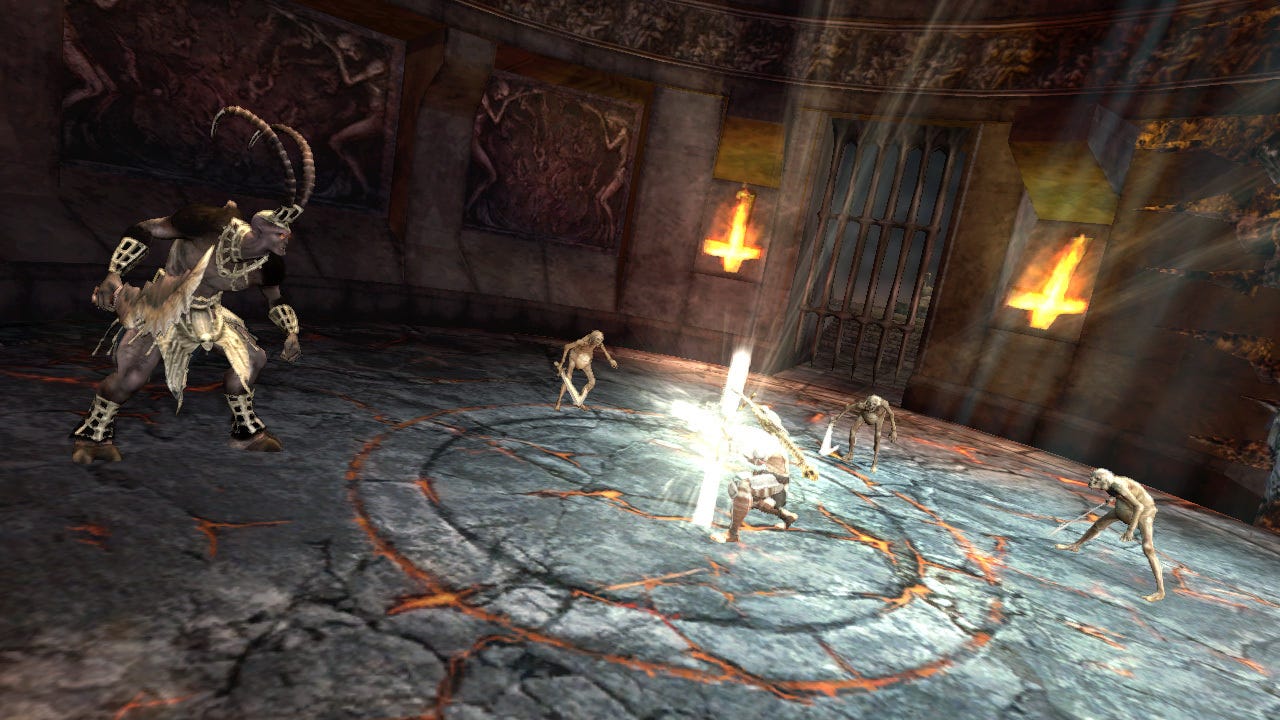
Control of Dante is fluid, responsive and satisfying. Initial waves of enemies, skeletal fiends that spawn from the ground like a Harryhausen movie, are thrown our way to get a feel for the controls. As with God of War, you can mash your way through these encounters untroubled, but your attacks can be finessed with mid-air grabs, throws, juggling combos and so on. And he's an agile chap, too, clambering across walls and up and down ropes with athletic ease.
The homage to Sony's title continues in the Cross-shaped status bar in the top-left, with two energy meters - one for health, the other for magic - replenished by collective coloured orbs left in the wake of dispatched foes, or prised out of chests with a few rapid taps of the circle button.
You'll gain more magic attacks as you progress; the only one available to us is Lust Storm, which produces a shimmering burst of supernatural energy to get you out of a tight spot; but we also saw listings for Sins Of The Father, Heart Of Cerberus and Suicide Fruit, which sounds like the cocktail menu in a goth pub.
The game's not out for at least another year, but is already encouragingly locked at 60 frames-per-second. And with Dante as level designer-at-large there's no excuse for a single wasted pixel in the construction of this virtual hell.
Even in a brightly lit room with multiple demo units and no headphones, the overall effect is powerful and compelling. The orchestral score is nothing short of stunning, swelling up and down with the tides of the action, strings thrashing wildly to high drama, and murmuring portentously during a carefully positioned lull. Sensibly, Virgil doesn't accompany you in-game; instead he plays the role of the omniscient narrator, booming out relevant chunks of verse at key moments during the action. It's all fabulously atmospheric.
Structurally, the playable stage sticks stubbornly to last-generation paradigms: clear away enemies; scoop up orbs; move on to next area; repeat. And progress is occasionally artificially blocked, by a wall of fire, for instance, until you've bumped off everything on-screen that moves.
This would rapidly prove a tedious formula were you simply slashing through samey sections and identikit foes over-and-over again. But at the core of Inferno's creative brief is a commitment to variety, surprise, freshness.
Knight tells us: "Obviously we want a game that feels absolutely long enough so that you feel you've completely got your money's worth. That goes without saying. But more important than length is that every level and every zone of every level gets attention from a designer. The way we work is each zone, even if it's just a combat arena, there's something about it, some object or some configuration of the enemies of the chest, or there's some little puzzle element to it or some secret area or clever way of moving the camera... Something that makes it unique from every other zone of the game."
It's the Gears of War 2 model: create a relentlessly spectacular, set-piece rollercoaster of a blockbuster, and gamers won't care if the core gameplay remains largely unchanged throughout.
"That's what I think people deserve," Knight adds. "That when they play through the game it's constantly fresh and you don't get bored and you don't feel you seeing the same patterns over and over again, and that the mechanics are being used in new and fresh ways every time. It's that novelty that we're going for and I think we've got the right design team to do it."
Speaking of which, in addition to the core team which made the excellent Dead Space, EA has hired Steve Desilet, one of the lead level designers on the Half-Life series and Oddword: Stranger's Wrath, and Mike Cheng, who worked on Metroid Prime and was lead level designed on God of War II (aha!). Meanwhile, Renowned fantasy artist Wayne Barlowe (stayed tuned for an interview with him later this week), is on character creation duties, and Knight teases that he's co-authoring the script with an "Oscar-nominated writer". The message is clear: this is a major new franchise for EA, and it's backing it to the hilt.
Back in the game, we encounter our first taste of an interesting mechanic tied intrinsically to the poem's themes of death, sin, punishment and damnation. Faced with a demonic soul begging for your mercy you are presented with a 'moral choice': Absolve or Punish. The concept of free will is central to Dante's belief system; in the game, he is deliberately presented as a more flawed figure than in the poem. Elect to Punish and Dante slays the demon by jamming his Holy Cross into its skull. We're not able to try out Absolve, but are told it triggers a mini-game which, if beaten, rewards you with double the energy. The moral: it's harder to absolve, but the rewards are greater.
It's highly reminiscent of the choice mechanic in BioShock, but with most of the game still under wraps, it's unclear what wider impact your choices may have. Knight will only hint at potential complexities, revealing that what begins as story of rescue becomes one of redemption. It's "less about saving Beatrice and more about saving Dante," he reveals.
Either way, it's fun violently shoving the cross into someone's face. If the early encounters are satisfying if standard fare for any God of War veteran, the first boss scrap offers a glimpse of the huge scale that promises to define Dante. Charon, the mythological ferryman of Hades, is represented as a giant galleon in the sky, its head at the bow, the deck its timber ribcage.
As the vessel soars through the sky, Dante must fend of a couple of enemy waves. With the deck clear, the camera pans to the starboard as a huge, hulking beast clambers over the side. At least 10 times the size of Dante, and under the control of a regular grunt, straddling its neck, it's a formidable opponent that requires strategic use of magic attacks and evasive manoeuvres (the right-stick rolls). Wear it down enough and you enter another God of War staple: a quick-time event sequence. Pull this off and you'll athletically bound up onto the beast's back, kill the rider and seize the reins for yourself. In control of this lumbering monster, you have access to its powers, including a double-fist slam and fire-breathing. It's an effective change of pace and dynamic.
Swatting away the remaining deck-based demons, you turn your attention to Charon. We won't spoil this bit for you, but suffice to say it's a deliciously satisfying end to a battle, after which Dante leaps with the beast from the crashing ship, clambering up a wall and racing to safety as massive stone platforms crumble and collapse beneath his feet. Replaying the level, we notice Charon in the distance, sailing serenely across the horizon, which is a lovely design touch, hinting at what is to come.
Beast-riding will play a major part in the experience, we're assured; and if the new trailer
is anything to go by, expect memorable encounters on a Shadow of the Colossus scale.
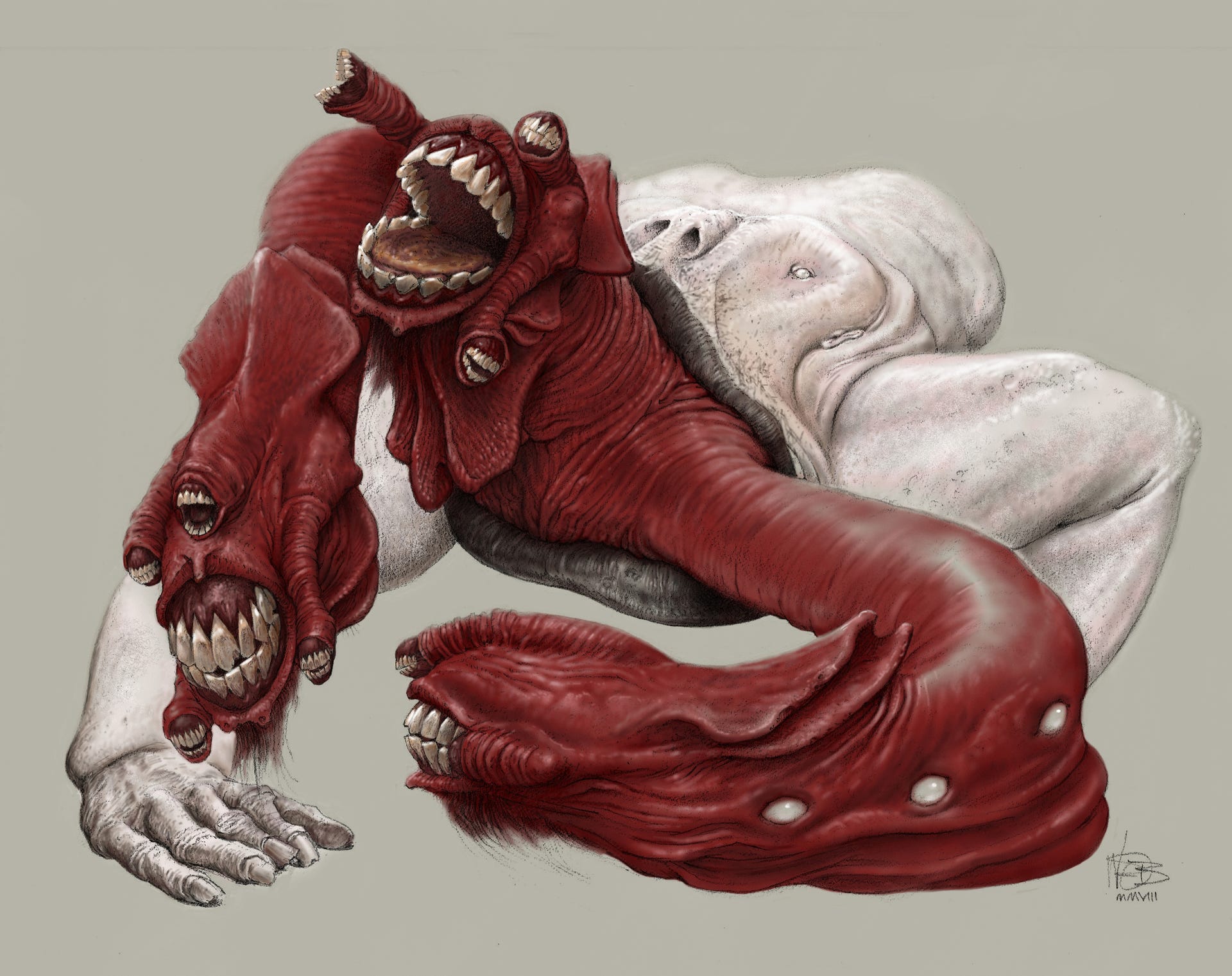
The playable section ends abruptly with a swarm of a new enemy, blade-handed babies, with the piercing shrieks of newborns, that we instinctively wince at while chopping up. Yuk.
So, with over a year to go before release, this snapshot of Dante's Inferno is already slick, gorgeous, thrilling, atmospheric and highly enjoyable. There's clearly still work to be done: AI can be dopily standoffish in larger-scale rucks; melee attacks, particularly during the boss encounter, don't yet given an adequate sense of physical impact; QTEs need randomising; and textures are patchy in places. There's plenty of time to fix all of these issues, though; and in truth, it's not often we see such an assured presentation so far ahead of release.
But it's impossible to ignore the elephant - or rather, the Titan - in the room. EA is sticking so stubbornly to the God of War formula that it will absolutely be judged against one of the all-time great action series. EA knows this, of course, and is talking the talk. But with God of War III expected to release later this year, and including - lest we forget - its own take on beast-riding, EA will need to pull off a blinder at the first attempt to compete (at least on PlayStation 3, the exclusive home of Sony's title).
What we've seen so far has impressed, but it's what we've yet to see that will make the difference. The pedigree of the team is good enough; the scope and imagination of the poem even more so. And Dante is a far more subtle and compelling character than the one-dimensional angry-man routine of Kratos.
Medieval Christian mythology overthrowing the gods of antiquity? Now that would be poetic justice for Dante.
Dante's Inferno is due out on PC, Xbox 360 and PlayStation 3 in 2010.
