Child's Play

The state of gaming for kids.

Once upon a time, the school holidays were heralded by the smell of freshly mown grass, the sound of the ice-cream man and a feeling of time unbound, carefree days that stretched on forever. Today, we know the school holidays are here because there's an influx of aggressively hyped animated movies at the cinema and their accompanying games fighting for attention on the shelf.

It's a shift in perspective rather than reality and ever since my son first voluntarily picked up a joypad at the age of two, I've been fascinated by the way he plays games, the things he responds to in games, and the surprisingly frequent parallels with my own first gaming experiences. I'm old enough to remember being intensely jealous that a friend had a ZX-81, with its chunky monochrome blocks, while my son will probably grow up harbouring similar nostalgic fondness for the innocent days of the Xbox 360, when games were only high-definition and had to be purchased on funny silver discs. The games that tickle our fancy, however, aren't all that different.

Strip away the advances in technology and you'll see that kids are perhaps the purest consumers of videogaming. Far from being some easily-distracted mass of attention-deficit brats, they often have a much more honest and untainted appreciation of what makes games fun. Having reviewed many children's games for Eurogamer over the past few years, I've often felt that the traditional standards applied to games criticism don't always work for this audience. In particular, derided concepts like repetition and linearity are almost always frowned upon these days, yet these are often the very things that make games accessible and fun for younger games.

Rather than falling back on the old roundup format, I'll be using two recently released kids' titles to explore these concepts in a little more detail. Bolt is the adaptation of the new Disney 3D animated movie about a TV star dog who actually believes he's the super-powered hero he plays on-screen. Ben 10 Alien Force is based on the new iteration of the phenomenally popular cartoon series about a young boy who can transform into ten different alien forms thanks to the power of a mysterious device known as the Omnitrix.

The aim, then, is to explore what makes a good children's game, to consider how this oft-maligned market can sometimes reveal bad game design habits that we've been conditioned to tolerate, and to offer a guide to the best games for kids available now by looking at the four design areas that I believe are key to making a successful game for children.

Structure
'Child's Play' Screenshot 1

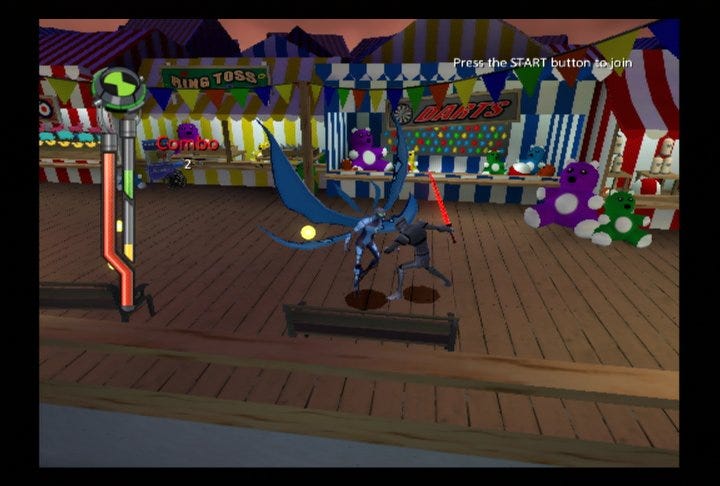
Ben 10's brawling may seem formulaic to adult gamers, but to kids it still seems fresh.

As with most things pertaining to children, they can be contradictory in their tastes. Nothing inspires them more than the freedom to do whatever they want, but they also crave guidelines and signposts to keep them moving forwards.

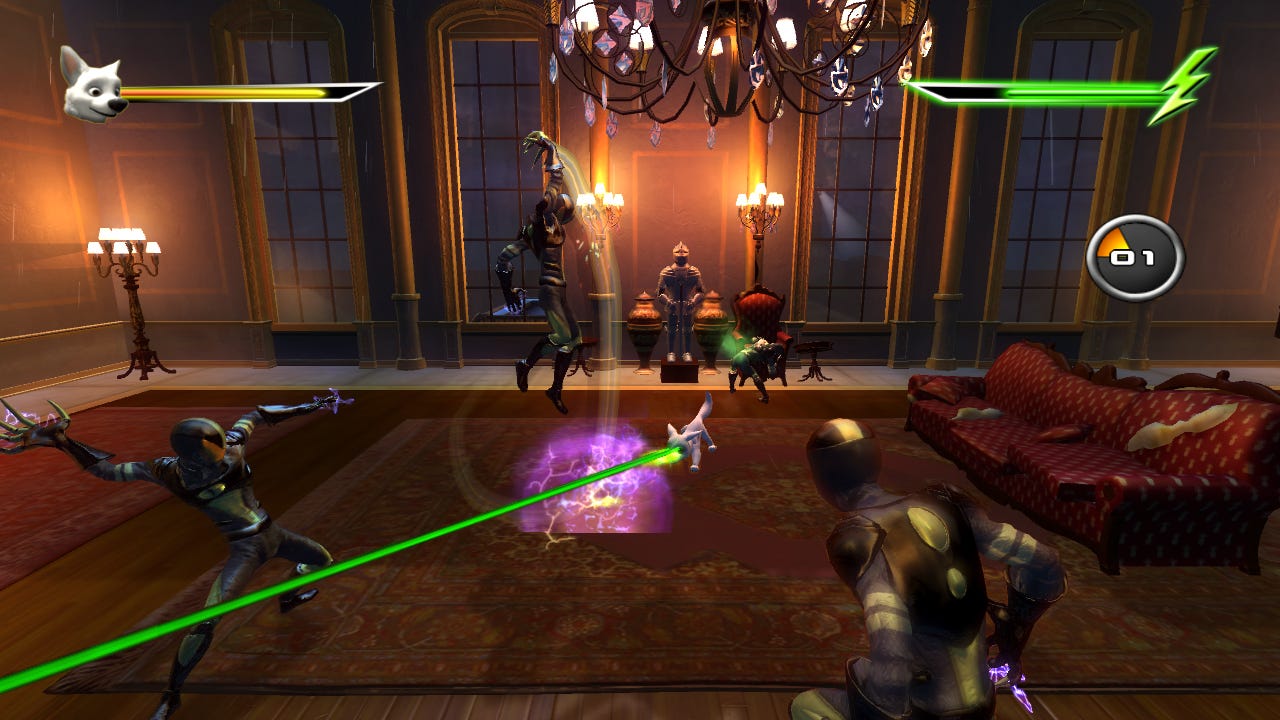
Both Bolt and Ben 10 are on familiar territory here, since they're following a fixed narrative. Rather than being based on the story of the movie, the Bolt game takes the form of an episode of the TV show from within the movie. It's a sensible decision, since it means that players get to use the full range of Bolt's special powers - including supersonic barks and laser-beam eyes - but it also means that there's a sense of discovery, rather than ticking off the expected scenes from the cinema. The same is true of Ben 10. The story isn't based on any particular episode of the show, but follows a formulaic tale of linear investigation that allows the player to unlock more of Ben's alien heroes as they go along.

The games are both utterly linear - often frustratingly so for an adult gamer. Invisible walls keep the action moving in one direction, and in Ben 10 it's even impossible to backtrack once you've passed unseen checkpoints. Watching my six-year-old son and his school friends play, however, it seems that these annoyances barely register. They share the game's forwards momentum and so don't mind being herded so blatantly towards the goal. Frustration is a greater buzzkill than boredom for this age group, and it's notable that the moments when their interest dips sharply are when they don't know where to go next. The Ben 10 game has a few moments like this, where progress relies on using a specific alien power on a particular piece of scenery, lingering just out of view, and it's then that the claustrophobic environments become a problem. Endlessly jumping and running around constricted arenas with no clear purpose is no fun, especially at that age.
'Child's Play' Screenshot 2

Disney's Bolt is a good example of solid, if unspectacular, character licensed gaming.

Bolt and Ben 10 both have serviceable structure, then, but it all seems geared toward finishing the story and nothing more. The games that get the structure absolutely right are those bearing the LEGO brand. I've praised this series many times before for its brilliant balance of exploration and progression, and it's really only when you watch the intended audience playing LEGO Batman, for example, that you see just how incredibly well Traveller's Tales understands the way kids play. The levels are linear, but the overall structure is freeform. Progress in one area aids progress in another. Each new discovery deepens the child's understanding of the gameworld and what they can and can't do in order to succeed.

In other words, while the latest crop of film and TV tie-ins do an adequate job of ensuring kids can make their own progress, and are therefore fine for a weekend's distraction, the games that keep kids coming back months later are those that sweeten their corridors with a little flexibility.

Difficulty

Games, much like exams, are too easy these days. That's the common refrain, and it would seem to be supported by the number of kids' titles that no longer place any long-term penalty on the player for failure. Remember when you'd desperately scan the pages of the games magazines for an infinite-lives cheat? Today's whippersnappers have no such problem.

It's certainly true of Bolt and Ben 10. While in both games you can "die" (Bolt, being from Disney, just curls up and has a nap) you simply start back at the last checkpoint, and there's no limit to the number of times you can plug away at each section. Bolt may earn some hardcore kudos since you still have to find health pick-ups to stave off this temporary setback. Ben 10, on the other hand, refills his health every time he changes into an alien form, earns extra health from the many smashable objects littering the scenery and can only be defeated if he loses all his health as a human kid.

Both games, thankfully, have regular and sensible checkpoints, meaning that restarting is never an aggravating chore yet inconvenient enough that the young player wants to avoid the stigma of failure. Bolt, perhaps, suffers most since combat in that game is rather long-winded, with even the most basic enemies requiring several knockdown combos before they expire.

Is this a bad thing? It's a debate that was recently and famously revived by Fable II. The entire concept of "lives" is really a throwback to gaming's arcade roots, when they were a tangible reminder of the need for spare change to prolong the experience. Certainly, today's youngsters wouldn't understand being thrown back to the main menu after falling foul of the old "three strikes and you're out" mentality. Far from lowering the stakes, I've found that my son's generation is no more fond of dying in-game than we were. Even without the looming threat of Game Over, he and his friends will fight to the last to avoid defeat. This, ultimately, is perhaps the best argument for redefining our understanding of "game death". People, regardless of age, just don't like losing.

'Child's Play' Screenshot 3

The Lego games remain the gold standard for interactive kids' entertainment.

Once again, the LEGO games have pioneered in this department, placing no penalty on death other than the loss of studs, the game's currency. In the short term, it's no big deal. In the long term, it matters. A poor player will struggle to accumulate the studs required to unlock the many extra characters and features of the game, effectively replacing the meaningless demise of an on-screen avatar with a more tangible loss of a desirable reward.

But there's a flipside to this argument, and one that once again illustrates the contradictory nature of kids, while providing a very compelling throughline from gaming's brutal early years to today. You see, my son's current favourite game isn't based on a film, or a TV show, and it's far from easy. It's the Xbox Live Arcade version of N+, the famously tough platforming game which gives you an Achievement for dying a thousand times. It's perhaps significant that N+ has no Game Over screen either, allowing you to bang your head against each challenge as many times as you like, but I know my son wouldn't stand for the constant ruthlessness in a title like Ben 10.

One of the key differences is story. There's no narrative to N+ and so no sense that you're missing something should you fail to progress. It's also far from linear, and with the numerous DLC level packs there are always dozens of other levels you can attempt instead. It's also relevant that N+ is a single-screen game. You can see your goal, you can see how you need to reach it, and all the player needs to do is navigate the obstacles in between.

That the stickman ninja is agile and provides almost tangible sensory feedback with regards to his weight and momentum also helps enormously - even a child can instinctively feel the movements required. It's an often ephemeral part of what makes a game fun to play, but whether you're guiding a hero from platform to platform, or tugging at a wobbling tower in Boom Blox, it's the sort of tactile connection that kids love to make and it can make even the toughest challenge more manageable.

'Child's Play' Screenshot 4

Poop and violence - no wonder Castle Crashers is a hit with the under-10 crowd.

N+ has actually reduced my son to tears on occasion, yet he keeps on playing. I want to tell him that it doesn't matter, that he can just switch it off, but I recognise the look on his face. It's the same look that kept me hammering away at Manic Miner many years ago. The difference is that my son is getting better. He can now easily beat levels that left me stumped, and was the first to get the Achievement for completing 30 episodes - or 150 levels - of the game. Even with my own I'm still astonished by this, yet to him it's no different to when he unlocked all the characters in LEGO Batman, another gaming feat he was incredibly proud of. Even though the games couldn't be more different in their approach to punitive measures, he's getting the same feeling of satisfaction.

Clearly the question of difficulty is more one of context from game to game than simply making it impossible for pampered players to lose, and therefore the best games for kids may not always be those banished to the "kids' games" ghetto. It's when this balance is skewed that the grim results are apparent. The recent Pixar games - Ratatouille and WALL·E - both exhibited an astonishing ignorance of what kids actually enjoy doing, and punished them harshly for it. They may have shifted units thanks to the name on the box, but that doesn't mean that kids actually enjoyed the game inside. Fiddly tasks, with no tactile reward, will only be repeated for so long before the game in question ends up gathering dust.

Longevity

I've never quite understood the obsession some gamers have with the hours of play a game can offer, since few would argue that the greatest movies or books would be improved by doubling their length, but where kids are concerned it does become a more valuable measure of a game's worth. Not only because parents don't want to shell out for a new game every week to keep the offspring amused, but because kids are much more willing to repeat an enjoyable experience over and over. Any parent who has sat through their children's favourite DVD every single day of the summer holiday can testify to this fact.

Longevity for kids, therefore, is less to do with how long it takes to play through the game the first time, but how often you can play the game afterwards and still extract the same enjoyment.

Ben 10 edges out Bolt as far as the most recent kids' games are concerned, simply because returning to previously played levels with new alien forms allows access to new areas and new collectables. Bolt, on the other hand, merely offers a bunch of rather tricky twin-stick shooter bonus levels which held absolutely no appeal for my young test subjects.

This ability to discover new elements through repeated play is a recurring theme in all the games that have found favour with my son and his friends, and it's no surprise that this is another prominent design element of the perennially popular LEGO games. Kids are natural collectors, so any game that taps into this instinct generally captivates its audience far more effectively than a game that just takes you from A to B with minimal distractions. The more characters, costumes and bonuses you can accrue along the way, the more chance of success. Heck, the enduring Pokémon phenomenon even made a catchphrase out of it: gotta catch 'em all. The key lies in making the bonus goodies something useful and fun, which means that any game designer still thinking that anyone gives a toss about concept art should probably reconsider their career.

This probably helps to explain the continuing popularity of Castle Crashers with my son's peer group. Despite being rated for 16 and over, presumably for its cartoon violence and scenes of explicit owl poo, it features several elements that make it ideal for younger players. As well as offering instantly accessible gameplay that walks a fine line between button-mashing mayhem and genuine skill, Castle Crashers is clearly a game designed to be played many, many times over. Finding all the animal orbs, picking up all the weapons, unlocking more and more characters with different magical attacks - this was the stuff of fevered obsession for my boy and his best friends for at least three months last year. It was the sort of all-encompassing passion that resulted in felt-tip pen fan art, home-made comic strips and a sudden interest in knights and castles. If the game hadn't offered so many environments, all accessible for replay at any time, with multiple trinkets to gather along the way, it never would have stayed in rotation for so long.

'Child's Play' Screenshot 5

In the new Banjo-Kazooie game, the excitement is building.

Castle Crashers also provides another essential ingredient for today's best kids' games: co-op. It makes sense that the audience most attuned to what we'd now call the retro mindset would love the old-fashioned joys of the two-player (or more) game, but it's surprising just how important it seems to be. As an adult, it's easy to forget just what an empowering and immersive experience gaming can be to a young child, and the ability to take your friends into a virtual world and share adventures with them is still a powerful thing.

It's an area where the Bolt game sadly misses the target completely, with no multiplayer elements at all. Few games make for good spectator sports and, given that much of the movie features three animal characters working together, it's also an area where kids looking to recreate the feel of the movie are going to feel short-changed. Ben 10 fares better, with a drop-in co-op system borrowed from - yes - the LEGO games. It's hardly the best two-player experience in town, though. Both players play as Ben, which leads to some confusion, and the camera struggles to keep both characters in view should they wander in opposite directions. The LEGO games suffered in this regard as well, but with a core offering that is nowhere near as polished and with no opportunities for players to actually co-operate beyond pummelling the same enemies, it can prove difficult to smooth over increasingly fractious arguments as the game continues.

In other words, the ability to share the gaming experience is incredibly important for kids, but only if the experience is worth sharing.

Creativity

This is an area where most children's games have yet to make their mark, so it's no surprise that standard fare like Bolt and Ben 10 doesn't have much to offer in the way of user-generated content. That's not to say it won't become increasingly important as consoles become more powerful - the desire to tinker and make is another natural part of childhood.

'Child's Play' Screenshot 6

LittleBigPlanet is the obvious pioneer as far as this new frontier goes, but the finer points of its level designer are clearly beyond the grasp of children. It's a fun sandbox, and once they learn how to blow things up and strap rockets to spongers there are plenty of giggles, but it's all a bit directionless and short-lived. My son even had a brief - and carefully chaperoned - few days of amusement mucking around with balloons, jets, headcrabs and bathtubs in Garry's Mod, the Source Engine editor that lets you do much the same thing in Valve's first-person universe. But then he decided he'd rather go nuts with a machinegun and grenades in a Counter-Strike cabin, and I decided that might be a little too empowering for someone still at primary school.

More interesting is Banjo-Kazooie: Nuts & Bolts which integrates the creative aspect far more successfully into the gameplay itself. It's rather ironic that the LEGO games, so tiresomely praised previously, fail at something so fundamental to the LEGO brand. For all its other flaws, Nuts & Bolts offers something LEGO should have implemented long ago - the chance to collect pieces, then create and build your own solution for each challenge.

So where does this leave today's kids games? In good health, rather surprisingly. No adult would ever deliberately choose titles like Bolt and Ben 10 over their glossier rivals, but what they lack in sophistication and polish they often make up for in old-fashioned accessibility. Not the games that kids will cherish for the rest of their lives, but as stepping stones to appreciating games as a hobby, there are far worse examples. It's important to remember that these worst examples generally suffer because they fail to consider the unique nature of their audience and fall back on clumsy design out of habit. The games that succeed are the ones that nurture and encourage young players to explore new experiences through their joypad, and allow them to project themselves - even just for a few hours - into a world of escapist fantasy. The good news is that there are more games like that than you might think.

Comments (38) Latest comment 3 years ago

Comments threads automatically close after 30 days, but please feel free to continue chatting on the forum!

  • DFawkes #1 3 years ago

    I played Build-a-Bear Workshop on DS recently (not mine) - it was surprisingly alright. I get that from a lot of games aimed at children, I'm never fussy about something seeming formulaeic if it's half-decent.

  • nickthegun #2 3 years ago

    Should have had the picture of that 13 year old Alfie, Karen Matthews and their baby all playing on Saints Row 2.
  • andromeda #3 3 years ago

    villageofthedamnedlol
  • UltimateWarrior #4 3 years ago

    A brilliant article. Well done for finally appreciating that different games are targeted at different audiences. It's about time they stopped being lunped into the same category all the time. The mainstream media still like to think of gaming as a kids thing. While the specialist gaming media think that no one exists other than hardcore gamers. This was the major flaw when Eurogamer reviewed last year's Bond game. It's obvious when playing it that it's not designed to be a COD4 beater. It's designed to appeal to those who love Bond, mainly young kids, who probably loved the game more than any Bond game since Goldeneye.
  • Acornhead! #5 3 years ago

    Exams are too easy?! You're kidding me, right?
  • Buztafen #6 3 years ago

    Back when i was a youngster, all we had to play with was dirt.....an even that had to be shared....
  • Sunyavadin #7 3 years ago

    Dirt? DIRT????

    We couldn't afford dirt. We came in from school half an hour after our bedtime, and were lucky to get to play with our food.
  • McGeeza #8 3 years ago

    Half an hour after bedtime? Luxury.

    We used to come home from school and then have to work six hours down t'pit before being sent to bed with a lump of coal to suck on.
  • metalangel #9 3 years ago

    Nobody plays games laying on their front like that... If you elbows don't start killing, your neck or stomach will.
  • evilbert #10 3 years ago

    This is all very true and as UltimateWarrior says, it's about time someone realised that kids games shouldn't be reviewed with the same criteria as 'grown-ups' games.
    Even though she has completed it more times than I care to imagine, my daughter still loves playing Disney Princess Enchanted Journey on Wii. Having played it with her (it has a drop-in-and-out co-op system) I'm certain that any mainstream review would have scathed it but it appeals to everything she wants from a game. And she was happy to trade the awful Cooking Mama against it too, which shows she has *some* taste. :)
    Edited by 1 at 02/03/09 @ 11:53
  • prettyboytim #11 3 years ago

    Banjo-Kazooie Nuts & Bolts is a great game for children, let down in a couple of areas. My son (4) adores the game and plays it anytime he can (Yes, it has a 7+ rating, but for the life of me I can't work out why that is). However the game is spoiled a little by its assumption that its players can read. All of the dialog has the standard Rare thing of text on screen, accompanied by generic grunting noises by the character - if they had recorded dialog, younger children (or those with learning difficulties) would still be able to understand the challenge instructions. However, given the amount of dialog and perhaps their reluctance to put a specific voice to characters to have up to now only grunted, I can understand why they didn't make that choice.

    Its biggest flaw however is how easy it is to lose all of your savegame progress. Whenever you start the game you have a choice between starting a new game or continuing with your current save. Selecting a new game will delete all your progress and there's only one save slot. The console has a whole fucking hard drive and there's only one save slot.

    Needless to say, when you have a four year old playing the game who can't read, he occasionally selects the wrong option. After losing all our progress several times I had to buy one of the shockingly expensive xbox memory cards to make backups of the savegame on. Grrr.
  • jonsaan #12 3 years ago

    Great article. I agree with most of your observations. However my 8 year old has slightly more discerning tastes when it comes to licensed games, he has cottoned on to the fact that 'most' of them are pretty hopeless.

    First things he will ask before picking up a new game:

    Is it 2 player?
    Can I go anywhere I want?
    Has it got stupid controls? (this is how he refers to waggle based stuff:)

    As you mentioned he loves unlocking stuff. He wants to be ale to play as many different characters as possible and he likes to be able to just explore without being beaten to a pulp by over eager AI.

    The absolute worst example of a development team who don't understand their target audience are Sonic Team. My son loves sonic but hates to play the games unless a sucker like me has been through and unlocked it all first. They are just too hard, and not good hard. Like you say, he will happily chip away at games like Little Big Planet, Alien Hominid and Castle Crashers but the Sonic games are just all over the shop in terms of an enjoyable difficulty curve.

    Last word on Little Big Planet. he is a couple of years older than your boy by the sounds of it Dan, but some of the stuff he has created in LBP has made my jaw drop. Mainly contraptions admittedly, he doesn;t have the skill to string it all together as a complete level but it's impressive none the less.
  • Lexx87 #13 3 years ago

    THOSE KIDS ARE HOLDING PLAYSTATION CONTROLLERS OMG EG BIAS
  • leftlion #14 3 years ago

    @prettyboytim - the banjo game probably has the 7+ rating because as you say: the kid needs to be able to read. My nephew is 8 and i won't let him play zelda: twilight princess (12+ age rating). not because i don't think he has the skill to do it. but because i don't think at 8 he'd really understand what he has to do and where he has to go....even if there were voice-overs. hell, even i got stuck on it a couple of times :p

    good article though :)
    Edited by 1 at 02/03/09 @ 12:30
  • IneptPercy #15 3 years ago

    I thought
    kids only played GTA these days...
  • jonsaan #16 3 years ago

    Actually it's amazing to see how much enjoyment an observed youngster can have with a game like GTA or Saints Row. they love the freedom and just pootle about. Evil actions don't really occur to them.
    Edited by 1 at 02/03/09 @ 12:40
  • metalangel #17 3 years ago

    jonsaan: he enjoys Alien Hominid but finds Sonic too hard?!
  • speedofthepuma #18 3 years ago

    @ Jonsaan: "Has it got stupid controls? (this is how he refers to waggle based stuff:)"

    Youngest troll ever?
  • cam_guin #19 3 years ago

    great article. Esp with the game length debacle. Why ARE people so obsessed with hours of play? COD4, short but oh so sweet.
  • kangarootoo #20 3 years ago

    My thoughts on the difficulty of games.

    If a high level of difficulty adds to the fun the target audience has when playing the game, it is absolutely valid. And if for another title a high difficulty detracts from the fun the target audience has when playing the game, it is absolutely valid to remove or reduce it.

    Its a shame that it ever becomes a matter of "being tough enough" or being "a proper gamer", when such things are really completely irrelevant.

    I play games 'cos they are fun. If I want to prove my manliness I go armwrestling sailors down the docks or bare fist fighting in my local gypsy encampment.
  • Entity #21 3 years ago

    You get past 'Eugene's Lair' with all your lives intact, just to watch it start going down the Thomas Crapper.
  • Robkinsons #22 3 years ago

    It's very true that kids like repetition in games, I know people who will spend hours just creating Mii's.
  • black2 #23 3 years ago

    @leftlion That's interesting, I lost patience with Twilight Princess long ago, yet my 8 yr old begs to play it, somehow loving to get turned over by the latest dungeon. He, like Dan's son, intrinsically understands the Lego games and can pick up on its language immediately.

    I didn't think age ratings were goverened by accessibility or difficulty, purely content.

    Good article by the way - far more interesting than something with a =RND(number) on the end.
  • atrb79 #24 3 years ago

    Good piece,

    it's amazing how much we tolerated as kids just because of the thrill of controlling something on screen -- I spent hours on Captain Planet on the Amiga. Maybe kids are more discerning now.

    One thing I disagree on - "Few games make for good spectator sports". Some of the best times I've spent on videogames have been a group of us, sitting round taking turns on a one-player game (Zelda, GTA 3, Resi 4 stand out) and shouting advice Crystal Maze style.

  • HuggyAtHome #25 3 years ago

    I think the controls have a lot to do with it too - my 2 kids (5 & 7) loved Flower because it was so simple to play and had that collecting angle. They also love driving games, but are pretty rubbish at them.
  • jonsaan #26 3 years ago

    @metalangel

    Yes, weird but true:)

    Bear in mind I have unlocked a lot of the Alien Hominid levels myself.
  • Slim #27 3 years ago

    This article should be called 'Boys games' not 'Childs Play', the stuff girls enjoy playing is very different from pretty much everything described here.
  • Entity #28 3 years ago

    "This article should be called 'Boys games' not 'Childs Play', the stuff girls enjoy playing is very different from pretty much everything described here."

    Yes, thank god for girls and their cheap shitty choices for games.
    "Here's CBeebies, knock yourself out for an afternoon on the same Flash-based game"
  • kangarootoo #29 3 years ago

    @Entity

    You have a very weird view of the world. Maybe if you knew a few more girls it wouldn't be such a problem. Though your reference to CeeBeebies suggests that perhaps you are too young to have really crossed that initial hurdle, and still think girls are just for throwing snowballs at, in which case we can let it slide.

    I know a few that could hand you your own arse in CounterStrike or Halo MP mind you.
  • Entity #30 3 years ago

    @kangarootoo

    Ugh, you pompous knob.
    I'm 30, father of two younglings, couldn't give a shit for Counter Strike. Was just trying to... nvm... build up another wrong profile of someone.

    Edit: Snowballs and pulling hair.
    Mr Right-on~
    Edited by 3 at 02/03/09 @ 18:11
  • koolfigo #31 3 years ago

    Brilliant Article sir. Loved it. It would really be appreciated if 'more' research based articles are published here, on Eurogamer. Being a student of English Literature, I really find your articles very well researched which involves a thought process generally not seen in other web sites (Gamespot anyone?). You write about a game and analyze it in the same way I write about "Jonathan Swift'" or "Flaubert". Keep goin. Cheers!
  • BadBoyBonner #32 3 years ago

    Jonsaan

    I am with you on this one - lil nephews love playing GTA IV - to ensure it is more child friendly I apply the following.

    1) Supervise at all times - set custom tasks i.e. seeing if you can work together to find the jumps in the game.
    2) Turn all Speech/sound effects off.
    3) Play Jack Johnsons Sing-a-long songs and Lullabies (from Curious George) or something similair.
    4) Ensure Nico has no weapons on him.
    5) Dial 6255550100 for Race bike 6255550150 for Scrambler/motoX and 3595550100 for the helicopter - which should save you hours of time having to track down the aforementioned vehicles.

    Reminds me of being a kid when games like Driller on the Spectrum or Hunter on the Amiga - i.e. go anywhere - they do love the freedom - probably even more than adults.
    Edited by 2 at 02/03/09 @ 19:21
  • bad09 #33 3 years ago

    Nice article Dan even though I'm 33 and bratless I still try and understand kids love games to. But really, lets be honest here. children these days care not about quality if it has a name, neither do the parents/relative blindly buying this "toy" for little johnny/Jenny. No one cares for review, editorial, insight or quality oddly - just look at the charts.

    It's a harsh truth about the mass market which we "hardcore" hate. The masses are stupid put a name on it or show a ad or give an image and make it fashionable and it will sell (well..a lot of the time).

    scary truth is though we "hardcore" are actually no better than the "stupid" masses for names, images and fashion - hands up you bought a bad, dreadful, embarrasing game?

    Anyway, serious question here to older gamers, is it me or are "children's" games getting dumber? Mrs bad09 will hate me for this but she always likes those animated movie tie-ins and "kiddie" stuff (although she plays Halo3 L4d PGR to name a few so Mrs bad09 has some gaming taste to!!) and I see a lot of it even though I have no kids. I have to say I was playing more interesting stuff as a youngster...

    / waves walking stick in the air "in my day games were games!"

    Seriously though, I'm actually with jonsaan and BadBoyBonner, if I had kids I'd rather have SUPERVISED "grown up" games played than the crap they shove at kids these days.

    / sticks in dead space and makes a 7 year old play it "BE SCARED KID!!!!"
    Edited by 1 at 02/03/09 @ 22:43
  • DanWhitehead #34 3 years ago

    Nice article Dan even though I'm 33 and bratless I still try and understand kids love games to. But really, lets be honest here. children these days care not about quality if it has a name, neither do the parents/relative blindly buying this "toy" for little johnny/Jenny. No one cares for review, editorial, insight or quality oddly - just look at the charts.

    I really don't think that's true. In my experience, adults are far more likely to persevere with a mediocre game. If a kid isn't enjoying a game, then they just stop playing. My son managed about thirty minutes playing Ratatouille. He stuck with Wall-E for a bit longer, but didn't grumble when it went on the trade-in pile. If these games fly up the charts it's because parents buy them for the name recognition, not because the kids are actually enjoying them.

    Anyway, serious question here to older gamers, is it me or are "children's" games getting dumber? Mrs bad09 will hate me for this but she always likes those animated movie tie-ins and "kiddie" stuff (although she plays Halo3 L4d PGR to name a few so Mrs bad09 has some gaming taste to!!) and I see a lot of it even though I have no kids. I have to say I was playing more interesting stuff as a youngster...

    I have to say, I think rose-tinted glasses are involved in this outlook. The best of today's kids games - the Lego titles, Nuts & Bolts etc - are far more complex and rewarding than their retro equivalents. Obviously, part of this is down to the increase in processor power enabling games to simply do more things, but it's also down to some developers taking kid's games seriously and actually investing thought and design into how they play. And that's only if you consider the games specifically marketed at kids. Like I said in the feature, most kids I know are drawn to other games regardless of the name on the box.
  • bad09 #35 3 years ago

    "I really don't think that's true. In my experience, adults are far more likely to persevere with a mediocre game. If a kid isn't enjoying a game, then they just stop playing. My son managed about thirty minutes playing Ratatouille. He stuck with Wall-E for a bit longer, but didn't grumble when it went on the trade-in pile. If these games fly up the charts it's because parents buy them for the name recognition, not because the kids are actually enjoying them."

    Maybe being related to a games reviewer has rubbed off on your son and he has taste! Even Mrs bad09 was happy to offload Ratatouille! :) I think you are right there actually though, adults probably will persevere longer with mediocore games (especially the gamerscore whores).


    "I have to say, I think rose-tinted glasses are involved in this outlook. The best of today's kids games - the Lego titles, Nuts & Bolts etc - are far more complex and rewarding than their retro equivalents. Obviously, part of this is down to the increase in processor power enabling games to simply do more things, but it's also down to some developers taking kid's games seriously and actually investing thought and design into how they play. And that's only if you consider the games specifically marketed at kids. Like I said in the feature, most kids I know are drawn to other games regardless of the name on the box."

    You could be right about glasses TBH, besides I am 33 and these games, as you say, thay are clearly not for me anyway. I dunno though (obviously not talking graphics/hardware etc here) I can't help but think gaming was more"interesting" when I was a kid - I'm not saying better just more interesting and challenging. I remember as a kid playing the likes of head over heals, Jack The Nipper, Skool Daze, Paperboy, Arkanoid, The Hobbit all kind of interesting games. They all seem to be really dull platform collect 'em ups these days.

    But yeah I suppose you are right back in the days of speccy you didn't really have that many "childrens" games - just games. Us kids played exactly what the adults did. It 's only when gaming "grew up" and we started getting more and more "mature" content that the games industry really started (and needed) to seperate childrens gaming IMO.

    It could just be gaming has reached that point now where us old farts can do the whole " back in my day" thing but like I said before if/when I have kids I do think I'd be happier with them being supervised and educated about gaming so they can play the more "adult" stuff safely rather than playing the stuff I see for kids these days. Obivously I was joking about stuff like DS, but I do actually think something like BadBoyBonner's supervised GTA fun could be a blast for kids! :)


    Edited by 2 at 03/03/09 @ 19:25
  • DanWhitehead #36 3 years ago

    You could be right about glasses TBH, besides I am 33 and these games, as you say, thay are clearly not for me anyway. I dunno though (obviously not talking graphics/hardware etc here) I can't help but think gaming was more"interesting" when I was a kid - I'm not saying better just more interesting and challenging. I remember as a kid playing the likes of head over heals, Jack The Nipper, Skool Daze, Paperboy, Arkanoid, The Hobbit all kind of interesting games. They all seem to be really dull platform collect 'em ups these days.

    I think that a lot of genres have merged over the years, so that where once there were clearer boundaries you're now more likely to find games with elements of platforming, adventure games and fighting/shooting all in one 3D world, even in kid's titles. Bully does everything that Skool Daze did, and - heresy! - does it better, just by virtue of the fact that the world of the game is larger, more varied and more interactive. And I think his attachment to N+ and Castle Crashers suggests that the game design that worked in 1984 still works today.

    And I've actually made a point of not letting my job influence my son. He's probably benefited from being exposed to more games than most kids, but I've never once told him what I think of the games he plays. I let him make his own mind up, and he's proved incredibly useful when it comes to reviewing games aimed at his age group. Spider-Man: Friend or Foe, for example. I thought the demo was arse, but he and his friends loved it. Once I played it through their eyes, the repetitive combat was accessible rather than boring, and the linear levels prevented frustration setting in. They loved all the characters and the quips - "Incey wincey spider's going to web you in the face" became quite a catchphrase.

    It was then that I realised that different standards needed to be applied. Not lower standards, just different. A wonky camera might be an annoyance in a grown-up's game, but it can be a game killer for kids. Equally, mashing the X and Y buttons to plough through dozens of enemies will be tedious to adults, but exciting and empowering to kids.
  • bad09 #37 3 years ago

    @ DanWhitehead

    "Bully does everything that Skool Daze did, and - heresy! - does it better, just by virtue of the fact that the world of the game is larger, more varied and more interactive."

    OK I'm now picking up Bully!!!!!

    "It was then that I realised that different standards needed to be applied. Not lower standards, just different. A wonky camera might be an annoyance in a grown-up's game, but it can be a game killer for kids. Equally, mashing the X and Y buttons to plough through dozens of enemies will be tedious to adults, but exciting and empowering to kids. "

    Yeah you're right, as adults it is hard to step away from a game a look at it from the view of people it's aimed at. Hell we gamers have trouble doing that with the "mature" games a lot of the time! :)

    Oh BTW, glad you're job doesn't influence your son, that way when he's older he can laugh at your DS review. I haven't forgot that one Whitehead! ;)
    Edited by 1 at 04/03/09 @ 13:44
  • Wickedbug #38 3 years ago

    Great articule. Kudos