Version tested: PlayStation 3
Back when Guilty Gear X hit the PS2 in 2002, 2D fighting games like Capcom vs. SNK 2 were being overlooked in favour of flashy 3D numbers such as Dead or Alive 3 and Super Smash Bros. Melee. But those who did pick up this quirky curio discovered a fighter with personality in excess. Guilty Gear X had a rich anime presentation, heavy metal music, instant kill moves and a deranged doctor wielding a giant scalpel - all of which combined to set it apart from the output of Capcom and SNK.
However, like Guilty Gear before it, Guilty Gear X was far from perfect. Apart from being notoriously unbalanced many found it difficult to get their heads around the game, as it certainly wasn't short on technical mechanics like Dead Angel Attacks, Roman Cancels and Gatling Combos. Despite this many fighter fans loved the extreme pace and depth and as Arc System pilled on the upgrades and sequels, adding new characters and readdressing the balance, Guilty Gear turned into a respected fighting series with a hardcore following.
The more recent Battle Fantasia felt like Arc's attempt to break out of the Guilty Gear rut. It cut back on excessive tech in favour of accessibility. But despite being an excellent fighter it felt a tad soulless - almost as if it were trying too hard to play like a Street Fighter game. With BlazBlue, however, Arc System may have cracked it. Unlike Battle Fantasia, it doesn't remove what makes Guilty Gear excellent in the hope of attracting new players. Instead the formula is tailored to better accommodate the new generation along with the existing diehards.
BlazBlue is set in a world where humanity once faced annihilation from a creature called the "Black Beast" - presumably some sort of intergalactic panther. But when all hope seemed lost six heroes showed up wielding the ancient power of magic. By combining this new power with their own technology mankind was able to construct new weapons called "Armagus", and with the help of the six heroes, the beast was slain in what became known as the "First War of Magic".
Daisuke Ishiwatari takes charge of the tunes in BlazBlue. His selections are more chilled out than those in Guilty Gear.
In the aftermath, civil war broke-out as different factions fought for control of the Armagus. The Novus Orbis Librarium eventually prevailed as the dominant power. BlazBlue kicks off with a lone man, known as Ragna the Bloodedge, destroying an entire branch of the Librarium singlehanded. Not wishing to lose face the Librarium react by placing the largest bounty ever recorded on Ragna's head. Many strong fighters go in search of this legendary criminal, each with their own personal agenda - be it wealth, glory, justice or power.
With 12 fighters to choose from BlazBlue's roster feels fresh, but at the same time highly reminiscent of Guilty Gear. Like Sol Badguy and Ky Kiske before them, the lead protagonists are Ragna and the Librarium's Jin Kisaragi. Also present are scary cat-girl Taokaka, child vampiress Rachel Alucard, Bang Shishigami - a highly vocal ninja who fights with a giant nail strapped to his back - and the impossibly large Iron Tager. Mai and Morrigan fans will also appreciate the gun toting Noel Vermillion and doctor Litchi Faye Ling. Arakune however is perhaps the most interesting inclusion. A clear homage to the No Face monster from Hayao Miyazaki's Spirited Away, his visage is like a mask attached to a giant blob of Marmite. Players tend to either love or hate him.
BlazBlue has one of the most comprehensive practice modes we’ve ever seen. You can’t argue with seven pages of options.
Graphically BlazBlue is quite the stunner. It forgoes the recent trend for 2.5D nonsense and instead opts for hand-drawn 2D sprites and 3D backgrounds. All the characters are highly detailed and noticeably larger than their Guilty Gear brethren. The animation during and between moves is top notch as fighters seamlessly combo from standard attacks into specials. But if we're being picky, this game doesn't quite reach the lofty animation heights set by Street Fighter III: Third Strike.
BlazBlue is a four-button fighter and shares a number of mechanics with Guilty Gear. Players get a choice of weak, medium, strong and drive attacks which in most cases can be chained from light to heavy. Every character also has a selection of specials moves, ranging from command throws to projectiles, which can be pulled off with the classic quarter and half-circle motions. It's also interesting to note that BlazBlue doesn't have a single charge character, with Taokaka's "Trick Edge" special being the only charge move in the game. So if you religiously play Guile or Balrog (Boxer), and your shotokan fundamentals suck, this could be a rare dealbreaker.
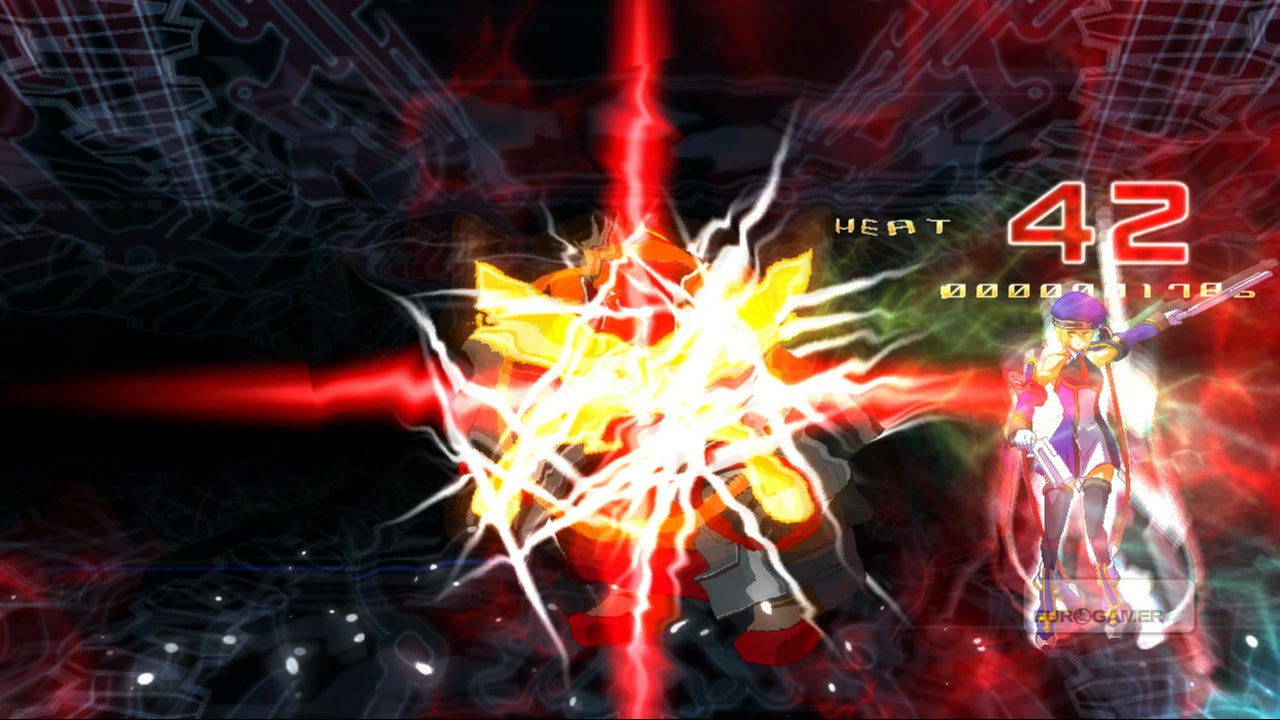
The game has its own whimsical jargon, so super moves are known as Distortion Drives and the super meter is titled the Heat Gauge. Heat is expended on Distortion Drives - most characters have a choice of two - but alternatively Heat can be used for Rapid Cancelling. For Guilty Gear vets this is essentially the same as Roman Cancelling, and for everyone else, this is a technique similar to Street Fighter IV's "Focus Attack Dash Cancelling" - whereby half the super meter can be used to cancel out of an attack animation, allowing for more technical combo possibilities.
But perhaps BlazBlue's biggest triumph is the new Drive system. In essence the Drive button does something completely different for each character. For Ragna, the Soul Eater Drive allows him to make attacks which absorb health. For nodachi enthusiast Hakumen, the Zanshin Drive acts as a parry, which if timed correctly will instantly throw the opponent for good damage. Jin's Frost Bite Drive meanwhile has the rather annoying ability to encase an adversary in ice. But thankfully we've yet to see him perform a spinal decapitation.
More tactical Drives include Tager's Voltic Battler, which uses the power of magnetism to make his throws less escapable, and Rachel's Slipheed, which affects the direction of the wind - keeping opponents at a distance and knocking projectiles off course. To succeed in BlazBlue it's important to adapt each character's unique Drive into your game plan. But the greatest accomplishment of the Drive system is that it offers a high level of diversity, often exceeding games which field far more characters.
Although BlazBlue is less frantic than Guilty Gear, it offers far greater scope for lengthy combos than Street Fighter IV. In order to give defensive players a chance to tackle rushdown maniacs, Arc System have furnished BlazBlue with a variety of Guilty Gear-style defences. Aside from blocking, players can activate a Barrier which gradually drains the Barrier gauge - the advantage being that chip damage is avoided and the opponent is pushed back. An Instant Block, similar to Just Defend in Mark of the Wolves, is also achieved by blocking when an attack connects and confers a slight frame advantage. Finally, a single use Barrier Burst can be used by pushing all four buttons in a crisis situation. This will save you from certain doom but you'll take 50 per cent extra damage thereafter.
The Astral Heats are OTT instant kill moves which can only be used with full Heat in the final round against an opponent with low health.
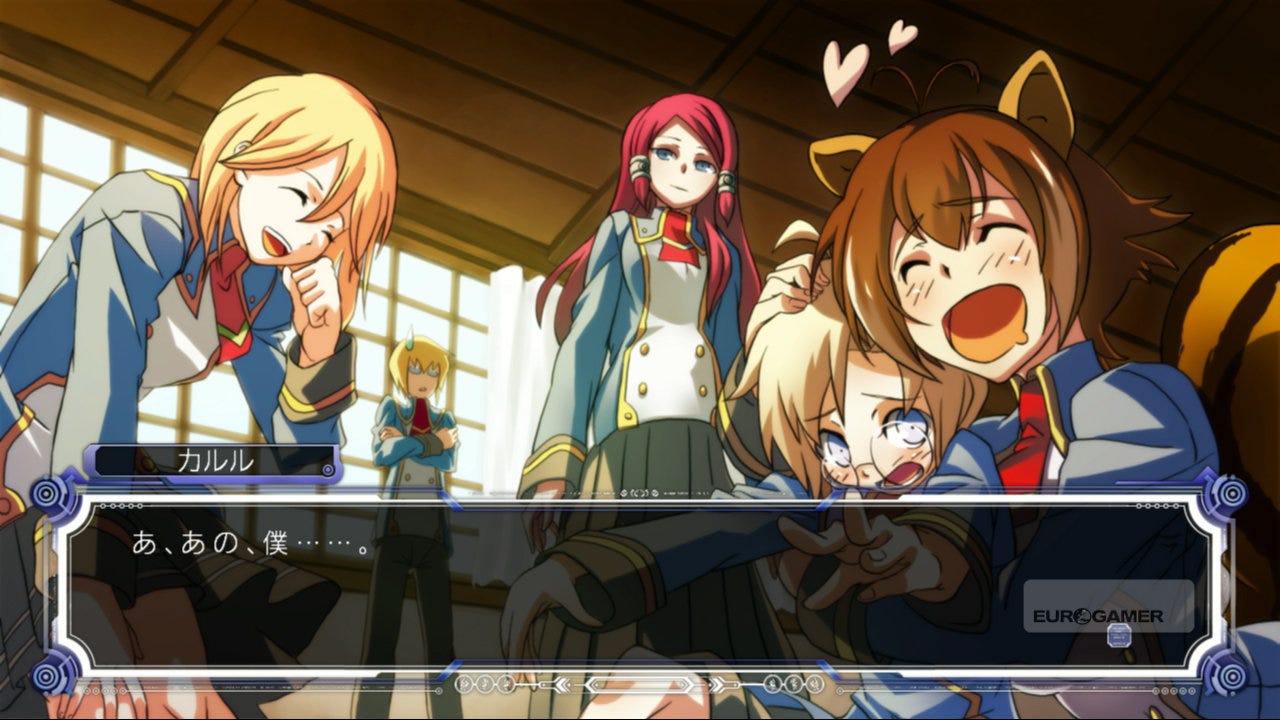
That pretty much covers the arcade aspects of BlazBlue and in this respect, its reproduction on the PS3 is more or less perfect. But Arc System rises above the tradition of the lazy arcade port by including a wealth of valid extras. In addition to the arcade, versus and score attack modes, BlazBlue has a story mode which is similar in quality to that of Battle Fantasia. As the player battles each opponent their character's story unfolds through various cut-scenes, complete with passable English voice acting. Ragna comes across as an apathetic anti-hero whereas Bang fits the anime convention of overenthusiastic idiot. Bang also gets his own super-activated theme song, which was written by Hironobu Kageyama. Go figure.
Despite being only available in the US and Japan at present, European BlazBlue importers can enjoy very stable netcode courtesy of PlayStation Network. Lag is noticeable, as it is with all online fighters, but various behind-the-scenes trickery keeps its impact minimal. BlazBlue also includes a hefty number of matchmaking options so players can adjust everything from the number of rounds to allowing use of the Astral Heat finishing moves.
In BlazBlue you can throw an opponent mid-combo. But with careful timing it’s possible to tech out and escape damage.
However, BlazBlue isn't the most balanced fighter for high level play. Certain matchups like Tager vs. V-13 can be somewhat one-sided as the game tends to favour the three best zoning (long-range) characters - notably V-13, Arakune and Rachel.
But despite some minor balancing issues, BlazBlue is an outstanding achievement by Arc System. Guilty Gear fans get a game which takes their way of fighting in a new and interesting direction, while casual players will discover a fighter which not only looks spectacular, but allows them to perform impressive combos without being overwhelmed.
I can think of only a few instances where a new fighting game has broken onto the genre as such a strong contender, but with the Drive system in place BlazBlue is a genuine challenger for any fight fan's time. As I write I'm about to get my first taste of The King of Fighter XII on the PS3, and I can't help but feel 2009 is perhaps the best year for fighting games yet.
9 / 10
