Blacksite

Harvey Smith: "My government is full of monsters."

Harvey Smith's resume probably emits an actual glow. It has Wing Commander, Ultima, System Shock, Deus Ex, Deus Ex: Invisible War and Thief: Deadly Shadows on it. Goodness me. Here he talks to Eurogamer about Blacksite - the sequel to PS2/Xbox shooter Area 51, but without any real connection - and some of the issues that face developers today, including a potentially uncomfortable parallel with Sony's current troubles with the Church of England.

Eurogamer: Obviously this is quite different to Area 51. Is that your influence specifically? Were you unhappy with the first game?

Harvey Smith: I didn't work on the first game. Some of the same people are working on this that worked on the first one, but I did come in and I said, "Look, I'm not going to tell you how to do this, this or this part of your job, but I'm a game designer and a writer and a creative director and here's the direction we're going. We're angry about politics. Here's the atmospheric vibe that I like in games. Here's the moodiness, the small-town." And I've downplayed all the comedy and anything like that, and I've added a few people from the Deus Ex team.

So it's a new team really. The Area 51 team was very strong at some things, really; the gameplay in places was really good and the art was good, but it's just not my kind of game. And so I took them in a different direction - more like Half-Life 2 or, you know. I'm the one who pushed the small-town America. But I also had allies from that team as well. They learned from their project as well. Each time you do a game you get a little bit better in some ways. So yeah, I told people this is not the sequel to Area 51; we do say there was a disaster at Area 51 and the events of this game follow that, but it's not the same characters or gameplay.
Eurogamer: It's funny actually - coming here I was jotting down silly questions about what you knew about the real-life Area 51, looking at it from the quirky angle, but obviously you've moved away from that now.

1

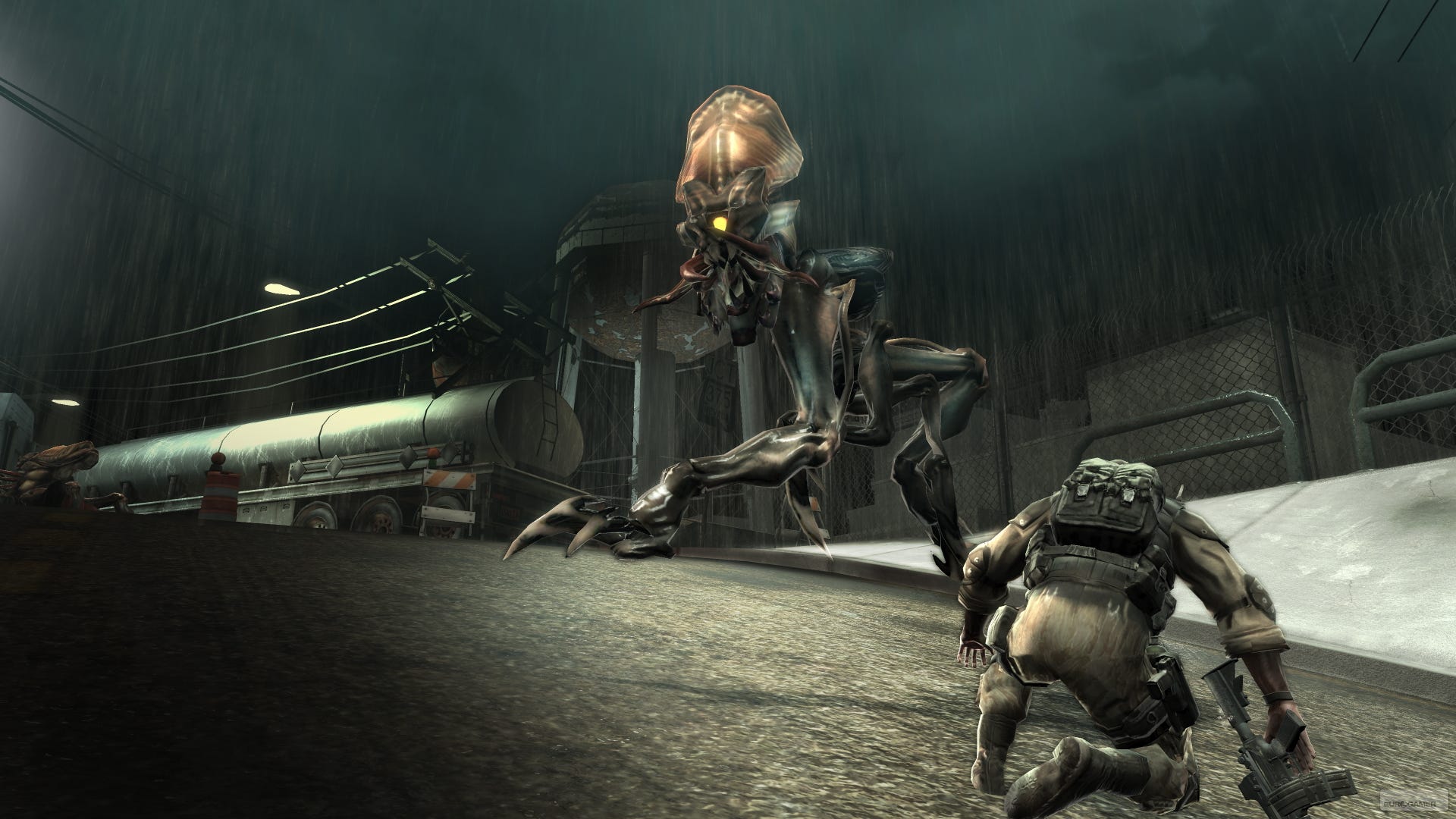
The demo on Xbox Live at the moment is short, but hints at the power of the Unreal-based tech.

Harvey Smith: Yeah. It's been hard to get that message out, too.

Eurogamer: What with your body of previous work, how does what you're doing on this diverge from those principles and how much is it instructed by them?

Harvey Smith: I've worked on different games. Everybody knows Deus Ex - if you're into the industry you know Deus Ex, I guess - and it's a hybrid RPG, but it has a lot of immersive environments and a lot of attention to detail that make it feel like you're in a real space, and that's the part that I think that we're pulling over. We want it to feel like a small town. But it's really nice to be working on a pure shooter just once. The next game, we might expand the world-exploration a little bit. But I felt like there were things I needed to learn, actually. There are developers like Blizzard or Bungie that put a certain level of polish into their games that we never could at Ion [Storm] or Looking Glass or Origin. And so I'm trying to figure out how to assimilate those things and synthesise them. But the love of fiction, the desire to innovate in some small way - the squad-morale feature and the breakables and the cover system - but then also the polish; the level of polish...
Eurogamer: We've seen the scenario you've set up but we've not heard much about the story.

2

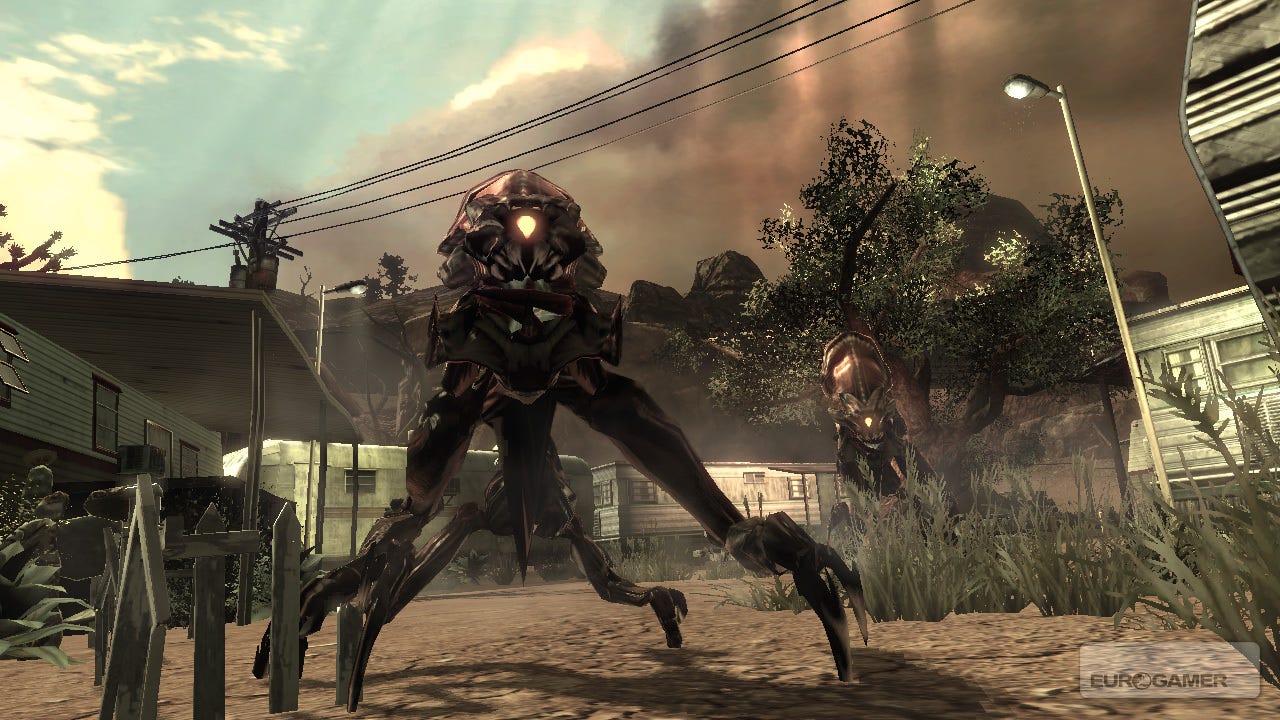
Smith is keen to play up the 'small-town America' vibe.

Harvey Smith: The story is interesting. I'm working with Susan O'Connor who worked on BioShock and Gears of War - and Blacksite - and what we wanted to do was start out with a jingoistic, patriotic kind of vibe, and you're Aeran Pierce, the leader of Echo Squad, Delta Force Assassination Squad, and you go to Iraq looking for a bunker full of weapons of mass destruction and find out that there aren't weapons of mass destruction and it's another government lie. And slowly but surely the game gets more and more subversive, and by the end you're American soldiers fighting against former American soldiers who have been unethically experimented on.

So we've created the insurgency; we've created our own enemies. And somebody's profiting from this conflict - the left hand is fighting the right hand and somebody's making money off of it. I think the last six years of American politics are a giant disaster; playing on people's fear; the military-industrial complexes. You know, there are companies making billions off of this - Halliburton and companies like that. You can point to directions where they're making billions of dollars off of this, and our vice-president is connected to this company and our secretary of state is connected, and our president is a former oil executive: my government is full of monsters; we're creating our own enemies and somebody's profiting on it, and the only people losing out are the common people, whether it's common Iraqis or the Americans who are losing their civil liberties. It's just a dark time.

Eurogamer: I don't know if you've seen in the last few days, but there's been this big furore about Resistance: Fall of Man on PS3 and its use of Manchester Cathedral. The Church of England is angry because on the one hand it's gun violence within a setting that in real-life has significant problems with gun-crimes, and on the other because Sony, they say, didn't seek permission. And this was the biggest story on the BBC News frontpage at the weekend.

Harvey Smith: Wow, I didn't know that.

Eurogamer: And you know, it's a game that came out eight months ago. Obviously it seems like in this sort of thing context ought to be king, and it struck me earlier that you were actually fighting Iraqis outside a mosque [in Blacksite], and on a very basic level that seems very similar. Do you think games can actually get away with doing that sort of thing, or do you think, I suppose, that there's a problem with games behaving this way that's maybe accentuated by a media that doesn't care what games are like and just sees them as toys?

Harvey Smith: I think you're asking a couple of different questions. One, can games get away with that? And my flip answer is "we're gonna find out". Deus Ex got away with some of that stuff. The trick will be when the mainstream media notices it. Because no one in the mainstream media noticed Deus Ex. We won a BAFTA, we got a lot of praise, there was a German avant-garde play, but nobody in the mainstream media cared about Deus Ex or noticed it. It didn't sell; it sold basically a million copies. And so what happens when the mainstream media picks up on that? That's one interesting angle on it.

And then the other question you're implicitly asking, I think, is by trying to tackle difficult subject matter, are games trivialising the subject matter because inherently they're not capable of sophisticated expression? And I think people believed that about comic books, for instance, before the comic Maus came out. And that's like, "okay, you're dealing with the Holocaust in a comic book - how can you do that?" And it's like, "no, this is a serious story, just rendered with cats and mice and dogs". I'm not saying that we're Maus or anything like that. I know that we're only incremental in terms of like, you know, I mean film has done much more subversive stuff than what we're doing, for instance. But at the same time, I do think that videogames are going there. I think if... America's Army is the most political game anyone's ever made. It is a complete commercial for the right wing. So, if that's a super-political game, what's wrong with making a game that questions the role of the US military in the world and the role of the military-industrial complex? I don't think we're any more political than America's Army - we're just on the other side of the split.

Eurogamer: An intelligent answer to a bumbling question - I thank you.

3

We like this monster. It's a shame it has to die.

Harvey Smith: [Laughs]

Eurogamer: One of the things you're doing is squad-combat, and there are obviously lots of those around at the moment. You've got Gears of War on this end of the spectrum, and then you move along through Brothers In Arms into tactical games. Whereabouts do you think you fit on that scale?

Harvey Smith: That's an interesting question, because Gears is almost entirely - I love Gears, it's beautiful - but it's almost entirely scripted, what the squad does. On the opposite end you have GRAW [Ghost Recon Advanced Warfighter], which is this tweaky little menu-type system where you could tweak out all these different things. And what we wanted - it's kind of a non-answer, because we're not really on that axis, I don't think. We wanted flexibility of telling your guys where to go and what to do without the menu. And so we are somewhere in the middle probably in terms of how much control you have over them; maybe even toward GRAW. But we're definitely toward the other end of the spectrum in terms of flexibility.

You know, you pull the squad bumper [button] and wherever the cursor's at they go do it. So they either go to that spot and take cover, or they go attack that enemy, or they go attack that turret, get in a vehicle, or they open a door, or kick off a cinematic. If that was all we did, it'd be great, but on top of that, we find that players do two things over and over once they learn the sort of vernacular of how to use the game: they send people further down the hall to see if it's safe, or down the street, and then if a fight kicks off they take up a more tactical location; and then once they get used to it they also send the squad to attack an enemy, and then they try and sneak around behind the enemy. And just those two simple tactics that you would see kids in a backyard - if they had toys like this - playing, that changes the experience as well.

Eurogamer: Are you actually going to be emphasising elements of their characters as well? Because it seems like the two examples you've just given are people basically using the squad around them like a tool or a weapon.

Harvey Smith: It is like a weapon. We had it on a trigger at one point, because it's like "gun and squad", and put the cursor somewhere and either send the squad or fire. But we moved it to a bumper at a certain point. But we want it to be as easy as firing a gun.

4

The Iraqi sections have very nice flag animations. So there you go.

Eurogamer: Sure, but it seems as though the things are kind of opposites in terms of the role of the characters in the narrative and the role of them in terms of gameplay. It seems like the two are almost diametrically opposed; that you're meant to care about them, but you don't really care about them because they're just things that you use to feel the way.

Harvey Smith: Oh I see. We also want you to empathise with them. But what I learned from Deus Ex was that repeat exposure to characters and seeing them suffer is how you care about them. And so Cody Grayson, Logan Somers, Noa Weis and Mitchell Ambrose - Mitchell Ambrose is a black guy from New Orleans, so we talk about Katrina as well, and the role of the government in undermining the funding for the people there, and the role of the government in making global warming worse that caused the problem in the beginning, so he alludes to New Orleans and Katrina; Noa is a woman from the Middle-East, who has a very global perspective on the US presence over there; Grayson is just like gung-ho, kick-ass, but he's very rebellious; and Somers is very gung-ho, but he is very, like, follow-orders-get-promoted and that kind of thing. And so there we have four personalities and you're just around them the whole time; they're just talking to you the whole time.

We try to keep them from being obnoxious, but we hope that by exposing you to them over and over and over and over, as you see their stories unfold you will eventually care about them. That's the goal.

Blacksite is due out on Xbox 360, PlayStation 3 and PC later this year. You can read our impressions of the Xbox 360 version elsewhere on the site.

Comments (19)

Comments for this article are now closed, but please feel free to continue chatting on the forum!

  • Loading...hold tight!