Throwing off the shackles of simulation racing might sound like a good idea to some extent, but in Bizarre Creations' case, the simmy side of Project Gotham Racing was only shackling it to, er, enormous critical acclaim. Having been swallowed up by Activision, however, the Liverpool-based developer had little choice but to start over on something new - and after a decade making sim-leaning racing games for Dreamcast and then Xbox and Xbox 360, it's little wonder that Blur is such a departure.
You can read about exactly where it departs to in our hands-on preview, but as a little bank holiday bonus, here's the full transcript of our chat with lead designer Gareth Wilson.
Eurogamer: Was it difficult shifting the design philosophy of the company so radically?
Gareth Wilson: Yes, to be totally honest. You know what the biggest problem was, we were coming up with a new IP and we had the entire Gotham team just sat there. I think that was the hardest thing, that we had loads and loads of people, 50-odd artists, waiting to make stuff. S***, what do we do, it would normally take 3 or 4 years to make a new IP and it's only two years. So that was the hardest aspect of it, keeping the dev team busy while we were working out what the hell we were going to do. So lots of stuff that we normally do right at the end we had to do at the start; we had people building lamp-posts, lorries and things like that.
And then from a design perspective, it was difficult to shift from reality to what's good for the game. The team for 10 years had advocated reality and done it really well. So yeah, it was tough but everyone's on board now. But really it was the art team that found it tougher than other sections.
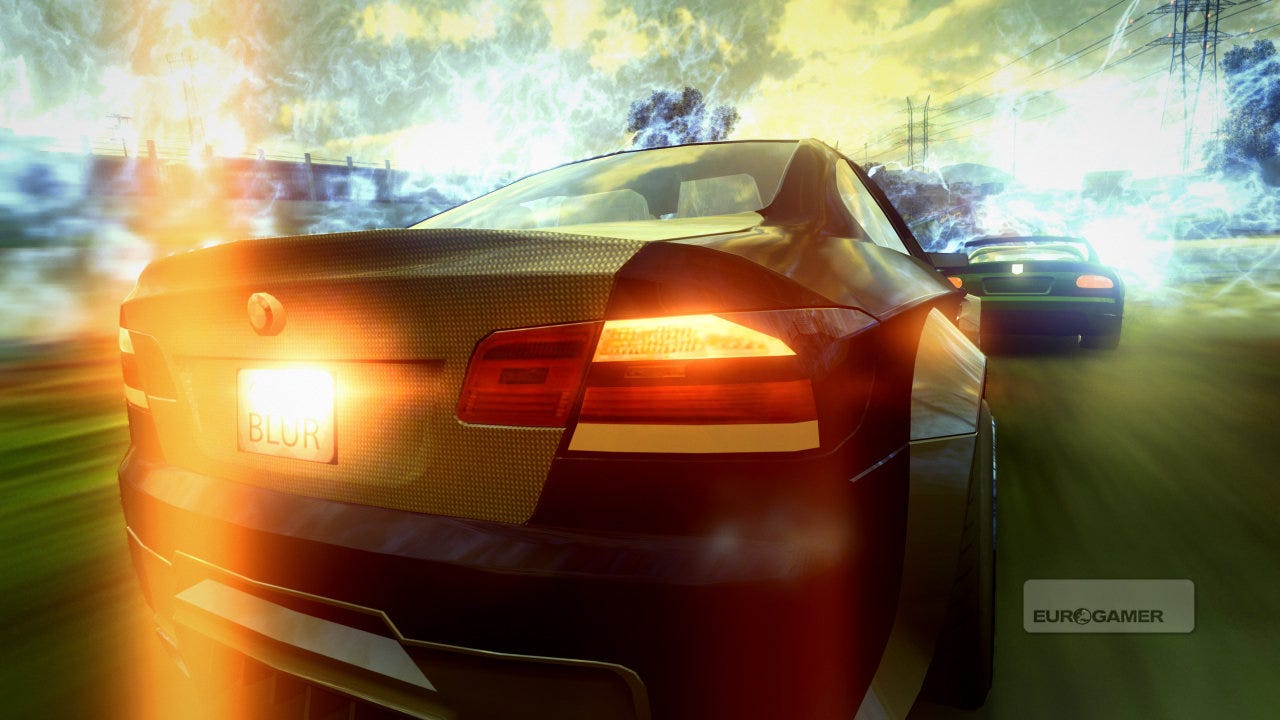
Eurogamer: Where's the emphasis shifted to from the "racification" - creating good racing corners on street circuits - where does that attention go now in the track design?
Gareth Wilson: Variety, really. It's gone from precision to variety. We're still taking as much care, maybe even more care in the track design itself, but we're just working much more on the experience, what we want people to feel, what we want them to remember about that track, whereas in Gotham it was more, let's make a great circuit out of this city. Now we're thinking, we want people to go to this desert race and do this track in Nevada because we want them to remember doing cool s*** in 4x4s and driving along on all these different surface types. So the track design is really about memorable moments and emotion.
I'd say we've done maybe three or four times more track design work in this game than on the previous game, because in the previous game everything was locked down. You had a track and you had to make it as good as you could from what you had. Whereas now, because we're not tied down to reality, you can just move stuff out of the way. So in a way, it gives you loads of freedom, but because you don't have those constraints it does make it quite a difficult task. Now, because you can do more stuff, you do more stuff.
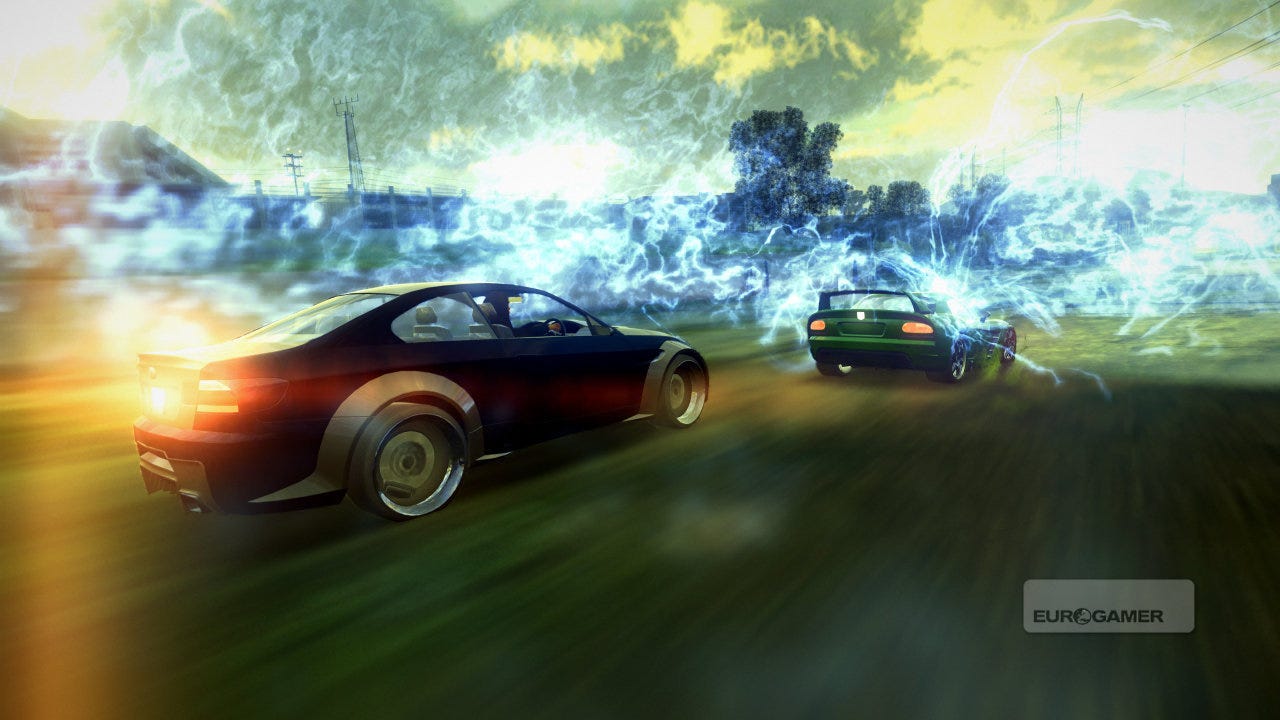
Eurogamer: In terms of the handling - are you able to keep the tactile satisfaction while making it more accessible? Most arcade racing games, the handling can be enjoyable but it doesn't really have that sense of contact between car and road.
Gareth Wilson: Well most of them don't have the physics engine really, do they. Like, Burnout doesn't really have a proper physics engine in the same way. So this is still a proper physics engine. It's a brand new one actually, it's completely multiformat, but it's based on the same stuff we had in PGR. We've things that go over the top in the physics, so we've got this thing which is called anti-flick - if the car starts drifting out, the game applies forces to the car to straighten it out. So some of the cars, the easy cars, if they start losing traction the forces kick in to basically allow less experienced players to drift on corners more easily.
Having said that, if you pick a very drifty car like the Dodge Challenger, then you'll get a pretty much carbon-copy Gotham car. So all we've done is broaden the bookends of Gotham, so like in Gotham the Ariel Atom was quite easy to handle, but if you gave it someone who didn't play racing games they'd smack into every wall, and go this is crap, I'll go and play Halo, thank you. So all we've done is really gone that way with the usability of the vehicles. So if you want a really drifty car, it'll be there for you. We're not dumbing down at all.
Eurogamer: Power-ups - you say they have less race-deciding impact than in a game like WipEout or Mario Kart?
Gareth Wilson: Well, WipEout's an interesting one. I think in power and influence we're much closer to WipEout than we are to Mario Kart. In Mario Kart you have the big blue shell and at any point while you're in first place, you could be battered by the blue shell. But in WipEout, they all really just slow you down. If you look at WipEout, all the weapons just slow you down for a little bit, it's much more like WipEout. Even if you get completely whacked by a power-up, hand of God will kick in. You probably lose maybe four seconds.
They certainly influence the race, and when you play harder difficulties you can't win those races without using power-ups, but they're not as random or as final as some of the Mario Kart power ups are.
Eurogamer: The custom groups thing is really interesting...
Gareth Wilson: That was something that came up quite early at the start of the project, actually. Yeah, we're really excited about it. We're hoping that it - obviously we want this to be a regular franchise, so we hope that moving forwards it's going to become a massively community-driven racing property; the final thing could be that it becomes the place where people come to effectively build their racing game.
Obviously because we're making a brand new IP, there's stuff we've not done in this iteration, but moving forwards we want to expand it even further. So right now we've got game modes and stuff like that, but moving forward there'll be all sorts of stuff, so you can have a massive car community that creates its own experience. So yeah, it could be really good, but the technical challenges are going to be a nightmare.
We have to have a server where you can pull down all the information about the groups and then distribute those groups between potentially 500, 600, 700,000 people simultaneously matchmaking. Xbox Live and PSN don't do this stuff right out of the box, so we're creating our own server which will basically handle distributing groups, allow people to swap liveries and pictures, all that community stuff. But it needs to be instantly accessible and work with hundreds of thousands of people using it.
Eurogamer: Is this community focus a replacement for what Bizarre's traditionally done - be a very leaderboard-driven company?
Gareth Wilson: I think the whole leaderboard thing is a bit of a red herring. I don't think the majority of people really care that much about being number one in the world. Don't get me wrong, we're still going to have leaderboards of who's the best on certain tracks... But PGR3 was a good example of this, you could download the world's best ghost, and you could race against it and at the first corner, it's gone. Mere mortals such as me couldn't keep up with that sort of thing.
What's going to be much more interesting is in time attack, if you're in my friends list and you do a best lap, the social network will inform me that you've just done a fastest lap on this particular track. You can send that ghost to me and go, beat that bitch, and then I'll race it, and then I'm actually playing against someone, probably of comparable difficulty who I'll actually care about beating. You can start trading lap times, and you can have a great big leaderboard of all your friends, all with ghosts that you can play against. You can actually go and select all the people that you want to race against even though they're not online. That's so much more inclusive than just downloading the world's best ghost.
Eurogamer: It reminds me of the great friends-list integration in Geometry Wars 2...
Gareth Wilson: Yeah, well that's where we've learned a lot of stuff. Geometry Wars 2, all the friends stuff there was great. It's really just doing more of that stuff for racing games.
Eurogamer: What's enabled you to do licensed cars in a combat racing game?
Gareth Wilson: The choice of vehicles for the game has helped. Ferrari and Lamborghini aren't in this game. The type of manufacturers has helped and also the attitude that we've taken has helped. If someone doesn't want to do what we want to do then we just won't put it in the game. There have been a couple of big manufacturers, can't tell you who, that have gone you can't set the cars on fire, and we've gone, OK we won't use your cars then. Because the cars are not the star of the game, the gameplay is the star of the game. Whereas in Gotham, if we didn't have Ferrari, Lamborghini and Porsche, then everyone on Eurogamer would be going 'oh my God'.
So because we've been more flexible, that's the number one thing. And also because we've asked. I think we were a little bit averse and a bit scared of asking before, and we didn't need to as well. Also other games have kicked the door down for us as well, like GRID and DiRT. They were doing all sorts of stuff. We had one thing with a manufacturer where they didn't want smoke coming out of the car, and we just said yeah but you're in GRID, and GRID does smoke. And they went, oh yeah. So I think every year, collectively, between us and Forza and Codies, we're gradually chipping away. Cos we've got fire now. If the car is wrecked, it's run out of repair, the car sets on fire. I don't think that's ever happened in a licensed car game - actual flames. So maybe if we do that, maybe in the next one Codies will manage to get flames while the car's moving, which then allows us to go maybe we can blow the car up next time. Every year we're chipping away at what we can do.
Eurogamer: Your competition, or perceived competition is changing from GT and Forza to Burnout, Split Second. Is that intimidating?
Gareth Wilson: No not really. It's weird because we've always thought that we went up against Need For Speed, but we were always perceived much more as a simmy game. But I think that space is up for the taking. I think NFS has lost its way. NFS Shift looks like it's just jumping on where Gotham was, it's almost like you can see them saying oh, no Gotham this year, let's do Gotham. I don't think that's the right thing to do. I think we should be going back to the reason play racing games, just having fun overtaking and racing, get back to that sort of OutRun, Road Rash golden age of racing.
If you've got a simmy game you don't really need any others. If you've got GT on the PS3 you don't really need another sim game. Look at RACE Pro. SimBin are the business, right? Stunning handling. How many units has it sold? I went into GAME and said have you got RACE Pro, they said what's that? I don' think there's a market for sim games.
One thing me and Jed [Talbot, another Bizarre dev] often talk about is the way that the console market moves through how old the console is, so at the start of the cycle, a sim game makes a great launch title. But once you're five, six, seven years into console development I think a sim game runs out of steam, because sim games are relying on tech. So for the next gen of consoles, making another kickass sim would be great, but once you've done that, you can't really go much further with the sim, I don't think. I think it so heavily relies on technology. That's another reason we want to move away from the sim.
Gareth Wilson is lead designer on Blur, which is due out for PC, PS3 and Xbox 360 later this autumn. Check out our hands-on preview for more.
