BioShock

Harvest soon.

"How can you do this to a child?!"

Um...

How could I? Oh God. But... But wasn't all this caused by her own hand? And how else can I save his family? And myself? "You're the only hope of me seeing my wife again," he says. That's not much of a choice is it? Besides, how can that thing still be called a child?

I've just harvested my first Little Sister. And it's one of the most arresting gaming moments I've experienced in a long time. Earlier this evening, Bioshock creator Ken Levine, facing the same choice, saved her.

"We're going to see what happens when she's turned back into a little girl," he announced. "She's a normal little girl there. In a minute she's going to run off and go back into the vent, and not until later on in the game will you find out what happened to them."

At the end of the first extensive section of Levine's sub-aquatic, dystopian thriller, all players will face that very choice. It's at the very heart of what Bioshock is all about; and your decision, Levine insists, will shape the rest of your experience. "Depending on who you follow, your character grows differently, you play the game differently."
1

Having seen Ken save the Little Sister, I was always going to go for the harvest option. Just for the sake of editorial balance, you understand. It was hardly a big deal. Until I saw what happens... But we'll get back to this later.

We've been tickled, teased and tantalised by Bioshock for what now seems an age; it rocketed up toward the top of our Eurogamer's Most Wanted list immediately after Kristan emerged slack-jawed from last year's E3 presentation. "Game of the show!" lots of people gushed, despite not having got within harvesting distance of a joypad.

The story should be familiar to anyone who has followed the game's progress since then. Set in the mid-20th century, post-WWII, Rapture is a utopian fantasy made real by Andrew Ryan, a renowned industrialist and capitalist who desires to create the perfect society on Earth, populated by the greatest human minds, to escape the corruption and poison of ordinary humanity. Rapture will be his apotheosis.

Unsurprisingly, it all goes wrong. As Levine notes: "The trouble is philosophies are these ideals and people are not ideal. And what happens when people mix up with these ideals? That's what Rapture is - really interesting ideas screwed up by the fact that we're people."
2

Rapture's "interesting idea" was advanced genetic modification of humans, fuelled by the discovery of 'Adam', a substance made by a sea slug parasite found close to the sub-aquatic paradise. Tenenbaum, a brilliant scientist and Holocaust survivor, manages to harness these cells to create Plasmids - intravenous genetic hits which grant the user instant super-human abilities. But in the end, like Frankenstein's monster, the creation turns on its master.

Having selected either Easy, Medium or Hard difficulty, the playtest begins at the very beginning, during the much-discussed but never previously seen opening sequence. Your plane has crash-landed in the ocean. Alive, and disoriented, you guide you character swimming through the burning wreckage until you catch site of the looming presence of a lone, dark lighthouse. This, as you'll find, is your one-way ticket to Rapture.

Inside the lighthouse, plaques for Science, Art and Industry indicate the intellectual ideals sought by Ryan. A capsule in the basement of the lighthouse is your vehicle to Rapture. There follows a cinematic, sweeping voyage to the bottom of the ocean, as Rapture's magnificent art deco structure reveals itself. All areas of the city we're seeing, Levine assures us, we'll visit during our adventure.
3

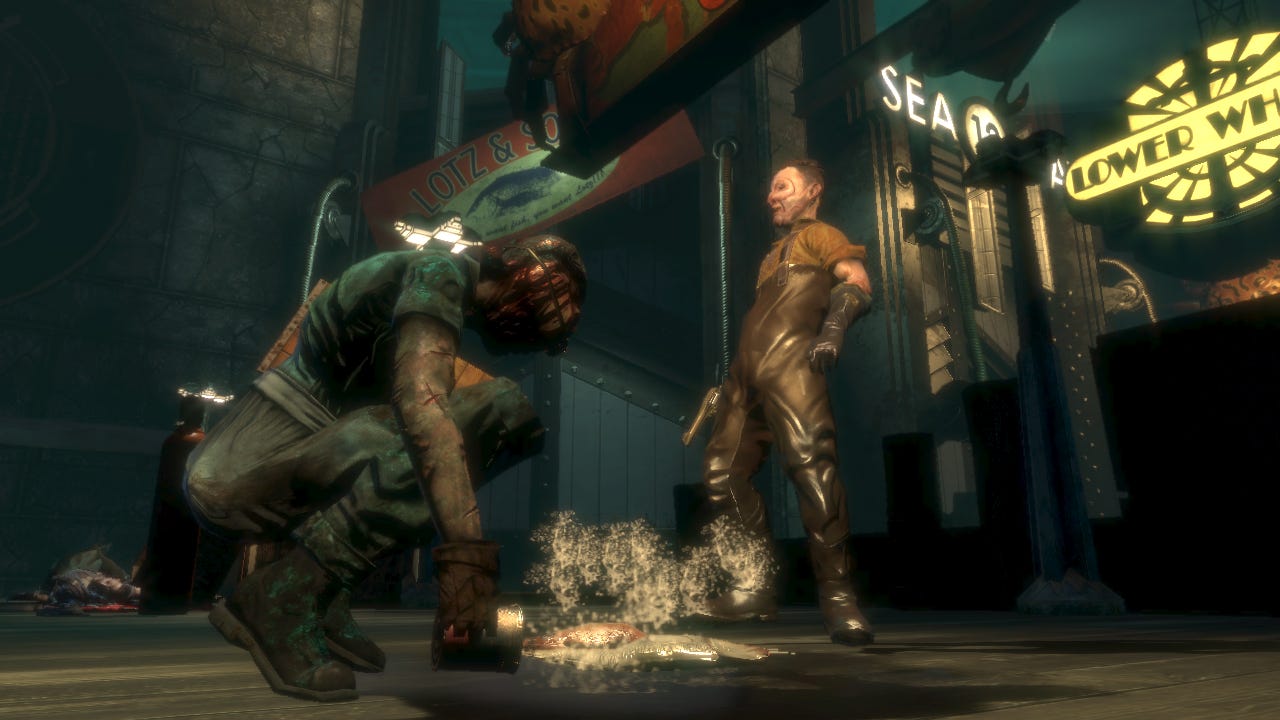
"All good things of this Earth flow into the city", proclaims the motto above the entrance to the city, with unintentional irony. Still inside the capsule, our first hint of the horrors within presents itself, as a hideous, disfigured man slaughters another right in front of the capsule.

This is a Splicer, a citizen of Rapture turned genetic monster through the sinister side-effects of Adam. It's unsettling stuff, and a fantastically engaging opening sequence that sets the scene for what lies ahead.

You're contacted by a mysterious Irish man named Atlus, who will be your guide through Rapture. His wife and child are still alive somewhere in the city and he needs your help to rescue them, in exchange for helping you to survive. Having just witnessed an hysterical, vicious murder from six feet away, it seems like a fair trade-off.

As you begin pacing around the environment, you immediately appreciate the staggering attention to detail hinted at in previous demos and trailers. The post-lapsarian devastation wrought by mankind on its own earthly paradise is captured brilliantly by the battered, punctured shell of Rapture. Water is seeping in everywhere, as reality inexorably bursts into this hermetic bubble of life; fish flap wildly on the floor, gasping for air; vast streaks of blood paint the floors and walls, hinting at the violence that lurks within; discarded, bloodstained placards tell a story of broken dreams - "Rapture's Dead"; "Ryan doesn't own us".

Atlus urges us to search the still-warm corpse of the victim. We pull out an Eve hypo and inject it into our arm. The effects are immediate and overwhelming, screaming as our body spasms uncontrollably and bolts of electricity flare from our veins. We've just had our genetic code rewritten, Atlus helpfully informs us. The Plasmid we just mainlined gives us our first taste of the power of Adam: Nanobolt, the ability to fire bolts of energy from our hand.

Eve, Adam's counterpart, is the serum that carries the Plasmids, providers of all the super-human abilities we'll evolve during the game. As well as a regular health bar, there's also an Eve meter, which depletes when abilities are used, and can be replenished via pick-ups and items purchased from vending machines found throughout Rapture.

You can also pick up a series of Gene Tonics, either Physical, Engineering or Combat, which provide more limited boosts to various abilities, as the names suggest.

Bioshock employs basic first-person controls with a few additions. The left bumper equips Plasmids, and the D-pad can be used to cycle between various types of ammo, for instance.

4

In the opening section of the game your traditional attacking options are limited to a couple of guns. But ammo is incredibly scarce, and faced with hordes of rampaging Splicers, we frequently found ourself reduced to smacking the freaks across the skull with a wrench.

You'll also have your genetic powers, of course, but again, these are strictly rationed and it's vital that you make every strike, every last bullet count, as you never know where the next ammo or Eve pick is going to be. And since the Splicers apparently spawn randomly, an itchy trigger finger will put you in some pretty deep water, if you'll forgive the pun.

This deliberate stinginess with ammo is clearly designed to ramp up the tension and stop deathmatch nutcases from storming around raining bullets in every direction. Tense, yes, but also occasionally frustrating as we're reduced to the wrench, without a sniff of ammo, against some pretty substantial odds. But then, your correspondent is probably just an FPS pussy. And the sense of achievement is palpable when a particularly gruelling section is cleared.

One of Bioshock's major selling points is the promise of attacking options limited only by the player's imagination. Levine has waxed lyrical about 'AI ecology' and the freedom of expression afforded by a truly interactive environment.

5

Before our playtest, the point was hammered home by a demonstration of a later section of the game approached in three distinctive, increasingly experimental ways. Despite the clear brief, the demoer was still required frantically to improvise because of the random distribution of foes.

In practice, and even at such an early stage of the adventure, we're delighted to report that Levine is as good as his word. (Frankly, there'd be riots otherwise). Splicers come as single tormentors and in battalions. And you never know where these ugly bastards are going to spring from. I lost count of the number of times I flinched in my seat, reeling from a surprise assault, stumbling around to get bearings, steady the weapon of choice and fight back.

When weapons are coupled with Plasmids, your options multiply dramatically. Nanobolt can temporarily stun Splicers, giving vital extra seconds for you to unload a couple of rounds to the face, or deal with any additional fiends. Back a few Splicers into standing water, and a quick blast fries them spectacularly where they stand, a fabulously orgy of electric death.

The Plasmid that produces flames works in the same way with oil. And Splicers set ablaze are just as likely to use water literally to save their own skin. Telekenisis is the final power available in our playtest, and if you've watched the trailers released so far you'll be acutely aware of its potential. The wasted art deco disaster zone or Rapture provides the perfect projectile playground, and a lifeline when ammo has been exhausted.

6

And then there's hacking. Machines can prove a deadly foe - stumble before the cold glare of a security camera, and hovering sentry robots are promptly dispatched to spray your brains up a wall.

Yet these can be adapted as an extra dimension to your arsenal through hacking. So a successfully hacked sentry suddenly becomes a Splicer-blasting scout for you, or can create the perfect diversion while you slip through an area unharmed. The penny finally drops for this formerly frustrated FPS pussy.

Vending machines are also susceptible, a successful hack revealing more items and cheaper prices. But while the results of hacking are a multitude of approaches, the actually act of hacking is something of a let down.

The game switches to a mini-game in which pipe sections must be rearranged in a grid to facilitate the flow of liquid. It's reminiscent of The Assembly Line's Amiga puzzler Pipe Mania; and, more recently, the bomb defusing mini-games in Spider-Man 3.

In the context of Bioshock, these serve to, for this writer at least, puncture the illusion and atmosphere, dragging you out of a tense, seamless, captivating gameworld to complete an arbitrary logic puzzle. None of which is particularly strenuous or taxing in the first section of the game; though we'd expect them to increase in complexity at the very least as the game progresses.

Special mention must go to the design of the Splicers. Alive, they terrify with lunging movements and screeching, barely comprehensible rants. On one occasion, what appear to be husband-and-wife Splicers can be heard screaming domestic abuse at each other, before turning their attention to murdering you once you intrude.

But only on viewing a pummeled corpse do you truly appreciate the violation of humanity they represent. Still dressed in period clothes, yet hideously disfigured, their collapse into genetic oblivion retains a painful human element - some even wear masks to hide their shame from the world. The breathtaking artistry ensures players register a profound sense of sadness at the folly of over-reaching human endeavour.

And such images say more than pages of dialogue. Levine doesn't really do cutscenes, because he doesn't have to. There are other ways to tell a story.

"It's great to be able to tell the core theme of the game just by looking at it," he explains. "You don't need to hear a word; you just look at it and go, 'I get a little bit of what's going on here just by looking at it'."

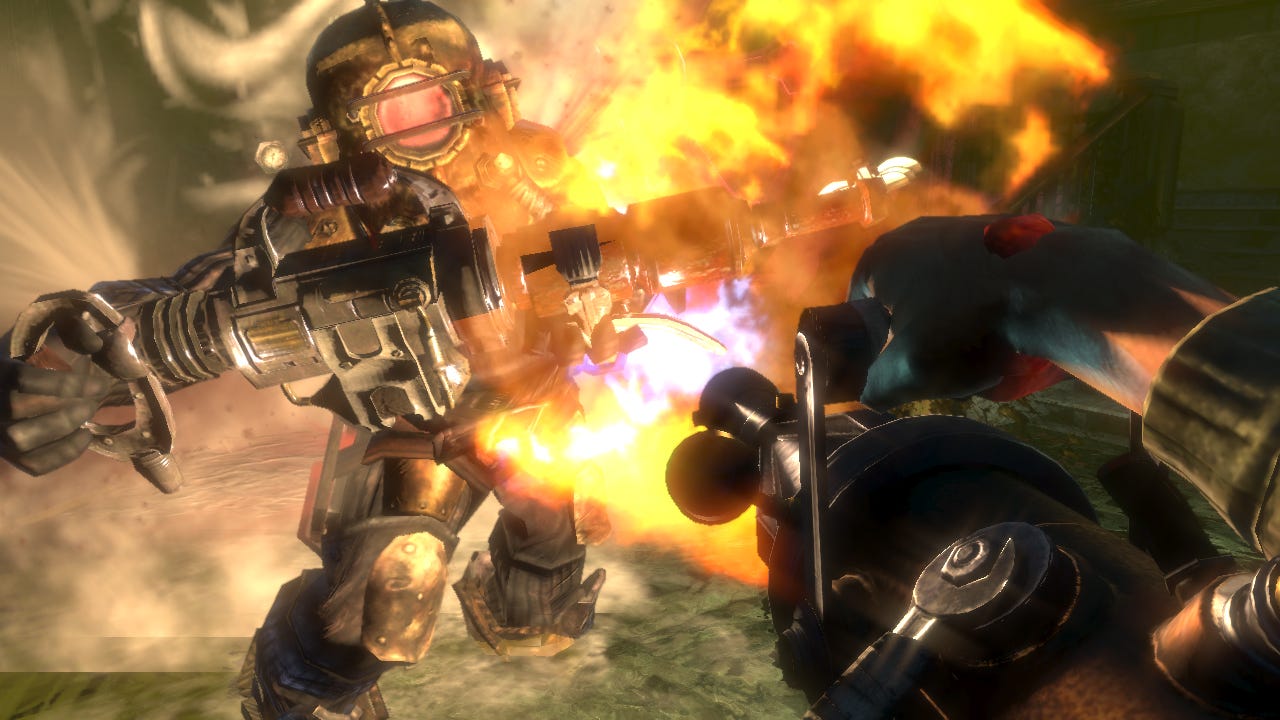
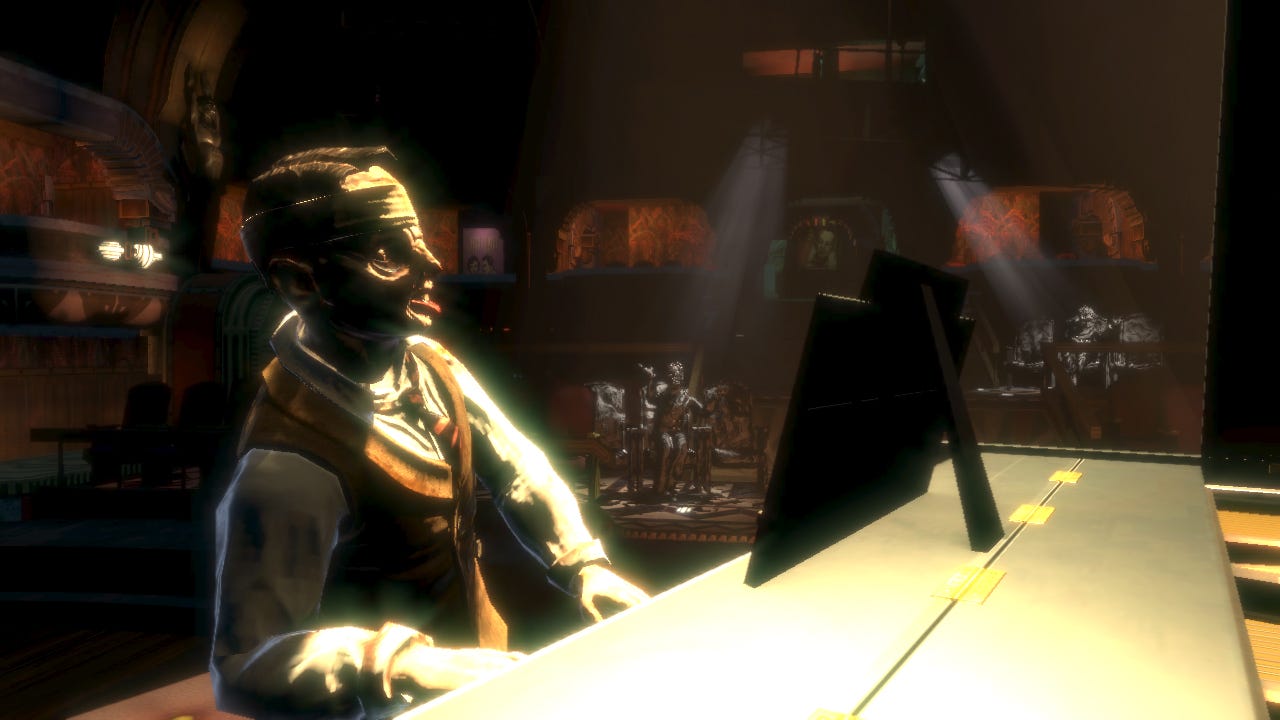
Equally, rather than subjecting the player to a boring monologue, the pivotal relationship between the Big Daddies and Little Sisters - genetically engineered protectors and collectors of Adam - is captured majestically in a brilliant scene in a theatre.

You watch from a safe distance, as the childish L'il Sis' skips nonchalantly towards a corpse as her Daddy paces menacingly behind. How exactly does she extract the Adam anyway? Ah, by using a giant syringe and then gulping down the contents as if it were a yard of ale on a stag weekend.

7

A Splicer, craving the Adam, suddenly races in to attack the Little Sister, at which point the monstrous, hulking Daddy shudders into life and savages the Splicer to death. Even though the scene is obviously scripted to a degree, by 'happening' upon it and sneaking around for a vantage point, the illusion is brilliantly maintained.

The Big Daddy/Little Sister relationship, and how you deal with it, is the game's nexus. Little Sisters are your source of Adam, which you'll need to develop your special abilities. And to get at that you have to get to them, by getting past them. One of the game's central themes is thus communicated .

The story is moved on in other ways, notably through personal audio files and logs you'll find. Finding some of these become mini-missions in themselves, containing information essential to progress. The rest are strewn throughout Rapture awaiting your attention. It's up to you whether you want to go that deep, but Levine claims they provide a "novelistic level of detail" if you want it.

It might not be a particularly realistic way of telling the story of Rapture, but it should mean that the storyline is never over-bearing in a 20-minute Final Fantasy cutscene way, which many gamers will appreciate.

8

Choice is all. Re-emphasised by your first proper encounter with a Big Daddy late in the stage. You can stay and fight, using every trick and tactic at your disposal to wipe out the brute to get to the Adam. Or you can just run away like a coward, but forfeiting the potential upgrade to your abilities.

The game's not entirely free-form, of course, and dynamic goals will be set as you complete various tasks. To help you navigate, a compass point will lead the way to key areas. And maps and messages are all stored via a menu system for you to check up on at any time.

In terms of impact and atmosphere, our initial experience with Bioshock thrills and captivates in this taster of Rapture's hidden depths. Other areas you'll visit, revealed but inaccessible on a menu, include Arcadia, Hephaestus, Point Prometheus, Neptune's Bounty, Fort Frolic and Apollo Square.

There are a few hangovers from old-style game design. Explore and find heat Plasmid to melt ice and progress; find telekinesis to move object and progress, and so on, which jar slightly with the otherwise impeccable structuring. Limited ammo and the need to improvise also requires a lot of weapon and action swapping on the fly which can prove a little clumsy and consuming at first, though hopefully familiarity and practice will cure this issue. And when using the wrench to tackle a horde of Splicers, resorting to wild, aimless flailing is not uncommon as you struggle to get a hold of the situation.

But these are minor niggles far outweighed by our thirst for further exploration of Rapture's astonishing, unique innards, and the dizzying scope and potential of the main action, only hinted at in the early stages as players are eased in.

9

At the section's climax, we meet Tenenbaum and a Big Daddy-less Sister is at last offered to you for Adam-grabbing immolation.

So here we are again. Rescue or harvest? Harvest or rescue? Tenenbaum, whose unchecked ambition, after all, caused this whole sorry mess, is begging you to spare her. Atlas, however, observes that these genetically modified freaks have already been stripped of their humanity; and you need the Adam to survive.

The game then spells it out to us. If we harvest, we get maximum Adam, but she dies. If we rescue, we get substantially less Adam but, Tenenbaum desperately appeals to our conscience, it will be worth our while. Our call.

We grab the girl and draw her right up to us. She's screaming, fear etched into her face, hopelessly, pathetically writhing and trying to push us away. "No! No! NOOO!" She still seems pretty human to us...

Sod it. "Harvest".

The hysterical child moves briefly out of view, there's a skin-crawlingly grotesque sound effect and... Well, you'll want to see this for yourselves.

"How could you do this to a child?!"

For more on BioShock, check out the latest Eurogamer TV Show featuring brand new hands-on footage and an interview with Ken Levine.

Comments (74)

Comments for this article are now closed, but please feel free to continue chatting on the forum!

  • Loading...hold tight!