BioShock 2's Jordan Thomas

Daddy's back.

Jordan Thomas is a games journalist's dream. He talks a mile a minute, hitting a dozen tangents in the process, but is consistently fascinating and entertaining - even when, as was the case with this interview, he's soundtracked by the alarming sound of a dozen dogs barking from the house next door.

While he doesn't think BioShock 2 is his magnum opus - he's clearly already planning something bigger - this is his first time fully under the spotlight, and he seems determined to make the very best of it.

Eurogamer: Let's start with the sense that there was this quite vicious backlash to the first game - are you interested in catering in that, or are you too busy making the game you want to make, and it doesn't matter what those guys think?

Jordan Thomas: I just cannot get through my day if I let the internet have a say, frankly. We have high enough standards for what we think BioShock means. Both myself and Melissa [Miller, senior producer], we worked on the first game, it is really ourselves that we have to convince. The experience of the first game was so subjective that if you talked to a hundred different people and asked them, "sooooooooo, what should be the primary features of BioShock 2?" they will tell you a hundred different f***ing things. Probably involving riding seals to freedom and so forth.

BioShock 2 specifically started out as "okay, what did BioShock 1 not do? What was not as good as it could have been?" I wanted to tell a very personal story, a kind of family conflict between three people - through the lens of Rapture, a kind of child's eye view on this magnificent city, and to show the contrast between the philosophy of rational self-interest that was embodied by Andrew Ryan and was critical to establishing the setting, and the sort of ethos of self-sacrifice that Sofia Lamb is bringing to bear. Now that we have that context, it felt like there was room for some interesting drama that comes very much from these polar extremes, and the conflicting forces between them, and the player is caught between those two impulses.

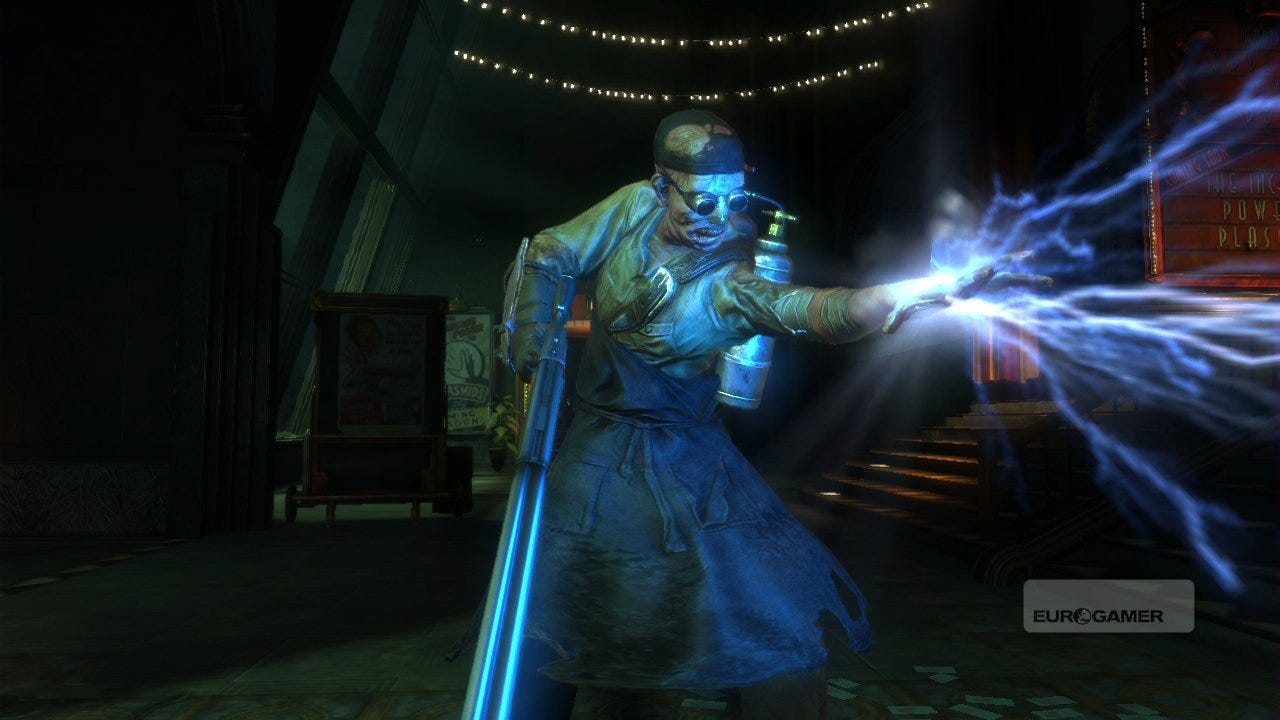
Beyond that, we had this goal to improve the game as a shooter. It felt like the first game - the story was very solid, very happy with that, the options for customising your character were also compelling, maybe not as deep as they could have been, so our goal for BioShock 2 was to celebrate your free will, I guess, both as a player and as a kind of partial author this time. That means giving you a lot more options to specialise, and it means giving you a lot more control over the narrative, in a way that didn't make sense for the first game, either in the commentary layer or in the broad 'how the hell do we get this game done, what does BioShock actually mean' questions we were answering the first time around.
1

Eurogamer: Which comes first - being a really good FPS, or being a game with moral deliberation and meaningful choices?

Jordan Thomas: I guess I refuse to prioritise one over the other, and that's why I hire badasses... My goal with building 2K Marin, and Alyssa Finney who's the executive producer, was to put together this internal 2K studio that could deliver on the quality bar expected by the BioShock name, and also work very well with several partners. Such as 2K Australia - who are veterans of the first game, and are returning for this one, and Digital Extremes who are responsible for the multiplayer component.

From there, I guess it became about hiring somebody I could trust with the design. So we found this guy Zak McClendon, who is a brilliant sort of systems designer that we found in the Bay Area. And he took control of much of the improvement of the game as a shooter, and I think has delivered on it spectacularly, and meanwhile that gave me the headspace to focus on the BioShock canon and deliver the script that would work in tandem with those mechanics and not constantly be fighting.
Eurogamer: I'm curious about the integration between the single-player and the multiplayer, given it's been farmed off to a different team. Is it something you wanted in the game, or is it more because of market pressure - it has to be there, and it's going to be its own thing regardless of what you guys are doing on the core game?

2

Jordan Thomas: From my point of view, it was definitely not a market pressure thing. There's a section of Rapture's history that I think it best represented by multiple intelligent survival-driven agents competing over Adam. And that's the civil war of Rapture - that turned from utopia into hell underwater. Specifically, 1959-1960, after the bombing of the Kashmir by Atlas' thugs, and the subsequent open warfare between his forces and those of Ryan.

So we saw an opportunity to scratch some of the itch to see Rapture still beautiful, and also to represent accurately that part of the timeline. Beyond that though, we did hear not only market pressure but also the fans that care enough to feed back to us - some of them really want the experience to extend when they're done with the single-player. And they, like us, saw potential in the combatorial expressions that the single-player supports but does not mandate.

So, you can do all these crazy things like covering an explosive barrel with trap rivets and then hurling the entire clusterf** towards one of your enemies and watching the suffering. That, while cool, is kind of more self-gratification in single-player; we don't require it. In multiplayer, the forces of competition - very Darwinian in fact - require you to migrate around in the tool-space and learn these combos. We in fact reward some of the more difficult ones with these sort of rider trials.

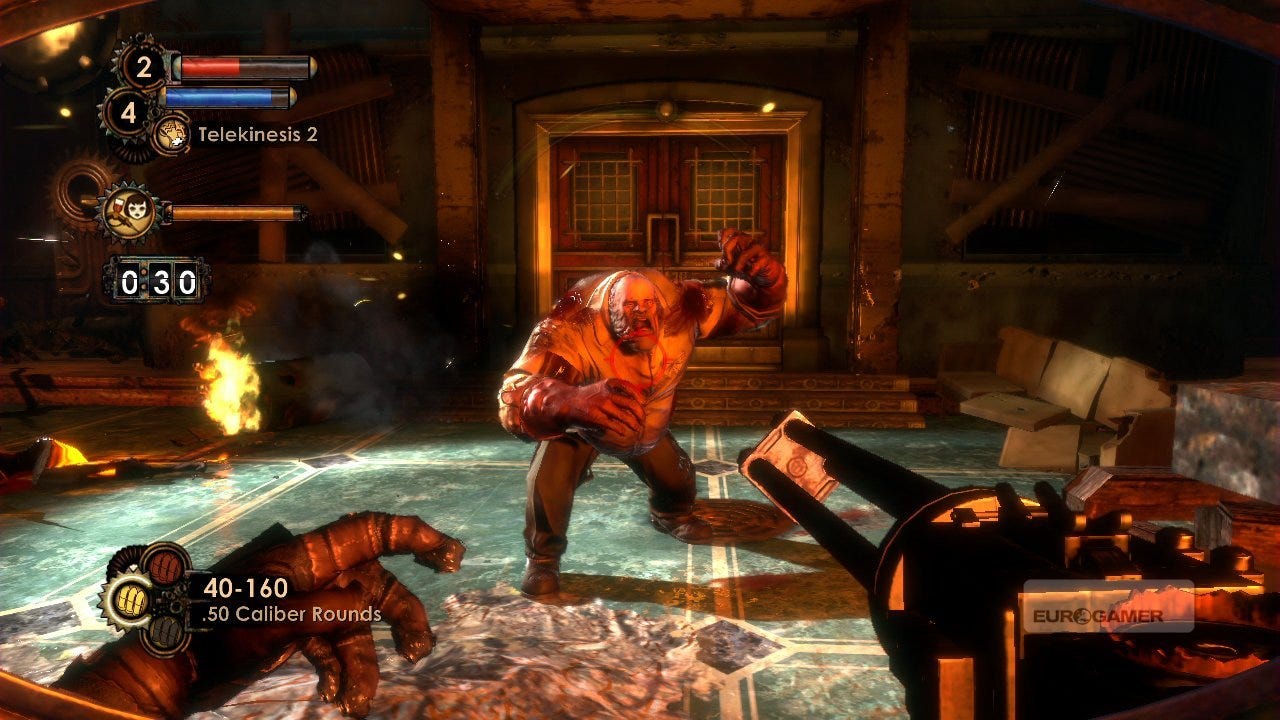
Melissa Miller: And that's not to say we were able to take the BioShock single-player and go like, "hey, now there's a bunch of you". There was definitely refinements that we had to make, and changes to the mechanics that were just an absolute necessity for the multiplayer. One of the first of things is the pacing of a multiplayer map - it's so much faster than a single-player map. In single-player, you can see how many choices I have. I have the chance to pause and say, "hmm, what should I use?" Well you don't have that in multiplayer - it's just not going to make a good experience. So we limit you to equipping two plasmids, two weapons and three gene tonics - so if you hit the bumper you're immediately onto your second weapon or plasmid.

But because BioShock is all about choices, that's just one loadout - and you can have up to three loadouts going into a match. So if I'm in a match and I'm playing Survival Of The Fittest and I'm not doing so well, maybe it's my loadout - so I can shift tactics when I'm killed and during the respawn I can choose a different loadout and see if that will help me. So we are trying to keep that choice alive and well in multiplayer.

Eurogamer: You're a designer who's specialised previously in scary dark places. Whereas a lot of people have looked at BioShock 1 and complained, "oh, it's just more dark FPS corridors", for you is that more of an opportunity than a limitation - a chance to hone those tricks of terror and atmosphere you're known for?

3

Jordan Thomas: That's a really good question, and one that I've been contemplating lately. I actually see BioShock as an opportunity for me to branch out from traditional horror. And the reason for that is that I see it more as a tragedy. We've made a number of choices as designers for BioShock that you are so empowered as an agent in this world that physical vulnerability, which I've exploited in prior games, is not one of the chief attributes of this series at all. You are still fighting overwhelming odds, you are still in a deeply atmospheric place and you have limited information, and those are my tools here.

But it's kind of more of a psychological warfare. My intent this time around is to inspire moral terror. Because you have free will, and because you are so central. My hope is that you become aware of that, and are creeped out by it rather than [adopts Mickey Mouse voice] "Oh God, they're going to jump on me" scares and so forth.

There are still long, spooky sections of BioShock 2, which we have deliberately engineered as pace-breakers, but I don't think they're the focus of the game in the same way as something like Condemned or Silent Hill. It is more of a kind of parable, which you decide the meaning of. And my goal in the second game has been only to augment that sense of tragedy, but also to move you to high action and adrenaline back to speculative sections that are purely about atmosphere.

Eurogamer: Is there a risk that the mention of moral dilemmas means people start thinking about BioWare games and the like - but those aren't the kind of choices and depth of choice that's really possible in an FPS?

4

Jordan Thomas: It's not a risk - it happens. It's a fact! If you mention moral dilemmas, that's where they go. I guess we had to drawn our line for this particular brand differently. Because this is a first-person shooter, and because seldom does a shooter that puts this much effort into the visuals and into the moments of high systemic drama also try to deliver on any of your possible narrative choices.

There's a strong internal conflict between all of those things, and it's hard to get all of them right. So, for BioShock 2 I've had to choose the number of variables that I think we can meaningfully and interestingly support. So when you make those choices, the pay-off is spectacular enough that you notice that it's there. As opposed to something like Fable or any of the BioWare games - of which I'm a huge fan - but there's so many variables in question that the results can often be so gentle that you don't necessarily perceive the change.

This game is about coming from the philosophy of 2K Boston and even before that, about discrete results as following from meaningful and strongly differentiated choices. It's just a less noisy system deliberately - and that's because I hope that you actually notice the change to the story this time.

BioShock 2 is due out for PC, PS3 and Xbox 360 on 9th February 2010.

Comments (56)

Comments for this article are now closed, but please feel free to continue chatting on the forum!

  • Loading...hold tight!