Ken Levine is buzzing. He's just spent the past two hours watching a group of journalists take control of BioShock for the very first time. And this is a game where taking control becomes a more profound, complex process than simply guiding a character through its world.
BioShock is the latest in a growing line of games where your decisions and actions are said to shape the world around you. One of Levine's favourite refrains has been that 'no two players will ever experience BioShock in the same way'. Tonight he has been able to see his vision play out for real across flickering banks of screens in a New York warehouse. That would make anyone a little perky.
BioShock's sub-aquatic dystopia of scientific endeavour gone horrifically wrong has created one of the most enduringly fascinating development cycles of any game in the past year. Each carefully orchestrated demo has amazed through both technical proficiency and narrative possibility. It's looked the bollocks, basically.
Finally, it's our turn. And you can read exactly what we made of our first excursion in Rapture elsewhere on the site today. First, we have a brain to pick...
Eurogamer: From the intro to the game we saw tonight, the ideological extremism of Rapture seems clearly linked to real 20th Century regimes of Hitler and Stalin. Is that how you see it?
Ken Levine: I grew up loving books like 1984 and movies like Logan's Run - I was obsessed with that movie. And I always loved the idea of this great world, but there was a catch - that was the slogan. And I looked at a guy like Andrew Ryan [Rapture's creator] - and a lot of guys that have a strong belief in a philosophy - and they always have great ideals. The trouble is philosophies are these ideals and people are not ideal. And what happens when people mix up with these ideals? That's what Rapture is - really interesting ideas screwed up by the fact that we're people.
The things that bring down Rapture, you'll find out, are the things that bring down all endeavour. There's no evil overlord - it's greed and sex and stupidity and jealousy and all these things. I want to create these three characters - and you met them all tonight - Ryan and Atlas and Tenenbaum. Totally different points of view on the world; and none of them come across as total villains. The player is thrown into this place, right in the middle of them.
I think we all kind of feel like that. We're in this world with all these powerful forces and we're stuck in the middle, and these guys are saying: 'No! This is the way!' And another guy is saying: 'No! This is the way!' I don't buy any of what you're saying; I'm in the middle here. And that's where BioShock came from, from a story perspective.
Eurogamer: The name 'Rapture' - is the theological connotation intentional?
Ken Levine: It's ironic because Ryan doesn't believe in God. He believes in man as a god. So when he built this city, all the best people got taken away to this place. The notion of The Rapture is that all the believers will be taken up to this ideal place. Well, this is his Rapture; this is where all his ideal people got brought to and were spirited away from the rest of the world. So it's his little joke.
Eurogamer: Science is a major theme in the game. Science was hijacked by the Nazis, who used biology to justify mass-murder. Are you suggesting something similar with the genetic modification and stem cell themes of BioShock?
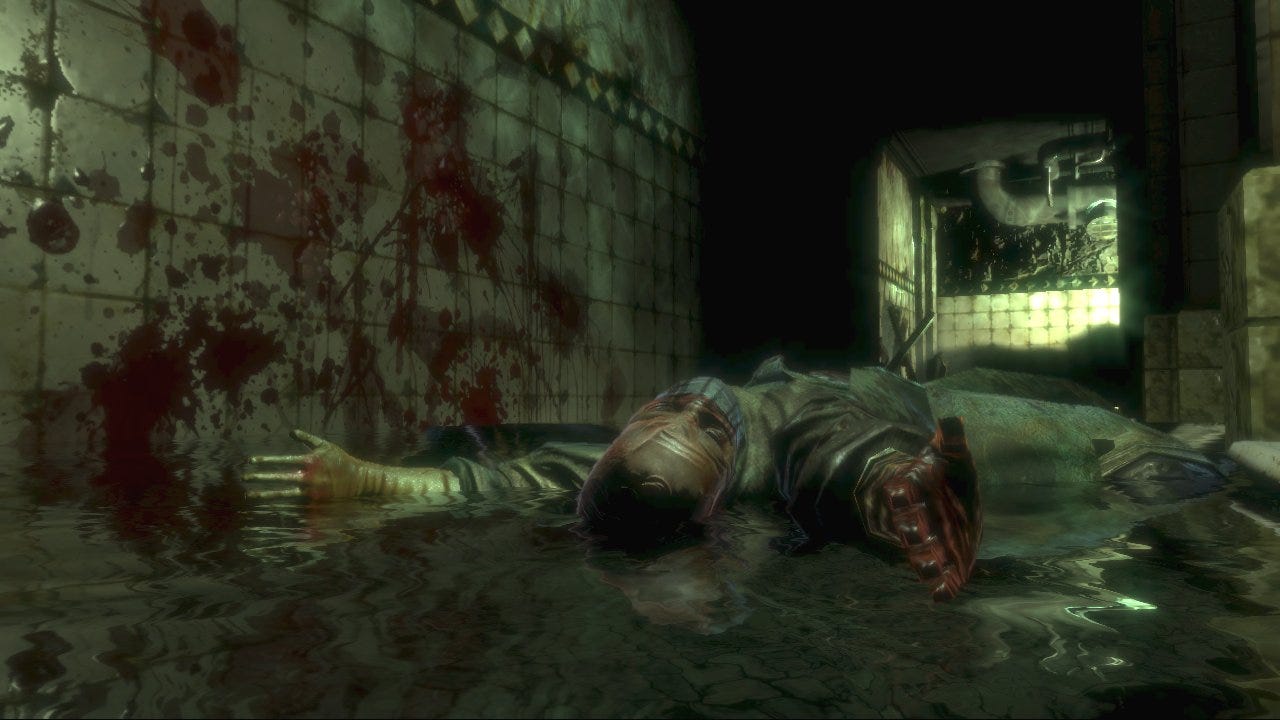
Ken Levine: With Tenenbaum [one of BioShock's three main NPCs, alongside Ryan and Atlas], if you read her early diaries, you find out that she was in the [Nazi] camps. And she was a scientific savant. She says: 'the Nazis always cared about colour of eye and shape of forehead; I care about, why is this one smart and this one stupid? Why is this one strong and that one weak?' The Nazis interest in that was moronic - it was about forehead shapes and eye colour. It was always about their ideology; it wasn't about the science.
Rapture's a place where they take all limits off on science and all restrictions; but they also do some incredible things. A lot of people ask me, is this a game where I'm condemning stem cell research? Absolutely not. I'm condemning not thinking about things. The game is commenting on believing in things without scepticism. I'm a big believer in scepticism.
Eurogamer: It's a truism, of course, that science isn't obliged to produce morally acceptable outcomes. And that its discoveries are invariably used for nefarious ends...
Ken Levine: But they also get used for incredible ends. It's always a yin and a yang; and the question is: do you take it to the extreme or do you step back and go, 'wait a minute'? Whenever someone goes, here's an absolute, I wanna go: 'Hmmm...' And that's a theme of the game. But the game has a lot of ambiguity in it.
I hope that, if there's anything people take away from it besides it being a great first-person shooter, they go: 'This guy was saying this thing that sounds really great; maybe it's not so great after all, this politician or whatever.'
Eurogamer: You've stated before that you see Rapture as a 'character' in its own right...
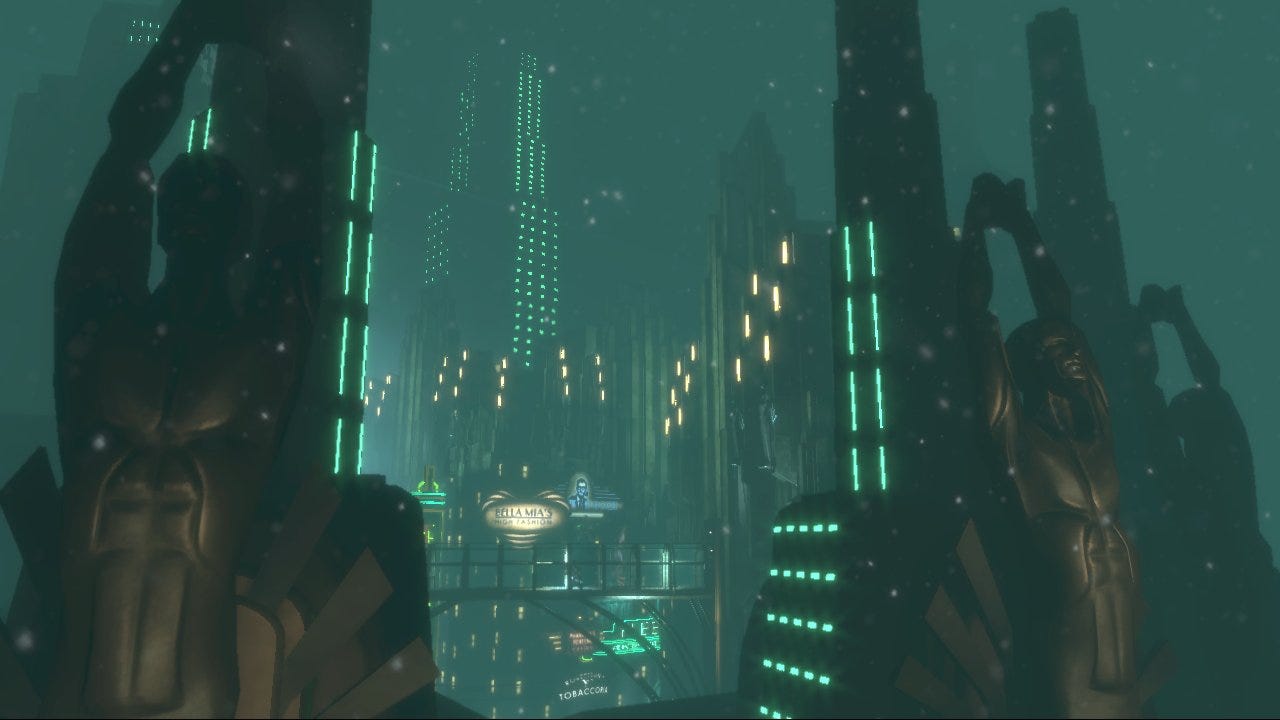
Ken Levine: It is a character in the sense that it's an expression of 'we can do this', that man can make this incredible place. We're going to build a city at the bottom of the ocean and we're not going to compromise. It's going to be the most beautiful city in the world. And the water pouring in is reality.
It's great to be able to tell the core theme of the game just by looking at it.
You don't need to hear a word; you just look at it and go, 'I get a little bit of what's going on here just by looking at it'. And it's a great period, it's a great look, it's a great style, it's a great feel. The art team did a great job in bringing all of that together.
Eurogamer: I read that not long ago you wrote your own screenplay of Logan's Run just for fun - why do you focus on making games now?
Ken Levine: I was a professional screenwriter for a while, and I've done a ton of plays before I became a game developer. I've sort of done that, and to me, the reason I like working in games is it's much more challenging. Telling a story, you have to think much harder - you can't have two guys sit down and say, 'I'm Ryan and here's my viewpoint' and somebody having an argument, because nobody wants to watch that.
Our big argument... we had to frame all of this in a game, and that's so challenging. That's what makes me scratch my head every day and turn to the talented people I'm working with, because I can't have a monologue, I can't have a scene where the camera's pointing this way.
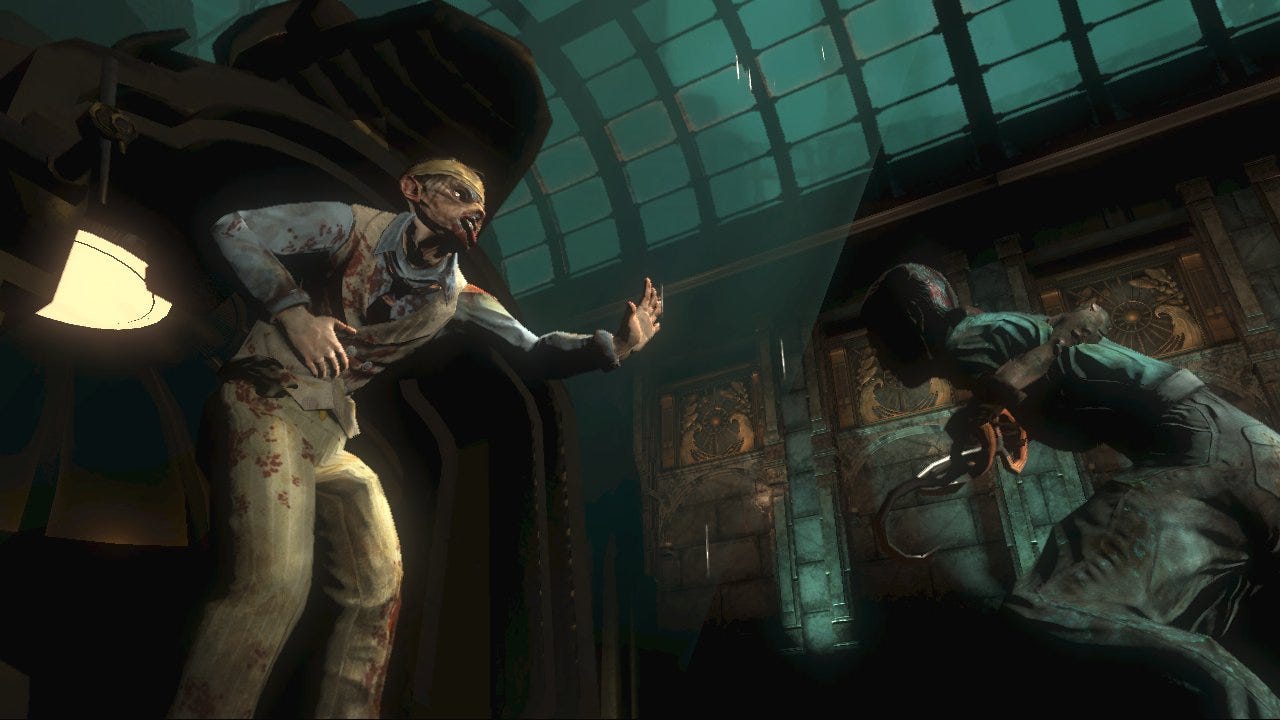
We don't really have cutscenes in this game, that's not my thing - I'm not a Final Fantasy guy where I'll write a 20-minute scene to tell the philosophy of the game. I have to do it really quick and really compress it, and have the world tell us a story, the Big Daddies and Little Sisters visually tell us a story. I like that challenge, because I'm not a gamer that likes watching story. I like themes and ideas - I don't want to sit there and watch a 20-minute cutscene.
Eurogamer: Given your previous work history and the detail of the world, are there any plans to develop BioShock across different media?
Ken Levine: I haven't thought about it that much because I'm so focused on telling the story in the game, because it's taken a lot of work to get right. It's really easy to tell evil overlord stories, but this story is very challenging.
If you want to get into this story, there's a novelistic level of depth. If you don't care about it, you just zip over the plot, but if you listen to every audio diary, you can really map out all of these relationships. There's 60 different characters in the game, and you learn all about them, about the backstories, relationships, who was sleeping with who, who backstabbed who. And it's all there. You could write a novel out of it.
I love the notion of BioShock, that you come into this world and you have to figure out what happened. I'd love to have the opportunity, I just don't know whether I would or when.
Eurogamer: Freedom of choice is at the heart of the experience. How flexible is the narrative outcome depending on what you do?
Ken Levine: The how? It changes gameplay more actually, whether you go the saving-the-Little Sisters path, which is what Tenenbaum wants you to do, or harvesting the Adam from the Little Sisters, which is what Atlas wants you to do. Because he's saying, those aren't even children anymore, they're monsters, they're already gone, they're dead already. But if you're gonna survive, and I'm gonna survive, and my wife and children who are trapped are gonna survive, you'll need the Adam to give you the powers to survive. So that whole choice is really ambiguous.
Depending on who you follow, the Atlas path or the Tenenbaum path, your character grows differently, you play the game differently. To me that's more important than branching story points, though there is some variation on that side as well.
Eurogamer: You said that you're tired of the clichés of first-person shooters and want to advance the genre. Which aspects of the FPS did you want to keep, get rid of, and add to?
Ken Levine: I'll never get tired of leading a target and shooting it with a cool weapon. That's always gonna be cool. But I am getting tired of a game that's like a one-ball string with a corridor that goes like this, and you go at the beginning and you go to the end, and there's no choice and you know that wall happened to get smashed through, so you continue on in the game; you know that monster's waiting for you at that very point.
You know that you have these weapons here and these weapons here; you know that you're always going to have these powers; you know that the environment's always going to be pretty static, even if it's got a few physics objects; you know that weapons won't speak to each other.
I want BioShock to be one of those games where people say, after I played BioShock I wanted more, I wanted this, and I wanted that, and when the other game didn't have it, I got mad. As a gamer, in the same way that when Gran Turismo came out people now expected to be able to tune their cars, not just race on tracks - that makes better games.
Eurogamer: So, looking ahead five years, when people look back on BioShock, what do you hope, do you think they will point to and say redefined the genre?
Ken Levine: Our producer at 2K, Greg, always says, 'you say yes to the player'. It's a game that says yes to the player, that their expectations are fulfilled, that their improvisation is rewarded, that their choice is validated, that their experience is different from their friends', and that a walkthrough is no good to you.
That they go by the watercooler or in the schoolyard the next day and say, 'oh you did it that way? I did it this way! I set a proximity mine on my bot and I shot the guy and my proximity mine went on a kamikaze run and blew up on him.' It's a game that says: 'I care more about what you want to do that what I want to do as a designer. I care about the players' experience'. As a gamer, that's what I want.
Eurogamer: The first time you showed BioShock to 2K you said: "This is shit". At what point after that did you think you'd finally nailed it?
Ken Levine: Different things got nailed at various points. A few months before E3, I wasn't happy with the way the game looked, for instance. The restaurant at the beginning - we built that one room, and we worked on that room. After we did the prototype and threw it out, we said, let's get one room. And we worked on the restaurant and the statue and the water and everything until we got that room right. Everything came out of that.
The Big Daddy was the first creature we had in the game. We always had the notion of a protector class, a protected class and the other splicers. After E3, everybody loved the water effects and people said to me, does the water have a gameplay impact? And I said no. But why doesn't it?
So we went back, and Greg said, 'say yes to the player!' So you light a guy on fire, he runs to water to put it out; a guy's in water, you electrocute him. In the past year, we've been pushing up those elements: say yes to the player, say yes to the player, say yes to the player.
I think of it as people-powered gaming. It's a gamer-powered game more than it is a designer-powered game.
Eurogamer: Is that the future?
Ken Levine: There's no doubt. I remember 10 years ago, I was watching all those FMV video games, and I was like, 'Oh God'. And then I think GTA really blew the wheels off all of that. The games we were doing at Looking Glass when I was there, like System Shock 2, we just didn't have the money. We had the ideas, but not the money or the time to really go out with it.
Now, ironically, because of GTA and Take-Two and the money, they gave us the time and money to take these ideas we had about first-person shooters and people-powered gaming and just run with it.
Eurogamer: We've seen it in action for the first time tonight - you get to choose whether or not to 'harvest' the Little Sister. Are you worried about what the media reaction to this will be?
Ken Levine: I think it's interesting, because it's a game that actually talks in depth about morality; it's centred around morality. Every theme of the game is about morality, and you can't deal with morality without moral choice, so if we're going to make a morality play... and the difference between a game and a movie and a book, is we don't tell you what the answer is.
For someone figuring their way out with morality, a young adult, whose parents are comfortable with them playing it, I don't want to tell them what to do. I want to put them in the place where they can make the decisions. This is a morally ambiguous place; Atlas is saying: 'These aren't even little girls anymore - if you're going to survive, if my family's going to survive, we're going to need to do this thing.'
And Tenenbaum's saying: 'No, they're little girls!' And Atlas says to you, 'she's the one that created them in the first place.' And you're like, what do I do? The whole world is grey. And to me that's the real world. And yes, people will try to simplify things, and want to say things are in black and white. It's always the same people who are telling you what to do morally, that I always worry about.
I have a lot of faith in people. The books... the Brave New Worlds, the Animal Farms, movies like Fight Club, are things that challenge me morally and don't tell me what the answer is. So we don't tell people what the answer is, but we're going to put them in a world where they understand the consequences of what they choose. And the consequences are very clearly defined.
Eurogamer: How have you approached incorporating Achievements into the game?
Ken Levine: I love little rewards. I'm a World of Warcraft whore and I love getting commendations and stuff, so to make a system-wide thing was a stroke of brilliance. As a game developer I love it as it's not complicated to implement. Doing clever ones is complicated, so we've gone back and forth. I remember the first time it happened to me in BioShock, and I was like, 'Oh cool!' It's that magical little tingle you get from an achievement. I love it and I think it's just one of those brilliant little things that some smart guy thought of, a combination that tickles you and is easy to implement - it's a win all around.
Eurogamer: What are you like as a boss? Are you hard to satisfy?
Ken Levine: On BioShock I've had the real reward of being satisfied on many occasions, because we have for the first time at Irrational the time and the money, and a team. To make a great game you need talented people and a lot of time. We've never had as talented a group as we have now and we've had more time that we ever had, and I was able to make mistakes.
First prototype I made I said was a piece of crap. Take-Two didn't freak out. Greg said, 'fix it', and I said, 'okay'. And we went and worked on it. I think most of the team are perfectionists - so when I said we've got two more months, they didn't say 'Ohhh...' they said, 'excellent!' And these guys have been working 60, 70, 80-hour weeks. They were psyched. We're all tired, but they want this to be great.
Eurogamer: What else are you playing at the moment?
Ken Levine: Not as much as I usually do. WoW's nice because you don't have to put a disc in, you just run it for a few minutes. And I got my new Blood Elf, and I go out for 10 minutes, and I kill some bears and get some meat and cook up my cooking skills a little bit.
Played a little Crackdown... I play everything, I'm a total whore. I can't wait to go home tomorrow and download a new WWII strategy game from Battlefront. I'm playing a Marvel trading card game on my PSP; I play everything.
Eurogamer: That you're influenced by cinema and literature is well known; but are you also drawing ideas from other games for BioShock?
Ken Levine: I'm a total slut. I get ideas from everywhere - games, movies, books, I play everything. There's a lot of Ratchet and Clank in this game, that it gives you this huge toolset and says go to town. I play almost every game, and I think that's really important for a designer. I hear these guys in the industry say they don't really play games, and I'm like, dude, what the hell are you doing in this industry?
My colleagues all around the world inspire me with great ideas and inspire the team. I'm constantly looking at other games. To me it's free ideas.
Eurogamer: Which elements of BioShock are you proudest of?
Ken Levine: The two things are: that it is really a game that says yes to the gamer and validates all his attentions. And I think the relationship between the Big Daddy and the Little Sister, two characters that have an immediately understandable and an immediately gettable, game-able relationship. It works emotionally, it works visually and it works from a gameplay perspective.
Eurogamer: You and your team are seeing people play the game for this first time tonight - how does it feel?
Ken Levine: The biggest reward is people talking at the watercooler. This is the first watercooler moment here tonight, and people are saying, 'oh I did this, and I did that'. To me that's what we want - it's a game designed for the gamer to drive the experience; to give him this incredible playground and let him loose.
I'm way more interested in watching what people do that I am in watching them follow a linear path and a proscribed experience.
Eurogamer: Once BioShock is finally put to bed, what's next for you?
Ken Levine: A nap! A very long nap, a vacation, and we're working on something else that's very cool that we're just not talking about yet, but it's awesome.
Eurogamer: When will we hear more on that?
Ken Levine: That's up to the corporate overlords; not for a little while yet.
For more on BioShock, check out the latest Eurogamer TV Show featuring brand new hands-on footage and an interview with Ken Levine.
