Best of Steam • Page 2

Casual games corralled for your pleasure.

You'll have noticed that Xbox Live Arcade gets a lot of coverage on here, with the EG staff regularly thrown into a frenzy of excitement about which new cut-price morsel is up for download this week. Well, the same happens on the PC's Steam (the pay-to-download client provided by those men of Half-Life, Valve), but we've been a little remiss in covering it, occasional highlights like Bookworm Adventures aside. Take a look at the store list now, and there's a bewildering torrent of games you've never heard of on there, growing all the damned time. Is anyone really playing Zen of Sudoku or Iron Warriors and, indeed, should they? Geometry Wars sloping onto Steam this week has made headlines, so now's a good time to play catch-up, starting with a look at what can loosely be clumped under the umbrella of casual games. I'll get the ones with guns out of the way first to keep you happy, because there's a whole lot of Peggle on the final page.

Geometry Wars: Retro Evolved

Let's start with the most recent release on Steam, of which much has been said already, and which you should read about again now if you're somehow unfamiliar with the game already - unfamiliar as in not having suffered the curious pleasure of constant messages from your Xbox Live friends list along the personable lines of "UR SCORE IS RUBBISH LOLS ROLF." The budget-priced darling of Xbox Live Arcade has been available on PC before, but as another of these Windows Vista-only titles Microsoft crazily believes will flog more copies of its performance-challenged new operating system. With a new release on Steam, the other 99% of the PC world can now join the party.

So. Uh. You're probably not going to like this. But, well, Geometry Wars ain't all that, at least not in the revised context of PC. While it's unquestionably a smart and impeccably-honed distillation of shoot-'em-ups' core ideas into a fixed gladiatorial arena of reflex, a lot of what made it work so well on Xbox 360 was the big-ass score on the top of the screen. On 360, that score is shared with your friends list, as are the Achievements your single-minded focus on shooting polygonal shapes has won you. Geometry Wars was the first game to really nail how Live was supposed to work, the friendly competition of it all and the sharing of experiences with friends. Not to mention that great, full-price games were in short supply for the first year of the console's life, making Geometry Wars something everyone with a 360 could happily cluster around. There's every chance that this simple, 2.5D, high-score-orientated shooter will become the console's defining game.

1

Purists will be distraught to know retro mode isn't included on PC.

All of the above is a rather long-winded way of explaining in advance why Geometry Wars on PC doesn't work as well as it should. It is now entirely offline, stuck in some sensory deprivation tank that precludes it communicating your scores to the rest of the world (especially sad given there is a Steam friends list). The Achievements are gone too, and from a game where 'achievement' really meant just that. The design and pace that makes Geometry Wars great do remain, but without the ability to compete with anyone but yourself, the urge to play again and again slumbers somewhat. It's almost just another Cute Indie Shooter. It's also significantly easier on keyboard and mouse - still hugely challenging, but the separation of your two hands, rather than simply two thumbs operating proximate gamepad sticks, makes it a lot more natural to direct movement with one and gunfire with the other. Natural isn't always right. The thumb-sticks genuinely give Geometry Wars the arcade feel it's built for, so please, play it with a gamepad.

Of course, for the current price on Steam of USD 3.95, don't take these criticisms as a reason to shun Geometry Wars. It's still splendid - it's just infuriating that so much of what makes it such a delight has been lost in translation.

7/10

Bullet Candy

I've gotta admit, when I heard jazz playing over the menu screen, I got quite excited about this. Perhaps it could be the weird and wonderful kitsch I crave. Unfortunately, the generic d'n'b in the game itself put paid to that theory, but Bullet Candy's still pretty good. As their arena-based shmup clocks in at four times the price of Geo Wars, developer Charlie's Games probably aren't going to see many sales over the next couple of months, which is a bit of a shame. Though Geo is a clear inspiration, it doesn't have the grip on Bullet Candy that it did on the late, unashamed clone Grid Wars. While the relentless pace, primitive sprites and points-won power-ups will take you to a similar place, the difference that collecting as well as killing things makes is vast. Small ships need rescuing even as you fend off attacking wotsits - while Geo Wars asks you to stay out the way of everything, here you've got to filter what's bad and what's good, making it a more intense prospect from the very start. The messier graphics muck this up a bit, too much going on at once and lacking the memorable individualism of Geo's foes. Of course, this does make Bullet Candy more challenging for anyone bored of Geo's ever-escalating single note, but simpler, clearer graphics would do it the world of good. As would a lower price.

7/10

Gumboy Crazy Adventures
3

If I was a really awful games journalist, I'd call Gumboy 'Sonic the hedgehog - on acid!'

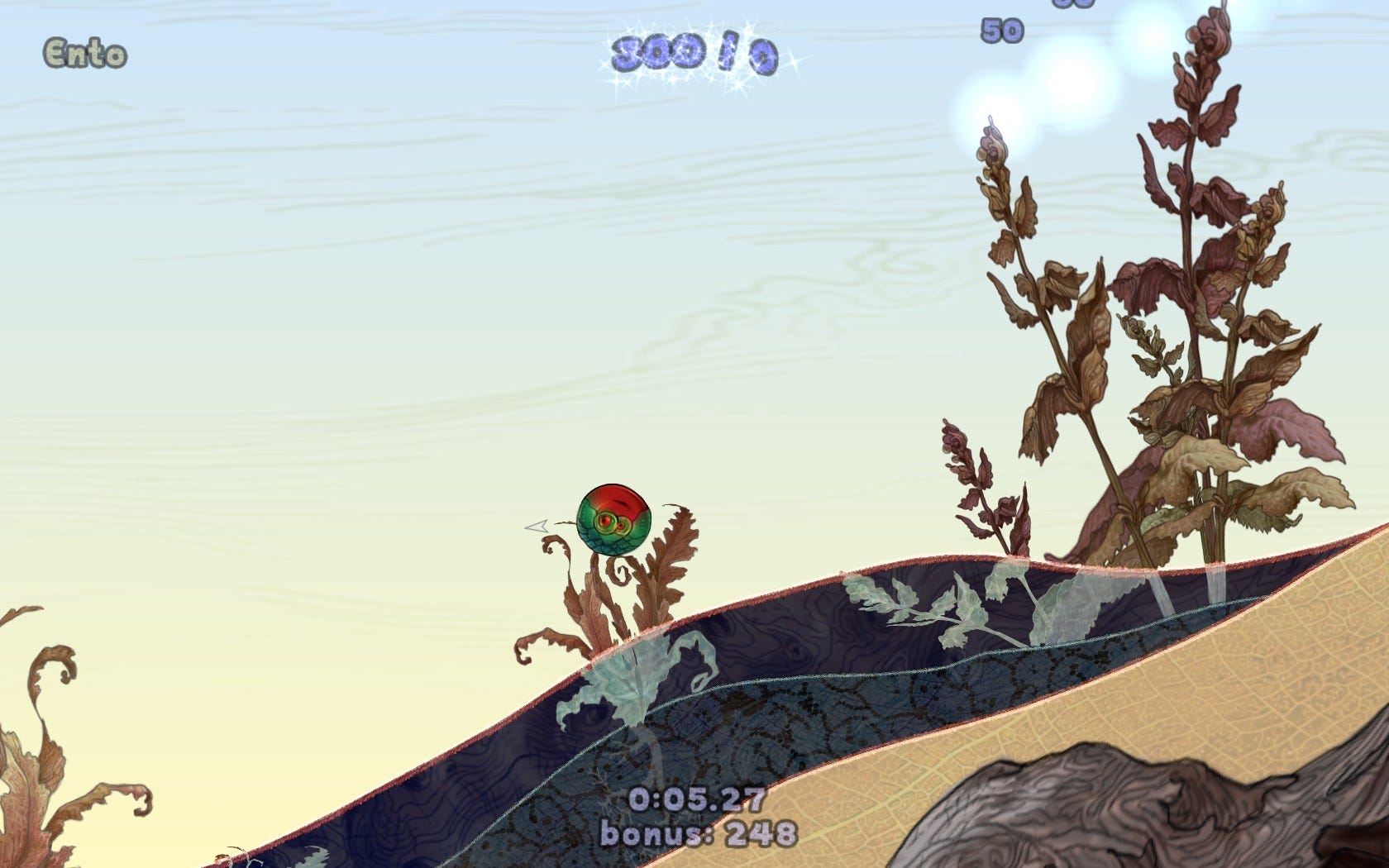
Almost a year old now, but don't let that stop you. Gumboy's a sort of impressionist take on Kirby, a thoughtful puzzle-platformer stripped down to the very barest essence of movement and collection. There's no combat of any sort - simply use of the environment to get the rolling, floating or flying (altered by occasional pick-ups) Gumboy to a level exit. While it's stripped down enough to just about qualify as casual, it does require a dawning understanding of momentum and reflex to progress far through its slightly sinister world.

Sporting a beautiful hand-painted look, and an endearingly weird lead character who communicates only in excited squeaks and gurgles like some untroubled multi-amputee baby, it's like the arthouse brother of Wik and the Fable of Souls. It may be lacking the immediacy and universal appeal of Geometry Wars or Peggle, but it approaches the current indie fad of game physics with a huge amount of charm and depth.

8/10

Pizza Frenzy
4

Coming soon to DS. Or at least it should, as it's a game totally built upon tapping.

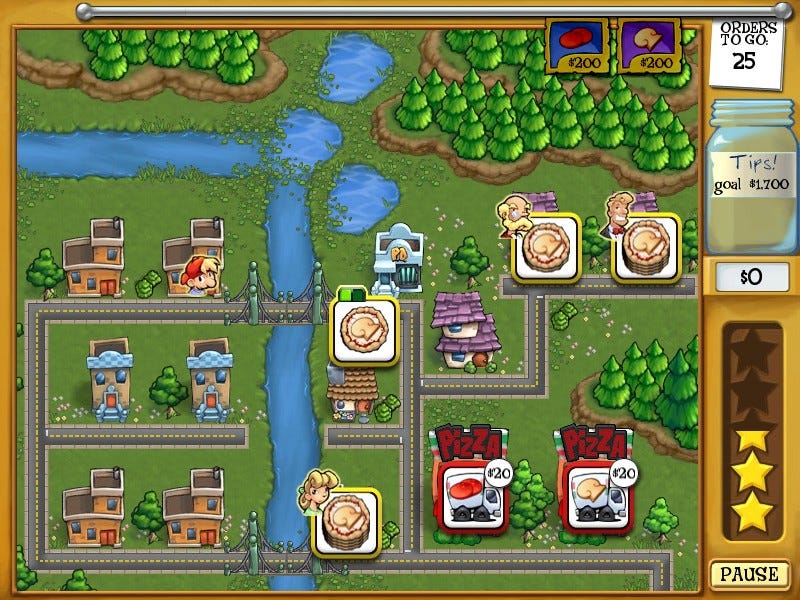
It's a little odd that a game about delivering pizza would seem to have the very concept of pizza delivery back-to-front. The challenge here is, apparently, to accept (rather than deliver) orders as quickly as possible by visiting customers' houses. This seems a colossal waste of time and manpower as opposed to them coming to you or phoning. But hey, let's go with this as Reverse Pizza Bizarro World, ignore the broken logic and talk about the game.

Like so many casual games, it's all about clicking. Man asks for mushroom pizza, you click on his house and then one of your pizza kitchens. Each kitchen can only make one type of pizza - presumably having pepperoni and mushroom in the same room creates some sort of matter-antimatter explosion. So click here, then there, then here again to collect your tip as quickly as you can. There's various bonuses to strive for - a combo of pepperoni-only orders, for instance, or reporting a thief to the police station rather than delivering a pizza to him you won't get paid for.

Occasionally, a Cooking Mama-like mini-game-within-a-mini-game crops up, asking you to place pizza toppings in an exact layout within a time-limit. Which seems an awful lot more considerate than the sort of sweetcorn all at one end, pineapple stuck to the top of the box pizzas I'm more accustomed to receiving, so perhaps I should emigrate to Reverse Pizza Bizarro World.

Anyway! It's the sort of simple, charming thing you can suffer that dread where-did-those-three-hours-go panic from several times over, but the repetition soon grates. It lacks the cleverness and refinement of the others games here - like that fifth pizza of the week, it's unquestionably tasty, but you're horribly aware you're not getting your five-a-day from it.

6/10

Peggle Deluxe

There aren't many videogames I play with my girlfriend, partly because they're just not her thing and partly, I suspect, because of the time I hurled my Wavebird against the wall and stormed out when she beat me at Mario Kart for the sixteenth successive race. Peggle, though, we've played together every night for the last week or two, with the PC hooked up to the telly and a wireless keyboard providing makeshift controls. We took turns, we oohed at each other's near misses, wooed at unlikely but spectacular triumphs and clapped with delight when a beaver on a skateboard popped up on the bottom-left of the screen to congratulate us. Truly, this was a game to cross the apparently infinite divide of me choosing to spend my time shooting pretend men in the face and her watching Buffy on repeat.

Sometime EG contributor and full-time Peggle disparager John Walker says we are idiots for this. While I'd agree it's not the textbook implementation of quality time, and that the image of a couple giggling at a cartoon owl is offensively saccharine, I strongly dispute any criticism of the game's quality and longevity. Peggle is as much the definitive casual game as Singstar is, an unashamed celebration of anyone-can-play gaming with enough subtle depths to lure in the high-score hardcore too. Though there is a campaign of sorts (and a long set of individual harder levels beyond that), this is not a game you ever finish. Peggle is always there, and always just-one-more-go. Peggle has made me miss deadlines - the first game to suck me in so stupidly completely since the earliest days of World of Warcraft.

To describe the game's essential nature is almost redundant and can, in fact, sound so mundane in cold text that it could damage potential interest in it. But, y'know, games journalism generally requires context, so let's get this out of the way quickly. It's Breakout by way of pinball - you shoot coloured pegs with a limited supply of balls, and there are various ways to clear more pegs or win extra balls. Clear all of the orange pegs and you win. Two things stop this undeniably simple formula from being just another glorified Pong derivation.

5

Orange peg placement is different each time. Peggle will never stop giving. Peggle wants you to have fun. Peggle loves you.

The first is chance. This is game that can be mastered, to a point, by a strong maths brain or snooker genius, but really that's to keep that high-score hardcore sated, and isn't something you should strive for. As often as it infuriatingly won't make sense that your carefully-aimed ball has hit a single peg then pinged off into the dread abyss at the bottom of the screen, it'll unexpectedly clip a bit of wall or stray brick and fire back into the heart of the remaining pegs, thus improbably winning you the level on your last ball, with equal regularity. I do apologise for that monstrously long sentence, but like to believe it evokes just how lengthy and eventful a single Peggle shot can be. Maybe.

Then there is the bucket, a hole that moves of its own accord across the bottom of the screen. Again, a joyless expert can often ensure he lands the ball in this, but that can't possibly match the unparalleled gift of an unexpected free ball because fortune has dropped your last one into the bucket. That the bucket is autonomous, and not controlled like the Breakout bat, is key here. It's your slightly disinterested guardian angel, swooping in to save you from certain doom when you least expect it. Regardless of the bucket's interference, it's more-or-less impossible to predict what's going to happen beyond the second or third peg the ball hits. This keeps Peggle constantly surprising, but also causes some folk to moan that's it's more a sequence of random events than a game. This is probably because the second fabulous thing about Peggle, which I'm getting to shortly, doesn't excite them in the way it does so many others.

So, that second thing, and Peggle's greatest triumph, is its musicality. My strongest criticism of the game is that the monotonous lift music of its soundtrack is inexplicably at odds with the smarts of its incidental effects. 25,000 points wins a new ball, but you don't watch the score gauge for this - you listen to the rising note of each successive peg hit, building to what seems an impossibly high crescendo. It's the sound of yearning, and when you hit that magic number, you're rewarded with a glorious chorus of MIDI angels. Oh, and an extra ball.

The weirdly harmonious wall of different sounds builds and builds. Each of the 10 character aids - with a special power, some goofy mannerisms and eyes that follow your ball around the screen - plays a tune when their ability activates. The best is Renfield's, the pumpkin who returns the next lost ball to play when you hit one of the two green pegs. He plays Bach's Toccata and Fugue in D-minor (the archetypal piece of horror music - you'll know it if you heard it), but just a bar at a time. One when you hit a green, another when he drops your ball back in. The only way to hear the whole riff is to hit both green pegs within the same shot, thus queuing up four different bars. It's just a spectacularly visceral and thoughtful way of telling you you've done something really good.

6

Peggle's backgrounds are delight of classic Warner Brothers-style surrealism.

Better than all of these is victory. The game sloooooows down and zoOOMS in if your ball approaches the last orange peg, and there's a drumroll. Inevitably, you don't breathe for a second. Miss the peg, and an unseen crowd sighs for you. Hit it, and EXTREME FEVER! There are fireworks. And, famously, there is Beethoven's Ode To Joy played loud, and, time and again, it's possibly the most rapturous, overwhelming feeling of accomplishment any videogame has ever inspired. Except, of course, for ULTRA EXTREME FEVER!, which is so ridiculously over the top that you'll laugh as well as cheer on those rare occasions you manage to clear every last peg on the screen.

An ode to joy is exactly what Peggle is. It's a constant series of rewards, slapping you on the back and tickling you affectionately under the chin for what you achieve by design and accident alike - the purest of celebrations of what videogames are all about. It's non-violent, very funny, incredibly charming and gently asks more of your brain than reflex. It creates nostalgia for a period of gaming that probably never actually existed. But now it does. Peggle! Peggle! Peggle!

9/10

Read the Eurogamer.net scoring policy

Comments (36)

Comments for this article are now closed, but please feel free to continue chatting on the forum!

  • Loading...hold tight!