The first thing you need to know about Banjo-Kazooie's expansive E3 demo is the one that's going to get the traditionalists shaking and sputtering with rage: you don't do very much platforming in it. The second thing you need to know, following close on the heels of the first, is that that's fine, because it's still great fun.
The demo level has, the developers tell us, been adapted especially for E3 and won't be like this at all in the final game, but is nevertheless a perfect example of the game's new focus. Less running and jumping, more driving, flying, hovering, sailing. Rare's previous pleas that this is not a racing game are entirely valid, but the extent to which vehicles play a role can't be underestimated. They're the absolute core, the beating heart of the game.
The E3 demo takes place in a huge indoor environment, one of five major worlds in the game - not including the hub world, Showdown Town, which may be the largest world of the whole lot. For the purposes of the demo, Rare has filled the world with a number of pre-built vehicles for players to discover and investigate. A variety of land vehicles, ranging from a simple buggy through to several more complex, gadget-filled types, give way as you explore to several air vehicles - helicopters, aeroplanes and even a bizarre lifting craft, with two helicopter rotors and a giant "sticky ball" dangling from the bottom.
Each of these vehicles handles in a different way, thanks to a fairly heavy-duty physics engine which takes into account the weight, balance and even aerodynamics of each craft - before slapping on a layer of common-sense handling limits that ensure everything is functional and fun to drive around. Many of them also feature a number of "gadgets", which are activated using the face buttons on the 360 pad and range from springs to bounce you off the ground, via gyroscopes to flip you around in mid-air, to folding wings that snap open and allow ground vehicles to take off.
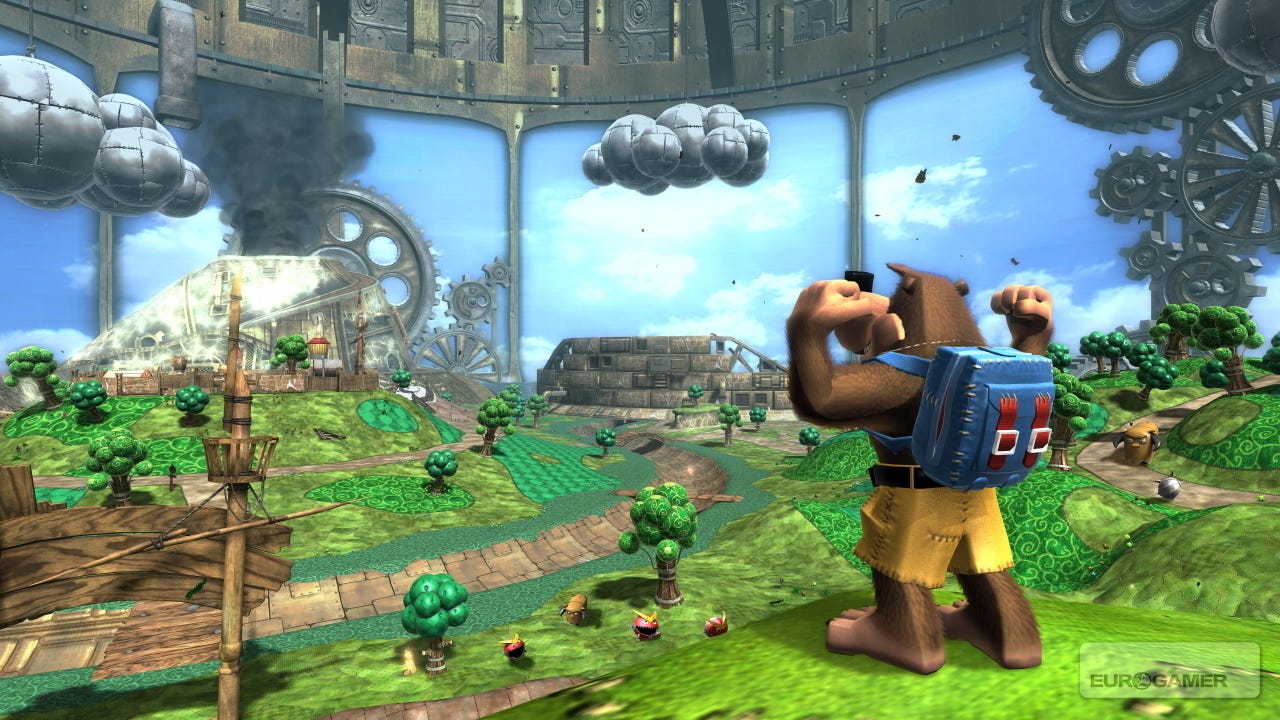
Banjo's colourful world looks stunning, with every zone playing host to tons of different challenges, races and secrets.
In the E3 version of the game, there are a number of challenges scattered around the environment - accessed by talking to the various weird and wonderful characters who inhabit Banjo's world. These include a challenge designed to introduce you to the spring and gyroscope gadget combo, in which you have to flip your buggy through a number of targets, and an amphibian race in which you use a pre-designed vehicle - one of a limited number of challenges in Banjo where you'll use a set vehicle rather than designing your own.
We suspect that most people who get their hands on the E3 code, however, will spend the bulk of their time simply exploring. There are quite a few vehicles to be found, especially once you get your hands on the first aerial craft and the full scope of the environment opens up to you.
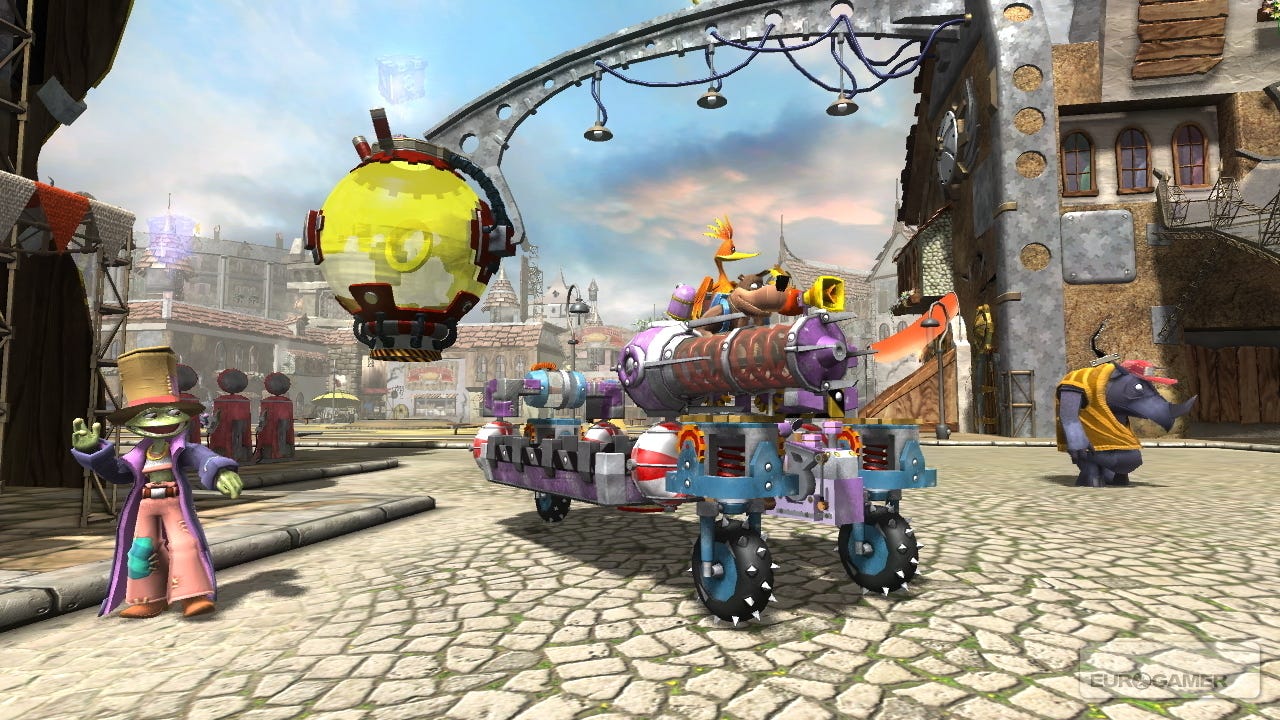
The character designs retain Rare's trademark weirdness - as do many of the bizarre vehicle components you'll find.
That's quite an impressive scope, too. While the final game is designed around the idea of entering each world in order to complete a specific task (think of Mario 64, for instance, where each world is pretty expansive but in general you only travel there with a specific objective in mind), that hasn't stopped the team at Rare from creating some impressively huge levels with the power the Xbox 360 places at its disposal.
The E3 demo is no exception, being designed and laid out somewhat like a large church or cathedral - in which Banjo and his pals are about the size of children's toys, running around in the naves. It's an epic, cavernous space, and the true scope only becomes apparent when you start flying around it. It's not even the biggest of the levels - the developers estimate that it's roughly the third largest of the five major worlds - and it's already far too big to sensibly navigate on foot. Those vehicles aren't just a quirk of the gameplay, they're a necessity for navigating Banjo's new environments.
In visual terms, everything remains as colourful and cheerful as you'd expect from a Banjo-Kazooie game. The level of detail Rare has managed in such enormous zones, however, is incredibly impressive. In the E3 demo, every texture and surface has been carefully considered - the team is aiming for a "constructed" look to the whole world, something which it's achieved by leaving the obvious scars of human construction on everything in the zone.
Grass looks like a woven fabric up-close, and has stitch marks at the edges where it joins another surface. Mountains and hills are constructed of bricks and concrete, sheer cliffs have rivets and metal plates on them. Overhead, metal clouds are suspended on barely visible wires. The effect is superbly consistent, giving the whole game an endearing, patchwork feel.
The character designs, of course, retain the slightly screwball, over-the-top nature that made the original Banjo such fun. Moreover, there's an interesting and potentially funny idea at work here, with the same characters appearing in each and every world - but often in radically different roles. This isn't to economise on character design work - it's done with a knowing nod and distinctly played for laughs, with the team happily describing each character's role in the different worlds as "amateur dramatics".
The prevalence of pre-built vehicles in the E3 demo is vital to allow people to quickly get zooming around the world - but in the final game, there's a huge focus on the whole process of building your own vehicles. The hub world, Showdown Town, is the closest Banjo gets to traditional platforming action as you drive around a vehicle that looks a bit like a shopping cart, collecting crates by solving various puzzles or platforming through sections of the level.
You'll pick up the components you need to build flying vehicles about a quarter way through the game, which opens up tons of new possibilities.
Upon bringing crates back to Mumbo's Garage, you earn parts for your vehicles - and while there'll always be an option to have Mumbo create a vehicle for you from the parts you've got, most players will want to dive in and build their own. This uses a fairly straightforward 3D positioning editor, in which you place the various chunks of vehicle as if you were building something from LEGO. As long as it's got fuel and an engine, it'll move - wheels or wings help, obviously - and the other gadgets you add are totally up to you and what you've managed to find so far.
This, of course, is how Banjo's progression is going to work - and it's in this that the game's platforming roots are most obvious. Acquire a new gadget or vehicle ability, and new parts of the world will open up to you simply by dint of finally being able to get there. A non-linear progression through the game's missions, which open up as you gain access to "Game Globes" around the world, is another major facet of this - while for those who get really obsessed, we can see near-endless replayability as you tweak your vehicles to try and shave seconds and milliseconds off your scores at the various challenges (complete with Xbox Live leaderboards, naturally).
Showdown Town, the game's impressive hub world, is the place you'll do most of your traditional platforming. Vehicles tend to rule the roost elsewhere.
Rare has unquestionably had a tough time of it since its acquisition by Microsoft - something which the studio addresses in Banjo in a typically self-deprecating British way, with the E3 demo level including a massive dustbin full of copies of Grabbed by the Ghoulies, its Xbox flop. Later in the level, we try to lift the dustbin, but it tips over in mid-air, spilling Xbox game cases all over the floor.
With Viva Piņata, however, it found its feet creatively if not commercially - and Banjo looks like it will be the next major step on Rare's road back to good fortune. Whether that's enough to make it into a bona fide hit or not is hard to say, but on the strength of the E3 showing, it's definitely going to be a lot of fun.
