One of the 2007's most anticipated games, Assassin's Creed thrusts you into the boots and four-fingered glove of a killer during the Third Crusade. Or is it? Ubisoft Montreal's figurehead for all things Assassin's is Jade Raymond, and she's not yet shedding firm light on the game's setting. Mysterious death screens and other details about main character Altair have led to all sorts of guessing. Comments about "genetic memory" upon player-death perhaps point to some sort of futuristic gene-reading technology, that absorbs recollections from captured genes, and Raymond's confirmed that Altair's no time-traveller. Still, the speculation pales next to the potential fun of hopping across rooftops in parkour-inspired free runs, evading pursuers and taking out your marks with a dagger poking out of your third knuckle. We sat down with Raymond at UbiDays in Paris recently, as you'll no doubt have seen on Eurogamer TV. What follows is the full interview transcript.
Eurogamer: It seems as though we're mainly seeing stuff we've seen before at UbiDays. There's a demo coming in July - can give you us any idea of what to expect?
Jade Raymond: First, [the new trailer] did show off some of the other cities that you haven't seen before. So if you pay attention to the trailer you'll see we showed some shots in Damascus, which hasn't been shown before, and we showed Jerusalem, and we showed Acre. But we're really saving the next big hands-on and demo and live playing and everything else for mid-July, so in the US we're going to have a big event that's assassins-only at E3, and then we're organising a thing also for Europe.
Eurogamer: There's lots of rumours about the storyline. When we interviewed Patrice [Désilets, creative director] at E3 last year, he said the actual assassin's creed felt the world was an illusion. Is the world we're seeing in Assassin's Creed some sort of illusion?
Jade Raymond: I can't comment on that [laughs] unfortunately. We will be able to tell you... there is something else there. I think we have been dropping some pretty obvious hints. There's been some people talking about it. I think if you really do your research, if you pay attention to the stuff we've shown and some of the more in-depth articles you can probably piece it together, but we'll be giving away some of the stuff we haven't been telling in a few months.
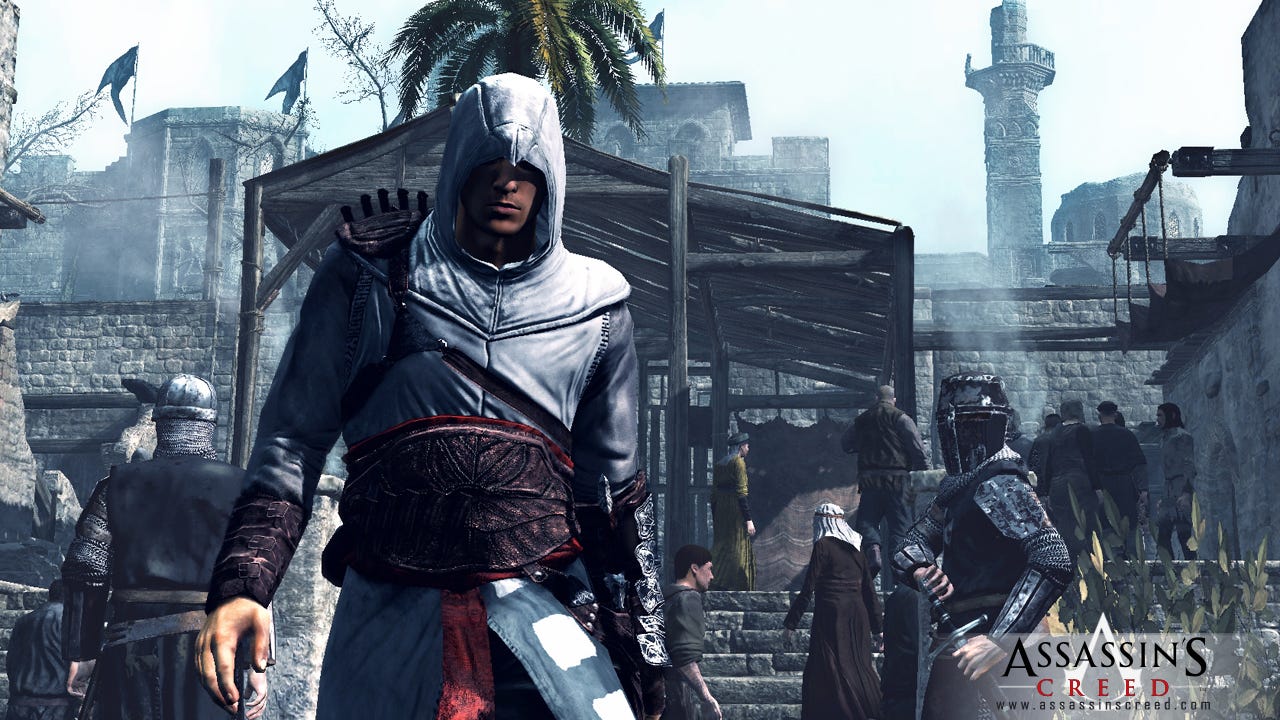
The UbiDays content was reportedly all in-game.
Eurogamer: You mentioned yesterday a conspiracy between some of the targets you're assassinating that might feed into present-day events. Is there any link to any of Ubisoft's other series?
Jade Raymond: No, there isn't. The thing we're doing with Assassin's Creed is we created a brand new franchise and that means that we wanted to for a change not go, 'oh, the first game was a success - what do you do with the second game?' if you're so lucky, right? We want to make a real plan where you can make a game, you make a book, you know, maybe other types of portable games that have complementary experiences, you can make a movie, if the game does well you can make a sequel - and not have it be we have to scratch our heads about a framework that it has to fit into from the start. So it's not any other Ubisoft games; it's really like stuff that I can't talk about [laughs]. The conspiracy is linked to the stuff I can't talk about.
Eurogamer: Speaking of other Ubisoft games, one game that a certain mechanic seems quite similar to is Splinter Cell: Conviction - obviously another Montreal game, which has slipping in and out of the crowd as a key part of the game. Are you guys sharing technology, or working together in some way?
Jade Raymond: One would think, but actually we created a brand new engine from scratch, which is going to be used by some other projects at Ubisoft, but Splinter Cell is based on the Splinter Cell engine so it's not at all the same technology. You know, crowd gameplay was one of the big promises of the next-gen. We all thought, 'ok, what can we do?' So, actually, surprisingly, we came up with some of the same ideas in terms of what crowd gameplay is, but in terms of the experience and the scope and being an assassin in the Third Crusade, and having loads people on screen is very different to what you're going to experience being a fugitive in the small areas that's really based on physics and interaction and those kinds of things [that Splinter Cell offers].
Eurogamer: At X06, you mentioned that the guy you killed was easier to reach because you'd done some missions with the monks you blend in with in the crowd. What sort of form do those take, and how's the game structured overall?
Jade Raymond: Well we've built in some things that are kind of like difficulty modulators, which the player can choose to do or not.
So for example, you can choose to go into some guy's fortress and be like, I'm a badass fighter, I like the adrenaline type of stuff, I'm just going to blast my way through these guards, try and mow through everyone and get out, and that's my style. If you want to have people helping you, that's always going to make the game easier and allow you to use some different tactics. So for example the monks, there's optional side-quests. If you come across, like, the military picking on someone - you know, it's the Third Crusade, the overriding thing is the population's suffering - you can choose to help people out. Like you may find a monk, then he'll tell his guys that the assassin's cool, he helped me, and then you'll be able to use the monk to get into places where you wouldn't normally be able to get into.
Some other examples are, if you see some women who are having trouble, you free them and the husbands will then stop guards from pursuing you, and that becomes kind of like, if you think Need For Speed - where you can make barricades fall dynamically and that'll block the police that are coming - these guys, these big vigilante dudes are kind of like that; you know where they are in the city, while you're being chased you could pass by that road and they'll stop the guards. So there's all kinds of things like that. There are elements of the crowd who will not be on your side, but there are other people who can help out later.
We still don't know much about your horsey. Seems like an oversight.
Eurogamer: The games industry desperately wants to be taken seriously as an artform, and obviously we're in the Louvre at this event; what's your view on the artistic credentials of gaming and games design?
Jade Raymond: Well I do actually think of games as an artform and an entertainment form. I think the key is really going to be when we realise the potential of what's different of games - so, the interactive side and not always be trying to compare ourselves to movies and have the best cinematics and have the same kind of production values, or go after a star who's and put them in the game. I think it's going to be when we really figure out all the stuff that you can do with the interactivity that's different. So, yeah, I mean it's interesting that you see that about the Louvre - I hadn't thought of it - but I guess I do believe of it as a legitimate artform. Eventually.
Eurogamer: On that point, would you actively step away from having Hollywood voice talent in games? Do you think that's unhelpful, that that's almost pandering to these other mediums that we still maybe give too much respect?
Jade Raymond: I think the important thing for a game is to have really clear voice acting. You're not really seeing the star in the game. At best it's the likeness of the star, which may be cool, but it's not the same as getting an actor in a movie where it's actually them. So I think it can make sense if they're a great actor, if they're a great voice actor, but probably more often it makes sense to redistribute the budget in some way that increases the gameplay quality or the general sound quality or just get more talented voice actors instead of just this one expensive voice actor. There definitely is some trying-too-hard in there, but, it's cute, no? [laughs]
Jade Raymond's favourite bit - and more than just a graphical rush.
Eurogamer: You said yesterday that your favourite kind of move is the leap of faith, and I guess that's the thing at the end of the trailer - but we never actually see Altair does once he jumps!
Jade Raymond: There is a gameplay reason to do that, besides it just being really cool. It's really cool because you can climb up - like, in the trailer, you see him climb up that really tall steeple - and you can jump off any high point in the city, with this crazy, free-falling kind of moment. But on the other end, you land in a bale of hay. It's quite fantastic, but the reason for doing that is that when you're being pursued and chased, what you're trying to do is, first, break the line of sight - so as long as guys see you they're going to follow you from everywhere, they're going to find a short way around - so what you want to do is speed up, do things where they can't follow you like climb up - your enemies don't know how to climb, they'll take ladders and find other ways - but you want to strategically go, they can't follow me, he's coming from there, he's coming from there, and one good way to lose your enemies is to climb up a high building, where it's going to take them a while, and then jump off into this bale of hay, and they're going to think, 'where did he go, he's vanished, he's dead,' and that will allow you to buy some time. It resets their awareness level back to the state that they don't know where you are, and that gives you to go back to the bureau and kind of finish your mission.
The Assassin's Creed release date is currently to-be-announced, but we expect it this year. It's in development for PlayStation 3, Xbox 360 and PC and, as Raymond hints, could branch off onto handhelds. Interview by Johnny Minkley and Tom Bramwell.
