Assassin's Creed

Should make a killing.

There were lots of highlights at E3 last week - running into Rutger Hauer, firing a pump-action shotgun, talking to Peter Moore about his braces - but one of the greater disappointments was Ubisoft's Assassin's Creed demo at the Microsoft conference. Having grown up in the public eye as an archly mysterious, beautifully imagined medieval kill-'em-up with more than its fair share of good ideas, it saw high-flying assassin Altair bumble onto the big screen, bounce off a few NPCs, prance across a series of beams, stab and gurn and then fire up an accent not so much west of Jerusalem as west of Adam West.

Fortunately, playing it does a better job of uncovering its accomplishments. Taking control of the same level on Xbox 360 (a PS3 version running nearby was basically identical), we got to direct Altair through the crowded streets of Jerusalem towards Talal's warehouse and the promisingly knifey climax. Beginning at one of the level's highest points, we're told how the controls map - with the analogue sticks handling movement (walking) and camera respectively, while the right trigger handles "aggression" or "high profile" moves, like running, and the face buttons perform context-sensitive actions that map to Altair's limbs. It's not all that revolutionary, mind you - A may be "feet", but that mainly just means "jump", while X and B do the arms and Y's your head.

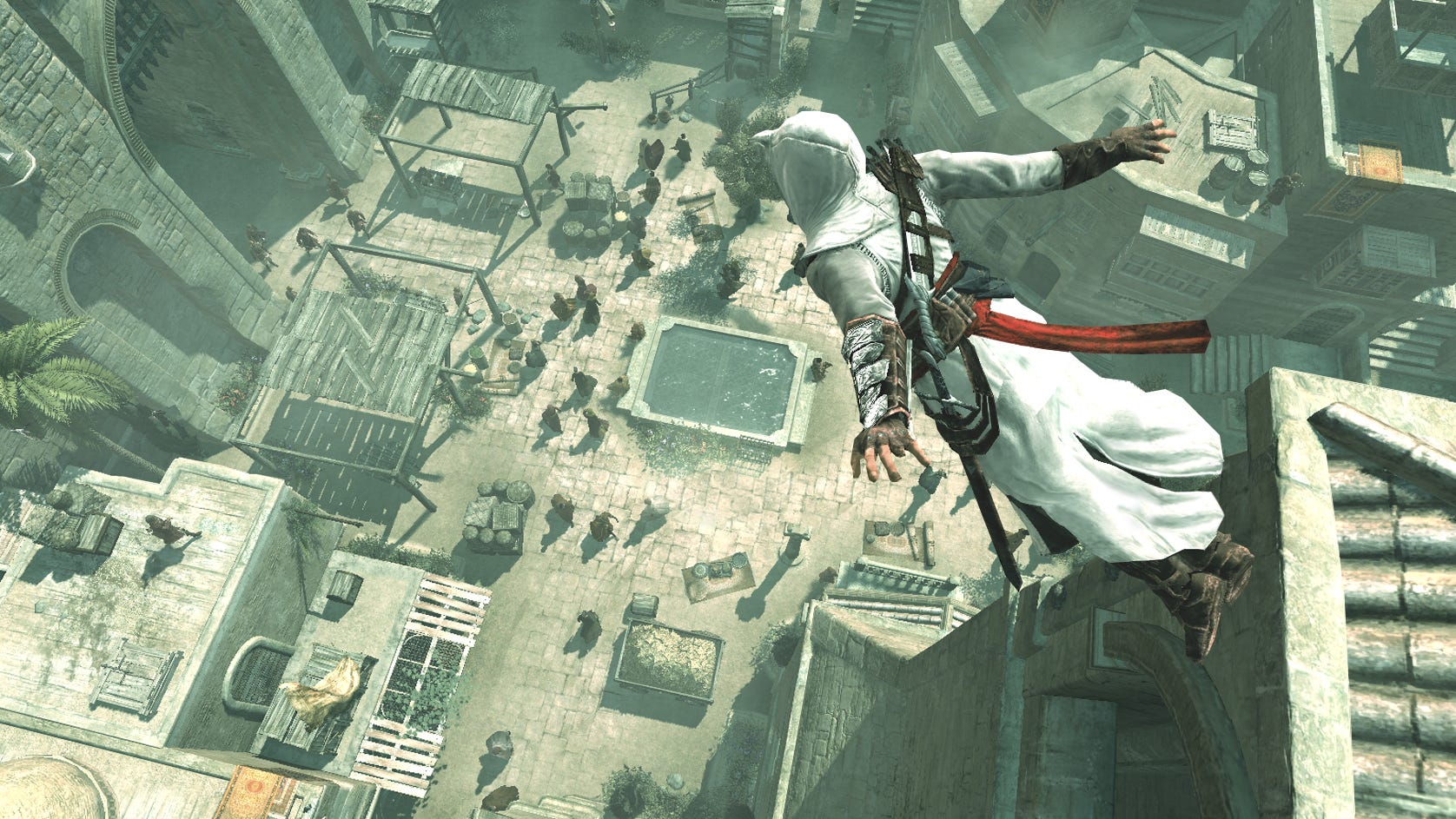
Holding the right trigger, then, we dart to the end of a little ledge and use the A button to spring from the rooftop towards the ground and a bale of hay that we've performed a "leap of faith" to land in. Hay-bales not only break your fall but, along with benches and covered market booths and sentry posts, serve as hiding spots when guards are pursuing you through the streets; break the line of sight and leap into one and you'll be given the chance to recover your anonymity, with a flashing alert status indicator in the top-left of the screen performing the function familiar to fans of Splinter Cell and Metal Gear Solid.
1

Every visible ledge, beam, wall and scaffold is a potential foothold on the prancing journey between objectives.

But that's enough about the hay. Striding onto the streets, the crowd mechanics quickly come under scrutiny. A diamond of face buttons in the top-right of the screen flash with context-sensitive commands, making it clear that you can either gently guide them out of your way or shove people to the ground. The former's preferable, of course, not least because a morale system that governs the NPCs means that bad behaviour could come back to cause you harm later on. Side-quests, previously mentioned by Ubisoft though fenced off at E3, contribute to your standing in the community and help exert your influence more positively, as certain groups aid your flight from the law or help guide you into restricted areas later on (the monks, shown at X06, for example). The crowd's a diverse bunch, too, and occasionally home to troublemakers, who are as good as their name.

The point of our E3 mission is, as you know, to take out the chap Talal, and the first phase is about reaching his warehouse. To this end you use the mini-map, which highlights mission objectives, as well as hiding spots and other useful information, to guide your movement. In the Microsoft conference presentation, this took the player to a high place, where Altair was able to kill a rooftop guard and send him hurtling to the streets below, before sneaking past the distracted soldiers who had previously blocked the stairway to Talal's base of operations. We decide to do somewhat the same, if only to test the game's claim that you can climb everything you can see.
2

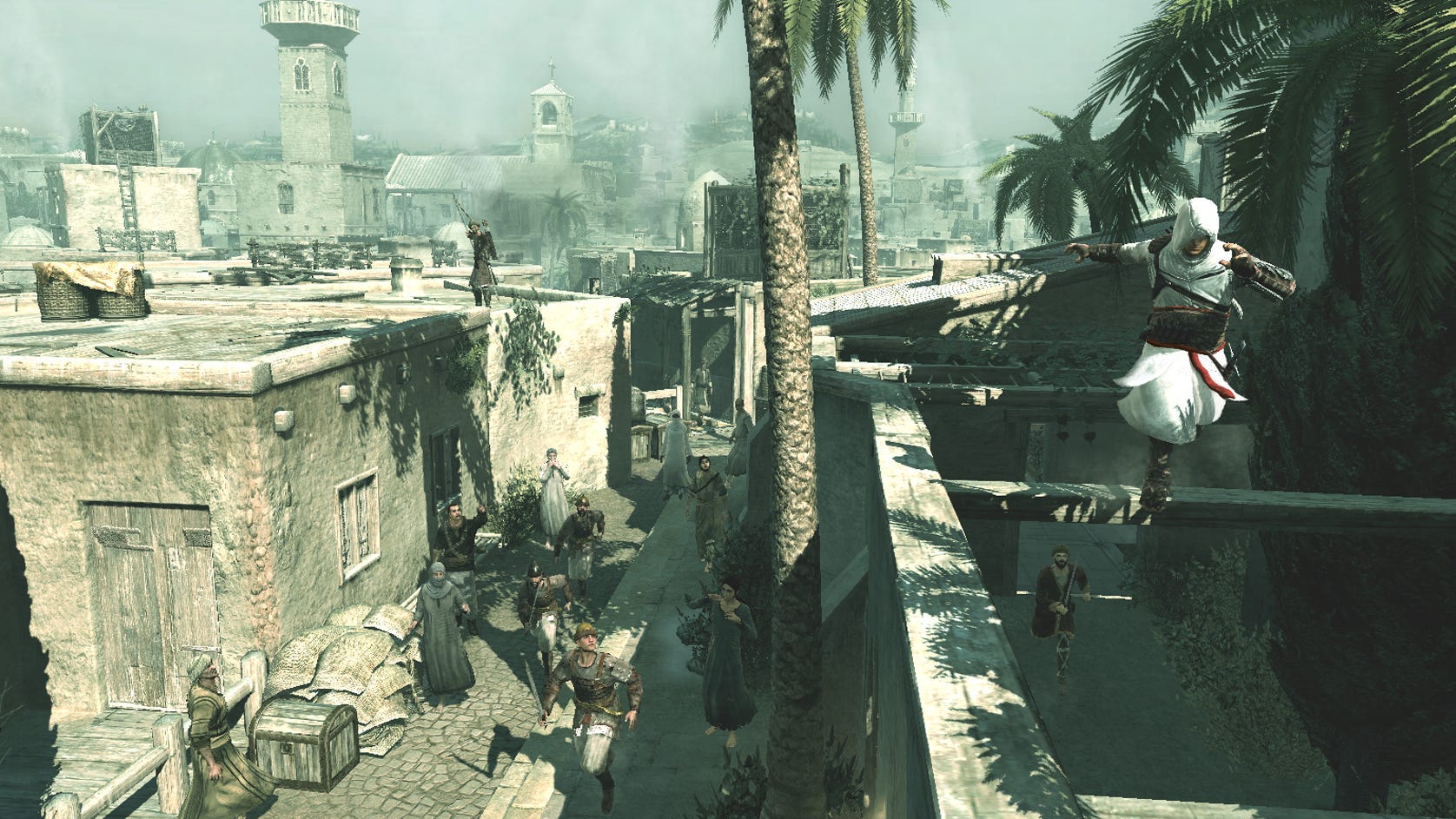
At no point does the frame-rate become an issue, and the graphics - though less impressive these days than they originally seemed - are still wonderfully detailed.

The first thing we do is, we're told, a common mistake - we run up the wall and grab hold of a ledge, but then send ourselves leaping away from the wall by pressing jump. You don't need to do that - you can just press up on the analogue stick to advance to the next handhold, shimmy side to side or press B to drop down again. Movement, even over complicated changing surfaces, is confident and smooth, although you may find your view slightly restricted, and certain pauses and jerks are a little jarring in light of the excellent Tomb Raider Anniversary. That said, there's still some tweaking to be done, as producer Jade Raymond acknowledged in light of the E3 demo's reception, and the more important bit is how much freedom it gives you, which is a lot.

That freedom is particularly relevant when it's coupled to the game's vaunted, parkour-influenced free-running, which allows you to dart without risk across narrow beams, and hop between arches, walls and street furniture, adding a new, untravelled gameplay path to the traditional high and low. Where it works, it's wonderfully intuitive and balletic. Where it falls down, if you'll forgive the pun, it can set you awkwardly off-balance, but that's best taken in the context of the demo's E3 setting: were we playing Assassin's Creed from the start, rather than dipping into a level that our hosts tell us is certainly not the first, we'd have more time to learn the language of the game. What's more, it's already rare to find the controls exhibiting that kind of over-sensitivity to context that made you lock onto surfaces in Gears of War when you meant to run. And for that matter, if you do threaten to stumble into an abyss, Altair spins round on the spot and clings onto the ledge.

Experiments over, we decide not to bother with the man on the roof after all. He's suffered enough (and continues to, judging by the four other pods around us where he's being stalked and killed over and over, sometimes by throwing knife, which we hadn't seen before). Instead we descend to the ground again (descent, incidentally, is as fluid as ascent), and pick on a soldier minding his own business on the other side of the bustling courtyard that fronts the warehouse entranceway. As we move in close, equipping our assassin's middle-finger blade with d-pad-left, we're told to hit X to assassinate, driving the knife into our prey and then backing away as his body slowly catches up with the fact he's dead and topples. His relatively gentle fall masks Altair's role believably, and as the dead man's noticed and the other guards approach, there's no question we could easily be missed - as we are, as we slink up the stairs towards the objective.

As we approach Talal, the game is taken somewhat out of our control, as assassin and target argue about whether one or both is being stitched up. Altair - and we agree, his voice is a bit pants - certainly sounds convinced, and Talal is obviously not counting on his words to solve the problem, dispatching half a dozen guards to the warehouse floor for the demo's inevitable battle sequence. The good news here is that those fearing a Prince of Persia dichotomy of stylish platforming and stumbling combat can calm themselves, because Assassin's may not be Devil May Cry or God of War, but it's not a time-waster either; instead it's somewhere in-between, with an emphasis on timing rather than technical knowledge. Guards advance, you tag them with the left trigger to lock on, hold the right trigger to parry their blows, and use the X button, struck just as they initiate their attacks, to counter them with an executional response. Tricky at first, the slick killing animations soon begin to flow, and well-timed counters have the added benefit of restocking your health-bar, meaning that we went from awkwardness on the back foot to violent gains within a matter of moments.

But there's no time to enjoy that, because Talal makes a break for it over the rooftop, and must be pursued and assassinated. This is where the minutes we spent messing around on the roof and dancing over the heads of civilians pay off, as our fleetness of flying foot allows us to close the gap in record time, take a final step off a market stall and leap onto his back to sink the blade in. As Talal expires, killer and victim speak again, on a white background, seeding yet more doubt as to the nature of Altair's mission.

3

Combat is simple and stylish, and didn't take us long to grasp.

When they finally shut up, the demo moves onto its final phase: the escape. Getting away will form the back-end to each of the game's nine missions, according to Ubisoft. The soldiers who chase you just want to keep the peace, and if you break the line of sight they will assume you're gone for good, which is fine by them, so the real trick isn't escaping so much as evading. Hiding spots pepper the mini-map, and you soon come to recognise them on sight. The devs claim to have avoided the copy-and-paste design that blights some 'sandbox' games, but they're sensible enough to allow for a uniformity of mechanical elements such as these, and - in another useful touch - legislate against the traditional stealth problem of not being able to tell when the coast is clear by offering an alternate camera view that tracks the nearest guard. When the alert status drops sufficiently, a message along the left indicates you can move off again, and make your way the final few steps to the assassins' headquarters. The message, playfully, says, "Reinitialising..."

It's one of a number of things that point to the 'big reveal' that we're all waiting for, and which Ubisoft continues not discussing. The noises in our headset that signal optional camera alternatives are called "glitches" by the developer walking us through the demo, while little splashes of glimmering data read-outs pop up around enemies and other elements, reinforcing the impression that Altair's Third Crusade home is not so ancient after all. The best hint we've had up to now actually came from an actress, Kristen Bell, who said that the story is based on the idea "that your genes might be able to hold memory", while the X06 demo included a reference to "memories /01" on the game-over screen. Altair is not a time-traveller, we're told again, but they're clearly going somewhere with this, and we doubt it's just the Holy Land.

4

The shonky 'crash detection' in crowded scenes during the conference demo was less prevalent hands-on, and Ubisoft promises further refinement pre-release.

Whether or not the game's secrets live up to their hype is not something Ubisoft's likely to help us decide any time soon - in fact, we'd be surprised if they openly discuss what it's all about this side of the game's release on PS3 and Xbox 360 in November - but the developers we talk to at E3 are adamant that the game itself will be compensation enough. The level we've played is "fairly early on", though not the first, and the full game will require players to complete missions to access some of the abilities we're able to use - certain weapons, techniques like grabbing the side of a building as you fall, or tackling people in the crowd - although the initial move-set is still aiming to impress.

Indeed, if the full game successfully expands on the range of mechanical and exploratory options on offer here, we're all in for a bit of a treat. Not unlike Killzone 2 and the USA Today screenshot, then, Assassin's Creed wasn't done any favours by its E3 conference presentation, but a proper look dispels some of the doubts it planted. Return roflcopters to roflpads.

Comments (98)

Comments for this article are now closed, but please feel free to continue chatting on the forum!

  • Loading...hold tight!