Army of Two

Live together, die less, experience greater combat variety.

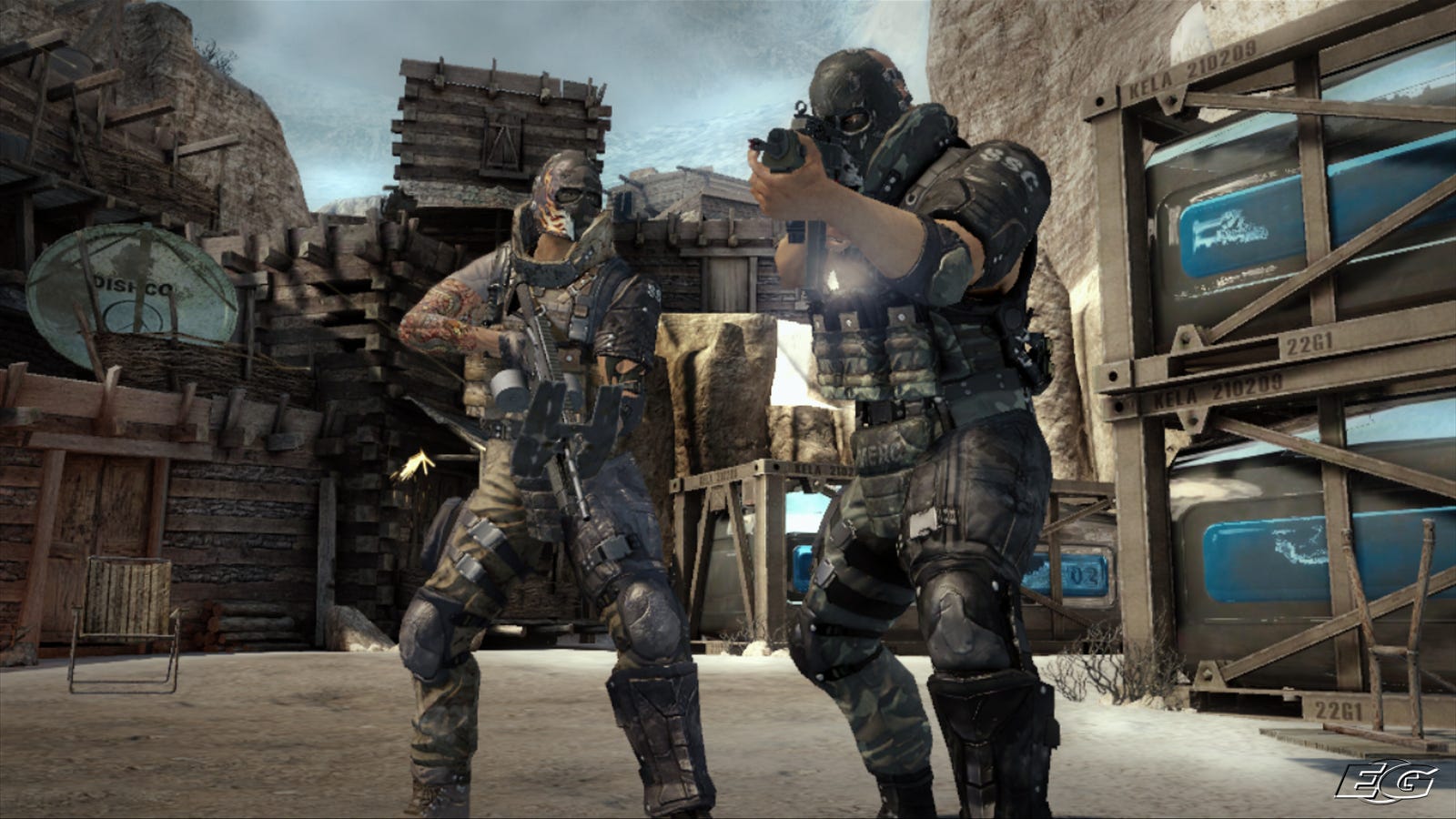
With Army of Two, EA Montreal believes it's struck on something that even the best co-operative shooters - like Gears of War and Rainbow Six Vegas - are missing out on: designing for co-op from the ground up. What that gives you is systems like Aggro - borrowed from MMOs, Aggro is the concept of drawing enemy attention in order to let your partner slip around unmolested.

Our recent first impressions gave us a taste of how we'll co-operate - with specific moves that bring players together to achieve shared goals, or to adopt new tactical approaches to each scenario - but we still had some questions.

Fortunately we managed to track down lead designer Chris Ferriera by phoning him up on the number he gave us, whereupon he told us how the game's seemingly disparate co-op systems, customisation options and level design themselves co-operate to give players an experience that not only encourages them to play together, but gives them more combat options than anything we've played before.
1

EA Montreal was built up around the Army of Two concept. It's also doing things like Boogie on Wii.

Eurogamer: Why did you decide to make a co-op game?

Chris Ferriera: The whole studio was initially founded around the idea of a co-op game. The original design was to create a new genre - the genre of the pure co-op game, of everything being focused on two players from the ground up. The first things we looked at were just navigating a world - how can two guys move objects, and work with each other, and still have this interaction where they have to communicate in order to get these things done, rather than just playing sort of linked animations?

On top of that, we asked ourselves what will sell the most, what can we apply this to that's very popular right now? The market's flooded with shooters, but we felt that co-op is the one area where we can innovate. The shooter genre, we feel, is capped - even if you look at games like the new Call of Duty, it's beautiful and they've honed and perfected everything that's there, but what's new? What's the new innovation in gameplay?

Eurogamer: So you felt that starting at the lowest level as a co-op game gave you a new take.

Chris Ferriera: For sure. Every aspect of the game, from the gameplay to the levels, and even the AI to your inventory weapon and customisation thing, is based around two players communicating with one another.

Eurogamer: What makes a good co-op game?

Chris Ferriera: The biggest challenge we have is this communication thing. Often it's like, 'I need you to be here at this exact time so we can open a door together'. Instead, we say 'you're the other half of my gameplay - I'm doing one mechanic and you're actually the other half, so we need to communicate and we need to work together'.

It's existed in other areas - we're not revolutionising every aspect of co-op. We've got this co-op snipe, where two people shoot the same target. We felt that we could communicate that better, so we do a split-screen. If I'm on my couch, you're on your couch, when I call this mechanic and you join me, I'll get a three-window split - I'll get my view, your view, and the view around me. I know what you're targeting, so I can tell you: I have the guy on the right, you have the guy on the left. With that little bit of information that's conveyed - what the other player's looking at - it makes it that much easier.

When you remove those barriers and get the two people talking, and communicating, it makes the game that much more fun and allows them to co-operate easier, and I think that's thing - the ease of communication, and that need to communicate.
2

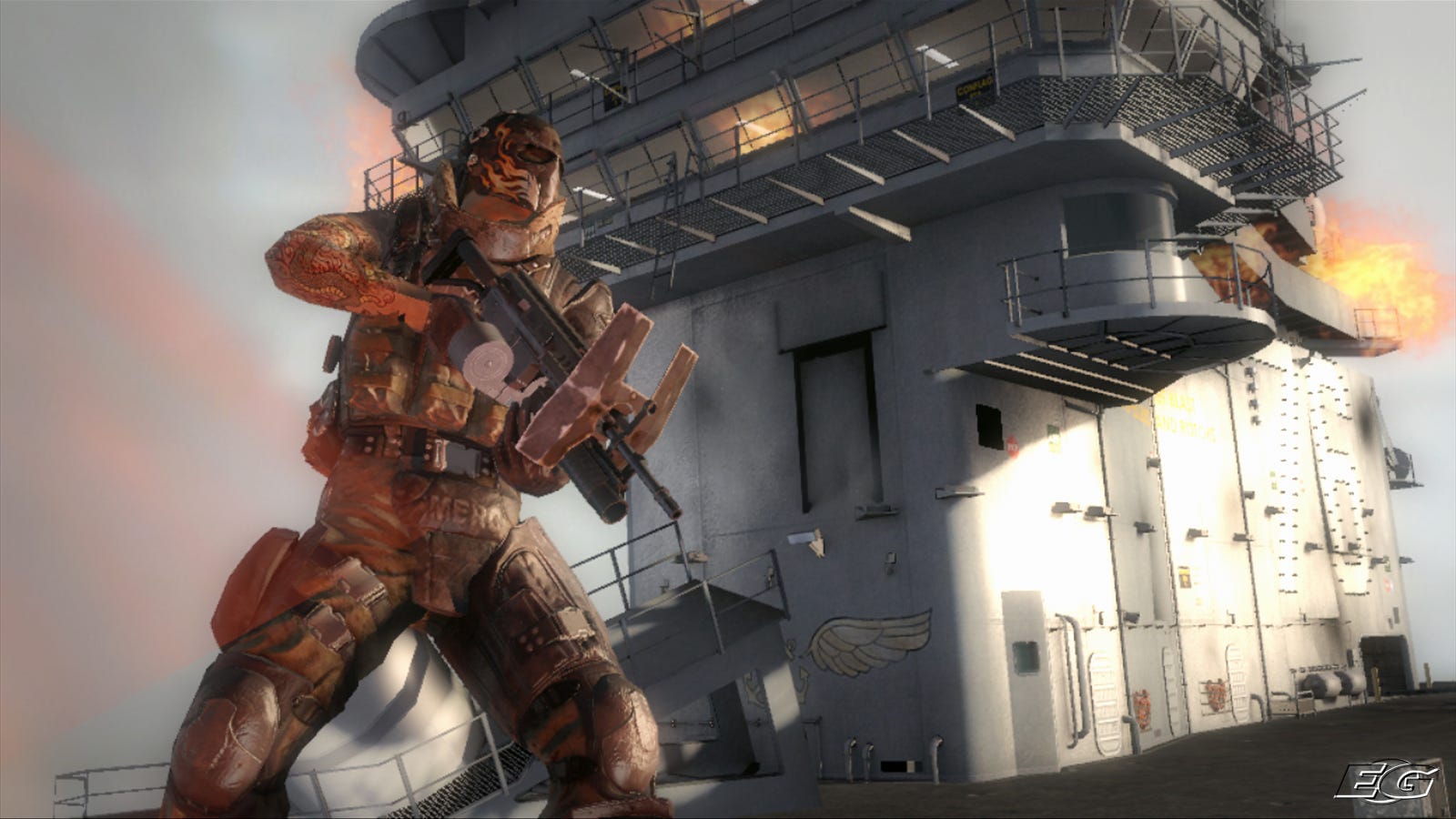
Mission design will focus gameplay variety into individual 'playgrounds' separated by checkpoints that allow you to save and retool.

Eurogamer: How do you go about educating players to play co-operatively, because obviously the natural impulse in a shooter is to rush on and do things for yourself?

Chris Ferriera: We're still tackling that issue today! A good example is with the Aggro system. In Rainbow Six Vegas, there's always someone who runs ahead, that knows the map and gets all the kills, and you're like 'Well why do I even play with you?' In our game the person that does that is going to build up all the Aggro and they're going to get cut down really fast.

The thing is that it's our job to tell that player, 'Listen, the game wasn't too hard, the tuning wasn't off, the AI wasn't that difficult - the problem was you weren't playing co-operatively.' We have a very smart tutorial at the beginning of the game and it introduces you to the characters and the world setting as well, unveiling the world as it explains the communication between the two of you.

Eurogamer: One of the things it was hard to discern from playing was where you're going to go with the broader design of the missions. Can you talk a little on that?

Chris Ferriera: Normally we'd do an insertion at the beginning. In Afghanistan we showed the parachute mechanic. In other missions you start in a vehicle - we do a couple where you insert on a hovercraft, and these are on water or on land, or transition between the two. Sometimes you insert in a jeep. So players start out in something that's familiar, where one's driving and one's shooting, and get a feel for the land and an eye for the enemies, and then we put you in on foot.

Once you're in the mission on foot, it's a very linear mission, but the way it works is that there's a linear channel into what we call a playground, which is a large open area, and then a channel to the next. In each of these open areas, it's easier for the AI to move around and it's easier for you to manipulate the Aggro, so every time you get to one of these playgrounds that's where the differentiation of play comes in. That's where a lot of the co-op mechanics exist. There might be a riot shield [one player uses a car door to protect the other from fire as they move around together] option, for instance. The way the enemies are brought around that area, as well as with the junctions, also differentiates.

Eurogamer: So it's partly the co-op moves and partly the shape of these playgrounds that injects variety.

Chris Ferriera: And the different way it plays the Aggro. Say that you're at one end of the map and the objective's at the other. Do you both rush the objective? Does one person pull the attention away so one can stealth around and get it? Do you both play it in the middle like a standard shooter? Do you use a different co-op mechanic to navigate vertically, to get the advantage on the enemy and split up that way? The risk there of course is that if you die above me, I can't get to you, but sometimes that's a risk you take, so it's sort of a risk-reward of how you play.

On top of that it's also who you're playing with, how experienced they are - and how good is their equipment? Because those three things are going to change your play-through every single time.

Eurogamer: How much emphasis are you putting on the cover system?

Chris Ferriera: The idea is that if you're in mid-Aggro, cover should be used. It's not mandatory - you can still survive, you can still move around, you're going to take some hits and eventually dive back into cover. If your Aggro's maximised, you must be in cover, because everyone's going to be firing at you. If your Aggro's minimal, you can actually hang out, but the problem is that as soon as you start firing your bigger weapon you're going to draw fire, so you'll want to use a smaller weapon that's precise like a pistol or a customised bigger weapon that's got suppressors to tune down the Aggro. That way you don't need so much cover and you can play more open.

Eurogamer: Could you talk about the customisation system?

Chris Ferriera: You carry three weapons into every map - the primary, the secondary and the special. Your primary weapons are assault rifles, shotguns, grenade launchers. Your secondary weapons are sub-machineguns and pistols - so like your side-arms. Your special weapons all have a scope, so it's a sniper rifle or an RPG, which allows for all your sniper stuff and for big destruction.

The primary set is your big Aggro-builder - lots of ammo, good damage. The secondary has a ton of ammo, high rate of fire, higher precision, less Aggro building, but also less damage. And then the specials are that the scope's the big differentiator. In each category there's a series of weapons, and each weapon has between, say, 5 and 10 upgrades, and actually there's more than 10 for some.

You can upgrade a barrel, and what upgrading a barrel will do is increase the damage and also increase the rate at which it builds Aggro. You can change the cartridges, which change your reload rate. You can change your stocks, which change your accuracy. You can put accessories on the front, like a battle grip that will increase your accuracy. You can put a shotgun undermount that takes out guys who charge you. But every time you tack things on to get better performance you're also going to build the Aggro, so you can also buy suppressors that lower the Aggro.

So, depending on what you buy versus what your partner buys, it's going to make a difference, because if you both buy a heavy machinegun with a big barrel and you're both firing them, the Aggro's going to be in the middle. At that point you can still offset that by telling your partner to take cover while you fire, or saying to use a pistol while you fire, or if you take a heavy machinegun and someone else takes a smaller assault rifle with a suppressor you can actually still fire at the same time and the Aggro will shift towards that player. It's a different play style to play a lot in cover and use the Aggro and manipulate the AI - one player can ghost around the level, complete objectives and accurately pop guys in the head rather than spray and pray.

3

Customisation doesn't just upgrade you - thanks to the Aggro system, it gives the pair of you more options in combat.

Eurogamer: So there's a lot of tactical considerations.

Chris Ferriera: Yeah, it's huge. It's a persistent inventory, too, so you don't actually lose anything. You can buy more and you can always change parts back to other parts.

The other thing is that these channels I mentioned between playgrounds act as checkpoints, and besides saving and whatnot you can also buy new weapons, upgrade old weapons and change your existing inventory, so if you think you bought the wrong gun for a mission you can adjust. Or if you know you're going to fight a boss, you can change to something bigger.

Eurogamer: One of the things about playing Gears of War co-operatively was that all the gung-ho, back-slapping stuff and banter obscured the plot. Did you find that?

Chris Ferriera: We have a very strong story, and it's very politically charged, and it's quite grim. We reference real-world events like 9/11 and then we talk about what's going on with America in Afghanistan and Iraq today, so it's the same stuff you'd see on the news but within the last four years of going into the future.

We talk about the problems of the privatised military and what that presents to America. But you can't just feed the player that, so we looked at other genres like buddy-cop films like Bad Boys or Lethal Weapon, where you have these two characters that banter back and forth but there's this underlying grim reality that makes it easier to swallow, where the guys aren't heroes. You play Gears of War and this guy's a hero, he's fighting for his race's survival, he's this last hope of humanity, where for us it's not - they're there for the money, they're there for the action, and there's this anonymity with the masks so you can kind of impose yourself on them a little bit.

As you play through, the banter will occur with the AI naturally, but also with the players between combat, because when you're out of combat there's this stuff via cinematics and story elements, which really tells you what's wrong, and the characters will evolve, and their banter evolves as it gets through the end. At certain points it gets more serious and drops more of the humour.

We bring you in and out of the story, but at certain times when the two are really gung-ho, you just gunned down a hundred guys and you're feeling pumped, that's the point you can high-five or whatever, but when you find out that you've just been betrayed or screwed over, you're not going to be making those same gestures.

4

While it's pretty obvious that Ferriera thinks real-world PMCs are a bit mental, he insists the game is not an attack on US foreign policy.

Eurogamer: You guys have pretty strong views about what's going on in the world at the moment by the sound of it.

Chris Ferriera: Yes and no. It's not like a political agenda.

Eurogamer: Did it influence the way you designed the game or was it just something that was useful as a backdrop?

Chris Ferriera: A little bit of both. We looked into these private military contractors - companies like Blackwater, DynCorp. - and they hire these guys who are ex-Deltas, ex-SEALs, and they have to fight overseas, but they have immunity to prosecution thanks to US law and also the fact that there's deniability. They can be hired by a government through five different companies and then those companies disappear afterwards, the paper trail can't be traced, and then the company can deny they even sent those guys over. It's a weird area that exists and we want people to understand that.

The craziest thing with all that is just how it really works today. We look at the American military and they can't keep special forces guys, and the army's dwindling because everyone's leaving. We kind of want to point that out, but we're not saying that America is wrong in the government and the actions they took in these wars.

Eurogamer: Are you planning to do a demo prior to release?

Chris Ferriera: Not prior to release. I don't know if there'll be something later, but the thing is given our release date [15th November for PS3 and Xbox 360 in the US and Europe] and where we're at, we'd rather focus on this rather than taking engineers off and having them do a demo.

Eurogamer: Why did you choose to do two players?

Chris Ferriera: Well, I can't talk to about any expandability beyond the two-player co-op. I'm not allowed to talk about that right now. But in general, it's been two years pre-production, two years production, so four years ago - so, looking forward then, the big thing was two players, and the other big thing then was Live. We didn't know how good the networking would be. Two players is relatively easy, but with four you need to start having hosts and servers. With two players it's pretty quick, so we found that that's an easy entry point, and going into the future we can continue to innovate more in the co-op space and really I think drive into four, but really there's things I'm just not allowed to talk about at this point.

Eurogamer: So Army of Four, or Army of Sixteen, or something like that.

Chris Ferriera: I can neither confirm nor deny the existence of such numbers of players [laughs].

Chris Ferriera is lead designer at EA Montreal. Army of Two is due out on PS3 and Xbox 360 from 15th November.

Comments (21)

Comments for this article are now closed, but please feel free to continue chatting on the forum!

  • Loading...hold tight!