ArmA II

Lord of war.

Moo! I am a cow, wandering peacefully through a warzone. Splat! I am now a tank, running over that cow. Boom! I am now an armed insurgent with a rocket launcher, claiming revenge for my bovine brethren. This is Armed Assault II: military simulator as pure, instant fantasy. While an elaborate campaign and intrinsic co-op play are what will sell the game, it's the amazingly easy to use editor that will keep people playing. You can create a war in minutes, then immediately jump into it as a soldier, civilian or dumb animal of your choice. The editor is truly remarkable, and astoundingly accessible.

Which, if you know anything about ArmA II's heritage, totally flies in the face of what you might expect. Both the first Armed Assault and its predecessor Operation Flashpoint (developer Bohemia Interactive Software losing the rights to the name to publisher Codemasters, which is currently working on its own sequel) were treacherous, buggy and cold - redeemed by a super-passionate community that modded these clumsy caterpillars into incredible butterflies of war-wish fulfilment. With ArmA II, BIS clearly wants to make a game that does what's intended right out of the box, rather than simply providing a structure for fans to build upon themselves.

My hands-on time with ArmA II achieved two things. Number one, it proved that I still am and always have been terrible at piloting helicopters in videogames, and as such will probably never be elevated beyond comically inept sidekick when playing this game. Number two, unlike the wildly inaccessible ArmA, I can nonetheless imagine myself being able to play this on a regular basis. Eventually, anyway. There is an incredible amount to learn before you can master ArmA II - this is a game that involves FPS gunplay, squad tactics, ground and air vehicle piloting skills, a sort of RTS-like army-management system, and eventually setting up an autonomous wartime economy across a vast island. This is truly the maxi-game - the stuff of sweaty dreams for Flashpoint/ArmA veterans, but, let's be honest, a little daunting for newcomers.
1

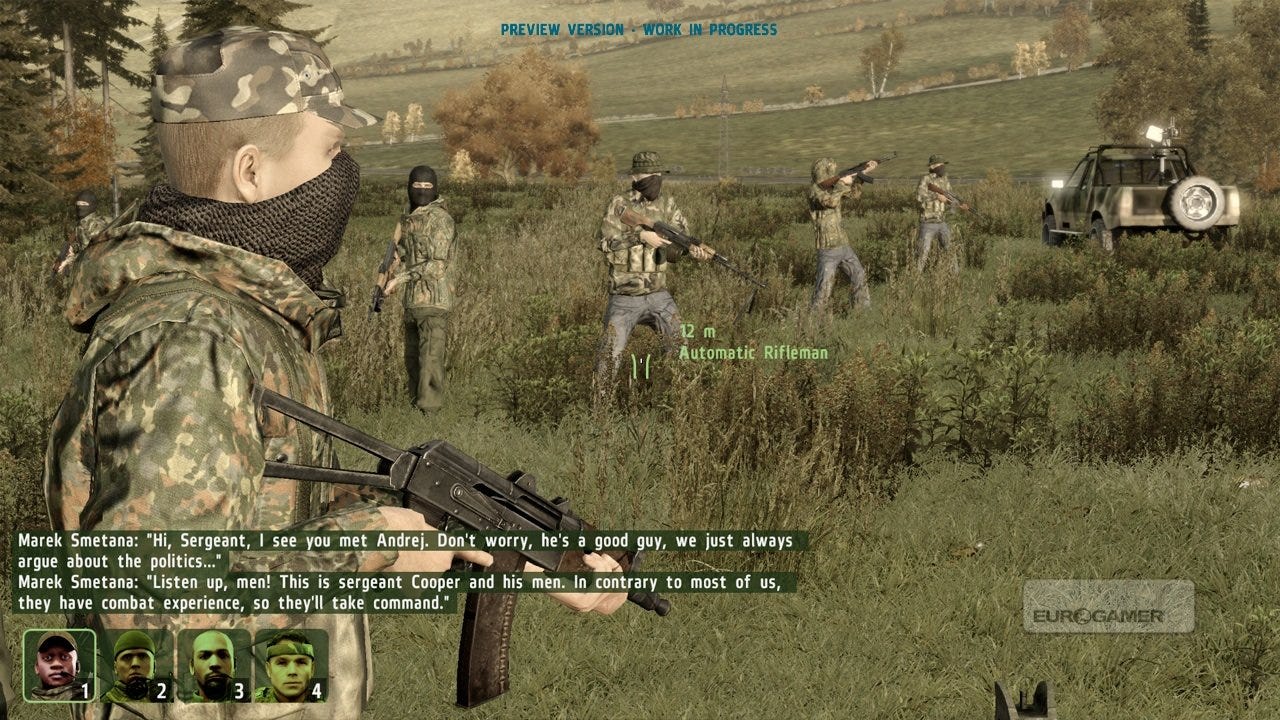
Razor squad is a set group of chaps you'll get to know well over the course of the game. There's also the option to play the entire game cooperatively.

So, this time around, there's a lot more emphasis on there being a way in. While a series of tutorials, in this build at least, appears a little too rushed, vague and buggy to really do the job they're supposed to, a sprawling, semi-linear campaign seems to offer the gradual learning curve necessary to wrestle such a many-armed beast to the ground. You kick off in the jackboots of the elite but grunt-level recon team Razor, in command of the lot of 'em but able to switch from jarhead to jarhead at will. It's careful, tactical combat, requiring precision gunplay and a whole lot of time crawling around on your belly - this isn't Call of Duty.

As the campaign strides on, you'll move from being given missions to choosing them, and eventually to doling them out to the rest of your army, once you've established a shifting front line that requires defence and forward motion across the length and breadth of the island.

That army, incidentally, is part fellow US troops, and part a faction or factions of your choosing. You'll end up helping out and being helped by one of the armies warring over ownership of the fictional, 225 square-kilometre island of Chenarus, each of which provides different troops and resources to you - and, naturally, sets one or more of the other factions against you. This could be what S.T.A.L.K.E.R: Clear Sky tried (and sadly struggled) to offer - freeform faction vs. faction warfare in a beautiful, living world. Chenarus is packed full of civilian towns, which you have the option to protect or decimate based on your own agenda.

The plebs' reaction to you will vary depending on how you've treated them and any factions with which they're associated. You even have the option to interrogate them, which can dredge up vital enemy info - a patrol spotted so many clicks away a couple of minutes ago, for instance. If you've been behaving like Captain Bastard, however, they're not going to want to help. Oh yeah, and there's cows. And dogs and boar and hens and all sorts. Hooray for animals! Miserablists will argue there's no need for them - that our furry friends don't serve any real purpose, unless you're convinced pigs are a greater threat to world security than armed insurgents - but they reflect BIS' desire to get this right, to make a world and not simply a hub into which other people plug things.

Though, of course, it is that too. ArmA thrived despite a confused critical reception because of modders' extensive work adding to and tweaking it. ArmA incorporates much of the community's finest hours out of the box (BIS even hiring some of this fan army as freelance designers), but of course there's that astoundingly quick editor. The need for elaborate scripting is removed, with preset AI behaviours selectable from a drop-down menu, but the option to wade in deep remains. The really epic conversions will still require dedication and possibly a touch of madness, but now anyone can create and share a custom conflict. With 136 vehicles (each with 40 different sound samples, incredibly) there's scope to sketch out monstrously huge skirmishes - the number of on-screen units limited only by your processor.

2

For some of the game you'll be based from an offshore aircraft carrier. No, you can't drive it - but you can explore the huge thing and land choppers on it.

And what of ArmA/OFP's other legacy, of embarrassing bugginess? Well, from my hours with this build, it certainly seems more robust than those did on release, but it would be a lie to say it was free of teething problems. Presentation values are significantly higher, the ArmA engine enjoying some mouth-watering treats to its lighting and draw distance, while the dialogue and story has this time been handled by a native English speaker rather than suffering dodgy translation. There are spots of missing or inaccurate text and this build suffered a couple of lock-ups, but generally, it seems a lot more polished than its predecessors.

Frankly, ArmA II should be forgiven a few minor misfires anyway - it's one of the most ambitious videogames ever made. If the final build gets even close to pulling it off, it deserves a place in history.

ArmA II is due out for PC on 19th June, with an Xbox 360 version due out later.

Comments (39)

Comments for this article are now closed, but please feel free to continue chatting on the forum!

  • Loading...hold tight!