"The biggest obstacle I think APB faces, period, is the difference between what people have put in their heads already and what APB is - because it's so simple and it's so easy to make a comparison to what's out there, to say, oh, it's a GTA MMO."
EJ Moreland, APB's design lead, is sitting in a quiet antechamber of Realtime Worlds' spacious offices in Dundee. The soft-spoken American ex-pat has just put his finger on the public relations mountain that this highly unusual online game from the makers of the brilliant Crackdown has to climb. He's also just said the two words - well, acronyms - that everyone else in these offices is desperately trying not to say: GTA and MMO.
Given APB's urban gangster stylings and ambitious plans for a social, persistent online experience, it's not hard to see why these two touchstones have been a common crutch for press to lean on when trying to describe it. I've used them myself. And it's also, surely, a mouthwatering pitch for any money-man regarding the twin gaming colossi of World of Warcraft and Rockstar's blockbuster crime series - especially given the fact that creative director and studio head David Jones was one of GTA's founding forefathers, and Realtime Worlds is infused with DMA Design's DNA.
But, in terms of moment-to-moment gameplay, APB really doesn't have much to do with either. Before talking to EJ I spent a couple of hours pinballing around the game's open-world, 100-player gangland skirmishes in the shabby city of San Paro. I screeched between dynamically matchmade gun battles while leaning out of the window of a custom car, sirens wailing, as one of the game's cool-cop vigilante Enforcers. I raided and defended, crouched and took cover and aimed down the sights of my gun at rival teams of criminals.
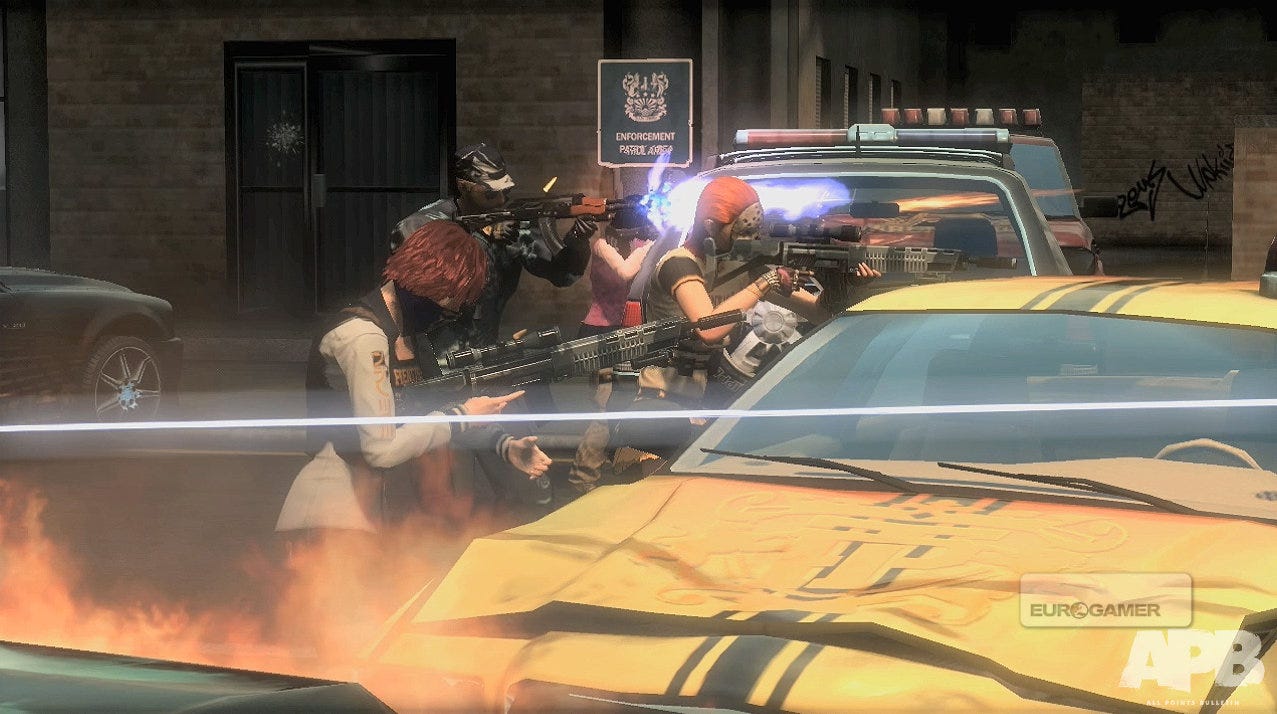
Despite the city setting and point-to-point car-jacking missions, the experience was almost as far from GTA's everyman action gaming as it was the skill-bars, cooldowns and number-crunching of an MMORPG. If anything, it was a halfway hardcore online shooter: like being involved in an epic, fragmented game of Battlefield or MAG, or a Counter-Strike where the lobby is a 3D city you can drive around. Only, it's not like most shooters in some important ways - notably the fact that it doesn't allow headshots, to discourage sniper culture. It's a twitchy game with no RPG underpinnings whatsoever, but you're still wearing people down rather than picking them off.
Ready for some more contradictions? Realtime isn't steering clear of the MMO tag purely to avoid connotations of class-based, hotkey-punching combat and interminable quest grind. With instances of all three of the game's areas - the skyscraper-lined streets of the Financial district, the multi-level warehouses and dockyards of the Waterfront, and the non-combat Social district - being limited to 100 players, it can scarcely be called massively multiplayer.
Or can it? These instances are limited in size by what's fun, and what's possible with current netcode and server hardware, given APB's free-wheeling and fast-paced gameplay. But you won't be tied to just one; in fact, you'll belong to a "world" of up to 100,000 players, larger in scale than almost anything this side of EVE Online's single universe. You'll be free to interact and join games with all of these players, including communication across the Criminal/Enforcer divide. And crucially, you'll be able to trade.
MMO communities are bound together by the games' economies as much as any other feature, and APB is proposing an ambitious and thrillingly different market based around creative skill rather than crafting and harvesting mechanics. Its foudnation is the game's insanely detailed customisation - of logos, graffiti, clothes and vehicles, as well as of your own avatar. Although there is a base economy of ammunition, weapons and the like, Moreland expects that the big-ticket items will all be player creations.
"The thing that I love about it is, in many MMORPGs your guild has a crafter that's really into the crafting game and you rely on him, but he's really just supplying you with goods that you use," Moreland says. "In ours, these guys are actually driving fashion in the world. Each one of these worlds is going to have its own fashion. [In MMOs it's] time and knowing the system. Here, it's a creative endeavour. That honestly is what hooked me when I came here... I thought, I've got to see what happens."
It's also the only economy we're aware of with marketing mechanics built in. You'll be able to bid on or rent display points in the social district to advertise your wares, or your clan. Other display points for graffiti or items will be free to use on a timed, first-come first-served basis, while others still - statues included - will be earned through climbing up the leaderboards, and will propagate across all the social districts in a world. Player housing and a real estate market is one of Realtime's longer-term plans for APB.
This side of APB - your persistent identity as a player, your social presence away from the tighter focus of the action itself - is not just the definition of a massively multiplayer game, but quite a forward-thinking definition to boot.
"The one catch-phrase that I keep pushing out there is 'persistence is existence', and that's why persistent games are so compelling," Moreland said. "Even the simple, casual persistent games. You actually create an existence in these worlds, and that's your identity there, and it's so important for that to be reinforced with real estate, with statues, with ways to leave your mark in the world."
It's not all about the benjamins, or the threads, however. Gamers do like to define themselves with numbers, and in lieu of the traditional levelling and accumulation of XP, APB offers three different estimations of your worth: Rating, Threat, and Notoriety (for Criminals) or Prestige (for Enforcers).
Rating is the closest thing to a player level, and will only ever go up, with no ceiling; it's a number that reflects how much you've done and how much time you've spent in APB. Threat tracks your performance in the action over a window of time, and is basically an indication of how skilled a player you are - roughly equivalent to a TrueSkill ranking, say. It will serve as a point of pride as well as a matchmaking tool for the game's dynamic mission system, which delights in pitching small numbers of high-Threat players against larger gangs with a lower Threat.
Finally, Notoriety and Prestige will apply only in a single session and scale up to five, similar to the Wanted rating in the popular free-roaming crime series we shall not speak of. They're an indiciation of how much attention you've drawn to yourself, and have consequences - hit a Notoriety or Prestige rating of five, and the entire opposing faction in your district will be alerted to hunt you down.
It's at this point that we should probably return to the mean streets of San Paro to explain how all this translates into gameplay. In a Financial district populated by some 40 or 50 Realtime staff and beta testers - which feels plenty busy enough - I'm matched up with an experienced Enforcer team and sent on patrol.
Although we begin with the familiar trappings of accepting a mission from a contact, buying weapons from a vendor and equipping them, there is no AI to fight, no player-versus-environment content to work through. Also, in a standard ruleset like this, you can't just attack anyone; unless I've been matched against a Criminal team, or come across someone with maximum Notoriety, other players' names are greyed out and I can't harm them.
All this means that the initial mission experience is somewhat odd. After tooling around enjoying the vehicle handling for a while - cartoony, but weighty, responsive and surprisingly entertaining given the keyboard controls - we start missions which might be characterised as "raids" or "pickups" but simply involve going to a checkpoint, clicking on something and going to the next checkpoint until you're done.
It seems undramatic, but this is just the first automated step of the action in APB, and the "players as content" matchmaking is layered on top. It's basically a way of getting yourself noticed. On our second such mission, a Criminal team is alerted to what we're up to and told to stop us. Defensive firefights ensue; we improvise cover from nearby vehicles as we try to complete the mission within a time limit, battling against our opponents and some rather distant spawn points (although, with even Enforcers being able to steal and jack cars, travel is always fast).
Then we're called in to interrupt some criminals on a mission of their own, the APB itself arriving with an siren sound and a notice splashed across the screen. Even though it might be followed by a tense wait for opposition to arrive or a vehicular scramble across town, this dynamic, in situ matchmaking is APB's calling card, its signature, and a pulse-raising thrill unlike anything else in gaming.
Half a dozen or more such missions blend into each other, with only an unbelievably tense standoff as we defend a small plaza, with some awkward approach routes, really sticking in the memory (perhaps that's because I won MVP in that round). It's the location and the opposition that define encounters, rather than anything of interest in the mission design, which is usually very functional. It's hard to imagine one APB session being very different from the next, but easy to imagine each one throwing up an uproarious anecdote or two. It's also easy to imagine logging in for ten minutes and staying three hours, so addictive and insistent is the rolling cycle of the mission matchmaking.
APB's unique structure, social features and style are what distinguish it right now. As a multiplayer shooter, it's certainly fun but lacks some of the crispness, definition, feedback and impact, not to mention the handcrafted map design, of the best out there. As a persistent online game, it's loaded with promise but shackled to a slightly samey, if moreish action experience.
But, more so than almost any game since EVE Online, APB is going to be defined by what happens after it launches. In our GDC interview with Jones, he stressed the importance of developing new rulesets in response to the desires of the community. Moreland echoes this. There will certainly be extreme districts where any player can attack any other. There might be districts where headshots are allowed.
"One I think we will actually be focusing on at some point, probably not in the near future, will be some sort of racing district that really heavily features different types of vehicles," says Moreland. He won't even rule out the eventual rise of opponent AI - zombie districts and bank heist scenarios are apparently a popular theme among the developers and in the community - but Realtime isn't prepared to bend its pure multiplayer focus for now. "For us, it's really just the multiplayer aspect; I mean Dave has, from day one since I've been here, said players are the content. It's not us making handcrafted..." Moreland trails off and smiles. "He loves to use the term 'artificial incompetence'."
There are a dozens of questions still. Will the first wave of APB players understand that this unique, initially rudimentary experience will multiply and evolve with their input? Will Realtime and distribution partner EA be able to communicate the hyrbidised, open nature of this game in the few months they have before release? Will they be able to restrain themselves from over-hyping a game that needs to grow organically? Will they be able to sell it without recourse to the poisoned chalice of those six letters? And, biggest of all, what is the business model, apparently two years in the making, that will pay Realtime's server bills and sustain the whole enterprise?
With the beta ramping up, APB's best hope is to speak for itself and let players spread the word. You really do have to play it to get it. It may not be GTA, or an MMO, but in truth, it has a little bit of what's best about both of them.
