Alan Wake Preview

Light-motif.

For all its cinematic and televisual influences - Hitchcock, Lost, Twin Peaks, The X-Files - Alan Wake isn't just another action game that wishes it were on the big screen. Light, its thematic motif, is woven inextricably into the gameplay itself; as well as a stylistic visual technique, it's a combat device, your means of progression, your guide through wide-open environments. Alan Wake tells its story like only a videogame can, deftly fashioning its narrative themes of light and darkness and subjective and objective reality into essential gameplay elements. Instead of feeling like the actual game is just getting in the way of the story, as is so often the case with such plot- and character-orientated videogames, Alan Wake's integration of an emotionally-engaging thriller narrative into a third-person action template feels entirely natural.

It's clearly not a happy accident that Alan Wake looks and feels so polished. It's been in development a long time now, and finding the correct balance of explorative gameplay and the linear structure necessary for effective storytelling has been a matter of trial and error. "The game is still built on openworld technology, but we consider ourselves storytellers, and in order to deliver that well it has to be a more linear experience," explains Remedy's ever-charismatic MD, Matias Myllyrinne. "We don't want the player to feel like they're being pulled by a string all the time - we want them to feel like he's making his own decisions and choices, even though we're delivering the story in a certain way."
1

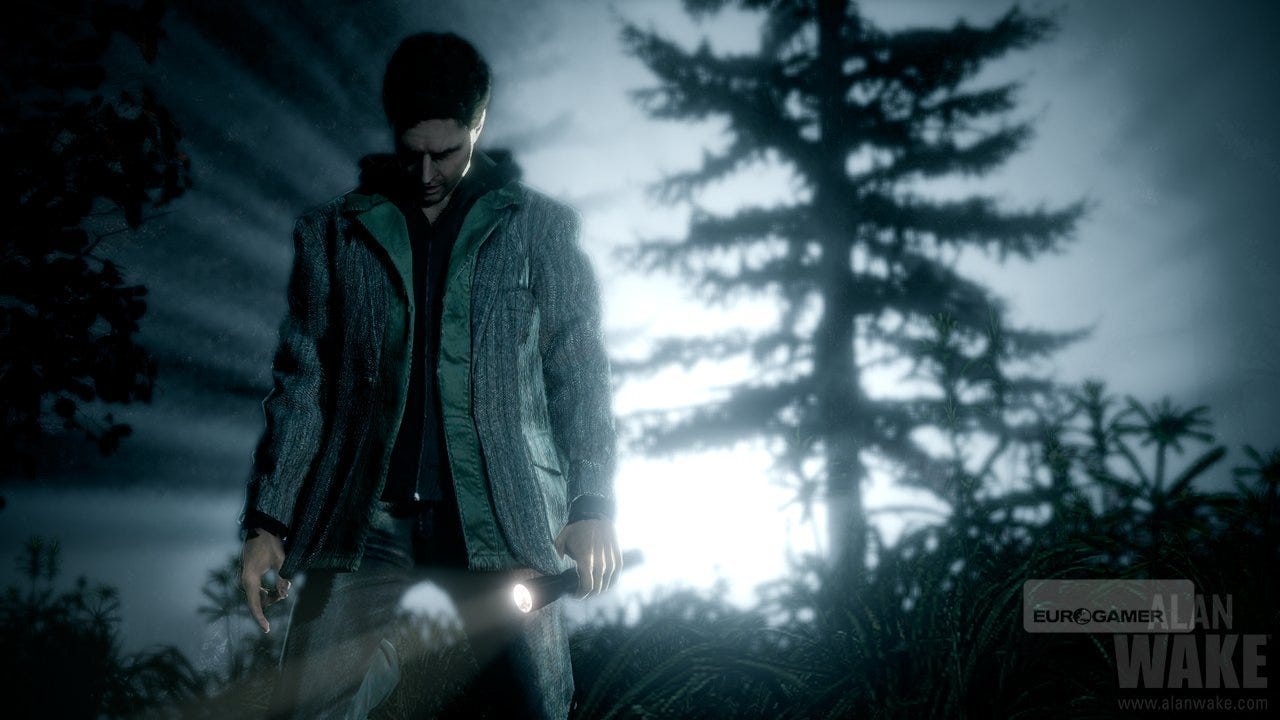
This is the kind of screenshot image that's had people worried that Wake was vapourware. Believe us, though, it's looking much more like an actual videogame these days.

In short, then, Alan Wake drops you into tightly-scripted cinematic set-pieces, but it lets you determine your own way of making your way through them. You can see a lone, abandoned farmhouse in the distance with the light left on, and figure out how to get there yourself - it doesn't force you along an arbitrary path between lovingly-rendered cut-scenes. The game's environments are miles wide, encouraging you to dig further into the fiction and really explore Bright Falls rather than follow a set path.

Your guide in Wake's world is light, whether from a distant building or handheld flashlight. At E3 we saw Wake using generators, flares and his trusty torch to forge a safe path through the darkness and attack possessed villagers in the mountainside town of Bright Falls, and saw how the mysterious dark presence that's overtaken the town's inhabitants is also capable of possessing a digger truck and cutting swathes through the forest like a hellish tornado for cinematic effect. In a state of panic or fear, Wake can will his torch to burn brighter, which ties into the game's underlying theme of subjective reality - pulling the left trigger intensifies the light, which drains the battery but keeps you safe until you can make it to a generator or the sun begins to creep over the horizon. The flashlight is more important than a gun in Alan Wake, more effective protection from the powers of darkness.

Behind closed doors at TGS, Remedy unveils a scenario that completely turns the tables on Alan Wake, robbing him of his torch and sending him fleeing through the woods from searchlights. Convinced that Wake is behind all of the ugliness and sudden deaths in Bright Falls, police suddenly turn up in search of him - information that you glean from snatches of speech from police radios and overturned cars, running from the beams of light that pierce the morning fog. As Wake flees through the woods, diving between trees to hide from the light, things start to get distinctly supernatural again - crouching behind a rock on a clifftop, we see a police helicopter taken down by a swarm of blackbirds, and the trees below bend out of the path something vast and horrible that starts extinguishing police flashlights.

"For this scene in particular, our director took the photo from X-Files where you have the flashlights in the woods and used that iconic image as inspiration - that and the Harrison Ford in The Fugitive," says Myllyrinne. "Visually and emotionally, that's where we want to go with this sequence... We're all film buffs, we were brought up on that stuff, so for us it's really easy to communicate that way. We take inspiration more from other forms of entertainment than games, really - we try to take things that are familiar to a wider audience, but that haven't yet been done in games."

We've fled from police before in games, obviously, rather more than we care to remember, but the way that Alan Wake works its scripted thrills and scares into the gameplay is genuinely new, and impressive. Admittedly, what we've seen so far have been prepared presentations, but if Wake guides you cleverly and intuitively enough through its scenarios it will all flow just as smoothly in the final release.

2

Remedy absolutely refuses to be tempted to namedrop any other videogame influences at all, but surely there must be a bit of Alone in the Dark in here somewhere.

Remedy is committed to building its game's fiction. Adrenaline and fear, as both Myllyrinne and David Cage pointed out at their GDCE keynotes this year, are easy emotions to play with, but if you want to go deeper than that, there have to be peaks and troughs, time for character development and opportunities for players to ground themselves in the game's world, not just an endless sequence of explosions and fights. In Alan Wake, the daytime gives you the opportunity to get to know the locals of Bright Falls and develop more of an attachment to the setting. Remedy has already shown its prowess with pacing in the Max Payne games, and it looks like Alan Wake will be even more accomplished.

On the surface, it might not seem that Alan Wake and Heavy Rain have all that much in common, but though they differ wildly as actual games, there are concurrences in their respective creators' vision that makes them exciting for the same reasons. Both draw their influences from outside the gaming sphere, both are committed to the creation of a whole and believable fiction, and both value the characterisation of strong leads above all else. Everything that we've seen so far suggests Alan Wake is going to be a great videogame thriller - but there's a chance it could stand shoulder to shoulder with classics of the genre in other media, too.

Alan Wake is due out for Xbox 360 in March 2010.

Comments (104)

Comments for this article are now closed, but please feel free to continue chatting on the forum!

  • Loading...hold tight!